A front desk that never
misses a call.
The 24/7 AI voice agent that answers every call, handles scheduling, and resolves patient requests in real time.


See what Commure Agents can save you.

$4M+
in New Revenue
Recover missed patient calls and appointment demand (per 100 providers modeled).
$650K+
Annual Cost Savings
Reduce manual call volume by 50% (per 100 providers).
60%
Higher Patient Satisfaction
Raise every interaction to your top performer's standard and cut hold times to zero.
Commure’s solutions are trusted across 130+ health systems and 400,000+ providers























See it in action
Get a personalized demo built around your EHR and practice size.
What to Expect:
A 30-minute live walkthrough focused on your use case.
See how AI agent works for your front office
Understand pricing, rollout and integration with your existing EHR
Get your questions answered with no obligation
Thank you! You're one step closer to 0 missed calls.
Skip the back-and-forth and book a time that works for you below.
What Commure Agents Handle Each Day
Commure Agents automate the high-volume interactions that overwhelm your front desk.
24/7 Scheduling
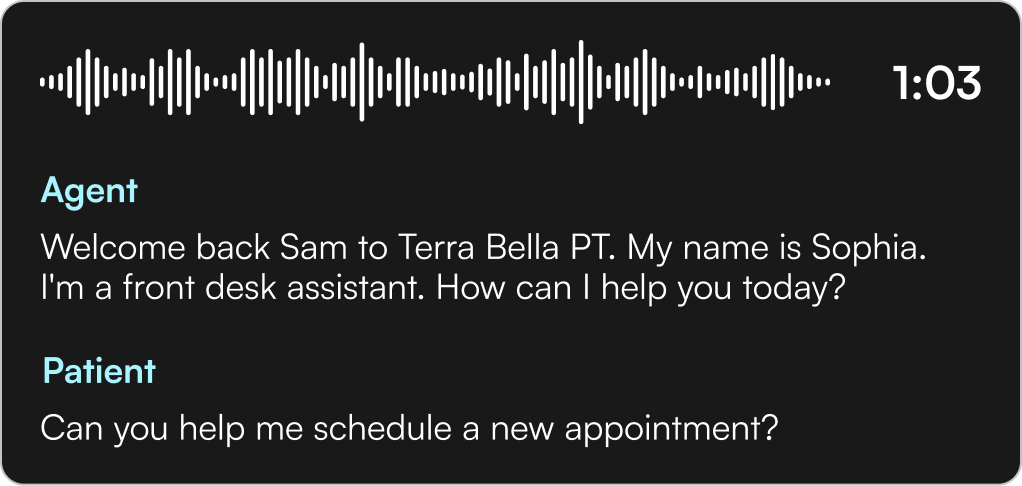
Patients book, reschedule, or cancel in real time by voice, with direct sync to your schedule.
Smart Triage
Agents route complex cases to the right team with a warm handoff based on your clinic’s protocols.
EHR Sync
We integrate directly with athenahealth, eCW, Epic, and others to log appointments and call outcomes in your EHR.
Smart Intake
Automatically collect demographics, insurance, and visit details before the visit begins.
DEMO
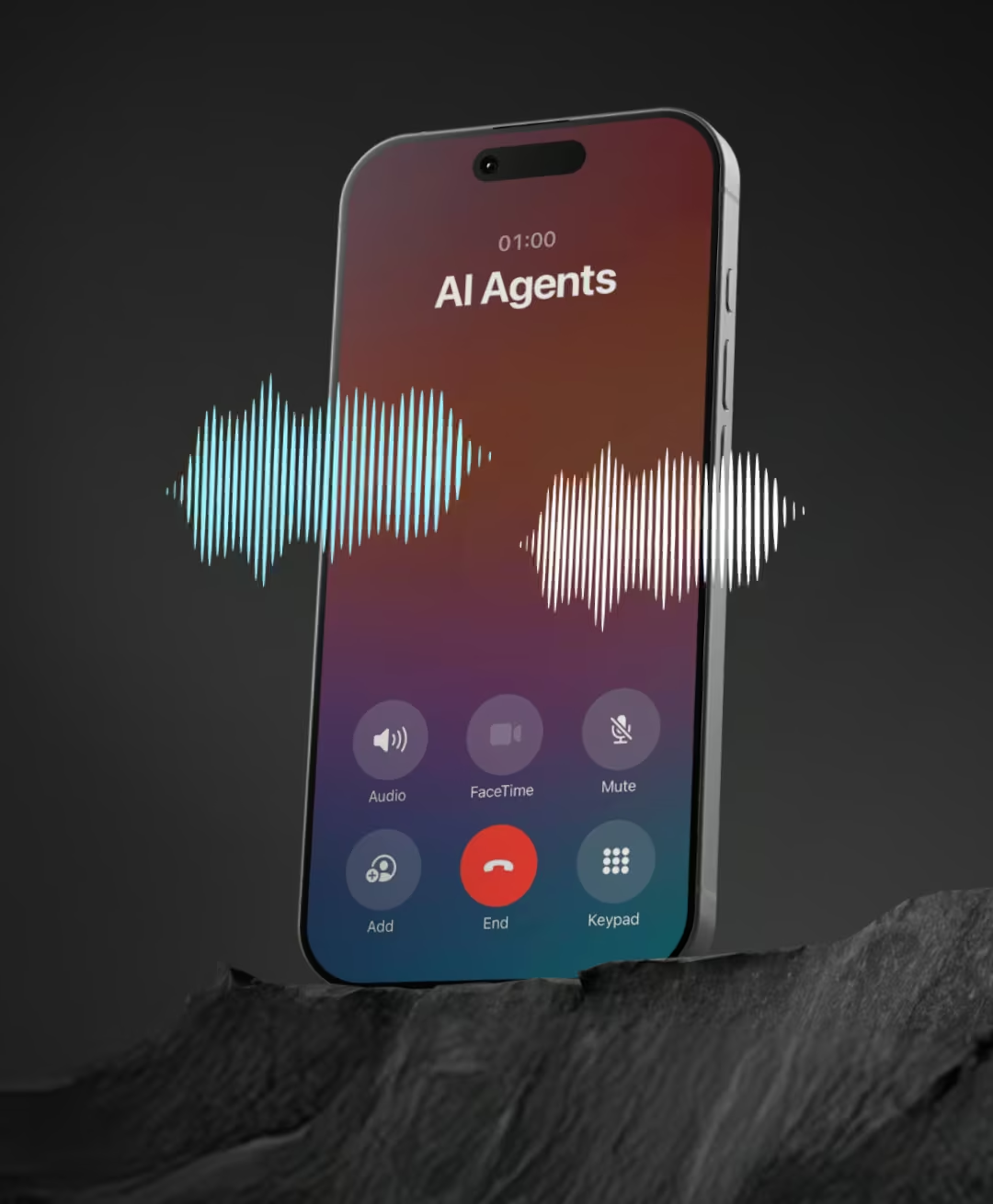
Hear Commure Agents in Action.

Security & Reliability
How Commure Agents ensure every call is handled safely.
Aligned to Your Workflow
Adapts to your clinic’s call handling rules so no workflow redesign is needed.
Real-Time Visibility
Your team can review every transcript and see exactly how patients are feeling in real-time.
Patient Safety First
High-liability or acute concerns are instantly escalated to your staff.

Understand your call center before you automate it.
Get a free breakdown of your call center's performance that:
See the gap between your best-performing staff and the rest of the team.
Quantifies your automation opportunity based on your specific call mix and peak demand.
Shows your automation opportunity based on call mix and peak demand.
Ready to stop missing calls?
Before you book the call
Best fit is practices with 1,000+ daily inbound calls, multi-location footprints. We work with multi-specialty groups, FQHCs, primary care, pediatrics, pain, ortho, urology, and many others.
Effectively unlimited. The agent scales horizontally with cloud infrastructure, so it can answer every inbound call simultaneously with no queueing, no busy signals, and no degradation during peak windows. You can deprecate the staffing math that assumes "X reps for Y calls per hour."
Approximately 4 weeks to go-live. Week 0: scoping, system access, and finalizing workflows. Weeks 1 and 2: build, integrate, and configure in sandbox. Week 3: UAT and structured testing. Week 4 and beyond: controlled production rollout (often 1 to 2 hours/day) before full go-live, with weekly performance reviews to monitor and tune.
We work with most modern EHRs. Common production deployments include eClinicalWorks, Athenahealth, Epic, ModMed, MEDITECH, and AdvancedMD. If you're on something different, we'll scope feasibility. Integrations are rarely a blocker.
We ingest your existing call center documentation, SOPs, scripts, and EHR configurations automatically, so the agent learns how your team operates without you rewriting everything from scratch. Anything we can't infer is captured in a structured scoping workbook and working sessions.
Beyond your EHR and telephony, we routinely integrate with marketing and call-tracking platforms, patient check-in tools (e.g., Phreesia), and referral networks (e.g., LeadingReach). Custom integrations are scoped during implementation based on your stack.
English and Spanish today. Additional languages can be configured upon request based on your patient population and call volume.
Yes, though we like to start with inbound and expand to outbound after the initial deployment, since that's where the highest ROI typically is. Once your inbound workflows are stable, outbound use cases (reminders, recall, no-show re-engagement) are a natural next step.
It escalates with a handoff to the right team, including front desk, billing, pharmacy, and on-call provider, based on routing rules defined during implementation. After hours calls can be handled by the agent, marked as a telephone encounter within your EHR with structured tasking, or routed to your answering service if you prefer. Every escalation is logged.
We configure scheduling rules, provider matching logic, location restrictions, visit type constraints, FAQ content, and routing and escalation paths during a structured scoping phase. Working sessions plus a scoping workbook drive the configuration. No custom engineering is needed for in-scope workflows.
During scoping and implementation: a few hours per week from one primary project manager and one person to support testing & QA. Once you're live, it's very limited and up to you. Most customers transition to a light-touch monitoring cadence.
Yes. Deployments operate under a signed BAA, with HIPAA-grade infrastructure already powering 500K+ providers. Every call is recorded, transcribed, and scored. Staff get a real-time dashboard tracking resolution rate, scheduling success, abandonment, and patient sentiment, reviewed weekly post-go-live.