



What Is an AI Medical Receptionist? A Guide for Health Systems
How AI voice agents handle inbound scheduling, intake, and routing end-to-end and where human staff still leads.
Written by the Commure Agents Team
Published: May 11, 2026
•
4 min min read
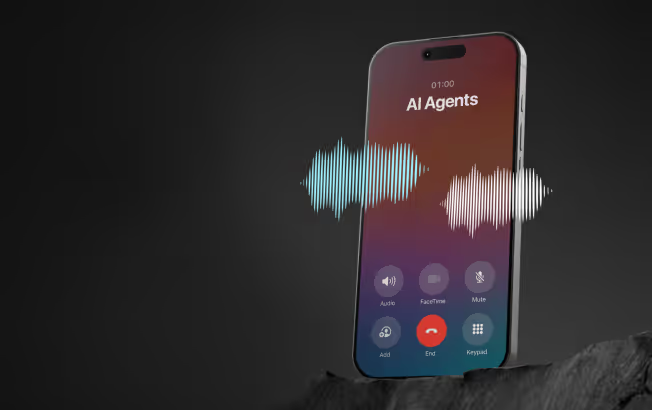
AI medical receptionists answer inbound patient calls and complete scheduling, intake, routing, and FAQs within their configured scope. Unlike IVR, they listen to what a patient says rather than routing based on button presses. Complex or non-standard calls escalate to staff.
Health systems field tens of thousands of inbound calls every month. Many call centers cannot staff to that volume consistently. Peak windows overflow, after-hours calls go to voicemail, and Monday mornings start with a backlog. Unanswered calls risk converting to appointments elsewhere.
AI voice agents now hold natural phone conversations, complete transactions in live EHRs, and hand off to humans when needed. That capability has driven growing interest in AI medical receptionists across health systems of every size. This article covers what they do, what they do not do, and what determines whether a deployment delivers.
Why This Term Is Appearing Everywhere Now
Three things are happening at once in medical group front offices right now. Front office turnover hit 40% across US medical group practices in 2022.¹ Practices that spend months training a front desk hire watch that investment walk out the door before it pays off. At the same time, phones have not gone away. Industry data suggests only 11% of medical groups report a majority of patients scheduling digitally.² Patients still call. A growing number of health systems are trying to answer more of those calls without adding more staff. Industry data suggests 68% of medical groups added or expanded AI tools in 2025, up from 21% in 2023.³ AI medical receptionists are one of the tools driving that number.
How an AI Medical Receptionist Works
A patient calls at 7:15 in the morning to reschedule a cardiology appointment. The practice opens at 8. The AI medical receptionist answers immediately. It greets the patient after verifying identity. The patient says they want to move their Thursday appointment to next week. The agent checks availability, offers two options, confirms the patient's choice, and updates the appointment in the EHR. It sends a confirmation. The call ends. The patient has a new appointment. No voicemail. No callback required. No staff member involved.
IVR routes. An AI medical receptionist resolves. This is the kind of workflow AI medical receptionists are built for: structured, repeatable calls that follow a predictable pattern. Scheduling, rescheduling, cancellation, new patient intake, answers to common questions, routing to the right person.
What It Handles and What It Does Not
Purpose-built AI medical receptionists handle structured call types end-to-end. They do not provide clinical guidance, verify insurance eligibility, collect payments, share lab results, or triage symptoms. Calls that require clinical judgment or fall outside the configured scope transfer to a staff member. That boundary is how responsible deployment works. Researchers at Harvard Medical School describe administrative tasks like scheduling and billing as low-risk applications for AI voice agents.⁴ Clinical advice and triage carry different requirements.
What Needs to Be in Place
Three requirements apply before an AI medical receptionist can operate in a health system.
First, a HIPAA-compliant vendor relationship with a signed BAA. The agent handles patient data on every call. No data changes hands without that agreement in place.
Second, a cloud-based telephony setup. The agent integrates with your phone system. Legacy on-premises PBX adds complexity that requires scoping before any deployment commitment.
Third, a scheduling system the agent can connect to. Without EHR or practice management integration, the agent cannot complete scheduling transactions. It can collect information but not act on it.
What the Operational Shift Looks Like
When these requirements are met and the call mix is right the shift is specific. Calls that previously required a staff member to answer, verify, look up, confirm, and document now complete without staff involvement. Staff time moves from routine transaction handling to calls that need a human: clinical questions, billing disputes, complex scheduling scenarios. After-hours calls that previously went to voicemail now reach an agent that can resolve them within an automated system that supports it.
How Commure Agents Fits This Use Case
Commure AI Call Center Agents handles inbound scheduling, intake, FAQs, routing, and cancellations for health systems and multi-location medical groups. It connects to major EHRs such as eClinicalWorks, Athenahealth, and Epic. It operates on RingCentral, Dialpad, Salesforce Service Cloud Voice, and other cloud-based platforms. Deployment requires a scoping engagement. It is not self-serve.
The starting point is a call center health analysis tailored to your call mix and operation. Commure reviews one week of call data. The output maps what the agent handles, what it does not, and what deployment looks like.
Sources
- MGMA DataDive Practice Operations, 2023. https://www.mgma.com/data-report-practice-operations-2023
- MGMA Stat poll, July 2025. https://www.mgma.com/mgma-stat/meeting-pressure-on-patient-digital-self-scheduling
- MGMA Stat poll, September 2025. https://www.mgma.com/mgma-stat/document-schedule-communicate-ai-tools
- Adams SJ, Acosta JN, Rajpurkar P. How generative AI voice agents will transform medicine. npj Digital Medicine 2025;8:353. https://doi.org/10.1038/s41746-025-01776-y
Try the #1 AI Scribe for Free
No Credit Card Required. Join 20,000 Clinicians.
Discover the Latest from Commure
From pre-visit prep to post-visit revenue capture, the Commure platform connects the workflows that matter most to clinicians and operations teams.