




Inside Summa Health’s 86% Ambient AI Adoption
How Summa Health is saving clinicians 40% on documentation time with Ambient AI
8,000
scribes weekly
71%
appointment utilization
2
minutes saved per note
About the Organization
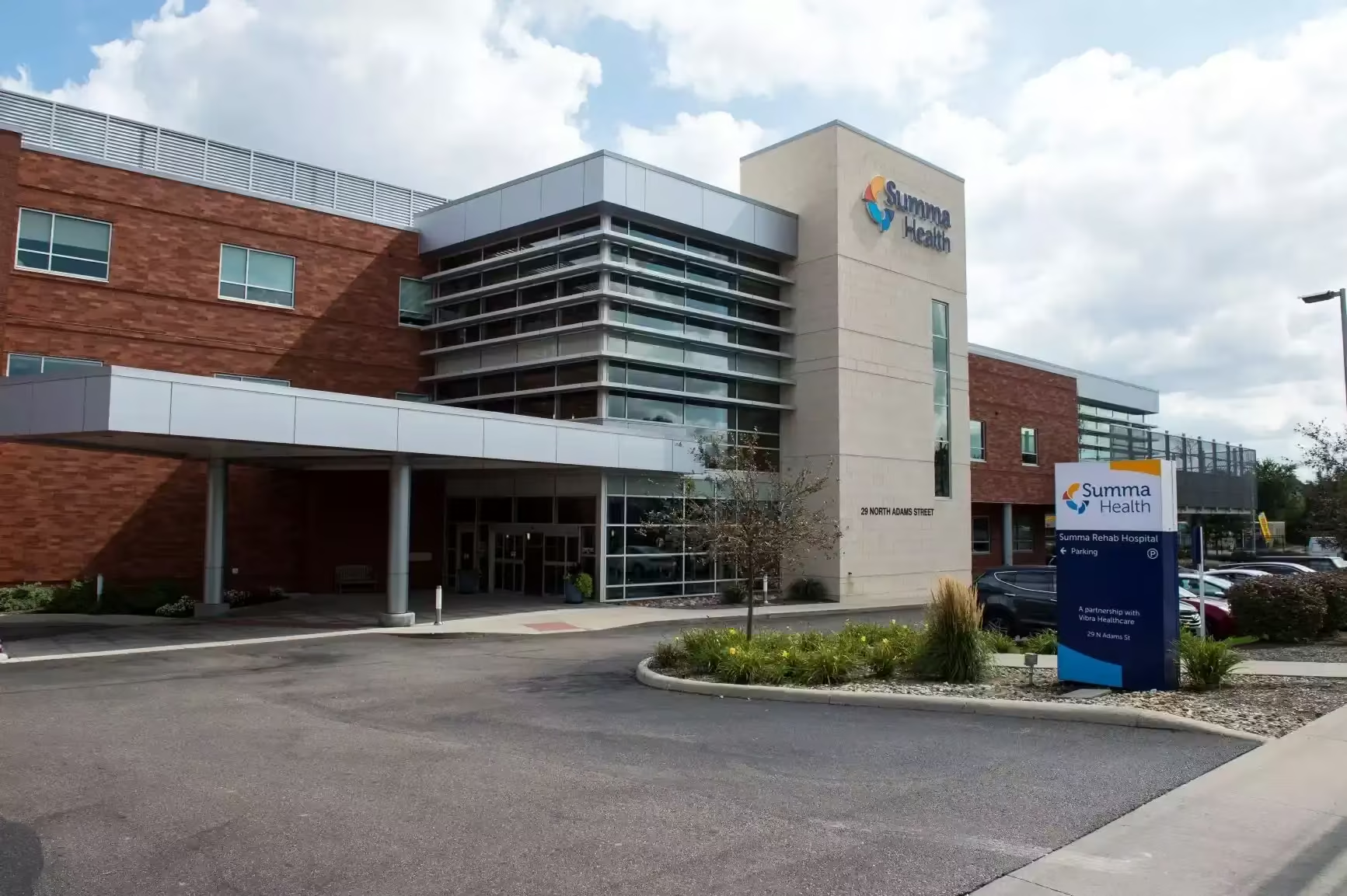
Summa Health is an integrated health system serving Greater Akron, Ohio, with two hospitals, twenty health centers, 870+ inpatient beds, 8,000+ employees, and 1.6M+ patient encounters annually. Together with General Catalyst and HATCo, Summa Health is building a proactive, community-based model of care in Greater Akron. Commure Ambient AI is the documentation layer of that model.
Executive Summary
Summa Health scaled Commure Ambient AI from 50 providers in January to over 300 by August. Weekly adoption climbed from 44% in April to 86% within four months. Today, roughly 8,000 patient visits a week are scribed automatically, returning 1,464 provider hours to the organization in July alone.
Documentation time per note dropped by 40% for providers using Ambient AI on 60% or more of their visits. Building on this foundation of automation, Summa is now piloting Autonomous Coding in Cardiology and other specialty areas, extending the same platform to suggest ICD-10, CPT, and E/M codes directly from the note, with 93%+ human audited accuracy.

The Transformation: Before vs. After
Impact by the Numbers
Key Success Drivers
Most health systems treat adoption as a soft goal: nice to have, optional, dependent on individual provider interest. Summa took a different approach.
- Dyad Accountability: Each clinical department is led by a physician-administrator dyad, and each dyad owned its weekly adoption number and set its own committed target. Cardiology went from 45% to 93%. Orthopedics climbed from 38% to 73%. Every clinical dyad moved up by double digits.
- Structured On-Site Support: Orthopedics ran the model first with 100+ hours of dedicated Commure support across three weeks. Practice managers identified which providers needed help up front, and each was guaranteed a block of time with a Commure specialist. That structure became the template for every wave that followed.
- Specialty Champions: Summa trains champions inside each specialty to shepherd adoption in their own groups, backed by two-hour in-person sessions, specialty-specific workflows, and pre-built macros.
- A No-Exceptions Standard: Leadership set the expectation that every clinician documents every encounter with Ambient AI. Governance kept scope, escalations, and open issues moving.
- Forward Deployed Engineering: Commure engineers embedded with Summa surfaced product friction and fixed it inside the deployment window. Workflows were decomposed by speciality and appointment type, allowing engineers to quickly build novel solutions to granular problems inhibiting efficiency.
“To have them move that quickly and get something done is not something you see with a lot of other IT vendors," Dr. Catlett said.
Extending Into Platform
Summa is applying the adoption playbook beyond ambulatory. The next expansion includes ancillary groups (e.g., OP Therapy), Emergency Department, and inpatient settings, with hundreds of providers. The same three levers (dyad accountability, structured support, leadership clarity) carry the work.
But documentation is just the foundation. Coding is the layer Summa is building on top of it.
In addition to the autonomous coding program now being rolled out, there is opportunity that Summa and Commure will pursue to connect both upstream into referral optimization and call center management and downstream into RCM.
Voices from the Frontline