



6 Best Patient Engagement Software Platforms for Health Systems (2026)
What to look for, what to ask, and which platforms are built for health system scale.
Written by the Commure Agents Team
Published: June 19, 2026
•
10 min read
What You Need to Know About Patient Engagement Software
- Healthcare providers miss an average of 29% of inbound calls. Of those patients who do not reach someone on the first attempt, 85% will not call back.
- As of August 2025, 99% of U.S. hospitals allow patients to view their health records electronically, yet most patient engagement software was built for single-site practices rather than centralized health system operations.¹
- Evaluating patient engagement software by digital channel alone misses the highest-volume contact point in most health systems: the phone call.
What Does Patient Engagement Software Do for Health Systems?
Patient engagement software handles how your health system communicates with patients: scheduling, reminders, digital intake, two-way messaging, and phone calls. At 100-plus providers, it needs to work across multiple sites and stay in sync with your EHR in real time.
There's a compliance angle too. CMS ties Promoting Interoperability payments to four capabilities: viewing, downloading, transmitting, and exchanging secure messages.⁸ Most hospitals have the basics covered. As of August 2025, 99% let patients view records online.¹ But bidirectional scheduling and patient-submitted data are still inconsistent across the industry.
The 21st Century Cures Act is also in play. It prohibits blocking access to patient health data, and HHS stepped up enforcement in September 2025. Penalties can reach $1 million per violation for health IT vendors.² One study in JAMA Health Forum found that access gaps aren't random; they follow demographic lines.³ A platform that works well for one patient group may quietly miss another.
For a health system, this is compliance infrastructure as much as a communication tool. HIPAA, interoperability, multi-site coordination: it all needs to be built in.
What Criteria Should Health Systems Prioritize in a Patient Engagement Software Evaluation?
Most patient engagement software was designed for small practices. What a 100-plus provider health system needs is different, and most vendor comparisons online don't cover it. Here are six criteria that matter specifically at health system scale:
EHR integration depth. Ask whether the software writes back to your EHR, not just reads from it. Confirmations, cancellations, and demographic updates need to sync in real time. If they don't, your front desk ends up cleaning up mismatches manually.
Voice and inbound call handling. Most platforms only handle outbound: texts, emails, reminders. But patients still call to schedule. Check whether the vendor has an actual inbound call solution, or just routes callers to voicemail.
HIPAA compliance and BAA availability. Get a signed BAA before anything else. Also think about what happens downstream. Portal message volume has increased 57% since COVID.⁴ U.S. doctors now get three times more inbox messages than peers in other countries.⁴ Software that drives more patient messages without helping triage them just moves the problem to clinical staff.
21st Century Cures Act compliance. Any software touching patient health data has to comply with information blocking rules.⁷ HHS has been enforcing this aggressively since September 2025, so it's not theoretical. Put it in the contract.²
Setup timeline and multi-site support. Ask for a project plan with milestones, not just a timeline estimate. Multi-site deployments are messier than single-site ones. Find out whether a dedicated setup manager is included or an add-on.
Physician inbox management. Text reminders work. MGMA data backs that up.⁶ But software that drives more patient messaging without any triage or routing just creates more inbox noise for doctors. Check whether the platform classifies and routes messages or passes everything through.
Quick Comparison: 6 Patient Engagement Software Platforms for Health Systems
The comparison below is based on internal modeling and publicly available information. It is a directional framework only, not a substitute for a detailed evaluation of each vendor.
6 Patient Engagement Software Platforms for Health Systems
Each platform below is reviewed against what health systems actually need: multi-site operations, EHR integration depth, and coverage from digital channels to inbound calls. Facts verified from vendor product pages, May 26, 2026.
Commure AI Call Center Agents
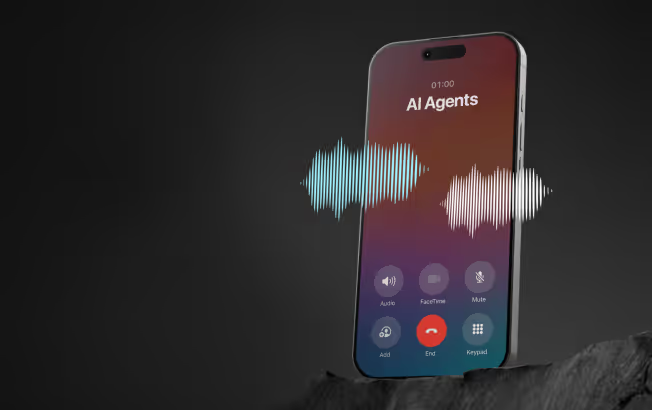
Commure AI Call Center Agents handle inbound phone calls for health systems. A patient calls and the AI agent answers immediately, with no hold time or queue. It handles the full interaction end to end: scheduling, rescheduling, cancellations, FAQs, and new patient intake. It integrates with 69 EHR systems, including athenahealth, eClincialWOrks, Epic, MEDITECH and others. It updates records in real time during the call. Staff arrive to a full, accurate schedule without having touched the phone.
It runs 24/7/365. Complex calls escalate to staff. Commure internal estimates suggest about 80% of structured inbound calls are handled autonomously. The complimentary call center health analysis gives you a one-week snapshot of call volume, call categories, and automation potential before you commit to anything.
Best fit: Health systems where inbound call volume, hold times, or after-hours abandonment is the primary access problem.
Artera
Artera won the 2026 Best in KLAS award for Patient Communications.⁹ It covers text, email, IVR, and webchat with real-time EHR integration via API, FHIR, and HL7v2. The 50-plus vendor marketplace connects Artera to tools already in your stack. The AI Co-Pilot (launched October 2024) generates no-show prediction reports. Artera Referrals handles outbound referral tracking, which most patient engagement platforms don't offer.
Best fit: Health systems that want KLAS-validated enterprise messaging, referral management, and omnichannel coverage at IDN scale.
TeleVox
TeleVox has been in healthcare communication for over 30 years and serves more than 2,000 health systems.¹⁰ The Enterprise Edition covers text, voice, virtual assistant, live chat, and email. Epic integration uses advanced APIs with full read and write-back. The platform has built-in support for value-based care programs: post-discharge follow-up, readmission workflows, and event-triggered communications. That's the piece most messaging-first platforms skip.
Best fit: Health systems running active VBC or readmission reduction programs that need post-discharge communication built into the same platform.
Phreesia
Phreesia is built for intake and payments, not messaging.¹¹ The platform powered 180 million patient visits in 2026. Patients register from their own device or from Phreesia's onsite hardware, capturing demographics, consents, and HIPAA forms directly in your EHR workflow. Payment collection happens at the same time: copays, outstanding balances, Apple Pay, Google Pay, payment plans. If intake and RCM are your biggest gaps, this is purpose-built for that.
Best fit: Health systems where the main gap is pre-registration completion, intake standardization, or time-of-service payment capture.
Luma Health
Luma connects to 70-plus EHR and practice management systems, the widest integration breadth in this comparison.¹² The Operational AI layer orchestrates workflows end to end rather than just sending reminders. In 2025, deployments across 50-plus health systems saved more than 2 million hours of staff time.¹² The 2025 acquisition of Tonic Health added digital intake forms, e-consents, and patient-reported outcomes.¹⁴ It also supports 20-plus languages and auto-updates the EHR when patients confirm or cancel by text.
Best fit: Health systems running multiple EHRs, or those adding patient-reported outcomes and workflow orchestration to their patient engagement stack.
NexHealth
NexHealth covers the front-office basics: online booking, intake forms, text and email reminders, and billing, with real-time EHR sync.¹³ It supports both dental and medical practices at a lower price point than enterprise platforms. Month-to-month pricing, no cancellation fees, and a developer API for custom integrations. Good for subsidiary clinics or smaller practices within a health system that don't need a full enterprise stack.
Best fit: Budget-conscious practices or subsidiary clinics that need core scheduling and reminders without enterprise-level investment.
What About the Phone? How Patient Engagement Software Handles Your Highest-Volume Channel
The phone is still how most patients schedule. Health systems miss about 29% of inbound calls on average, and 85% of those patients don't call back. If your patient engagement software only covers digital channels, your highest-volume contact point is going unaddressed.
Most platforms treat voice as outbound-only: automated reminders and IVR. That's different from handling inbound calls, where a patient picks up the phone to schedule, reschedule, or cancel.
Artera and TeleVox both include voice in their platforms, but they lead with digital messaging and enterprise workflows.
Commure AI Call Center Agents are built specifically for inbound. They pick up immediately, run the full interaction end to end, and update the EHR automatically. No hold time, no missed calls after hours. The two approaches work well together: a messaging platform for outbound digital communication, Commure AI Call Center Agents for inbound call volume.
Text reminders do reduce no-shows; MGMA data confirms it.⁶ But a reminder can't help once a patient has already decided to reschedule by phone.
What Should Health Systems Ask Before Signing a Patient Engagement Software Contract?
Every demo shows the best-case scenario. Before you sign, get these answers in writing, not just verbally from a sales rep. You'll want them during implementation.
- Which EHRs are supported, and what does integration actually mean? Find out which fields sync automatically: appointment status, demographics, cancellation reason. Read-only access is not the same as bidirectional sync.
- Is a BAA immediately available, and who handles the PHI? Confirm whether it's the vendor or a subprocessor. HIPAA accountability needs to be clear in the contract, not implied.²
- What does setup look like for a 100-plus provider network? Ask for a project plan with milestones. Multi-site implementations take longer than single-site. Find out whether a dedicated setup manager is included or costs extra.
- How does the platform handle inbound calls? "Patients can text us instead" is deflection. Find out if inbound phone calls are actually handled, or just redirected elsewhere.
- What controls exist for patient-initiated message volume? Portal message volume is a burnout driver.⁵ Ask how the platform routes and limits non-urgent patient messages before they land in a physician's inbox.
- What is the data portability policy at contract end? Information blocking rules cover data egress too.⁷ Find out what happens to your communication history, consent records, and patient demographics when you leave.
Frequently Asked Questions
Q: What is the best patient engagement software for health systems?
A: No single platform is best across everything. Artera is the 2026 KLAS #1 for enterprise messaging. Phreesia owns intake and payments. Commure AI Call Center Agents handle inbound calls, the channel most platforms skip entirely. Match the tool to your biggest gap.
Q: Does patient engagement software integrate with Epic and other major EHRs?
A: It depends on the vendor and the EHR. TeleVox has advanced Epic write-back. Luma connects to 70-plus EHRs. Commure AI Call Center Agents integrate with 29-plus EHRs and populate records during the call itself. For any platform, ask specifically about bidirectional sync.
Q: How is patient engagement software different from a patient portal?
A: A portal is where patients go to view records and send messages. Patient engagement software is what drives them to take action in the first place: reminders, scheduling tools, intake workflows, phone call handling. Most platforms include some portal-adjacent features, but they serve different parts of the patient journey.
Q: What is the difference between patient engagement software and an AI voice agent?
A: Most patient engagement software is outbound: texts, emails, portal messages. An AI voice agent handles inbound calls, when a patient picks up the phone to schedule, reschedule, or ask a question. They cover different channels and work together, not instead of each other.
Sources
1. Gabriel, M. H., Richwine, C., Owusu-Mensah, P., & Strawley, C. (2025). Health IT-Enabled Patient Engagement Capabilities Among U.S. Hospitals: 2024. Office of the Assistant Secretary for Technology Policy. https://www.healthit.gov/sites/default/files/2025-08/Patient-Engagement-Capabilities-Among-Hospitals-DB79_508.pdf
2. U.S. Department of Health and Human Services. (2025, September 3). HHS Announces Crackdown on Health Data Blocking. https://www.hhs.gov/press-room/hhs-crackdown-health-data-blocking.html
3. Richwine, C. (2023). Progress and Persistent Disparities in Patient Access to Electronic Health Information. JAMA Health Forum, 4(11), e233883. https://pmc.ncbi.nlm.nih.gov/articles/PMC10638642/
4. American Medical Association. (2023). When it comes to inbox overload, U.S. physicians have it worst. https://www.ama-assn.org/practice-management/digital-health/when-it-comes-inbox-overload-us-physicians-have-it-worst
5. American Medical Association. What's adding to doctor burnout? Check your patient portal inbox. https://www.ama-assn.org/practice-management/digital-health/what-s-adding-doctor-burnout-check-your-patient-portal-inbox
6. Medical Group Management Association. (2018). Text messaging remains an effective tool for patient appointment reminders. https://www.mgma.com/mgma-stats/text-messaging-remains-an-effective-tool-for-patient-appointment-reminders
7. Office of the National Coordinator for Health Information Technology. (2020). 21st Century Cures Act: Interoperability, Information Blocking, and the ONC Health IT Certification Program. Federal Register, 85 FR 25642. https://www.federalregister.gov/documents/2020/05/01/2020-07419/21st-century-cures-act-interoperability-information-blocking-and-the-onc-health-it-certification
8. Centers for Medicare and Medicaid Services. (2024). Promoting Interoperability Programs. https://www.cms.gov/medicare/regulations-guidance/promoting-interoperability-programs
9. Artera. (2026, February 27). Artera Named #1 Best in KLAS for Patient Communications. PR Newswire. https://www.prnewswire.com/news-releases/artera-named-1-best-in-klas-for-patient-communications-302699189.html
10. TeleVox. (2026). Enhancing the Patient Experience of Health Systems. https://televox.com/healthcare/health-systems/.
11. Phreesia, Inc. (2026, March 30). Phreesia Announces Fourth Quarter Fiscal 2026 Results. BusinessWire. https://www.businesswire.com/news/home/20260330072462/en/Phreesia-Announces-Fourth-Quarter-Fiscal-2026-Results
12. Luma Health. (2025, October 28). Luma Celebrates Record Year of Customer Impact, International Expansion. PR Newswire. https://www.prnewswire.com/news-releases/luma-celebrates-record-year-of-customer-impact-international-expansion-302595934.html
13. NexHealth. (2026). NexHealth Pricing. https://www.nexhealth.com/.
14. Luma Health. (2025, November 12). Luma Acquires Tonic, Taking on Healthcare Bottlenecks for Over 1,000 Health Systems and 100 Million Patients. PR Newswire. https://www.prnewswire.com/news-releases/luma-acquires-tonic-taking-on-healthcare-bottlenecks-for-over-1-000-health-systems-and-100-million-patients-302611514.html
Try the #1 AI Scribe for Free
No Credit Card Required. Join 20,000 Clinicians.
Discover the Latest from Commure
From pre-visit prep to post-visit revenue capture, the Commure platform connects the workflows that matter most to clinicians and operations teams.