



Best Voice AI Agents in Healthcare: 5 Healthcare-Native Vendors Across Patient Access, Clinical, Payer, and Platform
Compare five healthcare-native voice AI vendors on EHR, HIPAA, capabilities, and pricing.
Written by the Commure Agents Team
Published: June 12, 2026
•
10 min read
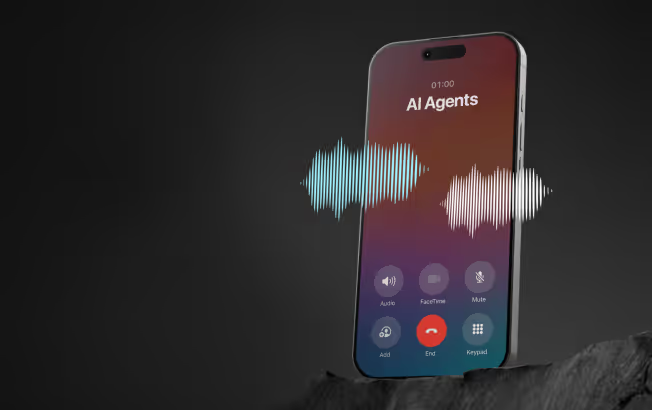
Best voice AI agents in healthcare are AI-powered conversational platforms that answer patient calls. They automate administrative workflows like scheduling and intake, handle FAQs, and route clinical questions to staff. Vendors vary in EHR write-back depth, HIPAA and BAA scope, voice capabilities, deployment model, and pricing transparency.
All facts here are sourced from each vendor's current materials and dated April 30, 2026.
What you need to know about the best voice AI agents in healthcare
- The best voice AI agents in healthcare cover use cases from patient access to clinical conversation to payer-side outbound calls.
- EHR coverage ranges from 4 named integrations to 29+, with vendors taking different approaches to where voice AI sits in the workflow.
- HIPAA support is universal in the category; pricing is consistently quote-based.
How do the 5 voice AI agents in healthcare compare at a glance?
This guide compares five of the best voice AI agents in healthcare on common fact slots. Each vendor profile covers use case, HIPAA and BAA posture, EHR write-back, voice capabilities, deployment model, customer outcomes, and pricing. The table below shows headline differences across the best voice AI agents in healthcare; full vendor profiles follow.
Per-vendor specifics in the table should be verified with each vendor before procurement.
The comparison below is based on each vendor's current materials and our internal modeling. It is meant as a directional framework only, not a substitute for a detailed evaluation of each vendor in your specific environment. Verified as of April 30, 2026.
1. Commure Agents
Commure AI Call Center Agents is a 24/7 healthcare-native voice AI that automates scheduling, cancellations, intake, insurance information capture, FAQs, and clinical-call routing. It integrates deeply with Epic, Cerner, MEDITECH, Athenahealth, eClinicalWorks, and 24+ more EHRs.
- Type: Healthcare-native voice AI
- Scope: 24/7 inbound voice
- Compliance: HIPAA. BAA required before data sharing.
- EHR integrations: 69 EHR systems, including athenahealth, eClincialWOrks, Epic, MEDITECH and others
- Voice capabilities: Scheduling, cancellations, intake, insurance information capture, FAQs, and routing of clinical calls to the appropriate team. Complex or non-standard scenarios escalate to staff.
- Deployment: Enterprise scoping; configured during implementation (not plug-and-play)
- Pricing: Not publicly disclosed; quote-based
- Customer outcomes: Multi-site deployment across 45+ locations and 225+ providers now answers 200K+ yearly inbound calls instantly, with abandonment sustained at or below 3% and approximately $200K in modeled annual labor efficiency
- Differentiator: 29+ deep EHR integrations plus end-to-end observability into AI call handling; Commure estimates a 2-4x return on investment
2. Hippocratic AI
Hippocratic AI focuses on clinical-conversation use cases like post-discharge follow-up, chronic care management, and screening outreach rather than patient access logistics. Polaris 5.0 launched April 30, 2026¹. Models are purpose-trained on real-world clinical interactions and medical licensing exams.
- Type: Healthcare-native voice AI (clinical-conversation focus)
- Scope: Inbound and outbound; "Our AI agents do not diagnose or prescribe"¹
- Compliance: HIPAA-compliant; CMS-regulated plan benefit accuracy
- EHR integrations: Epic, Cerner, Meditech, Salesforce
- Voice capabilities: Post-discharge recovery, chronic care management, RPM adherence, vaccination outreach, cancer screening outreach, annual wellness visits, joint replacement recovery, patient assistance program enrollment
- Deployment: Enterprise; native Mandarin and Spanish with mid-call language switching
- Pricing: Not publicly disclosed; quote-based
- Customer outcomes: 30% readmission rate reduction; 360% chronic care capacity increase; 20% higher pre-charting completion; 12x vendor-reported average ROI across use cases¹
- Differentiator: Clinical-grade conversation safety; models trained on real-world clinical interactions and medical licensing exams
3. Notable Health
Notable Health is a healthcare AI platform where voice AI is one capability among many². The platform integrates voice AI with scheduling, registration, intake, prior authorizations, copay collection, care gap closure, and HCC chart review². Notable serves 12K sites of care across health systems².
- Type: Healthcare-native AI platform (voice AI as one capability among many)
- Scope: Inbound voice AI plus broader workflow automation
- Compliance: HIPAA-compliant; integrates with Epic, Cerner, Meditech
- EHR integrations: Epic, Cerner, Meditech; Connector Hub framework for additional integrations
- Voice capabilities: Pre-procedure instructions; contact center automation; intake; scheduling; care gap outreach
- Deployment: Enterprise; Flow Builder low-code design tool plus Flow AI in-platform assistant
- Pricing: Not publicly disclosed; demo required
- Customer outcomes: 38M patients served; 97% patient satisfaction across 12K sites of care². Examples: 57% containment rate; referral work reduced from 14 days to 3 days; 14K+ no-shows avoided
- Differentiator: AI platform spanning patient access, RCM, and care operations with voice AI as integrated capability; Flow Builder low-code customization
4. Infinitus
Infinitus automates clinical and administrative voice calls between providers, payors, and patients³. Use cases include benefits verification, prior authorization status checks, eligibility, claims status, patient onboarding, and member outreach. Infinitus has supported 125,000+ providers across the healthcare ecosystem³.
- Type: Healthcare-native voice AI (payer / RCM outbound focus)
- Scope: Outbound and inbound; calls patients, payors, and providers
- Compliance: HIPAA + BAA
- EHR integrations: Custom integrations via API; Salesforce partnership for benefits verification flow
- Voice capabilities: Benefits verification, prior authorization, eligibility, claims status, patient onboarding, member outreach. Studio no-code agent builder for custom workflows. Dynamic local phone numbers, which the vendor reports doubled task completion rates for patient outreach.
- Deployment: Enterprise; "less than 30 days" time-to-launch per a documented customer (Mercalis)
- Pricing: Not publicly disclosed; quote-based
- Customer outcomes: 100M minutes of conversation automated; 6M+ calls completed supporting 125,000+ providers; 50% typical ROI³. Cencora reports calls completed 30% quicker with 10% higher quality vs. human agents³. Mercalis supports 50% more patients at current staff levels.
- Differentiator: Voice AI for the payer-provider-patient triangle; named customers across 44% of Fortune 50 including CVS, Humana, Aetna, Express Scripts, Amgen, and Cencora
5. Sully AI
Sully AI deploys purpose-built AI Employees across the clinical workflow⁴. The platform includes named AI Employees: Receptionist, Nurse, Consultant, Scribe, Pharmacist, and Medical Coder. Each AI Employee operates within its scope and coordinates with the others rather than running as a single general-purpose voice agent⁴.
- Type: Healthcare-native voice AI (multi-agent / AI Employees framework)
- Scope: Inbound and outbound across multiple AI Employee roles
- Compliance: HIPAA-compliant
- EHR integrations: Custom integrations
- Voice capabilities: Receptionist (patient calls, scheduling), Nurse (clinical questions), Scribe (visit documentation), Consultant (clinical decision support), Pharmacist (medication queries), Medical Coder (ICD-10 coding)
- Deployment: Enterprise; AI Employee deployment configured by use case
- Pricing: Not publicly disclosed; quote-based
- Customer outcomes: Midi Health 93.8% accurate ICD-10 coding⁴; ACG 98% drop in call abandonment⁴; Pure Psych $200K generated from missed appointments⁴; Ascend Medical 11% increase in additional visits⁴
- Differentiator: Multi-agent AI Employees architecture with named roles (Receptionist, Nurse, Scribe, Consultant, Pharmacist, Medical Coder); each AI Employee coordinates with others across the clinical workflow
How should you evaluate voice AI agents in healthcare for multi-site operations?
Evaluating the best voice AI agents in healthcare for multi-site operations comes down to six criteria. The criteria are EHR write-back depth, BAA tier specifics, escalation logic, implementation model, workforce framing, and governance. The framework below names what to ask each vendor and what good looks like.
CMS data shows patient experience scores affect Medicare reimbursement under the Hospital Value-Based Purchasing program⁵. The best voice AI agents in healthcare touch the same HCAHPS-tracked dimensions when they cut hold times and answer after-hours calls⁵.
A separate body of research has found reminder systems reduce no-shows by about 34 percent⁶. Reminder behavior is a core voice AI capability, and staff calls slightly outperform automated reminders in that same research⁶. The best voice AI agents in healthcare have to match what staff calls already deliver, not just answer faster.
Frequently Asked Questions
Q: What is the best voice AI agent in healthcare?
A: There is no single best voice AI agent in healthcare. The best voice AI agents in healthcare for your operation depend on your EHR mix, compliance posture, and which use case is the priority. The five listed above each anchor a distinct segment: patient access, clinical conversation, multi-product platform, payer/RCM outbound, and multi-agent clinical workflows.
Q: Are voice AI agents in healthcare HIPAA-compliant?
A: Most of the best voice AI agents in healthcare claim HIPAA compliance. Verify the BAA at your specific buying tier rather than relying on general HIPAA marketing. All five vendors on this list are healthcare-native, but the depth of additional certifications (HITRUST, SOC 2 Type II, ISO 27001) varies. Confirm at procurement.
Q: Which EHRs do voice AI agents integrate with?
A: EHR coverage varies sharply across the best voice AI agents in healthcare. Patient access vendors publish 4 to 29+ named bidirectional EHR integrations on this list. Clinical and payer-focused vendors integrate with fewer EHRs but go deeper into specific workflows. Epic appears across most vendors on the list.
Q: How much do voice AI agents in healthcare cost?
A: Pricing varies across the category, and most enterprise vendors require a demo and quote. None of the five vendors on this list publicly discloses tier pricing. Plan for enterprise pricing models, scoped deployments, and procurement timelines that range from weeks to a few months.
Q: How do voice AI agents handle complex or clinical calls?
A: Every one of the best voice AI agents in healthcare on this list supports escalation to human agents for complex scenarios. Patient-access vendors do not perform clinical triage; calls with clinical urgency route to a clinician. Hippocratic AI and Sully AI both handle clinical conversations directly within defined scopes, but neither diagnoses or prescribes. Research published in Nature Medicine found consumer LLMs under-triaged roughly half of medical emergency scenarios in a structured test⁷.
How to get started
Most evaluations of best voice AI agents in healthcare start with a baseline of current call volume, abandonment, and automation opportunity. Commure offers a complimentary call center health analysis that maps these metrics for your operation, then translates findings into a deployment plan. Request a call center health analysis to benchmark your current state.
Sources
- Hippocratic AI. (2026, April 30). Polaris 5.0 product, validation, and outcomes. https://hippocraticai.com
- Notable Health. (2026, April). Notable AI Platform, customer outcomes, and use cases. https://www.notablehealth.com
- Infinitus. (2026, April). Infinitus voice AI platform, customer outcomes, and named customers. https://www.infinitus.ai
- Sully AI. (2026, April). Sully AI Employees product page and customer outcomes. https://www.sully.ai
- Centers for Medicare & Medicaid Services. (n.d.). HCAHPS: Patients' perspectives of care survey. https://www.cms.gov/medicare/quality/initiatives/hospital-quality-initiative/hcahps-patients-perspectives-care-survey
- McLean, S. M., Booth, A., Gee, M., Salway, S., Cobb, M., Bhanbhro, S., & Nancarrow, S. A. (2016). Appointment reminder systems are effective but not optimal: Results of a systematic review and roadmap for evidence-based implementation. Patient Preference and Adherence, 10, 479-499. https://pmc.ncbi.nlm.nih.gov/articles/PMC4831598/
- Ramaswamy, A., Tyagi, A., Hugo, H. et al. (2026). ChatGPT Health performance in a structured test of triage recommendations. Nature Medicine. https://doi.org/10.1038/s41591-026-04297-7
Try the #1 AI Scribe for Free
No Credit Card Required. Join 20,000 Clinicians.
Discover the Latest from Commure
From pre-visit prep to post-visit revenue capture, the Commure platform connects the workflows that matter most to clinicians and operations teams.