



How AI Medical Scribes Work: What to Evaluate Before You Choose One
How AI medical scribes work, what to evaluate, and what clinicians actually notice first.

Medically Reviewed by Donald Lazure
Written by the Commure Scribe Team
Published: March 11, 2026
•
8 min read
Updated March 11, 2026
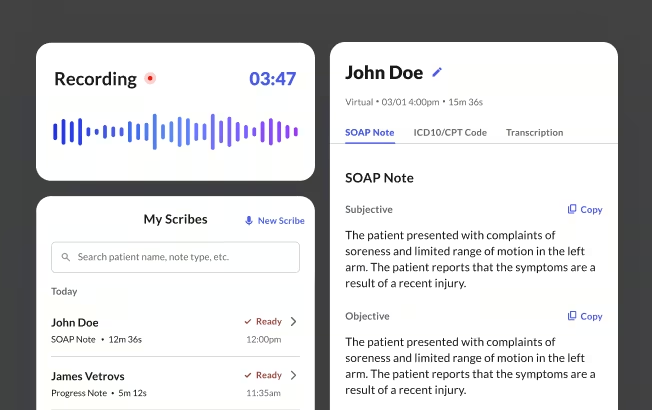
An AI medical scribe listens to both speakers in a visit. From that talk, it builds a structured clinical note using three systems in order. Speech recognition turns the audio into text, and speaker diarization separates who said what. Clinical natural language processing (NLP) then sorts the content into Subjective, Objective, Assessment, Plan (SOAP) sections. Seconds after the recording ends, the clinician gets a draft to review and sign. The draft carries suggested International Classification of Diseases (ICD-10) diagnosis codes and Current Procedural Terminology (CPT) procedure codes.
What you need to know about AI medical scribes
- A 2025 JAMA study found ambient AI scribes reduced physician burnout by 21% across two major health systems.4
- The most common finding from early adopters: the AI captures clinical context they would have missed or compressed under time pressure.
What clinicians should know about AI medical scribes before choosing one
You finish your last patient at 5:15 pm but you have another two hours of charts to write. For most clinicians, that's just Tuesday. The documentation burden is a second job.
AI medical scribes exist so you leave the building with every chart closed. The best ones capture the full context of the visit so you can focus on the patient in front of you, not the note you'll write after.
This guide explains how they work and what to look for.
Why AI medical scribes exist: the documentation problem they're built to solve
Time on charts. For every hour a physician spends with patients, they spend roughly two hours documenting.1 Across solo practices and group practices alike, that ratio plays out every day.
Burnout is the outcome. More than 40% of US physicians now report at least one symptom of burnout, and more than a third point to EHR and documentation work.8 A 2025 study across Mass General Brigham and Emory found that ambient AI documentation reduced physician burnout by 21% and improved wellbeing scores by 31%.3
Small practices feel this most. A 2025 survey of small primary care practices found 41% less documentation time and 60% less burnout after adopting an ambient AI scribe.9
Where documentation time goes without an AI medical scribe
The breakdown happens at the same point in every practice. The encounter ends, the patient leaves. The clinician now has 15 minutes or more of conversation that needs to become a SOAP note with ICD-10 codes before the next patient walks in. That gap is where documentation debt builds.
After-hours debt. By end of day, that debt is three, five, sometimes ten notes long. The American Medical Association (AMA) reports family physicians spend 86 minutes on after-hours EHR work per day on average.11 For a practice without extended admin support, that time comes out of the clinician's personal life.
Why scribes and dictation tools fall short and how AI medical scribes are different
Human medical scribes cost $30,000 to $45,000 per year per provider. For a practice without dedicated admin support, that is a fixed overhead line that doubles when a provider joins. They also require training, scheduling, and HIPAA agreements or could be absent due to illness or vacation. Note quality depends on the individual scribe's familiarity with each clinician's style. A virtual medical scribe works remotely, either live or asynchronously, though output still hinges on how well that person knows each clinician.
Traditional dictation tools require the clinician to mentally compose the note while speaking. That adds cognitive load during the visit rather than removing it afterward. The output is usually unstructured text that needs heavy reformatting before it can enter the chart.
Neither workaround solves the core problem: getting a structured, coded, EHR-ready note done without it following the clinician home.
What a well-written AI medical scribe note actually looks like
An AI medical scribe listens to a patient encounter and builds a structured clinical note from the conversation. Unlike dictation software, which transcribes what the clinician says, an ambient scribe listens to both speakers and pulls out the clinically relevant content.
The technology behind the note
Three systems work in order during every visit:
- Speech recognition converts the audio stream into text in real time. Medical-grade systems are trained on clinical terms, drug names, and specialty-specific language. Accuracy numbers only mean something if they hold in real clinical environments, not controlled demo recordings.
- Speaker diarization separates the conversation by speaker. The system knows which voice is delivering the history, narrating the exam, or reporting symptoms. This is what makes multi-speaker recognition work in a noisy clinic room.
- Clinical NLP (natural language processing) maps the transcript to clinical structure. It sorts content into the right SOAP note sections and applies specialty-specific patterns. A system trained on family medicine behaves differently from one trained on behavioral health. That gap shows up most in ICD-10 selection and plan organization.
The output is a structured, coded note built to match the clinician's specialty and workflow.
What happens when you click end recording
Within seconds of ending the recording, a structured SOAP note appears with ICD-10 and CPT codes already filled in. The plan section typically reflects the full scope of the visit, including differentials discussed, treatment rationale, verbal follow-up instructions, and patient education points that often get cut when charting under time pressure.
The value is not that the AI writes a better note. It is that the clinician, freed from composing the note during or right after the visit, can stay present in the room. Eye contact instead of a keyboard. Listening instead of typing. The record then reflects what actually happened, because the clinician was paying attention when it did. In a TPMG study of 7,260 physicians, 47% of patients reported that their doctor spent less time on the computer during the visit.8
What a good AI-generated note actually looks like
Where AI scribes earn or lose credibility is in the sections clinicians cut short when time runs out.
In the Subjective section, a clinician charting quickly might write: 'Patient reports knee pain, worse with stairs.' A system that captured the full visit would produce: 'Patient reports right knee pain starting about six weeks ago, getting worse over time, sharp going down stairs, dull at rest, with occasional swelling after long walks. Denies locking or giving way.' The second entry is not the AI's clinical judgment. It is the patient's account, captured fully rather than summarized.
In the Assessment and Plan section, the fuller record includes the differentials discussed, the treatment rationale, and the follow-up instructions given verbally. It also captures patient education points mentioned in passing. These are the sections compressed most when a clinician is charting visit #9 at 7pm. They also matter most for continuity of care, billing accuracy, and medico-legal records.
Suggested ICD-10 and CPT codes are filled in automatically on paid tiers. For practices without a dedicated coder, this cuts coding review time on routine visits without needing a dedicated coder.
Does the note sound like you, or like a generic template?
A well-configured AI scribe should produce notes that match your documentation style, not a one-size-fits-all format that requires heavy rewriting to feel like yours.
If routine visit notes still require significant editing after the first week, either the system is not capturing accurately or the template does not match your specialty. Custom templates let you specify the sections you want, the format you prefer, and the level of detail expected in each part.
The question is whether the tool holds up on a difficult day not on an easy morning. That is the benchmark worth tracking during any trial period.
What should a medical practice look for in an AI medical scribe?
Most practices want something that runs on any device, connects to the EHR already in use, and does not require an IT project to get started.
Accuracy in real clinical conditions
Real clinic rooms are noisy. Medical practices should see how AI medical scribes work in real patient encounters with multiple speakers. See how they hold up with overlapping voices, background noise, and children in the room. Accuracy numbers only matter if they hold in those conditions.
What AI scribes tend to miss was examined directly in a 2025 randomised controlled trial published in NEJM AI. The finding: omissions are the most common error type, not inaccuracies.4 The AI is more likely to leave something out than to state something wrong. In practice, this means the review step matters most for completeness, not correction. Medication names spoken quickly, dosage changes mentioned in passing, and patient-reported symptoms buried in conversational language are the categories most prone to omission. Review the note after the visit, while the encounter is still fresh, to catch any omissions.
Telehealth visits introduce the same variables that affect any audio call: connection stability and device microphone quality. Both visit types are supported by leading AI scribes. If accuracy feels lower on telehealth visits, audio quality is the first variable to check before assuming a system limitation.
Test it on a real visit before committing, not on a controlled demo recording.
EHR compatibility
The note needs to land in the chart, not in a separate document that requires manual transfer. EHR integration is one of the most frequently cited concerns when clinicians evaluate AI scribes.
The handoff between note to EHR varies by tier. At all tiers, a well-integrated scribe produces a structured, copyable note that transfers into any EHR in a single paste. Enterprise tiers typically offer one-click sync that populates chart sections directly without the manual step.
What breaks most often is the handoff between the note and the chart. EHR session timeouts, chart field structure changes after a version upgrade, and clipboard conflicts after software updates are the failure modes worth testing before going live with patients. Run the full workflow, from recording through chart entry, on a non-patient visit first.
Languages, visit types, and devices
The most useful AI scribes support multiple languages with automatic detection. Both in-person and telehealth visits should be supported. The tool should run on any device the clinician already uses: mobile, tablet, or desktop. Session recording length matters for extended or complex visits. Look for at least 60 to 90 minutes of continuous audio per session.
HIPAA and data practices
HIPAA compliance is a baseline for any tools that touches patient conversations . The questions that matter beyond the compliance checkbox:
- What is the data retention policy for clinical notes?
- Who has access to the data, including employees, contractors, and third-party processors?
- Is a Business Associate Agreement standard, or does it require a separate negotiation?
Tools that keep audio recordings create a separate category of PHI with its own access controls and breach exposure. When audio is processed and discarded, the only data left is the structured clinical note, governed by the same policies as any EHR record.
As for disclosures, the standard approach is to do so at the start of the visit. Let the patient know that an AI tool is being used to help with documentation. Give them the option to decline. In a 2025 randomised controlled trial, only 7% of patients declined when offered the option.4 Most patients, when given a straightforward explanation, have no objection.
Something like: 'I use an AI tool to help me document our visit. It listens during our conversation and generates the notes afterward. Is that okay with you?' That covers the material disclosure, gives the patient agency, and takes about ten seconds.
What specialties can use an AI medical scribe?
A general-purpose transcription tool doesn't distinguish between a SOAP note for family medicine and a DAP note for behavioral health. Specialty-trained systems do, and the gap shows up most in ICD-10 selection, note structure, and plan organization.
How documentation needs differ by specialty
Family Medicine and Internal Medicine: Visits often cover more than one problem in a single encounter. The challenge is capturing the full scope of each: the discussion, the decision rationale, the return instructions, without the note collapsing into a summary by visit #10. When documentation is handled, the clinician can give each problem the attention it needs in the room rather than trying to reconstruct it later.
Psychiatry and Behavioral Health: The subjective section carries particular clinical weight. Mood, affect, ideation, and response to treatment are often described by the patient in their own words. Those words matter for longitudinal care. A scribe that paraphrases loses that detail. Because the clinician is not typing during the session, the therapeutic relationship stays intact. Therapists can compare AI therapy notes tools on HIPAA compliance and note formats, since tools differ in how well they fit behavioral health.
Physical Therapy: Documentation has distinct structural needs: functional assessments, ROM measurements, treatment units, and progress toward goals.
Pediatrics and Dentistry: Each specialty has its own conventions. Developmental milestone tracking, vaccine visit templates, dental charting nomenclature. Specialty-specific templates handle these without requiring the clinician to adapt a generic SOAP format.
Do AI medical scribes actually save time and money?
A 2025 UCSF study published in JAMA Network Open found that physicians using AI scribes generated an average of $3,044 more revenue per year and saw 0.8 more patients per week compared to non-users.5 For most practices, the productivity gain covers the scribe subscription cost well within the first year.
Time savings are real but modest in controlled conditions. The first randomised controlled trial of an ambient AI scribe, published in NEJM AI in 2025, found a 9.5% reduction in time spent in the note compared to control.4 That is not the transformative figure vendor marketing often suggests. But it compounds across 20 visits a day, and it does not account for the reduction in after-hours charting, which is where clinicians in smaller practices feel the burden most.
Note quality is more nuanced. A human scribe who has worked with a specific clinician for two years will know their documentation style well. An AI scribe performs consistently from session one, handles multiple languages, and needs no HIPAA retraining or scheduling. For most practices, the challenge of finding and keeping a quality scribe is as real as the cost.
Adoption of ambient listening and AI documentation is growing across health systems. The Permanente Medical Group reported 15,791 hours saved across 7,260 physicians in a single year.6 UCSF found a productivity and revenue gain in a large cohort study.5 Mass General Brigham and Emory reported significant burnout reduction.3 Practices that build this into their workflow early are setting up documentation infrastructure that scales as they grow. Group practices weighing AI beyond the note can review the broader benefits of AI in healthcare, from coding and diagnostics to prior authorization, along with the risks.
Try it on real visits
Commure Scribe is an AI medical scribe captures the encounter and drafts a structured, coded note in seconds. It's the basis for this guide and evaluation framework. Check current Commure Scribe pricing. There's a 7-day free trial, no credit card.
How do you evaluate an AI medical scribe?
The most reliable way to evaluate an AI scribe and compare it to others is to use it on real patient visits. Watching a vendor demo or comparing feature lists won't tell you what you need to know. The variables that determine whether a tool fits your practice and specialty aren't visible in a product tour.
A structured one-week trial gives enough data to make a real assessment. Here is a practical protocol:
- Start the free trial. No credit card required.
- Record one real patient visit using normal conversation. No changes to how you speak.
- Read the note before editing. Assess what the AI captured from the visit.
- Edit the note and track how long it takes.
- Transfer the note to your EHR. Confirm it landed correctly.
- Record five more visits across different visit types. Compare after-hours charting time to your normal baseline.
- Assess: does the note more fully reflect what happened in the room? If yes, consider upgrading to Pro for ICD-10/CPT coding and custom templates.
The most useful benchmark after a one-week trial is not how much time was saved. It's whether the note more fully reflects what happened in the room. A complete note is a better clinical record, a better billing document, and a better reference at the next visit.
What makes clinicians stick with a scribe past the first month comes down to whether the tool holds up on difficult days, not just easy ones. The trial period is most useful when you test it across a range of visit types, including complex multi-problem encounters, not just routine follow-ups.
For multi-provider practices, run the trial with one clinician first. Let the results speak before asking the rest of the team to change their workflow.
Frequently Asked Questions
Commure Scribe achieves 99.4% transcription accuracy in real clinical environments, including background noise and multi-speaker conversations. Every AI scribe makes some errors, so the clinician reviews and approves each note before it enters the chart.
HIPAA compliance is a baseline requirement, not a differentiator. Every credible AI scribe vendor should be able to provide a signed Business Associate Agreement. Commure Scribe is HIPAA compliant and SOC 2 certified. Notes are securely stored and not shared with third parties. A BAA is standard.
Commure Scribe offers a 7-day free trial, no credit card required. After the trial, paid tiers scale by provider count. A human scribe typically costs $30,000 to $45,000 per year per provider. See the Commure Scribe pricing page for current plan details.
Commure Scribe connects with 60+ EHRs through its Chrome extension on all tiers. Supported systems include eClinicalWorks, athenahealth, SimplePractice, WebPT, Elation, AdvancedMD, Cerbo, Tebra, Practice Fusion, and Kipu. Enterprise accounts add one-click EHR sync.
Ask each patient before you record, even where the law does not require it. HIPAA permits recording for treatment documentation without a written authorization. State recording laws vary, and some states require consent from everyone in the conversation. Many practices give a short verbal disclosure at the start of the visit and note the patient's agreement in the chart. Have counsel confirm the wording for your state.
Sources
1 American Medical Association / RAND Corporation. Physician Time Spent Using the Electronic Health Record During Outpatient Encounters. 2022. https://www.rand.org/pubs/research_reports/RRA1030-1.html
2 American Medical Association. AMA Organizational Biopsy: Physician Burnout Rate and Pajama Time. 2024. https://www.ama-assn.org/practice-management/physician-health/burnout-way-down-pajama-time-stands-still
3 UCLA Health / Sinsky et al. Physicians Spend 2 Hours Documenting for Every 1 Hour of Patient Care. 2025. https://www.uclahealth.org/news/release/ucla-study-finds-ai-scribes-may-reduce-documentation-time
4 You et al. Ambient Documentation Technologies Reduce Physician Burnout. JAMA Network Open. 2025. https://www.massgeneralbrigham.org/en/about/newsroom/press-releases/ambient-documentation-technologies-reduce-physician-burnout
5 Lukac et al. Randomized Controlled Trial of Ambient AI Scribe on Documentation Time and Patient Acceptance. NEJM AI. 2025. https://pmc.ncbi.nlm.nih.gov/articles/PMC12768499/
6 Holmgren et al. AI Scribes Associated With Increased Physician Productivity and Revenue. JAMA Network Open. 2025. https://docit.ucsf.edu/news/ucsf-study-finds-ai-scribes-associated-increased-physician-productivity-and-revenue
7 The Permanente Medical Group / NEJM Catalyst. AI Scribes Save 15,000 Hours and Restore Human Side of Medicine. 2025. https://www.ama-assn.org/practice-management/digital-health/ai-scribes-save-15000-hours-and-restore-human-side-medicine
8 American Medical Association. U.S. Physician Burnout Hits Lowest Rate Since COVID-19. 2025. https://www.ama-assn.org/practice-management/physician-health/us-physician-burnout-hits-lowest-rate-covid-19
9 The Permanente Medical Group / NEJM Catalyst. AI Scribes Save Physicians Time, Improve Patient Interactions and Work Satisfaction. 2025. https://permanente.org/analysis-ai-scribes-save-physicians-time-improve-patient-interactions-and-work-satisfaction/
10 Phyx Primary Care / Rise Health. Ambient AI Scribe Cuts Small Primary Care Providers Burnout by 60%. Survey. 2025. https://www.risehealth.org/insights-articles/ambient-ai-scribe-cuts-small-primary-care-providers-burnout-by-60-new-report-reveals/
11 American Medical Association. Family Doctors Spend 86 Minutes of "Pajama Time" with EHRs Nightly. 2017. https://www.ama-assn.org/practice-management/digital-health/family-doctors-spend-86-minutes-pajama-time-ehrs-nightly
.jpeg)
.jpeg)
.jpeg)
.jpeg)

.jpeg)
.jpeg)