



Free Trauma Timeline Worksheet for Therapists (Fillable Template)
A free fillable trauma timeline worksheet for therapists, with field-by-field guidance on how to introduce and complete it in session.
Written by the Commure Scribe Team
Published: May 15, 2026
•
5 min read
Updated May 15, 2026
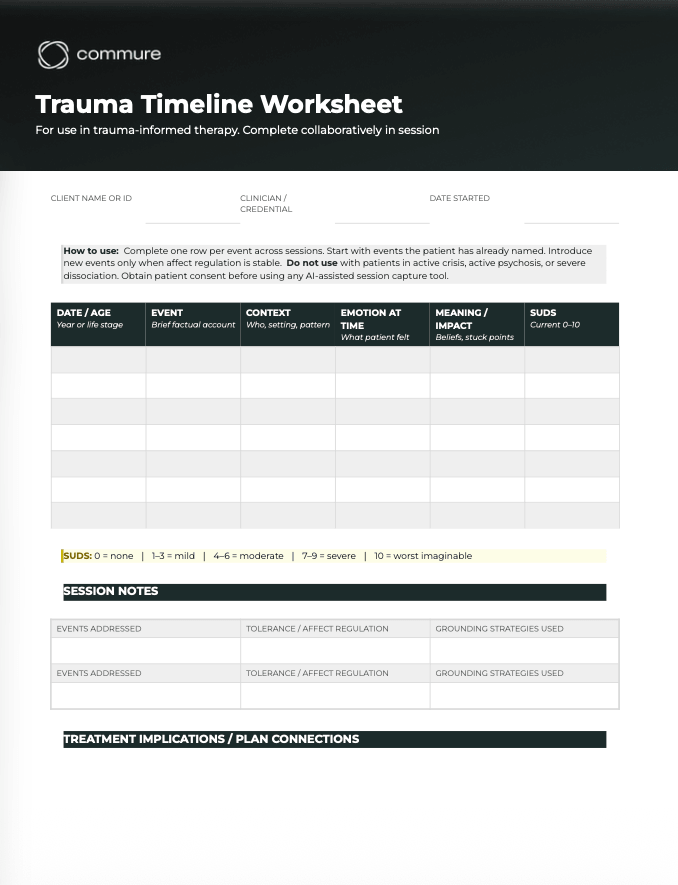
A trauma timeline worksheet is a structured form therapists use to map a patient's adverse event history in chronological order. Each row captures a date or age, a brief event description, the emotional response, and a current distress rating. Completed in session together, it supports history-taking, treatment planning, and progress monitoring across eye movement desensitization and reprocessing (EMDR), CPT, and trauma-focused cognitive behavioral therapy (CBT).
What Is a Trauma Timeline Worksheet?
A trauma timeline worksheet is a one-to-three page clinical form the therapist and patient complete together. It organizes a patient's history of traumatic or adverse events into a chronological record. That record can be revisited, updated, and used to track how a patient's relationship to past events changes over time.
The worksheet is not a diagnostic instrument. It does not generate a score or determine a diagnosis. Its function is organizational. It helps the patient see their own history as a sequence and helps the clinician identify which periods and events need the most attention. Diagnosis and scoring come from other intake tools, such as a biopsychosocial assessment template with a Patient Health Questionnaire-9 (PHQ-9) companion form.
The format works across modalities. Trauma timelines appear in EMDR preparation phases, CPT assessment work, narrative therapy, and trauma-focused CBT. No single treatment model owns the format, which makes it one of the more portable tools in behavioral health.
What Does Each Field in the Trauma Timeline Worksheet Capture?
The trauma timeline worksheet uses six fields. Each serves a distinct clinical function.
- Date or age at the time of the event. This establishes the chronological spine of the worksheet. Use calendar years, developmental age ranges, or both. Consistency across rows matters more than the specific format chosen.
- Description of the event. A brief, factual account of what happened. One to two sentences is enough to start. Depth can be added across later sessions as the therapeutic relationship strengthens.
- Context and circumstances. Who was present, what the setting was, and whether the event was isolated or recurring. Context is often where diagnostic clarity emerges, particularly for complex or developmental trauma.
- Emotional response at the time. What the patient felt during or right after the event. This field surfaces dissociative responses, numbness, or delayed processing, all of which inform treatment planning decisions.
- Meaning and perceived impact. What the patient understood about the event when it happened, and how they understand it now. Cognitive distortions and core beliefs surface here. In CPT, these stuck points become explicit treatment targets.
- Current distress rating (0–10). A subjective units of distress (SUDS) rating for how distressing the event feels today. Revisiting this number across sessions gives the clinician observable data on treatment progress.
How to Use the Trauma Timeline Worksheet in Session
Therapists in small outpatient practices can follow these steps to introduce and complete the trauma timeline worksheet safely.
- Step 1: Establish readiness first. The trauma timeline worksheet should not appear in early sessions. A solid therapeutic alliance and basic affect regulation skills are prerequisites. Most trauma-informed frameworks recommend grounding and stabilization work before structured history-taking begins. Active psychosis, severe dissociation, or active crisis, including active suicidal ideation, recent psychiatric hospitalization, or acute substance use relapse, are contraindications. When in doubt, consult with a supervisor before introducing structured trauma history-taking. Readiness decisions can also draw on an intake trauma assessment that pairs a structured template with the PTSD Checklist for DSM-5 (PCL-5).
- Step 2: Introduce it as a shared task. Frame the worksheet as something you complete together, not a homework assignment. Trauma material that surfaces without a clinician present can be activating. A plain explanation works: "We're going to map the difficult things that have happened in your life so we can understand what we're working with."
- Step 3: Build across sessions. For patients with complex trauma histories, completing the worksheet in a single visit is inadvisable. Start with events the patient has already named and work outward. End each session with enough time to close down activation using established grounding strategies.
- Step 4: Anchor treatment planning to the completed worksheet. A completed trauma timeline worksheet makes treatment planning concrete. Rather than writing "patient presents with trauma history," the clinician can reference specific events, developmental periods, and stuck points connected directly to measurable goals.
- Step 5: Track distress ratings across treatment. Current distress ratings revisited at intervals show whether treatment is reducing the patient's emotional charge around specific events. This serves both the clinical record and patients who do not perceive their own progress.
How to Document Trauma Timeline Sessions
Documentation of trauma timeline sessions carries specific considerations for therapists in small practices.
Progress notes should reflect the clinical process, not reproduce the content. A note that lists every event the patient named is a narrative transcription, not a clinical progress note. For broader guidance on documentation standards, see our clinical documentation improvement guide. The note should record which events were addressed, the patient's affect regulation and tolerance, and grounding techniques used. It should also note the treatment implications of what was discussed. In a DAP notes template (Data, Assessment, Plan), Data can summarize which events were addressed, Assessment can record affect regulation and tolerance, and Plan can carry the treatment implications.
Treatment plan connections should be explicit. If the trauma timeline worksheet surfaces a developmental period or event cluster that becomes a treatment focus, the treatment plan should reflect that. Reviewers and auditors expect connections between assessment findings and treatment plan goals.
For patients treated in a federally assisted SUD program where trauma work is co-occurring, records may carry additional protections under 42 CFR Part 2. Not all dual-diagnosis settings are covered. Clinicians should confirm with their compliance consultant whether Part 2 applies to their specific program and how trauma timeline documentation is handled in their EHR. For EHR selection guidance, see best EHR for mental health private practice.
Clinicians should obtain patient consent for AI-assisted session capture (see our HIPAA-compliant AI note taking checklist) in accordance with their state's recording and privacy laws before using any AI scribe tool.
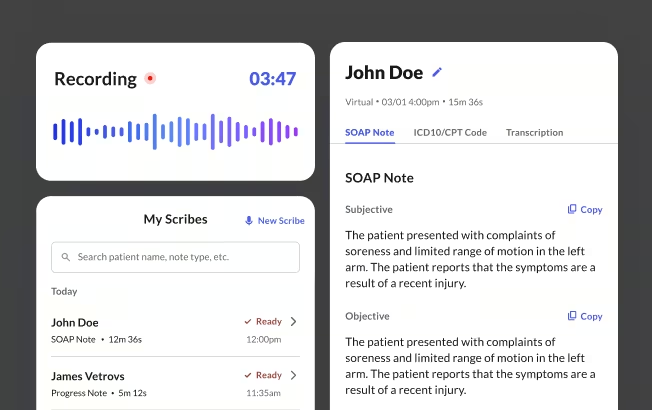
Documentation time adds up across a full caseload. Trauma timeline sessions tend to generate more detailed notes because the clinical content is complex. Commure Scribe captures the session and generates a structured draft note. The clinician reviews and finalizes it before it enters the chart. Clinicians report closing charts in an average of 43 seconds, which for many shifts a meaningful portion of documentation out of after-hours time.
Trauma Timeline Worksheet Template Download
Download a copy of this template
Thanks! Your free trauma timeline worksheet is ready.
Click below to download
Frequently Asked Questions
A trauma timeline is a structured worksheet that maps a patient's history of adverse events in chronological order. It records emotional responses and current distress ratings alongside each event. Therapists use it during history-taking and treatment planning to identify patterns, prioritize treatment targets, and track changes in distress across sessions.
A thorough trauma history includes the date or approximate age of each event, a factual description, and the context and circumstances. It also records the patient's emotional response at the time, the meaning or belief the event produced, and a current distress rating. Note whether events were isolated or recurrent, and whether the response included dissociation or delayed processing.
Document the clinical process, not the content disclosed. Record which events were addressed, the patient's tolerance and affect regulation, grounding techniques used, and the implications for treatment planning.
A trauma timeline helps PTSD treatment by making the patient's history concrete and navigable. In EMDR, it informs target selection and sequencing. In CPT, it surfaces stuck points and cognitive appraisals that become explicit treatment targets. Tracking distress ratings over time also provides observable evidence of processing progress.
A trauma timeline worksheet is created collaboratively in session. The clinician introduces it after a therapeutic alliance is in place and the patient has basic affect regulation skills. Together, they work through each event, recording the date or age, a brief description, context, emotional response, and current distress rating. Most timelines are built across multiple sessions.
Sources
- American Psychological Association. Clinical Practice Guideline for the Treatment of PTSD in Adults. 2025. https://www.apa.org/ptsd-guideline/ptsd.pdf
- Resick, P.A., Monson, C.M., & Chard, K.M. Cognitive Processing Therapy for PTSD: A Comprehensive Manual. Guilford Press, 2017. https://www.guilford.com/books/Cognitive-Processing-Therapy-for-PTSD/Resick-Monson-Chard/9781462528646
- Shapiro, F. Eye Movement Desensitization and Reprocessing (EMDR) Therapy: Basic Principles, Protocols, and Procedures. 3rd ed. Guilford Press, 2018. https://www.guilford.com/books/Eye-Movement-Desensitization-and-Reprocessing-EMDR-Therapy/Francine-Shapiro/9781462532766
- Substance Abuse and Mental Health Services Administration. SAMHSA's Concept of Trauma and Guidance for a Trauma-Informed Approach. HHS Publication No. (SMA) 14-4884. 2014. https://www.health.ny.gov/health_care/medicaid/program/medicaid_health_homes/docs/samhsa_trauma_concept_paper.pdf
- Ford, J.D., & Courtois, C.A. (Eds.). Treating Complex Traumatic Stress Disorders in Adults: Scientific Foundations and Therapeutic Models. 2nd ed. Guilford Press, 2020. https://www.guilford.com/books/Treating-Complex-Traumatic-Stress-Disorders-in-Adults/Ford-Courtois/9781462543625