



Virtual Medical Scribe: A Practical Guide
Live and asynchronous virtual medical scribes for independent and group practices: outcomes, evaluation, and how AI scribes compare.
Written by the Commure Scribe Team
Published: June 6, 2026
•
6 min read
Updated June 6, 2026
What You Need to Know About Virtual Medical Scribes
- A virtual medical scribe is a remote person who produces the clinical note from a visit, live or asynchronously.
- A primary care study found scribed periods sharply reduced after-hours EHR work and improved note completion times.
- Practices considering one should evaluate accuracy, HIPAA, EHR fit, and trial design; AI scribes are a separate alternative covered later.
What is a virtual medical scribe?
A virtual medical scribe is a trained person who joins the visit remotely and produces the clinical note¹. The scribe is connected to the encounter through audio or video but is physically located elsewhere. They draft the note in real time during the visit (live virtual) or from the visit recording afterward (asynchronous). Some practices call these services online medical scribes or virtual scribe services.
The peer-reviewed evidence base for virtual medical scribes is concentrated in primary care and specialty outpatient settings¹ ². AI medical scribes, which are software rather than human, are a separate category covered later.
How does a virtual medical scribe change note quality and patient presence?
Published virtual medical scribe studies report a consistent shift in the clinician's relationship with the visit² ³. The remote scribe drafts the note from the encounter, and the clinician reviews and finalizes it.
Clinicians can put down the computer, stay present in the room, and actively listen during the visit. Drafting work moves off the clinician's plate, and charts close before leaving the building rather than late at night.
The peer-reviewed signal is generally positive but mixed. An asynchronous virtual scribe program found burnout, productivity, time savings, and self-reported quality all moved in positive directions³. Virtual medical scribes have also been associated with significant decreases in time on notes per appointment².
What are the main types of virtual medical scribes?
There are two operational models, and they differ in when the draft is produced⁵.
The literature suggests practices with high visit complexity consider live virtual scribes, and practices with more variability in visit length consider asynchronous workflows¹ ⁵.
What outcomes do practices report with virtual medical scribes?
The strongest signal is reduced clinician time on the EHR. In two academic medical centers, virtual scribes were associated with significant decreases in total EHR time per appointment and pajama time per appointment².
A primary care study found scribed periods linked with less than one hour of after-hours EHR documentation per day, and notes more likely to close by the end of the next business day⁶. A national longitudinal cohort study of team-based documentation support found significant increases in visit volume per clinician and decreases in EHR time per visit⁸.
Most studies were conducted in academic medical centers or large telehealth programs, and practice-size segmentation in independent and group practices is still being established² ⁵.
What should independent and group practices look for when evaluating a virtual medical scribe?
Five dimensions to evaluate any virtual medical scribe or virtual scribe service:
- Accuracy and review workflow. Every model needs clinician review and finalization¹. Look at typical edit volume per note and how the system handles complex or multi-speaker visits, including telehealth.
- HIPAA and audio handling. Use a HIPAA compliance checklist to standardize vendor questions about audio storage, retention, transcript control, and whether audio is used for AI model training⁵.
- EHR fit. Independent practices typically rely on copy-paste into the existing EHR; group practices benefit from one-click sync. Avoid solutions that depend on browser extensions, which break with EHR updates.
- Trial design. A low-friction trial with day-one value beats a long sales cycle. The workflow should be evaluable within a normal week of clinic, with no IT ticket and no months-long setup timeline.
- Practice-size fit. Solo and small group practices can pilot with a single clinician. Mid-size groups benefit from a structured pilot across several clinicians; larger groups need a governance and rollout plan.
How do AI medical scribes compare to virtual medical scribes?
AI medical scribes are an alternative. Instead of a remote person, software listens during the visit and drafts the note autonomously, then hands it back for clinician review.
A real-world study of ambient AI scribes found burnout prevalence dropped from 51.9% to 38.8% within 30 days⁴. A telemedicine AI scribe study reported that three-fifths of providers experienced decreased burnout and two-thirds reported greater satisfaction with documentation time and time engaging with patients⁷.
AI scribes typically offer lower per-visit cost at scale, faster note turnaround, and no scheduling dependency on a remote human. The five evaluation dimensions above still apply, with extra attention to accuracy and how the AI handles complex or multi-speaker visits. For cost, AI medical scribe pricing runs $39 to $89 per provider monthly for self-serve tools, against $1,200 to $4,000 for a virtual scribe service.
How does Commure Scribe support note quality and patient presence?
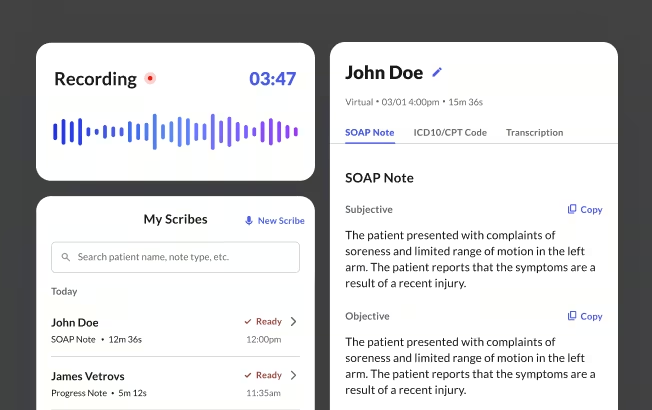
Commure Scribe is the AI version of what a human virtual scribe does. The Capture, Edit, Finalize workflow drafts a structured note from the visit with suggested ICD-10 and CPT codes, then the clinician reviews and finalizes. The clinician stays present in the room and reviews a finished draft, and often says the AI caught things they would have missed.
For practices weighing a human virtual scribe against an AI, the comparison comes down to accuracy, oversight, and audio handling. Transcription accuracy is 99.4%, the clinician finalizes every note, and 91% of providers report less fatigue. Audio is encrypted, stored onshore, never used for AI training, with retention one year active and six years archived per HIPAA minimums.
For EHR fit, solo and small practices use copy-paste into the existing EHR and group practices use one-click sync across 60+ integrations, including eClinicalWorks, Elation, and Cerbo . A 7-day trial with no credit card lets a single clinician evaluate Commure Scribe on real visits. See Commure Scribe pricing for plan details.
This article is for informational and educational purposes only, does not constitute legal, medical, or professional advice, and does not guarantee any specific outcome.
Frequently Asked Questions
A virtual medical scribe is a trained person who joins your visit by audio or video. The scribe writes the note from offsite, either live during the visit or from a recording afterward. An AI medical scribe is a separate category, because it is software rather than a person.
An in-room scribe is physically present during visits and types the note in person. A virtual medical scribe is a trained human connected to the encounter from a different location, live or asynchronously. AI medical scribes are software and a separate category.
Accuracy varies by visit type and the scribe's training. Real-world studies report high satisfaction with note quality. Review every note before signing, whether a person or an AI tool drafted it.
Compliance depends on the vendor. Look for a business associate agreement and audio encrypted in transit and at rest. Confirm restricted access to stored audio, transcript deletion controls, and whether audio is used for AI model training.
Run a one- to two-week trial with a single clinician across the practice's typical visit mix. Review edit volume per note and time-to-close.
Sources
- van Buchem MM, Boosman H, Bauer MP, et al. The digital scribe in clinical practice: a scoping review and research agenda. npj Digital Medicine. 2021;4:57. https://www.nature.com/articles/s41746-021-00432-5
- Rotenstein L, Melnick ER, Iannaccone C, et al. Virtual scribes and physician time spent on electronic health records. JAMA Network Open. 2024;7(5):e2413140. https://pmc.ncbi.nlm.nih.gov/articles/PMC11127114/
- Stephens J, Kieber-Emmons AM, Johnson M, Greenberg GM. Implementation of a virtual asynchronous scribe program to reduce physician burnout. Journal of Healthcare Management. 2022;67(6):425-435. https://pmc.ncbi.nlm.nih.gov/articles/PMC9640286/
- Olson KD, Meeker D, Troup M, et al. Use of ambient AI scribes to reduce administrative burden and professional burnout. JAMA Network Open. 2025;8(10):e2534976. https://pmc.ncbi.nlm.nih.gov/articles/PMC12492056/
- Hudelson C, Gunderson MA, Pestka D, et al. Selection and implementation of virtual scribe solutions to reduce documentation burden: a mixed methods pilot. AMIA Joint Summits on Translational Science Proceedings. 2024;2024:230-238. https://pmc.ncbi.nlm.nih.gov/articles/PMC11141854/
- Gidwani R, Nguyen C, Kofoed A, et al. Impact of scribes on physician satisfaction, patient satisfaction, and charting efficiency: a randomized controlled trial. Annals of Family Medicine. 2017;15(5):427-433. https://pmc.ncbi.nlm.nih.gov/articles/PMC5593725/
- Kuiper LB, Watson AJ, Eckerson AC, et al. Adoption of AI-based scribes in telemedicine: provider attitudes and insights. Telemedicine and e-Health. 2026 Feb 18 [Epub ahead of print]. https://pubmed.ncbi.nlm.nih.gov/41706444/
- Apathy NC, Holmgren AJ, Cross DA. Physician EHR time and visit volume following adoption of team-based documentation support. JAMA Internal Medicine. 2024;184(10):1212-1221. https://jamanetwork.com/journals/jamainternalmedicine/fullarticle/2822382