



Mental Status Template: Free Printable Guide
How to build, use, and standardize MSE documentation across your practice
Written by the Commure Scribe Team
Published: June 25, 2026
•
8 min read
Updated June 25, 2026
A mental status template is a structured form for mental status exam (MSE) findings. Clinicians fill it in at each psychiatric or behavioral care visit. Its first domains cover appearance, attitude, behavior, speech, mood and affect. The template then moves through thought process, thought content, perceptions, cognition, insight and judgment. A risk section records suicidal ideation, homicidal ideation, self-harm and the safety plan. A final section notes changes from the prior visit.
What You Need to Know About Mental Status Templates
- Psychiatric and behavioral care visits need some form of mental status exam (MSE) documentation to support billing and clinical decision-making. Full MSE for initial evaluations, focused update for follow-ups.²
- The MSE covers appearance, attitude, behavior, speech, mood, affect, thought process, thought content, perceptions, cognition, insight, and judgment.⁸
- A structured template with domain-specific prompts makes it faster to document real findings than to start from scratch each time.
A mental status template is the structured form you use to document MSE findings at each visit. (For a broader walkthrough of the exam itself, see the mental state assessment guide.) This page includes a blank mental status template you can download as a printable .docx, a filled-in example showing what strong documentation looks like, and domain-by-domain guidance on what to write in each field.
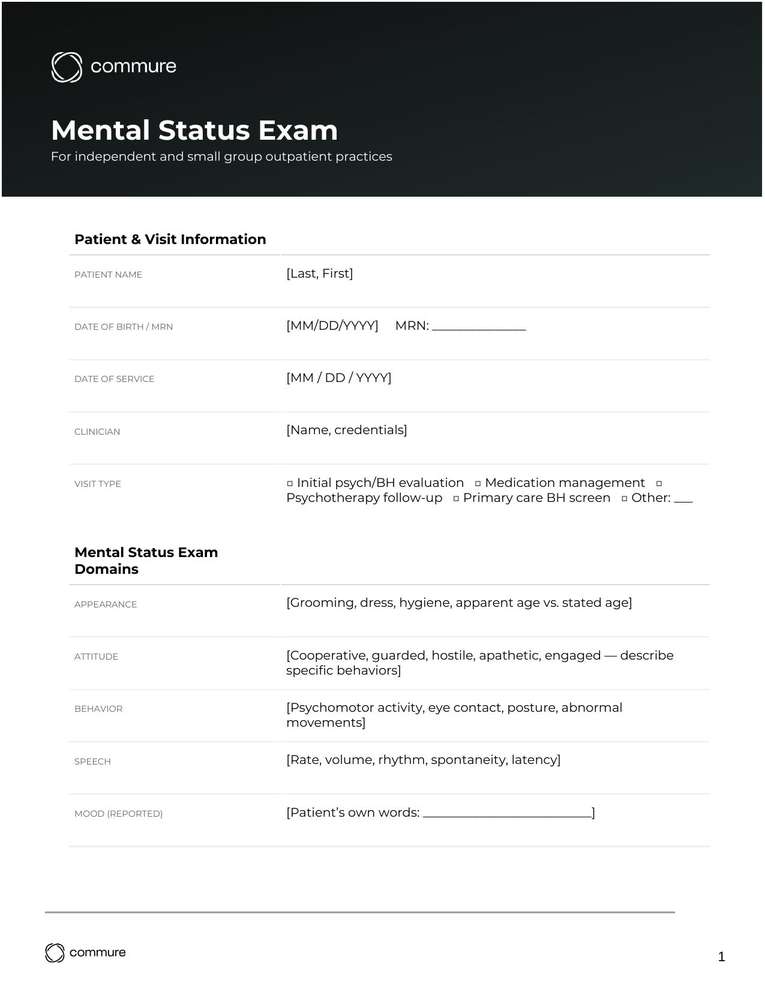
Mental status template (blank form)
**The template below covers the core MSE domains outlined in URMC's psychiatric documentation requirements.**²⁸ [Download the printable .docx version] or copy the list below into your EHR.
- Appearance: Grooming, dress, hygiene, apparent vs. stated age
- Attitude: Cooperative, guarded, hostile, apathetic, engaged
- Behavior: Psychomotor agitation/retardation, eye contact, posture, mannerisms
- Speech: Rate, rhythm, volume, tone, latency, spontaneity
- Mood: Patient's stated mood in their own words
- Affect: Range, reactivity, congruence with mood, intensity
- Thought Process: Linear, goal-directed, tangential, circumstantial, flight of ideas
- Thought Content: Delusions, obsessions, phobias, preoccupations
- Perceptions: Hallucinations (auditory, visual, tactile), illusions, derealization
- Cognition: Orientation (x4), attention, concentration, memory, insight, judgment
Risk assessment
- Suicidal Ideation: Active/passive, plan, intent, means, protective factors
- Homicidal Ideation: Active/passive, identified target, plan
- Self-Harm: Current behaviors, history, urges
- Safety Plan: In place (Y/N), reviewed this visit (Y/N)
Changes from prior visit
- Domains Changed: List any domains with new or changed findings since last visit
- Clinical Summary: Brief narrative linking changes to diagnosis and treatment plan
Download the printable mental status template (.docx)
How to document each MSE domain
Write what you see and hear, not what you think it means. The most common documentation mistake is summarizing rather than describing. Here's what the difference looks like across the domains clinicians tend to shortcut:
Appearance. Vague: "Appearance normal." Specific: "Well-groomed, dressed appropriately for the weather, appears stated age, no visible injuries." The specific version is defensible because every descriptor is something you directly observed.⁸
Attitude and behavior. These two domains overlap, and clinicians often collapse them into one line. Keep them separate. Attitude is the patient's stance toward you and the visit (cooperative, guarded, dismissive). Behavior is what their body is doing (psychomotor agitation, poor eye contact, fidgeting, pacing). An engaged attitude with psychomotor restlessness tells a different clinical story than a guarded attitude with calm posture.
Speech. Rate, rhythm, volume, and spontaneity are the four dimensions that matter. Note what stands out. "Pressured speech with increased volume" is useful. "Speech normal" doesn't give a future clinician anything to compare against.
Mood and affect. Mood is what the patient tells you. Affect is what you see. Charting both separately, with context, is what makes the MSE clinically useful.⁸ Vague: "Mood euthymic, affect appropriate." Specific: "Patient reports mood as 'better than last month.' Affect bright and reactive when discussing return to work, constricted when discussing custody dispute."
Thought process and thought content. Process is how the patient thinks (linear, tangential, circumstantial). Content is what they're thinking about (delusions, obsessions, preoccupations). A linear thought process with paranoid content is a very different presentation than a tangential process with no abnormal content. Document both.
Thought content. Vague: "No abnormal thought content." Specific: "Denies SI/HI. Reports persistent worry about job performance but no obsessive quality. No paranoid ideation." The specific version documents what you screened for, not just that you found nothing.
Perceptions. Ask about and document each modality: auditory, visual, tactile. "Denies auditory and visual hallucinations, no illusions" is more defensible than "Perceptions WNL" because it shows you actually asked. (If you're doing a full psychiatric review of systems, perceptions get their own section there too.)
Cognition. Vague: "Cognition intact." Specific: "Oriented x4. Attention sustained throughout 45-minute session. Able to recall three medication changes discussed at prior visit." The specific version gives a future clinician something to compare against.
Insight and judgment. These are clinical impressions, not patient-reported data. Insight is whether the patient understands their condition and need for treatment. Judgment is their capacity to make reasonable decisions. "Partial insight — acknowledges depression but attributes it entirely to situational stressors" is more useful than "Insight fair."
Keep the risk section inside the MSE, not as a separate note. SI, HI, and safety concerns are part of the mental status exam itself.⁸ When risk lives inside the mental status template, you don't have to remember to chart it separately.
The "Changes from prior visit" section is the most important part of the template. When you note which domains shifted and why, the chart shows you actually assessed the patient at this visit. It ties your MSE findings to the diagnosis and treatment plan, which is what both clinical reviewers and payers want to see.
Sample completed mental status template
Here's what the mental status template looks like filled in for a real visit. This example is a follow-up for a 38-year-old patient with MDD, six weeks into sertraline 100mg.
- Appearance: Well-groomed, casual dress appropriate for setting, appears stated age
- Attitude: Cooperative, engaged, good eye contact throughout
- Behavior: No psychomotor agitation or retardation, sits comfortably
- Speech: Normal rate and volume, spontaneous
- Mood: "Better. Not great, but better."
- Affect: Brighter than prior visit. Reactive, congruent with stated mood. Tearful briefly when discussing mother's health
- Thought Process: Linear, goal-directed
- Thought Content: Worry about mother's cancer diagnosis. No obsessive quality. No paranoid ideation
- Perceptions: Denies hallucinations, no illusions
- Cognition: Oriented x4. Recalled dosage change from last visit. Attention sustained throughout session
Risk:
- SI/HI: Denies suicidal ideation, denies homicidal ideation
- Self-Harm: No current behaviors or urges
- Safety Plan: In place, reviewed this visit
Changes from prior visit:
- Domains Changed: Mood improved from "terrible" to "better." Affect brighter, more reactive. Sleep improved from 4 to 6 hours. New stressor: mother's diagnosis
- Clinical Summary: Partial response to sertraline at 6 weeks. Mood and affect trending positive. New psychosocial stressor may limit further gains. Continue current dose, reassess in 4 weeks
How do you adapt the template by visit type?
You cover the same core domains every time, but you lean into different ones depending on the visit.
Med checks: focus on mood, affect, thought content, and cognition. You're answering one clinical question: is the medication working? These four domains are where treatment response shows up. If a patient started an SSRI six weeks ago, you need to know whether mood actually shifted, whether affect is more reactive, whether cognitive fog lifted, and whether any new thought content appeared (intrusive thoughts, SI as a side effect). A psychiatric SOAP note uses this same focused approach. Key domains to detail:
- Mood vs. prior visit
- Affect reactivity
- Suicidal ideation screening⁸
Therapy follow-ups: focus on behavior, thought process, and insight. Your clinical question here is different: is the patient engaging with the work and making progress? Behavior shows engagement (participating, making eye contact, completing homework). Thought process shows cognitive flexibility (moving from rigid patterns to more adaptive ones). Insight shows whether self-awareness is growing. The MSE section of your psychotherapy notes should capture that trajectory. A concise update might cover:
- Orientation
- Session engagement
- Denied suicidal ideation
- Congruent affect⁴
Primary care behavioral screens: keep the template lean. You're screening, not treating. You need enough MSE to catch red flags and support the billing code. (A progress note template can house the brief MSE alongside vitals and plan.) Orientation rules out delirium. Mood/affect catches depression and anxiety. Suicidality screening is a safety floor. Cognition flags decline that may need referral. Cover the basics:
- Orientation
- Mood/affect
- Suicidality screening
- Cognition²
When you're billing psychiatric services, Centers for Medicare & Medicaid Services (CMS) expects MSE documentation regardless of your specialty.²
What does CMS expect in MSE documentation?
For a psychiatric diagnostic evaluation, CMS expects your note to include:
- Mental status examination
- Diagnosis
- Treatment plan
- Progress toward goals²
Follow-up psychotherapy visits (90832–90838) have a different clinical documentation profile: focused mental status, diagnosis, symptoms, functional status, and progress.² The LCD backing this (L33252) reinforces that a documented MSE supports medical need.³ For the initial diagnostic evaluation, a psych eval template aligned with American Psychiatric Association guidelines and the same LCD lays out each required section.
Your institution or payer may want more. Some systems want MSE findings tied directly to the diagnosis and treatment plan, not sitting as standalone observations.¹ Others want an MSE update at every visit, even if it's just to confirm nothing changed.⁴ The pattern is the same everywhere: your mental status template should produce notes where the clinical thinking is visible, not just the checkboxes.
How can your practice standardize MSE documentation?
Start with a single mental status template everyone uses. Pair it with your biopsychosocial assessment template for intakes. The MSE is one piece of that broader evaluation. The template should cover the core MSE domains with prompts, a risk section, and visit-type guidance. When the whole practice charts from the same template, you can actually review note quality. Pull a sample and look for domains being skipped, risk fields left blank, or boilerplate replacing real findings.
Scale the review process to your size. If you're solo, review your own documentation once a quarter. In a group, assign a clinical lead to own the template and update it when standards change. Larger groups can version-control templates in the EHR and track who's using them.¹
An ambient AI scribe can also help here. It generates visit-specific MSE language from the clinical conversation, so the note reflects what actually happened rather than a default template.⁵
How Commure Scribe supports mental status documentation
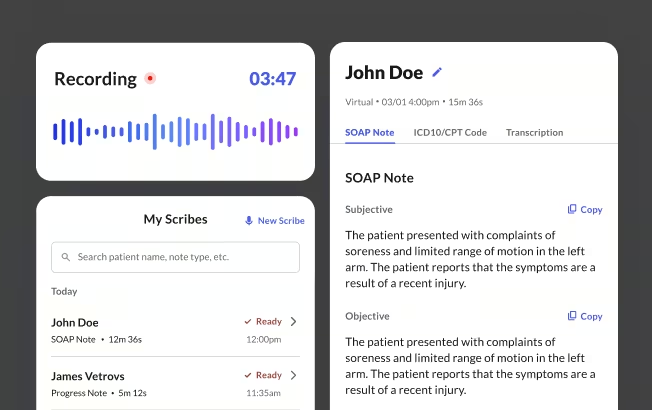
Commure Scribe generates visit-specific mental status notes from each clinical conversation. You review and approve the note before it goes into the chart. The tool includes specialty-specific templates and a custom template builder, so you can set up MSE documentation to match how you actually chart. Commure Scribe produces structured notes with 99.4% transcript accuracy, and 90%+ of providers using it reduce their charting time and digital fatigue. For a closer look at how it handles MSE and risk documentation in therapy and psychiatry workflows, see the behavioral health page.
This article is for informational and educational purposes only and does not constitute medical, legal, or compliance advice. Consult a qualified professional for guidance specific to your practice.
Mental Status Template Download
Download a copy of this template
Thanks! Your mental status template is ready.
Click below to download.

Frequently Asked Questions
The full MSE covers all the core domains and you typically do it at intake. A mental status update is a focused check during follow-ups. You're documenting what changed and confirming what didn't. Both use the same mental status template, but updates don't need the same depth when findings are stable.⁴
Every visit with a psychiatric or behavioral care piece should include some form of MSE update, even if it's brief. Some institutions specify periodic updates just to confirm no change.⁴ CMS expects the MSE to reflect the current encounter for payment.²
The structure stays the same. The content should reflect the current visit. A mental status template with structured fields keeps your notes consistent. But the observations in those fields need to match what actually happened at this encounter.
A typical unremarkable MSE would note: Alert and oriented to person, place, time, and situation; Grooming and dress appropriate; Cooperative attitude; Normal speech rate and volume; Euthymic mood with matching, reactive affect; Linear, goal-directed thought process; No delusions, no SI/HI; Cognition intact; Insight and judgment fair to good⁸.
They generate the MSE from what's said in the conversation, but you sign off on every note. Accuracy depends on transcript quality and the clinical model behind the tool. Reviewing before you finalize is the whole point.⁵
Sources
- California Mental Health Services Authority. (2025, April 24). SMHS clinical documentation guide. CalMHSA. https://www.calmhsa.org/wp-content/uploads/2025/04/SMHS-Clinical-Documentation-Guide-4.25.2025.pdf
- Centers for Medicare & Medicaid Services. (2014). Outpatient psychiatry & psychology services [Fact sheet]. CMS. https://downloads.cms.gov/medicare-coverage-database/lcd_attachments/31887_33/Outpatient_Psych_Fact_Sheet09.18.14.pdf
- Centers for Medicare & Medicaid Services. (2015, January 9). Psychiatric diagnostic evaluation and psychotherapy services (LCD L33252). CMS Medicare Coverage Database. https://www.cms.gov/medicare-coverage-database/view/lcd.aspx?lcdid=33252&ver=29&bc=0
- Columbia University Counseling and Psychological Services. (n.d.). Patient electronic health record policy manual. Columbia University. https://intranet.health.columbia.edu/sites/default/files/content/Documents/Policies/CPS-EHR%202%20Patient%20Electronic%20Health%20Records.pdf
- MedicalXpress. (2025, August 20). Ambient documentation technologies reduce physician burnout. MedicalXpress. https://medicalxpress.com/news/2025-08-ambient-documentation-technologies-physician-burnout.html
- NASW Massachusetts Chapter. (2025, October 30). Mental status examination and documentation. National Association of Social Workers, Massachusetts Chapter. https://www.naswma.org/page/180
- U.S. Department of Justice, Civil Rights Division. (2022, December 19). MDOC final agreement. U.S. Department of Justice. https://www.justice.gov/d9/2022-12/ma_doc_agreement_0.pdf
- University of Rochester Medical Center, Compliance Office. (2012). Outpatient psychiatric services — documentation requirements. URMC. https://www.urmc.rochester.edu/medialibraries/urmcmedia/compliance-office/education-tools/compliance/documents/psychiatricsvcs-documentationrequirements0212.pdf