



Biopsychosocial Assessment Template: Free Download for Clinicians
Guide and free biopsychosocial assessment template
Written by the Commure Scribe Team
Published: May 28, 2026
•
8 min read
Updated May 28, 2026
A biopsychosocial assessment template is a structured intake form. It captures biological, psychological and social data in one record. The header usually carries patient and visit IDs and provider credentials. The body covers the three clinical domains, a risk screen and a safety plan when risk is positive. It closes with a diagnostic impression, a level-of-care plan and a psychotherapy notes notice. Therapists, social workers, counselors, psychiatrists and primary care clinicians use it at intake.
What You Need to Know About Biopsychosocial Assessment Templates
- A biopsychosocial assessment template is a structured intake form that captures biological, psychological, and social data in one record¹.
- Mental health intake templates typically include risk screening, a safety plan, and a psychotherapy notes notice consistent with HIPAA mental health guidance (45 CFR 164.508(a)(2))⁶.
- Use this free downloadable biopsychosocial assessment template with a companion PHQ-9 screening form to start intake after your compliance officer review.
What Is a Biopsychosocial Assessment?
Outpatient clinicians use these forms to pull medical, mental health, and social data into one intake record¹. Licensed therapists, social workers, counselors, psychiatrists, and primary care clinicians all perform these assessments during intake¹ ⁴. The model traces back to George Engel's 1977 paper in Science². Engel argued clinicians need more than biology to care for patients². Community mental health clinics, university counseling services, primary care behavioral teams, and state mental health systems all rely on it today¹ ³ ⁴.
The scope is wider than a SOAP note. A SOAP note covers one visit. A biopsychosocial assessment tracks patterns across many. It maps risk factors, support systems, substance use, prior diagnoses, and social conditions⁴. These patterns shape treatment choices. Many health systems and state agencies require one at admission, at level-of-care changes, and at set review intervals³ ⁴.
A good biopsychosocial assessment template covers four needs: section structure, in-visit workflow, mental-health-specific compliance, and a path to less charting time.
Download the Biopsychosocial Assessment Template
Note: This template is for informational purposes only and does not constitute legal or medical advice. Have your compliance, privacy, risk, or legal contact (internal or external) review it before clinical use.
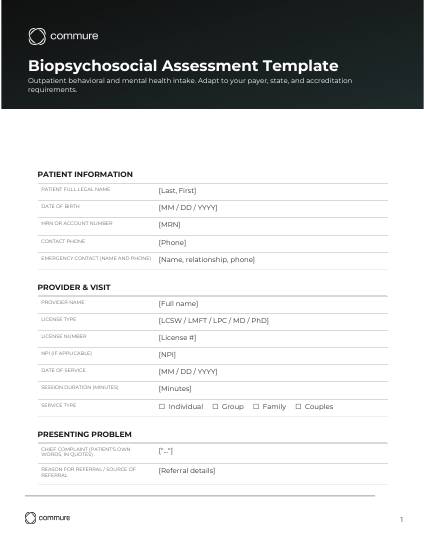
- Download the free Biopsychosocial Assessment Template: fully editable Word document you can customize for your practice.
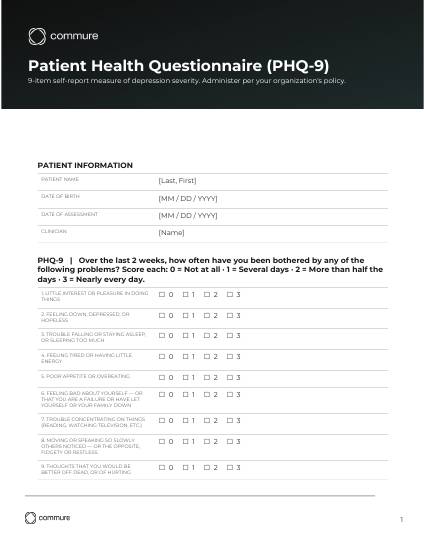
- Download the PHQ-9 Depression Screening Form: complete 9-item depression screener with scoring guide (free for clinical use).
Why Do Outpatient Clinicians Need a Structured Biopsychosocial Assessment Template?
A structured biopsychosocial assessment template cuts charting time by forcing every required field into one place, in one order. Free-text notes leave sections to memory. Memory fails at 5 pm on visit ten.
Institutional and state mental health forms include explicit domain checklists for exactly this reason³ ⁴.
Charting load is the dominant after-hours burden in outpatient care. A 2016 time-and-motion study found physicians in four specialties spent nearly two hours on the EHR for every hour of direct patient care⁵. Documentation burden remains a major challenge.
Mental health clinicians often work in solo or small group practice without scribe support. They carry the same documentation weight without the staffing help. A biopsychosocial assessment written from scratch adds to that load, especially when the clinician has to recall each required section mid-note.
A structured biopsychosocial assessment template solves four problems in one form:
- Completeness. Every domain (biological, psychological, social, risk, plan) becomes a required field. The clinician cannot skip one without noticing¹.
- Consistency. In a group practice, every clinician documents the same intake the same way¹. Coverage clinicians, auditors, and billing staff all know where to find each data element.
- Defensibility. Many state mental health programs and health systems require risk and safety plan sections at intake. A template surfaces them every time³.
- Throughput. A form with pre-built sections cuts the time from visit end to finalized note. Clinicians can finish the assessment during or right after the visit.
Templates also make it possible to layer in AI help later. A free-text page gives AI nothing to map to. A structured biopsychosocial assessment template gives it a target for every domain.
What Should a Biopsychosocial Assessment Template Include?
A comprehensive biopsychosocial assessment template typically pulls these elements into one intake form¹ ³. They cover identifiers, provider credentials, three clinical domains, risk, safety plan, diagnosis, plan, and consent notes. Each field maps to a question the clinician can ask in a normal intake conversation. Adapt and augment to match your payer, accreditation, and state requirements.
Patient and visit identifiers:
- Patient name, date of birth, MRN. Captures who the record belongs to. Makes chart retrieval and insurance matching possible¹.
- Date of service, session duration, service type. Required for billing time-based codes and often reviewed in payer audits³.
Provider credentials:
- Provider name, license type, license number, signature, date. Tells the reader who is clinically responsible for the note. Required by state licensing boards and most payers³.
The three clinical domains (the core of any biopsychosocial assessment):
- Biological. Captures medical history, current medications, substance use, and family medical history. Flags drug clashes with psychotropic prescribing and medical causes of psychiatric symptoms¹.
- Psychological. Captures presenting problem, mental health history, current symptoms, and a brief mental status exam. Anchors the diagnostic impression¹.
- Social. Captures relationships, housing, employment, legal issues, support systems, and social determinants of health. Identifies factors that shape the treatment plan¹.
Risk and safety:
- Risk screen. Covers suicidal ideation, homicidal ideation, and self-harm history. Many state mental health agencies and health systems require risk screening at intake; check your state and facility requirements¹ ³.
- Safety plan. Present when risk is positive. Documents steps the patient will take during a crisis, including warning signs, coping strategies, and contacts³.
Clinical impression and plan:
- Diagnostic impression. One or more Diagnostic and Statistical Manual of Mental Disorders, Fifth Edition, Text Revision (DSM-5-TR) or ICD-10-CM codes with the clinical reasoning. ICD-10-CM codes are updated annually by Centers for Medicare & Medicaid Services (CMS), effective October 1; use current codes for billing and documentation³.
- Level of care or plan. Outpatient therapy frequency, group participation, medication referral, or referral to higher level of care³. Carry this plan into a mental health treatment plan template that sets specific, measurable, achievable, relevant, and time-bound (SMART) goals.
Consent and privacy:
- Consent for treatment reference. Confirms the patient signed a separate consent form. Does not re-capture the full consent inside the assessment¹.
- Psychotherapy notes notice. A short line stating that the assessment is part of the medical record and is distinct from psychotherapy notes. Psychotherapy notes are defined narrowly at 45 CFR 164.501 and receive additional protection under 45 CFR 164.508(a)(2) when kept separate from the rest of the record⁶.
How Do You Fill Out a Biopsychosocial Assessment Template Step by Step?
The goal is to complete the biopsychosocial assessment template while the patient is still in the room. Working top to bottom keeps the flow natural for the patient and cuts after-hours charting.
Before the visit (1–2 minutes):
- Pull identifiers from the EHR. Patient name, date of birth, medical record number (MRN), and insurance. Confirm with the patient to catch errors.
- Set service type. Mark individual, group, or family, plus session duration for time-based billing codes³.
Presenting problem:
- Use the patient's own words. Record the chief complaint in quotes. "I can't sleep" carries more clinical signal than "insomnia".
- Tie history to a timeline. Note onset, course, triggers, and what the patient has already tried¹.
Biological domain:
- Confirm medications with the pharmacy record. Include OTC, supplements, and substances of misuse¹.
- Record substance use in standard units. Drinks per week, days per week, and years of use beat "social drinker" for clinical value¹.
Psychological domain:
- Screen with validated instruments. Patient Health Questionnaire-9 (PHQ-9), Generalized Anxiety Disorder-7 (GAD-7), and AUDIT-C are validated tools available for clinical use at no cost⁷. For licensed tools like the Beck Depression Inventory or MMPI-2, use them only with a valid license.
- Record a brief mental status exam. Appearance, mood, affect, thought process, and cognition¹.
Social domain:
- Capture current living, not historical living. Social context changes. Do not copy-forward this section from a prior visit¹.
- Document social determinants directly. Housing stability, food security, transportation, and legal status affect treatment adherence¹.
Risk, diagnosis, plan, and signature:
- Routinely screen for SI/HI/self-harm at intake and at clinically relevant visits. Document the screen even when negative, consistent with your organization's policy¹ ³.
- If significant risk is present, develop or update a safety plan during the visit when clinically indicated. Reference the plan here³.
- Record the diagnostic impression with DSM-5-TR or ICD-10-CM codes. Use current code sets and effective dates from your payers and regulators³.
- Sign and date before leaving the room. Unsigned notes accrue as inbox work.
What Compliance Rules Apply to Biopsychosocial Documentation?
A biopsychosocial assessment is a federally protected mental health record. Two federal rules set the floor. State laws often add more.
HIPAA Privacy Rule (45 CFR 164.502–514):
- HIPAA's minimum necessary standard applies to payment and health care operations, not to treatment (45 CFR 164.502(b)(2))⁶. Clinicians may collect information reasonably needed for treatment.
- Release mental health records only with a valid HIPAA authorization, unless a treatment, payment, or operations exception applies (45 CFR 164.508)⁶.
- Retain HIPAA compliance documentation for six years (45 CFR 164.530(j))⁶. Medical record retention is governed by state law and typically runs longer; check your state requirements.
Psychotherapy notes (45 CFR 164.508(a)(2)):
- Psychotherapy notes are defined narrowly at 45 CFR 164.501 and refer to a clinician's process notes kept separately from the rest of the record. When kept separate, they receive additional protection and require separate patient authorization for release⁶.
- The biopsychosocial assessment itself is part of the medical record. It is not a psychotherapy note. State this on the template so staff know the difference⁶. Ongoing therapy notes follow the same split, with progress notes in the medical record and psychotherapy notes kept apart.
42 CFR Part 2 (substance use disorder records):
- When care is provided by a Part 2 program or involves Part 2-protected substance use disorder records, 42 CFR Part 2 may apply. The rule was revised in February 2024 (enforced February 16, 2026) and now aligns more closely with HIPAA, while keeping unique consent requirements⁸.
- Part 2 includes specific consent and notice requirements for certain disclosures and redisclosures⁸.
- Part 2 limits the use of substance use disorder records in legal proceedings without patient consent or court order⁸. Consult legal counsel for current requirements under the 2024 revision.
State law:
- Many states go beyond HIPAA for mental health records. Some require separate consent for release of mental health records¹.
- Age of consent for mental health treatment varies by state. Minor consent rules change by condition and by state.
- Check your state's specific requirements. Have your compliance, privacy, risk, or legal contact (internal or external) review the biopsychosocial assessment template for local rules.
CMS documentation support (billing-adjacent):
- Documentation must support the level of service billed under current CMS Evaluation and Management documentation guidelines⁹.
- Sign the note the same day. Late entries need an amendment note with a date⁹.
This article is for informational purposes only. It does not give legal advice. Have your compliance, privacy, risk, or legal contact (internal or external) review the biopsychosocial assessment template before using it in a clinical setting.
How Can Ambient AI Fill a Biopsychosocial Assessment Template During the Visit?
Ambient AI medical scribes listen to the intake conversation and write a draft note in the background. The clinician reviews the draft and signs. The setup maps well to a biopsychosocial assessment template because the domains follow the normal flow of an intake interview.
A well-built AI scribe can:
- Sort the conversation into the three domains. Medical history into biological. Symptoms into psychological. Living situation into social.
- Capture the patient's own words. Quoted chief complaint flows into the presenting problem field.
- Flag incomplete sections before the clinician signs.
- Draft a plain-English summary so the clinician edits rather than starts from scratch.
Some fields must stay with the clinician:
- Risk assessment. The clinician asks SI/HI/self-harm questions and records the answer directly.
- Safety plan. Must be co-written with the patient, not generated from the transcript.
- Diagnostic impression. The AI can suggest. The clinician assigns the final DSM-5 or ICD-10 code.
What to look for in an ambient AI tool for mental health intake:
- BAA-level HIPAA compliance with secure storage and no third-party data sharing. See our guide to HIPAA-compliant AI scribes for what to verify.
- EHR integration so the draft drops into the practice's existing biopsychosocial assessment template.
- Structured output by domain. A free-text blob is not an upgrade over dictation.
- Mental health specialty support. Generic primary care templates miss risk, safety plan, and domain structure.
Used well, an ambient AI scribe paired with a biopsychosocial assessment template can move documentation from a post-visit chore to an in-visit review. Clinicians finish the note while the patient is still in the chair, rather than after the last visit of the day.
For a ranked breakdown of AI medical scribe tools by practice size and specialty, see the best AI medical scribes guide.
How Commure Scribe Fills a Biopsychosocial Assessment Template
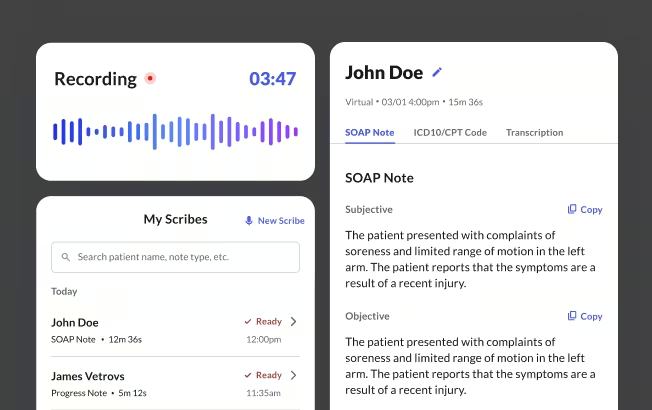
Commure Scribe is an ambient AI medical scribe used by 75,000+ clinicians across 25 specialties, including Behavioral Health. It listens during the intake conversation and drafts a structured note that maps to each section of a biopsychosocial assessment template. The clinician reviews, edits, and finalizes. The workflow is Capture → Edit → Finalize.
Within seconds of tapping End Recording, a structured note appears with the biological, psychological, and social sections populated from the conversation. The note captures the full clinical context of the encounter, along with suggested ICD-10 and CPT codes in a separate tab for review. 90%+ of providers reduce clinical documentation time and digital fatigue. 91% of providers report feeling less fatigued.
Commure Scribe is HIPAA compliant and System and Organization Controls 2 (SOC 2) certified, with onshore data storage. Audio is encrypted in transit and at rest, is not used for AI training, and is retained per state and federal medical record requirements. It supports 90 languages with automatic detection, on any device, including mobile, tablet, and desktop.
Independent and small practices use copy/paste into any web-based EHR. Medium and large group practices can use write-back integration with 69 EHR platforms to push the biopsychosocial assessment template directly into the practice's existing template. Specialty-specific templates are available alongside a custom template builder, so the biopsychosocial assessment template structure matches what the practice already uses.
The ambient capture surfaces details from a long intake that memory alone can lose, then routes the structured note through the clinician's review before it enters the chart.
See how Commure Scribe automates biopsychosocial assessment documentation for outpatient mental health practices. Start a 7-day free trial.
Biopsychosocial Assessment Template Download
Download a copy of this template
Thanks! Your biopsychosocial assessment template is ready.
Click below to download.

Sources
- Wade DT, Halligan PW. The biopsychosocial model of illness: a model whose time has come. Clinical Rehabilitation. 2017;31(8):995-1004. https://pubmed.ncbi.nlm.nih.gov/28730890/
- Engel GL. The need for a new medical model: a challenge for biomedicine. Science. 1977;196(4286):129-136. https://pubmed.ncbi.nlm.nih.gov/847460/
- Ohio Department of Rehabilitation and Correction. Mental Health Biopsychosocial Assessment (DRC5309). https://dam.assets.ohio.gov/image/upload/drc.ohio.gov/MyOhio/Policies/Forms/DRC5309.pdf
- Borrell-Carrió F, Suchman AL, Epstein RM. The biopsychosocial model 25 years later: principles, practice, and scientific inquiry. Ann Fam Med. 2004;2(6):576-582. https://pubmed.ncbi.nlm.nih.gov/15576544/
- Sinsky C, Colligan L, Li L, et al. Allocation of Physician Time in Ambulatory Practice: A Time and Motion Study in 4 Specialties. Ann Intern Med. 2016;165(11):753-760. https://pubmed.ncbi.nlm.nih.gov/27595430/
- U.S. Code of Federal Regulations. Title 45, Part 164 — Security and Privacy (HIPAA Privacy Rule, including 45 CFR 164.501, 164.502, 164.508, and 164.530). https://www.ecfr.gov/current/title-45/subtitle-A/subchapter-C/part-164
- Kroenke K, Spitzer RL, Williams JB. The PHQ-9: Validity of a brief depression severity measure. J Gen Intern Med. 2001;16(9):606-613. https://pubmed.ncbi.nlm.nih.gov/11556941/
- U.S. Code of Federal Regulations. Title 42, Chapter I, Subchapter A, Part 2 — Confidentiality of Substance Use Disorder Patient Records (42 CFR Part 2; 2024 Final Rule, enforced February 16, 2026). https://www.ecfr.gov/current/title-42/chapter-I/subchapter-A/part-2
- Centers for Medicare & Medicaid Services. Evaluation and Management Services Guide (2021 revisions). https://www.cms.gov/Outreach-and-Education/Medicare-Learning-Network-MLN/MLNProducts/Downloads/eval-mgmt-serv-guide-ICN006764.pdf