



Client Feedback Form: Free Template for Medical Practices
A practical guide for independent and small group practices on what to include, how to deploy, and how to use patient feedback to improve care.
Written by the Commure Scribe Team
Published: June 26, 2026
•
4 min read
Updated June 26, 2026
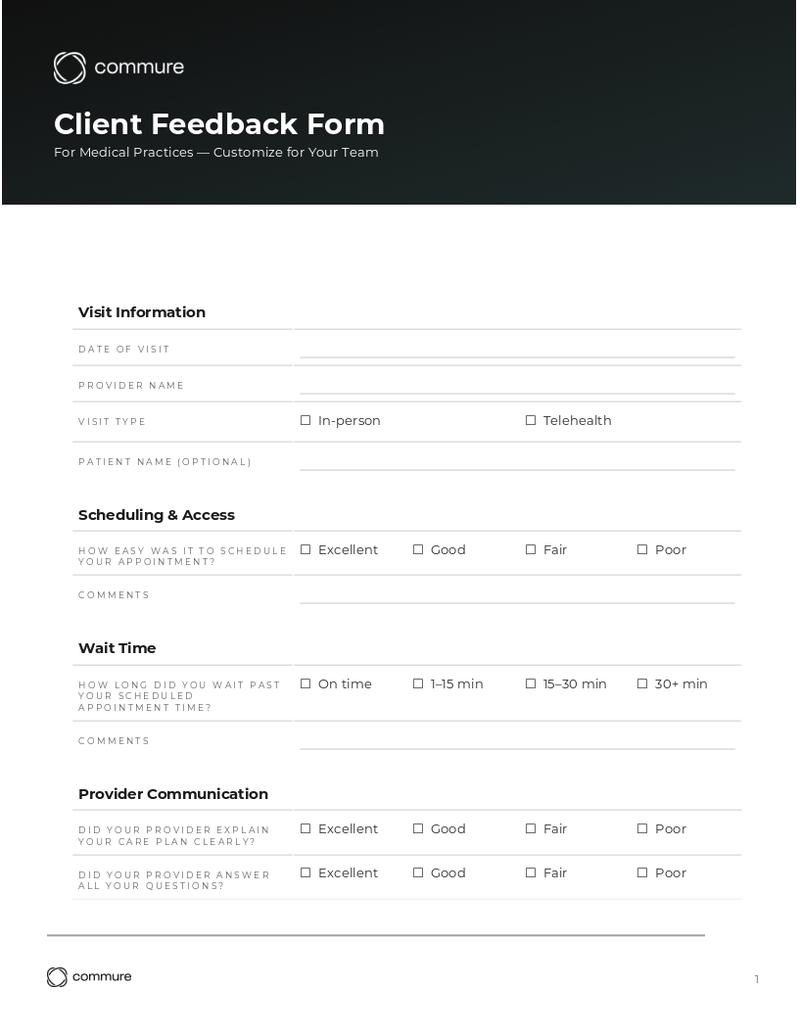
A client feedback form is a short patient survey sent after a visit. It gives patients a private channel to raise concerns before they post online. This template covers visit information, scheduling and access, wait time and provider communication. It also rates staff and front office, plus overall satisfaction on a 0 to 10 scale. An open comment field comes last. Independent and small group practices use it to catch problems early and coach staff.
What You Need to Know About Client Feedback Forms
- A client feedback form is a short survey that captures patient impressions after a visit. Most practices use it to catch problems before they become online reviews.
- According to Tebra's 2025 Patient Perspectives survey, 78% of patients say they would return to a practice that responded to their negative online review. Most practices have no consistent system for collecting that feedback.⁴
- Use this template as your starting point. It covers all six sections of a well-built patient experience form and includes guidance on HIPAA-aware data handling.
Download the Free Client Feedback Form Template
This template is provided for informational and educational purposes only. It does not constitute legal or compliance advice. Requirements vary by state and practice type. Consult a qualified healthcare attorney or compliance officer for guidance specific to your practice.
What Is a Client Feedback Form and When Does Your Practice Need One?
A client feedback form is a short patient survey sent after a visit. You need one when you have no reliable way to know a patient left unhappy before they post about it online. Most practices find out from a one-star review. A client feedback form gives patients a private channel to share concerns before they go public.
Independent and small group practices use a client feedback form for two main jobs. The first is catching problems early. The second is gathering data to coach staff and improve operations. A 2023 study of an outpatient clinic found that applying structured improvement processes to patient feedback produced measurable gains in patient experience scores.³
Short forms work best. Five to eight focused questions get more responses than a 20-question survey. Patients fill out short forms at checkout or right after a visit. They skip long ones.
What to Include in Your Client Feedback Form
A well-built form covers six areas. Each one surfaces a different type of problem.
1. Visit information
Fields: [Date of Visit], [Provider Name], [Visit Type (in-person or telehealth)]. You may also include an optional [Patient Name / Contact] field if you want to follow up directly. Mark it optional. Named responses become PHI. See the data handling section below.
Put this at the top. It lets you filter responses by provider or visit type.
2. Scheduling and access
Sample question: "How easy was it to get an appointment?"
Scheduling is the first thing patients notice. According to Tebra's 2025 Patient Perspectives survey, 43% of patients say online booking options make a big difference in their healthcare experience.⁴
3. Wait time
Sample question: "How long did you wait past your scheduled appointment time?"
Offer answer choices in 15-minute increments. Specific choices give you data to act on. A single rating scale does not.
4. Provider communication
Sample question: "Did your provider explain your care plan clearly?"
This section matters most. According to Tebra's 2025 data, a poor experience with the provider is the top reason patients leave. It is cited by 42% of patients who have switched practices.⁴
5. Staff and front office
Sample question: "Was our front desk staff helpful and professional?"
First impressions start at the front desk. According to Tebra's 2025 data, a bad front office experience leads 46% of patients to consider switching providers.⁴
6. Overall satisfaction
Sample question: "On a scale of 0–10, how likely are you to recommend our practice to someone you know?"
This is the best single measure of patient loyalty. Track it month over month to spot trends early.
7. Open comment field
One free-text box at the end: "Is there anything else you would like us to know?"
Ratings tell you what happened. This field tells you why.
How Do You Fill Out and Deploy a Client Feedback Form?
Three things shape how well your form performs: format, timing, and data handling.
Format
- Paper forms work for any practice. They need no setup and no software.
- Digital forms sent by text or email get more responses. They are also easier to track and review.
- Keep the form to one page or one screen. Long forms get abandoned.
Timing
- Send the form the same day as the visit or the next morning.
- Patients fill out forms while the visit is still fresh. A same-day send works better than a form sent a week later.
- AHRQ recommends building feedback collection into your regular quality improvement work. Treat it as an ongoing practice, not a one-time activity.¹
Data handling and HIPAA
HIPAA stands for the Health Insurance Portability and Accountability Act. It sets rules for how you store and share patient data.
- Build your form to avoid collecting PHI when possible. PHI stands for protected health information. It is individually identifiable health information: data that is both health-related and could be used to identify a specific person.
- If you collect named responses, your digital platform must sign a Business Associate Agreement (BAA) with your practice (45 CFR 164.502(e) and 164.504(e)).
- Use a platform that encrypts data in transit and at rest.
- Store paper forms in a locked location. Shred them when they are no longer needed.
Anonymous forms carry the least risk. A form that collects no individually identifiable information is generally not PHI.
How Do You Act on Client Feedback?
Collecting client feedback form responses is the easy part. Most practices skip the next step.
Build a simple review process into your schedule:
- Monthly: One person reads all responses. Group them by topic: scheduling, wait time, communication, or staff. Look for patterns.
- Quarterly: Share summary findings with your team. Pick one thing to fix. Tell your staff what you are changing and why.
- When a negative review appears online: Respond within two days. According to Tebra's 2025 Patient Perspectives survey, 78% of patients would return to a practice after a negative review was addressed.⁴ Another 70% say a provider response improved their opinion of the practice.⁴
A few ground rules:
- Keep individual responses private. Share only summary findings with your team.
- Do not mention a patient by name or visit details in a public review response. That can expose PHI (protected health information). Invite the patient to call your office instead.
- For standardized, benchmarkable data, AHRQ's CAHPS program offers free outpatient patient experience surveys.²
Less Time on Charts Means More Time on Feedback
A well-used client feedback form surfaces the patient experience. Commure Scribe surfaces the clinical encounter.
After each visit, a clinician's first job is completing the clinical note. For many providers, that documentation runs well past the end of the scheduled day. Clinicians who close charts faster have more capacity to review feedback, respond to patients, and make the operational changes the form data points to.
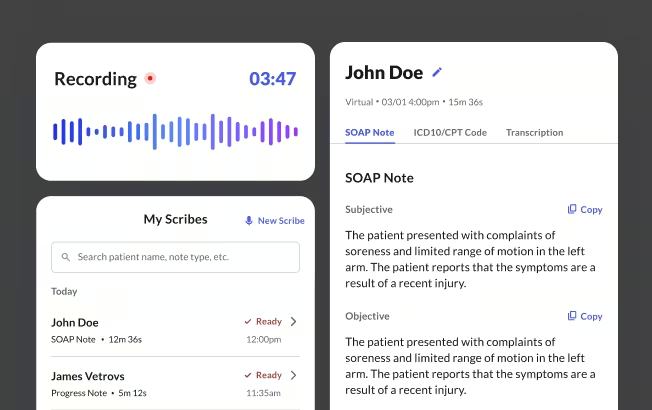
Commure Scribe is an AI medical scribe that listens to the clinical encounter and generates a structured note for the provider to review. The clinician captures the visit, edits the AI-drafted note, and finalizes it without typing from scratch at the end of a shift. Clinicians report an average chart close time of 43 seconds. More than 90% of providers who use Commure Scribe reduce clinical documentation time and digital fatigue.
The feedback form and the clinical note serve different purposes. One captures the patient's experience. The other captures the clinical encounter. Commure Scribe handles the second so clinicians can give more to the first.
Client Feedback Form Template Download
Download a copy of this template
Thanks! Your client feedback form template is ready.
Click below to download.

Frequently Asked Questions
A good client feedback form covers six areas: visit information, scheduling ease, wait time, provider communication, staff and front office, and overall satisfaction. Add one open comment field at the end. Keep the total to 8–10 questions. Fewer questions get more responses.
HIPAA governs how you handle data. It does not regulate what questions you ask. An anonymous client feedback form that collects no individually identifiable information is generally not PHI and carries the least HIPAA risk. If you collect named responses, your digital platform must sign a Business Associate Agreement (BAA) with your practice (45 CFR 164.502(e) and 164.504(e)).
Send a short client feedback form by text message on the day of the visit. Keep it to one page or one screen. Five to eight questions is the right length for most practices.
The terms are used interchangeably in outpatient settings. A "patient satisfaction survey" often refers to standardized instruments like CAHPS. These use validated question sets for benchmarking across practices. A client feedback form is a shorter, practice-designed tool for everyday use. Both capture the same core information.
Send a client feedback form after each visit for new patients and after significant care milestones. For established patients, quarterly or after major visits is sufficient. Do not send forms after every routine appointment. Patients experience survey fatigue and response rates drop.
Sources
- Agency for Healthcare Research and Quality. "Health Literacy Universal Precautions Toolkit, 3rd Edition — Tool 17: Get Patient Feedback." Last reviewed May 2024. https://www.ahrq.gov/health-literacy/improve/precautions/tool17.html
- Agency for Healthcare Research and Quality. "About the CAHPS Program and Surveys." Last reviewed June 2025. https://www.ahrq.gov/cahps/about-cahps/index.html
- Siddiqui, Muhammad Usman Hassan, Abdullah Ahmed Khafagy, and Faisal Majeed. "Program Report: Improving Patient Experience at an Outpatient Clinic Using Continuous Improvement Tools." Healthcare 11, no. 16 (2023): 2301. https://pmc.ncbi.nlm.nih.gov/articles/PMC10454562/