



Psych Eval Template: Free Psychiatric Evaluation Form
A structured psychiatric evaluation form covering key APA and CMS-required sections, with guidance on HIPAA, 42 CFR Part 2, and CPT 90791/90792 billing.
Written by the Commure Scribe Team
Published: June 26, 2026
•
5 min read
Updated June 26, 2026
A psych eval template is a form for the initial psychiatric diagnostic evaluation. Licensed mental health providers bill that visit under Current Procedural Terminology (CPT) code 90791 or 90792. Its nine clinical sections begin with the chief complaint and history of present illness. Psychiatric history, medical and medication history, social and family history, and substance use follow. The mental status exam, risk assessment, and diagnostic impression with treatment plan close the form. The filled-in form also serves as the record if a claim is audited.
What You Need to Know About Psych Eval Templates
- A psych eval template is a form mental health providers use to chart initial psychiatric assessments.
- Centers for Medicare & Medicaid Services (CMS) requires specific documentation for CPT 90791 and 90792. Incomplete records are the most common reason for psychiatric billing audits.²
- A complete template covers the core sections required by APA Practice Guidelines, from chief complaint through treatment plan.
Download the Psych Eval Template
Download the editable psychiatric evaluation form template.
This psych eval template is for informational and educational purposes only. It does not constitute legal or medical advice and does not guarantee regulatory compliance. Rules vary by state and payer.
What Is a Psych Eval Template?
A psych eval template is a structured clinical form that organizes the initial psychiatric evaluation into the required sections defined by APA Practice Guidelines and CMS LCD L33252.¹ ² For broader mental health intake workflows, a biopsychosocial assessment template covers biological, psychological, and social factors in a single structured form.
Licensed mental health providers use it for the initial diagnostic interview. This visit is billed under CPT 90791 (without medical services) or CPT 90792 (with medical services).²
The template also serves as the clinical record. If a claim is audited, it proves the eval was complete. Gaps in any needed section can trigger claim denial or recoupment.²
What Should a Psych Eval Template Include?
A complete psych eval template covers nine required clinical sections, from the chief complaint through the diagnostic impression and treatment plan, as defined by APA Practice Guidelines and CMS LCD L33252.¹ ²
Chief Complaint. Record the reason for the visit in the patient's own words.¹ Clinical paraphrase does not replace direct quotation here.
History of Present Illness. Note the onset, duration, and context of current symptoms.² The HPI links symptoms to the working diagnosis.
Psychiatric History. List prior diagnoses, hospitalizations, medication trials, and treatment responses.¹ Missing hospitalization history is a common audit flag.
Medical and Medication History. Record all active medical conditions and current medications.¹ Many psychiatric symptoms have medical causes. Drug interactions are a safety concern.
Social and Family History. Note the living situation and support systems.¹ Also record work status, trauma history, and family psychiatric history.¹ A psychiatric review of systems can supplement this section by screening for symptoms across all major psychiatric domains. When trauma history comes up, use a trauma assessment template with a PTSD Checklist for DSM-5 (PCL-5) form and a comparison of validated assessment tools.
Substance Use Assessment. Ask about alcohol, tobacco, cannabis, and other substances in turn.¹ Charting a substance use disorder triggers 42 CFR Part 2 protections for those records.³
Mental Status Examination. The MSE needs at least ten domains.² These are: appearance and behavior, speech, mood, affect, thought process, thought content, perception, cognition, insight, and judgment. Chart risk in a separate section.
Risk Assessment. Note suicidal ideation, homicidal ideation, and self-harm history.¹ Record ideation type (passive or active), any plan, access to means, and intent. A noted "patient denies SI/HI" is still a needed data point. Do not skip this section.
Diagnostic Impression and Treatment Plan. Record the working diagnosis with Diagnostic and Statistical Manual of Mental Disorders, Fifth Edition, Text Revision (DSM-5-TR) criteria and ICD-10 codes.² Describe the treatment type, frequency, goals, and rationale.¹ CMS needs notes on medical need for covered care.² For ongoing care coordination, a mental health treatment plan template provides a structured format for documenting goals, interventions, and progress across the course of treatment.
More items for completeness:
- Safety plan or safety plan reference (needed when risk is found)
- Consent for treatment notation
- Provider credentials, license number, and signature
How to Fill Out Your Psych Eval Template
The psych eval template works best when providers fill each section during the visit. Do not rebuild notes from memory after the fact.
Before the visit. Pull any referral notes and prior records. Pre-fill name, date, and insurance fields. Review intake forms if the patient completed one ahead of time.
During the visit.
Chief complaint: Ask "What brings you in today?" Write the response in the patient's words, not your clinical view.¹
HPI: Use timeline prompts. "When did you first notice this?" and "What makes it better or worse?" give the detail CMS needs.²
Psychiatric history: Ask about hospitalizations directly. Patients often omit prior hospitalizations unless you ask.¹
MSE: Fill each domain in order. Chart mood and affect as separate findings. For example: "Mood: anxious. Affect: restricted, congruent with stated mood."²
Risk assessment: Use direct language. Ask about suicidal ideation, intent, plan, and access to means. Chart the response whether or not ideation is present.¹ A blank risk section is a compliance failure.
Substance use: Ask about each category in turn. Use "non-prescribed" rather than "recreational."
AI scribes can capture the visit in real time. They produce a structured draft for provider review. The provider has the option to review the note before it enters any record.
After the visit. Fill in the diagnostic impression and treatment plan while recall is fresh. Sign and date the record. An unsigned note creates liability. If a safety plan was made, attach it to the visit record.² For patients with documented SUD, confirm records are flagged for 42 CFR Part 2 handling before any disclosure.³
Compliance Requirements for Psychiatric Evaluations
The psych eval template falls under four overlapping frameworks.
HIPAA: Psychotherapy Notes. HIPAA defines psychotherapy notes at 45 CFR 164.501 and gives them extra protection under 45 CFR 164.508(a)(2).⁴ Psychotherapy notes are process notes from therapy sessions. A diagnostic evaluation form is not a psychotherapy note. If you keep separate session process notes, store them apart from the main record. Sharing them needs specific patient approval.⁴ Practices using HIPAA-compliant AI note-taking should confirm that their vendor's business associate agreement (BAA) covers psychiatric evaluation records distinctly from psychotherapy notes. Ongoing therapy progress notes also belong to the medical record, and they differ from psychotherapy notes in content and in the protection HIPAA gives them.
42 CFR Part 2: Substance Use Records. If you chart a substance use disorder, 42 CFR Part 2 applies to those records.³ The February 2024 final rule aligned Part 2 with HIPAA. A single consent for treatment, payment, and operations now covers most re-disclosures. Use of records in legal proceedings against the patient still requires specific consent.³ Penalties now match HIPAA civil and criminal enforcement levels.³
CMS LCD L33252: Billing. CMS requires documentation of all core evaluation elements (chief complaint, HPI, psychiatric history, MSE, risk assessment, diagnosis, treatment plan) to support billing.² A missing risk assessment, an incomplete MSE, or no treatment plan can result in claim denial or recoupment.
State Mental Health Confidentiality Laws. State laws may set stricter rules than HIPAA for mental health records.⁴ Before releasing any record, check your state's mental health privacy law. State law controls when HIPAA does not.
How Commure Scribe Works with Your Psych Eval Template
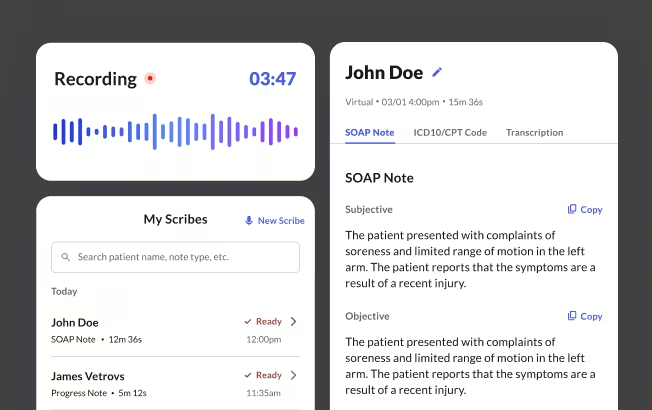
The initial psychiatric evaluation is the most charting-heavy visit in mental health care. Commure Scribe captures the visit as it happens. When you click End Recording, a structured note appears within seconds. It pulls the chief complaint in the patient's words, includes the HPI with timeline detail, fills the MSE domains as you observed them, and records risk findings as you assessed them.
Suggested ICD-10 and CPT codes are generated in a separate tab. The note is a draft. Review it, edit what needs editing, and finalize before it enters the chart. 90%+ of providers reduce clinical documentation time and digital fatigue. 91% report feeling less fatigued.
Commure Scribe is HIPAA compliant, System and Organization Controls 2 (SOC 2) certified, and stores all data onshore. Audio is never used for AI training or any other purpose. For solo and small practices, a 7-day free trial needs no credit card. For medium and large group practices, Commure Scribe offers one-click EHR sync. For a ranked comparison of AI scribes built for psychiatric documentation, see the full guide.
Psychiatric Evaluation Form Template Download
Download a copy of this template

Frequently Asked Questions
A psych eval template charts the initial diagnostic evaluation. It covers history, MSE, risk, diagnosis, and treatment plan. A psychotherapy progress note charts individual therapy sessions. Psychotherapy notes get separate HIPAA protection (45 CFR 164.508(a)(2)). They need distinct storage and disclosure handling.⁴ For charting tools for ongoing therapy, see AI therapy notes.
Yes. APA guidelines call for suicide and violence risk to be noted in the initial evaluation.¹ CMS coverage policy for psychiatric diagnostic evaluation sets the same expectation.² A missing risk section is an audit flag for CPT 90791 and 90792 claims. A documented "patient denies SI/HI" satisfies the rule.
CPT 90791 covers the psychiatric diagnostic evaluation without medical services. CPT 90792 covers the evaluation with medical services, such as prescribing or medication management. Both require complete psychiatric evaluation documentation under CMS LCD L33252.²
For most treatment and payment purposes, standard HIPAA authorization applies. If the eval contains substance use disorder charting, 42 CFR Part 2 needs separate, specific consent before any disclosure.³ Psychotherapy process notes need their own distinct approval under 45 CFR 164.508(a)(2).⁴
Yes. AI scribes can capture the evaluation in real time and draft structured sections for provider review. The provider reviews and approves the note before it enters any record. Get informed consent for audio recording before the visit begins.
Sources
¹ Armstrong C. "APA Updates Guidelines on Psychiatric Evaluation in Adults." American Family Physician. 2016;94(1):62–64. https://www.aafp.org/pubs/afp/issues/2016/0701/p62.html
² CMS. LCD L33252: Psychiatric Diagnostic Evaluation and Psychotherapy Services. https://www.cms.gov/medicare-coverage-database/view/lcd.aspx?LCDId=33252
³ U.S. Department of Health and Human Services (OCR and SAMHSA). "Fact Sheet: 42 CFR Part 2 Final Rule." February 2024. https://www.hhs.gov/hipaa/for-professionals/regulatory-initiatives/fact-sheet-42-cfr-part-2-final-rule/index.html
⁴ U.S. Department of Health and Human Services. HIPAA Privacy Rule and Sharing Information Related to Mental Health. https://www.hhs.gov/sites/default/files/hipaa-privacy-rule-and-sharing-info-related-to-mental-health.pdf