



Psychiatric Review of Systems: What to Include and How to Document It
A practical guide and template for psychiatrists and PMHNPs who need a complete, audit-ready ROS without adding time to the visit.
Written by the Commure Scribe Team
Published: May 21, 2026
•
7 min read
A psychiatric review of systems (ROS) is a structured list of symptoms the patient reports. It spans psychiatric and related domains. It typically covers mood, anxiety, psychotic symptoms, substance use and sleep. Other domains include suicidality and self-harm, cognition, trauma symptoms, and psychosocial stressors and functioning. Clinicians record each domain in the patient's own words. Suicidality and substance use get their own update at each visit. The ROS stays apart from the mental status exam (MSE), which the clinician observes.
What You Need to Know
- An audit of 373 psychiatric records found that 83.65% contained at least one documentation defect, with progress notes showing among the highest defect rates. The ROS is consistently among the most incomplete sections.
- Copy-paste mistakes contributed to 35.7% of diagnostic errors in cases where clinicians had copied prior notes. Suicidality and substance use domains are the highest-risk ROS sections to carry forward without review.
- Since 2021, outpatient codes 99213 through 99215 are selected based on medical decision-making or time, not the number of ROS systems documented. ROS is now documented as clinically appropriate and per payer policy, not as a direct code-level requirement.
What is a psychiatric review of systems, and how is it different from a mental status exam?
The psychiatric review of systems is a structured, patient-reported inventory of symptoms across psychiatric and related medical domains. It captures what the patient has experienced, in their own account, across categories relevant to psychiatric diagnosis.
This guide covers what belongs in a psychiatric review of systems, how it connects to E/M coding, and what documentation looks like when the ROS section doesn't hold up the rest of the chart.
How the ROS and MSE differ
The mental status exam is the clinician's direct observation during the visit: appearance, affect, speech, cognition, insight, and judgment. Both sections appear in a complete psychiatric evaluation. They answer different questions:
- The ROS reflects what the patient reports.
- The MSE reflects what the clinician observes.
Conflating the two creates a note that does not accurately represent either. A patient can endorse sleep disturbance, low energy, and passive suicidal ideation on the ROS while presenting as calm and well-groomed on the MSE. Substituting one for the other leaves a documentation gap that payers and licensing boards notice.
For the observed side, a mental state assessment example shows filled MSE entries for outpatient mental health, primary care and telehealth visits.
What does a complete psychiatric review of systems actually include?
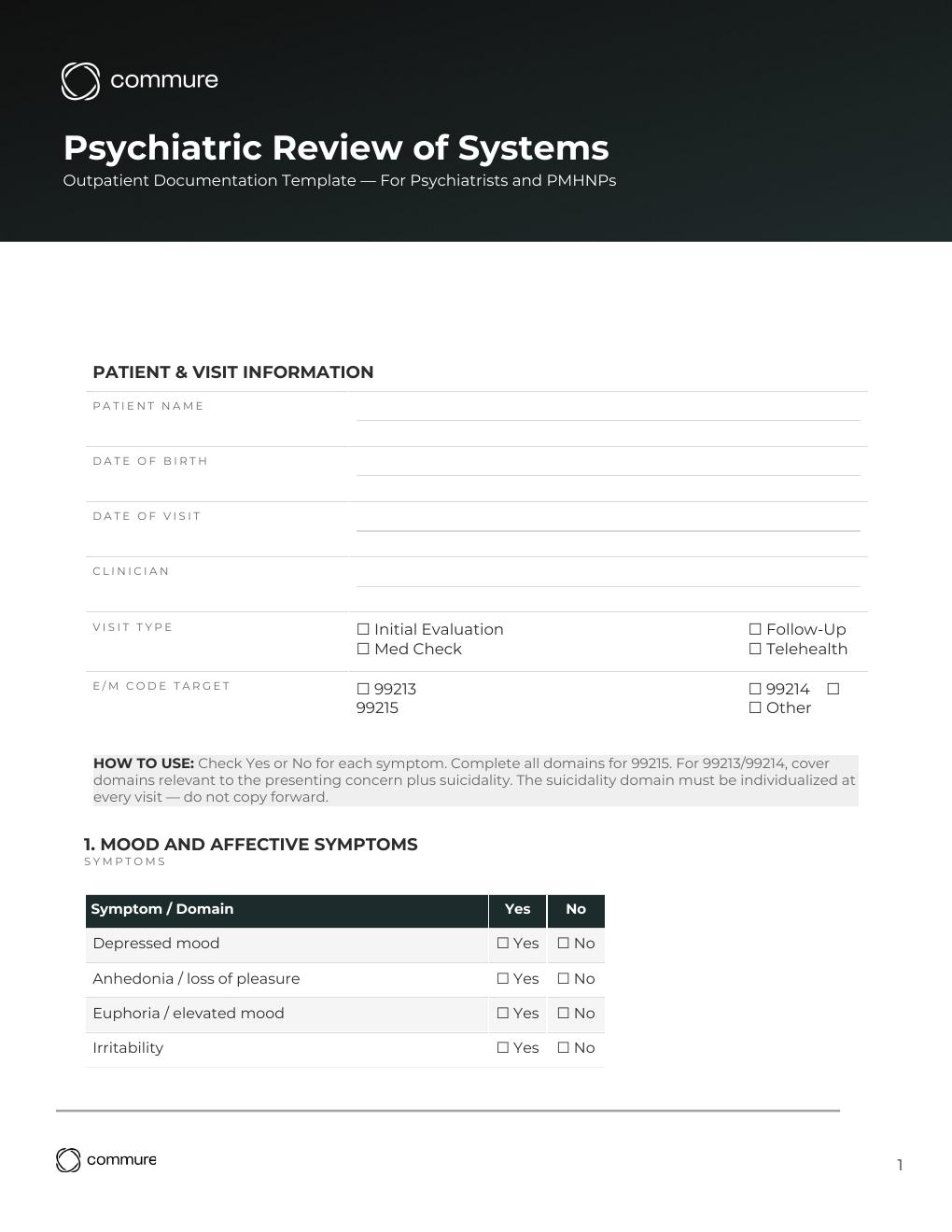
A complete psychiatric ROS covers the symptom domains relevant to psychiatric diagnosis and differential. The following domains align with Diagnostic and Statistical Manual of Mental Disorders, Fifth Edition (DSM-5) diagnostic categories and appear in standard clinical guidelines:⁴
- Mood and affective symptoms. Depressed mood, anhedonia, euphoria, irritability, emotional lability, and mood cycling. This domain anchors the differential between unipolar depression, bipolar spectrum conditions, and mood features of other disorders.
- Anxiety and worry. Generalized worry, panic symptoms, phobic avoidance, and somatic anxiety. The patient's account of what anxiety feels like and when it occurs informs both diagnosis and medication selection.
- Psychotic symptoms. Auditory or visual hallucinations, paranoid ideation, disorganized thinking, and delusional content. Negative symptoms, including social withdrawal, flat affect, and avolition, belong here as well.
- Substance use. Current and historical use across alcohol, cannabis, stimulants, opioids, and sedatives. Quantity, frequency, and the patient's characterization of their own use pattern.
- Sleep. Onset difficulty, maintenance difficulty, early awakening, hypersomnia, and changes from baseline. Sleep is both a symptom of most psychiatric conditions and a treatment target; it warrants its own domain rather than being folded into mood.
- Suicidality and self-harm. Active ideation, passive ideation, intent, plan, access to means, and recent self-harm behavior. This domain must be individualized at every visit. It cannot be copied forward.
- Cognitive symptoms. Concentration, memory, processing speed, and the patient's perception of change from their baseline. Relevant across mood disorders, anxiety, ADHD, and early neurocognitive presentations.
- Trauma and PTSD symptoms. Intrusive memories, hypervigilance, avoidance, and sleep-related trauma symptoms. This domain is often underrepresented in brief ROS formats and tends to surface only when asked about directly.
- Psychosocial stressors and functioning. Relationship, occupational, and housing stressors. Changes in the patient's functional baseline since the last visit.
Research on measurement-based care, which depends on this kind of structured, repeated symptom assessment, consistently associates systematic monitoring with higher remission rates than usual care. Some studies report substantial relative improvements, though effect sizes vary by setting and implementation fidelity.⁵
How do you conduct and document a psychiatric review of systems efficiently?
The most efficient psychiatric ROS builds on structure established before the visit. The clinician knows which domains are covered, in what order, and what the prior visit documented. The visit itself focuses on changes and updates, not rebuilding a baseline from scratch.
Embed ROS inquiry in the natural flow of the visit. A clinician asking about sleep, appetite, and energy during a medication follow-up is covering ROS domains without a separate formal review. The documentation challenge is capturing those responses as a structured ROS rather than as narrative in the history of present illness (HPI).
For the suicidality domain, no efficiency shortcut applies. The inquiry must be direct, patient-specific, and documented in the patient's own terms or the clinician's contemporaneous record of the exchange. An ROS that states "denies SI/HI" without a corresponding account of what was asked and how the patient responded does not meet Joint Commission suicide risk assessment documentation standards (NPSG 15.01.01), and falls below the contemporaneous documentation standard most state psychiatric licensing boards apply in malpractice review.
For group practices, a shared ROS format reduces cross-coverage burden. When every prescriber documents the same domains in the same order, a covering clinician can locate the prior ROS and identify changes without reading the full note. Group practices that chart in DAP notes can keep patient-reported ROS findings in the Data section, so a covering clinician finds them apart from the Assessment.
ROS in a 15-minute med-check. Since 2021, outpatient codes 99213 through 99215 are selected based on medical decision-making or time, not the number of ROS systems documented. ROS is documented as clinically appropriate and per payer policy rather than as a direct code-level requirement. In a brief med-check, covering the domains most relevant to the presenting concern and documenting them accurately is the practical standard.
How does psychiatric review of systems documentation connect to E/M coding and audit readiness?
Documentation of the ROS has long been a core element of outpatient E/M records. Under history-and-exam-based frameworks, auditors expected broader review at higher code levels. Since 2021, outpatient codes 99213 through 99215 are selected based on medical decision-making or time. The ROS no longer maps directly to code selection. It remains clinically and legally relevant as a record of what was asked and what the patient reported. Confirm current expectations with your billing team.⁶
Coding risk runs in both directions. A note that claims a complete ROS but contains only a copied-forward checklist is vulnerable to a clawback if audited. A note with a thorough ROS that is inconsistently documented, or that buries ROS content inside the HPI without labeling it, may be coded below the level the visit actually supports. A 2022 Department of Health and Human Services (HHS) Office of Inspector General report found that Medicare Advantage plans denied 13 to 18% of behavioral health prior authorization requests with some plans reaching 20 to 30% for residential and intensive outpatient levels of care.⁷ Documentation deficiencies were among the primary reasons cited.⁷ While this finding covers prior authorization specifically rather than outpatient E/M claims, documentation quality affects all claim types subject to payer audit.
Multi-prescriber consistency serves a second function. In practices where multiple prescribers see the same patients, a standardized ROS format makes clinical continuity legible. A covering provider can locate and read a consistent ROS across visits from different clinicians and assess change without requesting a full chart review.
Why does the psychiatric review of systems fall apart during brief outpatient visits?
The 15 to 20-minute med-check is not designed for extended symptom review. A prescriber in that window is managing a medication question, addressing an acute concern, and updating the patient's longitudinal picture. The ROS competes with all of that for the same limited time. A national TrendBurden survey of 1,253 healthcare professionals found that 74% said documentation tasks impede patient care, and 77% reported regularly finishing work later than desired or at home because of charting obligations.¹
Copy-forward is the most common workaround, and the riskiest. When a prior ROS is imported into the current note, the clinician must actively override the defaults to reflect changes. In a fast-moving session, that often does not happen. An analysis of primary care diagnostic errors found that copy-paste mistakes contributed to 35.7% of cases where clinicians had copied prior notes. ROS sections are among the most vulnerable: a copied ROS may read as negative while the HPI explicitly documents a positive finding.²
Delayed documentation compounds the problem. When the ROS is not completed during the visit, it becomes reconstruction work assembled from memory or brief notes. That reconstruction is slower and less accurate than documentation completed while the visit is still present.
In psychiatric documentation, suicidality and substance use domains need individualized, contemporaneous entries at every visit. A copied-forward ROS in those domains is a patient safety exposure, not a time-saving shortcut.
Why do templates and copy-forward tools not solve this for independent practices?
EHR-embedded ROS templates address the structure problem, not the time problem. A pre-populated checklist still needs the prescriber to stop, review each domain, and update responses against what the patient reported in this visit. In a 15-minute session, that time does not exist alongside managing the conversation, assessing risk, and handling a medication decision.
Audit data confirms the gap. An audit of 373 psychiatric records found that 83.65% contained at least one documentation defect, with progress notes showing among the highest defect rates.³ For practices with multiple prescribers and cross-coverage, inconsistently updated ROS sections create a secondary problem: notes are not comparable across the clinical record, which complicates cross-coverage and audit review.
Standalone medical dictation is better than silence, but it still needs the clinician to narrate the ROS explicitly and verify that the transcription captured all domains. Without a structured framework, the ROS section can still be incomplete or inconsistently formatted.
How does Commure Scribe support psychiatric review of systems documentation?
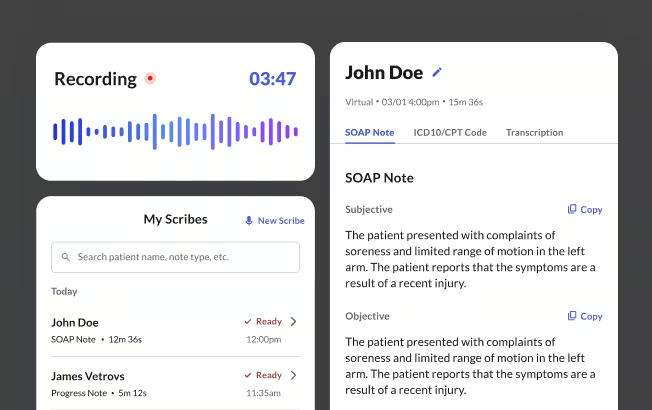
Commure Scribe is an AI medical scribe that captures the full psychiatric visit in audio and generates a structured note from the encounter. The ROS section of that note reflects what the patient reported during the session, drawn from the ambient recording rather than a prior visit's template.
The ROS structure itself is not pre-built for psychiatry out of the box. Clinicians configure a custom template through Commure Scribe's template builder, defining the domains, order, and format that match their clinical workflow and documentation standards. Once the template is set, Commure Scribe learns the clinician's phrasing over time and applies it consistently across visits. Learn more about AI scribes for psychiatry and how clinicians in outpatient settings configure it.
Psychiatric Review of Systems Template Download
Download a copy of this template
Thanks! Your psychiatric ROS template is ready.
Click below to download.

Frequently Asked Questions
A complete psychiatric ROS covers mood and affective symptoms, anxiety, psychotic symptoms, substance use, sleep, suicidality and self-harm, cognitive symptoms, trauma-related symptoms, and psychosocial stressors. The suicidality domain must be individualized at every visit and cannot be carried forward from a prior note.
Under CMS guidelines in effect since 2021, outpatient codes 99213 through 99215 are selected based on medical decision-making or time, not ROS level. The ROS is no longer a direct code-level requirement under current CMS outpatient rules, though it remains clinically expected documentation. Note that some commercial and Medicaid managed care payers continue to audit against the pre-2021 history-and-exam framework. Confirm which documentation standard your payers apply before adjusting practice.
The ROS is a patient-reported inventory of symptoms. The mental status exam is the clinician's observation of the patient's presentation during the visit. Both appear in a complete psychiatric evaluation, but they draw on different sources and serve different documentation functions.
Under pre-2021 history-and-exam frameworks, a 99214 needed an extended ROS covering at least two systems, and a 99215 needed a complete ROS covering ten or more systems. Under current CMS rules, code selection is based on medical decision-making or time. ROS documentation should reflect what was clinically reviewed, recorded in the patient's own terms where possible, particularly for suicidality and substance use.
A shared template that defines the domains, their order, and the documentation format is the most reliable approach. When all prescribers document against the same structure, notes are comparable across visits and across providers. AI scribes that learn each clinician's phrasing while outputting into a shared template structure can support both consistency and individual clinical voice.
Ambient AI scribes can identify ROS-relevant content as it occurs in the conversation and structure it into the appropriate note section. Research finds that ambient AI scribes report overall documentation error rates of about 1 to 3%, compared to 7 to 11% for traditional speech-recognition dictation. Hallucinations, including fabricated findings and omitted symptoms, present distinct risks at any error rate.⁸ Clinician review of every note before it enters the record is needed regardless of the tool used.
Sources
- AMIA 25x5 Task Force TrendBurden Pulse Survey. (2025). Documentation burden impact on patient care. Applied Clinical Informatics. https://www.healthcareitnews.com/news/amia-survey-documentation-burden-impacting-patient-care
- Partnership for Health IT Patient Safety. (2017). Electronic health record safety-enhanced design. Journal of the American Medical Informatics Association, 24(1), 1–7. https://pmc.ncbi.nlm.nih.gov/articles/PMC5373750/
- Ebnehoseini, Z., et al. (2022). Quality of psychiatric medical records. Indian Journal of Psychiatry, 64(2). https://pmc.ncbi.nlm.nih.gov/articles/PMC9045351/
- American Psychiatric Association. (2022). Diagnostic and statistical manual of mental disorders (5th ed., text rev.). American Psychiatric Association Publishing. https://psychiatryonline.org/doi/book/10.1176/appi.books.9780890425787
- American Psychiatric Association. (2022). Resource document on implementation of measurement-based care. https://www.psychiatry.org/getattachment/3d9484a0-4b8e-4234-bd0d-c35843541fce/Resource-Document-on-Implementation-of-Measurement-Based-Care.pdf
- Centers for Medicare and Medicaid Services. (2026). Evaluation and management services guide. U.S. Department of Health and Human Services. https://www.cms.gov/files/document/mln006764-evaluation-management-services.pdf
- U.S. Department of Health and Human Services, Office of Inspector General. (2022). Some Medicare Advantage organization denials of prior authorization requests raise concerns about beneficiary access to medically necessary care (OEI-09-18-00260). https://oig.hhs.gov/reports/all/2022/some-medicare-advantage-organization-denials-of-prior-authorization-requests-raise-concerns-about-beneficiary-access-to-medically-necessary-care/
- Topaz, M., Peltonen, L.M. & Zhang, Z. Beyond human ears: navigating the uncharted risks of AI scribes in clinical practice. npj Digit. Med. 8, 569 (2025). https://doi.org/10.1038/s41746-025-01895-6