



EMR vs EHR: Differences and How to Choose
A practical look at how EMRs and EHRs differ in scope, interoperability, and documentation workload, and how to pick the right one as your practice grows.
Written by the Commure Scribe Team
Published: June 3, 2026
•
11 min read
Updated June 3, 2026
What You Need to Know About EMRs and EHRs
- An EMR is a digital chart used inside one practice; an EHR is a longitudinal record built to share patient data across providers.
- The main practical difference is interoperability: EHRs support structured data exchange, while EMRs typically require manual export.
- Most modern outpatient systems function as EHRs, so choose by information flow and growth plans rather than the label.
What do clinicians mean when they ask EMR vs EHR?
When clinicians ask "EMR vs EHR," they are sorting out which of two record categories a system belongs to. EMRs keep documentation inside one practice. EHRs move information across providers, settings, and patients.
The question comes up when a practice is picking, replacing, or evaluating a system. The terms themselves come from different eras. Early electronic systems were single-practice tools, and clinicians called them EMRs.
The newer term "EHR" was coined for systems built around data exchange.² Federal policy and the "meaningful use" framework pushed practices toward EHR adoption.² Most office-based clinicians now use a system that meets the EHR definition.³
In daily usage, the EMR vs EHR labels stay loose. Clinicians call any digital chart an "EMR," and vendors use the terms interchangeably. What matters for the practice is scope and capability, not the term on the marketing page.
What is an EMR in an outpatient practice?
In the EMR vs EHR conversation, the EMR is the simpler term to define. An electronic medical record is a digital chart for documentation inside one practice or clinic.² It holds the encounter notes, diagnoses, medications, and treatment history that the clinical team writes during patient care. The chart is the in-practice source of truth for what happened on each date with each clinician.
The functional scope of an EMR is encounter-centric. It supports the documentation work that happens during a clinic visit. The chart sits inside the practice's system, and once a clinician signs the note the record is complete in that practice.²
EMR-only systems usually include the basics that make in-practice work efficient. Common features cover encounter notes, problem lists, e-prescribing, and lab orders within the same office.
An EMR's design stops at the practice walls. Most EMRs cannot move records to a hospital, a referral specialist, or another office without manual export.² Information stays where the patient was seen.
This creates a trade-off. Inside one practice, an EMR is efficient; across organizations, the limits show up quickly. If a patient changes practices, the new clinician usually starts fresh or asks for a printed summary.
The handoff is where the EMR-only model shows its age. Sending records to a referral specialist or hospital usually means manual export rather than a smooth electronic transfer.² The receiving organization then has to bring the data back into its own system.
Some clinicians actively prefer the EMR boundary. The chart stays inside the practice, the workflow is theirs to control, and the staff knows how everything works.
In 2011, the CDC reported that 55% of office-based physicians used a partial or full EMR/EHR system, an early national baseline.³ For a solo or small practice, an EMR-style system can still fit when most patient data stays in-house. As referrals, hospital partners, or quality reporting expand, the EMR vs EHR limits of single-practice scope start to show.
What is an EHR, and how is it broader than an EMR?
The EHR is the more expansive half of the EMR vs EHR comparison. An electronic health record is built to move with the patient.⁴ It collects information from every clinician and care setting that touches the patient. The chart becomes the patient's record across organizations, not just one practice's record about the patient.
The shift in scope brings new capabilities. EHR core functions include:⁵
- Clinical data storage and longitudinal patient history
- Test result management across providers
- Order entry and order management
- Evidence-based clinical decision support
- Electronic communication between providers
- Patient access through portals
- Administrative processes and reporting
- Population health management
Sharing is the headline function. The system is designed so that referral specialists, hospitals, and public health registries can receive structured patient data without the sending office printing or re-entering.⁴ The Office of the National Coordinator for Health Information Technology (ONC) describes the EHR as the record that lets information follow the patient through every modality of care.²
Decision support is the second headline function. Drug interaction warnings, allergy checks, screening reminders, and clinical guidelines run inside the workflow.⁵ The clinician sees these checks in real time as orders and notes are written.
A 2024 systematic review in JAMA Network Open found that EHR nudges can change ordering patterns and improve documentation quality in primary care.⁶
The patient is also a participant. EHRs are designed for patient access through portals, so patients can read their visit notes, request refills, and message the practice.⁴
For an outpatient practice working through EMR vs EHR options, the EHR's broader scope is what makes it the federal preference. It is also the default choice for groups that exchange data with hospitals or referral networks.²
What are the key differences between an EMR and an EHR?
The most useful way to frame EMR vs EHR is to look at the dimensions that affect everyday work. Four dimensions cover the bulk of the practical difference: scope, interoperability, user reach, and regulatory positioning.²
DimensionEMREHRScopeOne practice's encounter recordLongitudinal record across providersInteroperabilityLimited; manual export typicalBuilt for structured data exchangeUsersClinical and admin staff in one practiceClinicians, patients, and external organizationsRegulatoryHIPAA Privacy/Security RulesHIPAA plus ONC certification and patient access standards
Scope is the foundation. An EMR records what happened in a single practice. An EHR records the patient's clinical reality across every practice and setting that touches them.⁴
Interoperability separates the two in daily workflow. An EMR can hold rich clinical data, but moving it to a hospital, lab, or specialist usually depends on manual steps. An EHR is built for structured exchange that minimizes manual handling.⁴
The ONC defines interoperability as the ability of systems to send, receive, find, and use information without special effort by the user.⁷
User reach is the third dimension of the EMR vs EHR comparison. EMRs are tools for the clinical and administrative staff inside one office. EHRs add the patient as a participant via portals.
EHRs also bring in external organizations as connected counterparties. These include referring providers, hospitals, public health agencies, and quality reporting programs.⁴
Regulatory positioning differs more than most clinicians realize. Both EMRs and EHRs must comply with HIPAA's Privacy and Security Rules. EHRs face more federal expectations on top of HIPAA.⁷
ONC certification criteria, patient access requirements, and information blocking rules apply specifically to certified EHRs. Information blocking rules in particular bar practices and vendors from withholding electronic health information without a permitted reason.⁷
In an EMR vs EHR comparison, the differences compound. A practice that handles routine referrals, integrates with a regional hospital, or participates in value-based contracts will run into the EMR's scope limits faster. A single-physician office that handles most care in-house can stay with an EMR-style system longer.
How does the EMR vs EHR choice change your documentation workload?
Both EMRs and EHRs concentrate documentation work in the system, and that concentration has measurable costs for clinicians. The EMR vs EHR choice shifts where the work lives. By itself, it does not solve the bigger problem of how much time goes into the chart.
Peer-reviewed research has quantified the burden. A 2024 Health Affairs study of primary care physician documentation time reported that EHR documentation is associated with reduced time for health-improvement work in observational data.¹
A 2024 study of acute and critical care nurses reported parallel findings. Documentation burden in the EHR was associated with time pressure, fatigue, and reduced bedside time across the units studied.⁸
Survey research on EHR use describes documentation burden as one of the most consistent factors associated with clinician dissatisfaction.⁹ Time inside the chart is closely linked to burnout and after-hours work in that survey data. The pattern shows up across primary care and many specialties.⁹
The EMR vs EHR choice does change the texture of the work. With an EMR, documentation is mostly a single-system task. The clinician writes, signs, and files inside one chart. With an EHR, documentation includes the same encounter work plus structured fields for sharing, reporting, and decision support.⁵
The same structure that makes the EHR useful also makes the chart heavier. A 2020 review of the EMR experience identifies usability and workflow burden as the persistent downside of richer record systems.¹⁰
A practice can pick the record system that fits its size and partnerships and decide separately how the documentation work itself gets done. AI medical scribes generate the structured note from the clinical conversation. They work across both EMR and EHR systems and connect through established integrations or simpler manual workflows.
In the EMR vs EHR decision, the record system stays the practice's choice and the documentation method becomes a separate decision with its own trade-offs.
How should independent and group practices evaluate EMR vs EHR options?
The EMR vs EHR choice depends on what the practice already does and where it is going. Three questions cover most of the decision. How much information needs to leave the practice? How much needs to come in? And how big does the practice plan to get?
Information flow is the first filter. A solo practice that handles most care in-house, refers rarely, and skips hospital affiliations or value-based contracts can often get by with an EMR-style system. A practice that exchanges data with hospitals, accepts referrals routinely, or reports quality measures to payers will need the structured exchange that EHRs provide.⁴
Practice size shapes the second EMR vs EHR filter. Independent and group practices in the 1 to 100 provider range vary widely in how they use a record system. A small primary care office and a large multispecialty group practice sit at different points on the EMR-to-EHR continuum. In the broader EMR adoption literature, many groups beyond a few clinicians appear to fit better with EHR features than with EMR-only tooling, though the comparison reflects expert interpretation more than a single empirical figure.¹⁰
Growth direction is the third filter. A practice planning to add locations, take on new partners, or join an integrated delivery network should evaluate EHR options earlier rather than later.¹¹ Migrating from an EMR to an EHR after the practice has scaled is more disruptive than starting on an EHR. Groups planning to add locations can compare the best EMR software platforms on AI charting, interoperability, costs, and migration time.
Long-running EMR adoption research has found that successful setup depends as much on workflow design and clinician engagement as on the software itself.¹⁰ Practices that involve clinicians early in the selection tend to transition more smoothly. Those that buy first and train second usually run into more friction.
Several practical evaluation criteria apply to both sides of EMR vs EHR:
- HIPAA compliance and security posture, including encryption and audit logs
- Specialty fit for the practice's clinical workflow
- Total cost over time, including training and migration
- Vendor responsiveness and live support availability
- Documentation workflow and how the chart fits the clinician's day
- AI scribe and ambient documentation compatibility
Whichever side of EMR vs EHR the practice picks, the documentation work still has to get into the chart. A scribe layer that works across EMR and EHR options keeps the documentation decision separate from the record system decision.
How Commure Scribe fits with your EMR or EHR
Whichever record system your practice uses, the documentation work still has to land somewhere. Commure Scribe is an AI medical scribe. It captures the clinical conversation, generates a structured note, and connects to the practice's record system through 60+ EHR integrations. The capture happens passively during the visit. The clinician stays present in the room with the patient.
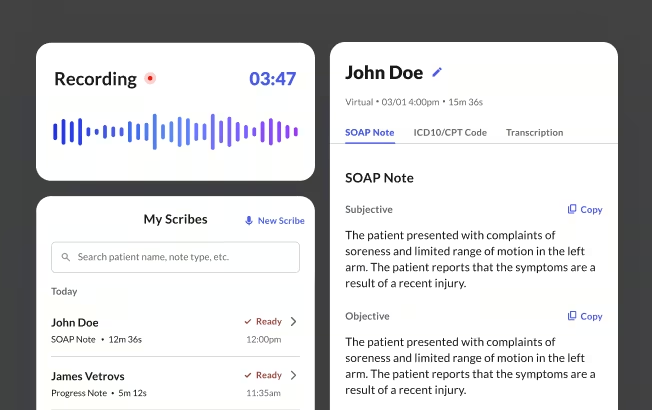
Commure Scribe works through a Capture → Edit → Finalize workflow. The clinician clicks End Recording at the end of the visit. Within seconds, a highly accurate structured SOAP note appears that captures the full clinical context of the encounter. Suggested ICD-10 and CPT codes are generated alongside the note. The clinician reviews, edits, and finalizes before anything posts to the chart.
Integration adapts to practice size. Solo and small practices in the 1 to 5 provider range can use copy/paste to move the finished note into their EMR or EHR. Medium and large group practices have access to one-click sync that lands the note directly inside the chart.
The platform is HIPAA compliant and System and Organization Controls 2 (SOC 2) certified, with onshore data storage. It supports 90 languages with automatic detection, runs on any device, and is in use by 75,000+ clinicians across 25 specialties.
Commure Scribe keeps the EMR or EHR as the practice's record system and treats the documentation method as a separate layer. The documentation work moves out of the after-hours window and back into the clinical day.
Frequently Asked Questions
The EMR vs EHR difference comes down to scope. An EMR is a digital chart that stays inside one practice and supports encounter documentation for that office's clinicians. An EHR is a longitudinal record designed to share patient information across providers, settings, and the patient. The most common practical difference is interoperability, since EHRs are built for structured data exchange while EMRs typically need manual export.²
Most modern systems sold to outpatient practices function as EHRs even when the vendor materials still call them "EMRs."² The clearest test is functional scope. If the system supports structured data exchange with hospitals, labs, and patient portals, it is operating as an EHR. If data leaves the practice mainly through manual export, the system is functioning as an EMR regardless of the marketing label.
The EMR vs EHR answer depends on the practice's needs. A solo or small office that handles most care in-house can run efficiently on an EMR-style system. A small office that exchanges data with hospitals or reports quality measures benefits from EHR features.⁴ Growth plans matter, since migrating later is more disruptive than starting on the right system.
The federal government has favored EHRs since the meaningful use era.² EHRs support data exchange, decision support, patient access, and quality reporting in ways EMRs typically do not.⁴ For practices, EHRs make referrals, hospital integration, and quality programs easier to manage. The trade-off is more system complexity and more documentation structure that staff have to maintain.
Yes. AI medical scribes generate the structured note from the clinical conversation and connect to either side of EMR vs EHR through different integration paths. Many EHRs allow direct sync of the finished note into the chart. EMR-style systems and smaller practices typically use a copy/paste workflow. The record system stays the practice's choice while the documentation method is independent.
Sources
- Holmgren AJ, et al. (2024). Electronic Health Record Documentation Burden Crowds Out Health Improvement Work by Primary Care Physicians. Health Affairs. https://www.healthaffairs.org/doi/10.1377/hlthaff.2024.00398
- Office of the National Coordinator for Health Information Technology (2011). EMR vs EHR: What is the Difference? HealthIT.gov. https://www.healthit.gov/buzz-blog/electronic-health-and-medical-records/emr-vs-ehr-difference
- Centers for Disease Control and Prevention (2011). EMR/EHR Use by Office-based Physicians. National Center for Health Statistics. https://www.cdc.gov/nchs/data/hestat/emr_ehr/emr_ehr.htm
- Office of the National Coordinator for Health Information Technology (2025). Electronic Health Records and Their Benefits. HealthIT.gov. https://www.healthit.gov/health-it-basics/benefits-ehrs/
- Elsevier ScienceDirect Topics. Electronic Health Record (overview). https://www.sciencedirect.com/topics/medicine-and-dentistry/electronic-health-record
- Nguyen OT, Kunta AR, Katoju SV, et al. (2024). Electronic Health Record Nudges and Health Care Quality and Outcomes in Primary Care: A Systematic Review. JAMA Network Open, 7(9):e2432760. doi:10.1001/jamanetworkopen.2024.32760. https://jamanetwork.com/journals/jamanetworkopen/fullarticle/10.1001/jamanetworkopen.2024.32760
- Office of the National Coordinator for Health Information Technology (2026). Health IT and HIE Frequently Asked Questions. HealthIT.gov. https://healthit.gov/health-it-basics/hit-hie-faqs/
- Cho H, Nguyen OT, Weaver M, Pruitt J, Marcelle C, Salloum RG, Keenan G. (2024). Electronic health record system use and documentation burden of acute and critical care nurse clinicians: a mixed-methods study. Journal of the American Medical Informatics Association, 31(11):2540-2549. doi:10.1093/jamia/ocae239. https://pmc.ncbi.nlm.nih.gov/articles/PMC11491602/
- American Medical Association (2026). Electronic health record (EHR) use research. https://www.ama-assn.org/practice-management/digital-health/electronic-health-record-ehr-use-research
- Honavar SG. (2020). Electronic medical records: The good, the bad and the ugly. Indian Journal of Ophthalmology, 68(3):417-418. doi:10.4103/ijo.IJO_278_20. https://pmc.ncbi.nlm.nih.gov/articles/PMC7043175/
- Kumari R, Chander S. (2024). Improving healthcare quality by unifying the American electronic medical report system: time for change. Egyptian Heart Journal, 76(1):32. doi:10.1186/s43044-024-00463-9. https://pmc.ncbi.nlm.nih.gov/articles/PMC10942963/



.jpeg)

.jpeg)
.jpeg)

.jpeg)