



Best EMR for Small Practice in 2026: 9 Systems Compared
Nine EMRs for independent group practices of 2–9 providers, compared on price, specialty fit, billing model, and the watch-outs each vendor would rather skip.
Written by the Commure Scribe Team
Published: April 17, 2026
•
14 min read
Updated April 17, 2026
For independent practices of 2 to 9 providers, nine electronic medical records (EMRs) are worth shortlisting. The list covers Tebra, athenaOne, eClinicalWorks, DrChrono and Elation Health, plus SimplePractice, Practice Fusion, OptiMantra and CharmHealth. Elation Health fits independent primary care. It won a 2025 KLAS award for practices of 1 to 10 physicians. Tebra bundles billing and charting, while athenaOne and eClinicalWorks suit groups near 10 providers. CharmHealth has the lowest published entry point.
What You Need to Know About the Best EMR for Small Practice
- This guide covers independent practices of 2–9 providers. Independent practitioners (1 provider): see Best EHR for Solo Practice. Enterprise health systems and multi-location groups: see Best EMR Software.
- By 2024, 95% of office-based physicians used an EMR, so the choice is about fit for your size and specialty, not adoption¹.
- This guide compares 9 systems on total cost, specialty fit, support depth, and honest watch-outs before you commit.
How Do the 9 Best EMRs for Small Practices Compare?
The table below compares the nine systems on the criteria that drive small practice EMR decisions: starting price, billing model, specialty focus, and built-in telehealth. Starting prices are vendor-published or vendor-reported figures as of June 2026. They are starting points, not quotes. Most vendors price per provider per month, while CharmHealth bills by encounter volume and athenahealth ties fees to collections.
Per-provider pricing rewards low headcount, and per-encounter pricing rewards low volume. A solo clinician seeing a light schedule may pay less on CharmHealth's encounter model. A two-provider group with a full panel usually does better on a flat per-provider small practice EMR rate.
What Are the 9 Best EMRs for Small Practices in 2026?
The nine systems below cover the main profiles in the EMR for small practice market: billing-led generalists, specialty platforms, and budget cloud options. Each profile pairs strengths with watch-outs, because no small practice EMR wins on most counts at once.
1. Tebra
Tebra, formerly Kareo, bundles charting, billing, scheduling, and patient marketing in one login. Kareo won Best in KLAS for small-practice ambulatory EMR and practice management in 2021⁵. The platform was built for independent practices, not scaled down from an enterprise product. According to Tebra, bundles run from about $99 to $399 per provider per month⁶. AI note drafting is sold separately.
Strong fit: independent offices that want billing, charting, and patient acquisition in one EMR for small practice use. Watch-outs: Tebra does not publish a fixed price list, so quotes vary by setup. The module count can push total cost well past the entry price.
2. athenaOne
athenaOne, from Athenahealth, pairs a cloud EHR with managed billing on a shared network model. Payer rules update across the network automatically. Practices do not maintain their own claim-rule libraries. Fees are tied to a percentage of collections rather than a flat rate.
A sensible match: small groups that want revenue cycle work handled and accept paying a share of collections. Watch-outs: percentage pricing grows with revenue, so it can cost more than flat-rate rivals as you scale. The platform also runs deeper than a solo clinician needs. Onboarding takes longer than lighter tools.
3. eClinicalWorks
eClinicalWorks runs one database across EHR, practice management, and billing, with tools the vendor says cover 40+ specialties. According to eClinicalWorks, the EHR-only plan starts at $449 per provider per month⁷. Revenue cycle management (RCM) services bill at 2.9% of collections⁷. Its eCW AI module adds ambient charting inside the same system.
Where it earns a spot on a best EMR for small practice shortlist: practices planning to grow past a handful of providers without switching platforms. Watch-outs: the per-provider rate is among the highest here. The feature depth means a steeper learning curve, and small teams may use a fraction of what they pay for.
4. DrChrono
DrChrono is the mobile-first option, built natively for iPad and iPhone. DrChrono says it connects to 40,000+ labs, with speech-to-text charting plus an AI no-show predictor. DrChrono does not publish list pricing. Buyer guides reviewed for this article reported starting rates near $199 to $250 per provider per month.
It suits clinicians who chart on a tablet at the point of care, including house-call and concierge models. Watch-outs: reported entry rates sit above budget rivals, and quotes vary by practice setup. Desktop workflows can feel secondary to the mobile experience for some staff roles.
5. Elation Health
Elation Health won the KLAS award for best EHR for small practices, 1-10 physicians, in 2025⁸. The system is clinical-first: charting is built around the visit note rather than the bill. Elation cites an American Academy of Family Physicians (AAFP) study in which burnout resolved for 9 of 11 physicians after their office adopted the system⁸. According to Elation, plans start at $349 per provider per month, less on annual terms⁸.
The natural home: independent primary care, including direct primary care and concierge models. Family medicine offices weighing note burden alongside the EMR choice can compare options in this guide to AI documentation for family medicine. Watch-outs: the primary care focus cuts both ways. Specialty groups outside that core will find thinner template coverage. Billing is an add-on rather than the platform's center of gravity.
6. SimplePractice
SimplePractice serves 250,000+ private-practice clinicians, mostly in mental and behavioral health⁹. According to SimplePractice, plans run from $49 to $99 per clinician per month⁹. Insurance billing sits on the upper tiers. Credentialing help is included at signup, and clients book and join telehealth through the portal.
Pick it if you are a solo therapist or counselor who wants the lightest small practice EMR admin load. Watch-outs: it is not a general medical EMR. Prescribing tools cost extra, the entry tier lacks insurance billing, and interoperability with outside EHRs is limited by design.
7. Practice Fusion
Practice Fusion built its base as the dominant free EHR for one-to-three-clinician offices. It now charges a flat subscription. According to Practice Fusion, pricing starts at $149 per provider per month on an annual contract¹⁰. The vendor's template library spans 40+ specialties and adapts to charting behavior.
Budget-minded offices that want a simple cloud EMR for small practice work with minimal setup get the most from it. Watch-outs: the annual contract locks you in, and telehealth is not a core strength. Veradigm owns the product, and its roadmap now serves a larger portfolio than small offices alone.
8. OptiMantra
OptiMantra targets integrative medicine, med spas, and multi-modality wellness groups. According to OptiMantra, pricing starts at $99 per month for the first practitioner¹¹. Added practitioners cost $49 and clinical staff $25 per month¹¹. Charting, point of sale, memberships, and telehealth sit in one system.
Cash-pay and hybrid clinics mixing medical and wellness services are the core audience for this EMR for small practices. Watch-outs: insurance billing is priced per claim as an add-on. The platform is less proven for insurance-heavy primary care. Add-ons stack quickly, since fax, eRx, and texting each carry their own monthly fee¹¹.
9. CharmHealth
CharmHealth prices by encounter rather than by provider. According to CharmHealth, a free tier covers up to 50 encounters per month¹². Past that, the encounter plan bills $0.50 per encounter with a $25 monthly minimum¹². The modular design lets a practice add telehealth, billing, or RCM when needed.
Very low-volume or part-time practices get the clearest value from this small practice EMR pricing model. Watch-outs: encounter fees scale with volume, so a busy panel can outgrow the price advantage. The free tier auto-upgrades once you cross 50 encounters per month¹².
What Should a Small Practice Expect From an EMR in 2026?
Adoption is no longer the question, so the search for the best EMR for small practice work starts with fit. Which EMR for small practice use earns its monthly fee without adding work? Solo and small group practices run with thin staffing. There is no IT department to manage servers, no analyst to build templates, and no billing team to absorb a complicated claims workflow.
That changes what a small practice EMR has to deliver. Cloud delivery, fast onboarding, and bundled billing count for more than enterprise features. Price sensitivity is real, and so is the gap between the sticker price and the total cost. Setup fees, per-provider tiers, and add-on charges often double the first-year spend on an EMR for small practices.
The vendors below were scored on small-practice criteria: specialty fit, total cost, support quality, and how well each pairs with AI charting tools. The profiles, pricing table, and hidden-cost breakdown reflect that lens, with honest watch-outs for each system. For a wider market view beyond small offices, see this best EMR software comparison.
How Were These Small-Practice EMRs Evaluated?
Each candidate for the best EMR for small practice use was scored on four criteria weighted for solo and small group realities. Usability carries the most weight because it has measurable stakes. One multi-center study found nine-fold differences in task time across systems. The same study found eight-fold differences in clicks for the same order². Federal research has also linked EMR usability problems to patient safety events³.
The four criteria:
- Specialty fit. Does the system ship templates for your specialty, or will you build them? A generic small practice EMR can cost more in setup time than a niche one costs in fees.
- Total cost of ownership. This covers sticker price plus setup fees, add-ons, data migration, and contract terms.
- Support and onboarding. Small practices lack in-house IT, so live support and training depth matter more than feature count.
- AI charting compatibility. Excess data entry and note bloat are tied to clinician stress and burnout⁴. Systems were checked for ambient AI options or open paths that cut keystrokes. For background on how ambient tools work, see the AI medical scribe pillar and the best AI medical scribes guide.
Pricing figures come from vendor pricing pages, checked in June 2026. Vendors change rates without notice. Treat each figure as a starting estimate and confirm quotes in writing. No vendor paid for placement. The watch-outs in each profile draw on the same sources as the strengths, which is what a credible EMR for small practice comparison owes you.
How Does Commure Scribe Work With a Small Practice EMR?
Commure Scribe is an AI medical scribe that sits on top of whichever system you pick, so the EMR decision stays independent of the note-burden decision. You can choose the cheapest system that fits your billing model, then solve charting speed separately. Commure Scribe offers 60+ EHR integrations, with copy/paste transfer for solo and small practices.
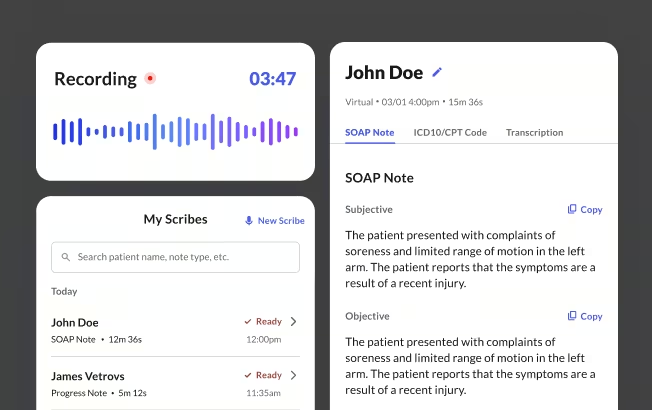
The workflow is Capture, Edit, Finalize. After End Recording, a structured Subjective, Objective, Assessment, Plan (SOAP) note appears within seconds, with suggested ICD-10 and CPT codes generated. The clinician always has the option to review before finalizing, and clinicians say the AI caught things they would have missed. Per internal survey data, 90%+ of providers reduce clinical documentation time and digital fatigue.
Pricing is transparent. Solo and small practices of 1–5 providers get a 7-day unlimited trial with no credit card, then $89/mo, or $59/mo billed annually, including AI Copilot for documentation tasks generated from the encounter. Current rates are on the AI scribe pricing page.
What Hidden Costs Should Small Practices Watch For?
The subscription fee is usually the smallest line on the first-year EMR for small practice invoice. According to OptiMantra's small-practice cost guide, setup runs $1,000 to $10,000 and data migration $500 to $10,000 or more¹³. Those one-time charges can exceed a full year of license fees for a solo office. Five cost categories deserve a line-item review before any contract is signed.
- Setup and training fees. Many vendors quote setup separately, and the same vendor guide puts training at $1,000 to $5,000 per staff member when unbundled¹³.
- Per-provider tiers. A price quoted "per provider" multiplies with each hire. Adding a part-time NP can trigger a full provider license on some plans.
- Telehealth and eRx add-ons. Video visits, controlled-substance prescribing, faxing, and texting often bill as separate monthly modules. Stacked add-ons can double a base subscription.
- Data-export charges. Some vendors charge to export your own records when you leave. Ask for the export fee and format in writing before you sign.
- Contract lock-ins. Annual contracts with auto-renewal are common, and early exit usually forfeits prepaid months. Month-to-month terms cost more per month but preserve leverage.
A useful discipline is to model 36 months of total small practice EMR cost, not the monthly rate. Include the billing percentage if the vendor takes a share of collections. A 2.9% RCM fee on $500,000 in annual collections is $14,500 a year, far above most flat subscriptions⁷.
Which EMR Fits Your Practice Size?
Headcount changes the math more than any feature list does. The best EMR for small practice teams of one looks different from the right pick at eight providers, even when the specialty is the same.
For a solo clinician, admin time is the scarce resource. EMR work already crowds the day: one time-motion study of family physicians measured 5.9 hours of EMR time in an 11.4-hour workday¹⁴. Solo picks should favor flat, low entry pricing and self-serve setup. SimplePractice fits solo behavioral health. CharmHealth's encounter pricing suits part-time panels. Practice Fusion and OptiMantra keep entry costs low for general and integrative care, and pediatric offices can pair either with an AI scribe for pediatric practices. A fuller breakdown of EHR options for solo practitioners covers the one-provider case in depth.
For groups of two to ten providers, billing throughput and shared workflows start to dominate the EMR for small practice decision. A second front-desk login, multi-provider scheduling, and claim scrubbing pay for themselves at this size. Tebra and Elation built their KLAS records in the 1-10 physician segment⁵ ⁸. Near the top of that range, athenaOne and eClinicalWorks make more sense. Collections at that size justify percentage fees and deeper tooling.
Two size-driven rules hold across vendors. First, per-provider pricing punishes growth, so groups planning to hire should price the system at next year's headcount. Second, team efficiency is tied to clinician well-being. In a national sample of family physicians, high team efficiency was linked to 0.61 times the odds of burnout¹⁵. A small practice EMR the whole staff can run matters more as the team grows.
How Do You Switch EMRs Without Losing Revenue?
Revenue risk during a switch comes from three places: stalled claims, slower visits, and lost records. Each has a known control, and small practices can plan all three without a consultant.
Start with migration scope. Decide which records move as structured data and which move as PDFs. Structured migration costs more, while PDF archives are cheap but hard to search. Most small offices migrate active patients as data and archive the rest. Beyond the export terms covered above, confirm the export timeline before you give notice, since a slow export can stall go-live.
Plan retraining around real visit volume. Schedule lighter for the first one to two weeks on the new EMR for small practice workflows, because new-system charting is slower at first. Local setup choices drive much of that slowdown, since the Ratwani study traced wide task-time gaps to setup rather than vendor design alone². Budget formal training hours per role, front desk and billing included, not just clinicians.
Run the systems in parallel for a defined window. Keep read-only access to the old EMR through at least one full billing cycle. Submit a small claim batch from the new system first and confirm payment before moving full volume. The overlap doubles license fees for a month or two. That cost is small next to a denied month of claims. Done this way, a move to the best EMR for small practice operations protects revenue instead of risking it.
This article is for informational and educational purposes only, does not constitute legal, medical, or professional advice, and does not guarantee any pricing, performance, or purchasing outcome.
Frequently Asked Questions
CharmHealth has the lowest published entry point: a free tier up to 50 encounters per month, then $0.50 per encounter with a $25 monthly minimum¹². For flat per-provider pricing, SimplePractice starts near $49 per clinician⁹ and OptiMantra near $99¹¹. Total cost still depends on add-ons and setup fees.
A free small practice EMR can be safe if it is ONC-certified and HIPAA-compliant, since certification is required for CMS interoperability programs¹⁶. The risks are practical: limited support, ads or upsells, and forced upgrades. CharmHealth's free tier auto-upgrades past 50 encounters per month¹², so read conversion terms first.
Small practice EMR timelines vary by vendor, data volume, and billing complexity, so get a written schedule in your quote. Plan around milestones instead of dates: data export from the old system, staff training per role, a test claim batch, and a parallel-run window of at least one billing cycle before full cutover.
Vendor-published rates in this comparison run from about $49 per clinician at SimplePractice⁹ to $449 per provider at eClinicalWorks⁷. Mid-range options include Practice Fusion at $149¹⁰ and Elation at $349⁸. Setup, training, and add-ons sit on top, so the monthly EMR for small practice rate is a floor.
It depends on billing model and specialty. Elation Health leads for solo primary care on KLAS small-practice recognition⁸. Practice Fusion keeps costs low for general use¹⁰, and CharmHealth's encounter pricing fits part-time panels¹². The solo-practice guide linked above breaks down the one-provider case by specialty and billing model.
Sources
- CDC National Center for Health Statistics, "National Electronic Health Records Survey (NEHRS) Results," https://www.cdc.gov/nchs/nehrs/results/index.html, 2024.
- Ratwani RM, et al., "A usability and safety analysis of electronic health records: a multi-center study," Journal of the American Medical Informatics Association, https://academic.oup.com/jamia/article-abstract/25/9/1197/5047907, 2018.
- AHRQ, "Improving Electronic Health Record Usability for Patient Safety," https://digital.ahrq.gov/program-overview/research-stories/improving-electronic-health-record-usability-patient-safety, 2020.
- Kroth PJ, et al., "Association of Electronic Health Record Design and Use Factors With Clinician Stress and Burnout," JAMA Network Open, https://jamanetwork.com/journals/jamanetworkopen/fullarticle/2748054, 2019.
- Tebra, "Kareo Named Best in KLAS for Small Practice Ambulatory Electronic Medical Records & Practice Management Solutions," https://www.tebra.com/press-release/kareo-named-best-in-klas-for-small-practice-ambulatory-electronic-medical-records-practice-management-solutions, 2021.
- Tebra, "Tebra Pricing: Software Plans for Private Practices," https://www.tebra.com/pricing, 2026.
- eClinicalWorks, "eClinicalWorks Pricing Plans: EHR, Practice Management, RCM," https://www.eclinicalworks.com/products-services/pricing/, 2026.
- Elation Health, "EHR Software Pricing: Find the Right Plan," https://www.elationhealth.com/contact-us/pricing/, 2026.
- SimplePractice, "SimplePractice EHR Pricing and Plans," https://www.simplepractice.com/pricing/, 2026.
- Practice Fusion, "Affordable EHR Solutions: Practice Fusion Pricing," https://www.practicefusion.com/pricing/, 2026.
- OptiMantra, "OptiMantra Pricing," https://www.optimantra.com/pricing, 2026.
- CharmHealth, "Electronic Health Record Software EHR EMR Pricing," https://www.charmhealth.com/ehr/ehr-pricing-us.html, 2026.
- OptiMantra, "How Much Does an EMR for a Small Practice Cost? Full Cost Breakdown," https://www.optimantra.com/blog/cost-breakdown-what-will-an-emr-for-a-small-practice-really-cost-you, 2026.
- Arndt BG, et al., "Tethered to the EHR: Primary Care Physician Workload Assessment Using EHR Event Log Data and Time-Motion Observations," Annals of Family Medicine, https://pmc.ncbi.nlm.nih.gov/articles/PMC5593724/, 2017.
- Rotenstein LS, et al., "Team and Electronic Health Record Features and Burnout Among Family Physicians," JAMA Network Open, https://jamanetwork.com/journals/jamanetworkopen/fullarticle/2825642, 2024.
- CMS, "CY 2024 Medicare Promoting Interoperability Program Requirements," https://www.cms.gov/files/document/2024-medicare-promoting-interoperability-requirements-infographic.pdf, 2024.




.jpeg)

.jpeg)
.jpeg)

.jpeg)