



Best EMR Software in 2026: 10 Platforms Compared
A methodology-first comparison of 10 EMR platforms for hospitals, health systems, and multi-location ambulatory groups, with sourced costs and AI charting detail.
Written by the Commure Scribe Team
Published: April 17, 2026
•
18 min read
Updated April 17, 2026
The 10 best electronic medical record (EMR) platforms for 2026 are Epic, Oracle Health, MEDITECH Expanse, eClinicalWorks and athenahealth. NextGen Office, AdvancedMD, SimplePractice, OpenEMR and Tebra round out the list. Epic fits large health systems and academic medical centers. MEDITECH Expanse fits community and critical access hospitals. eClinicalWorks, athenaOne, NextGen Office, AdvancedMD and Tebra serve outpatient groups. SimplePractice serves behavioral health, and OpenEMR is the free open-source option.
What You Need to Know About the Best EMR Software
- This guide covers enterprise health systems, hospitals, and multi-location ambulatory groups with 10+ providers. Solo practitioners: see Best EHR for Solo Practice. Independent clinics of 2–9 providers: see Best EMR for Small Practice.
- HealthIT.gov estimates EMR software purchase and install costs run $15,000 to $70,000 per provider¹.
- This comparison covers 10 EMR platforms, from Epic and Oracle Health for health systems to ambulatory suites for growing groups, with AI charting, interoperability, and pricing detail.
How Do the 10 Best EMR Software Platforms Compare?
The 10 best EMR software platforms split into three groups. Epic, Oracle Health, and MEDITECH are enterprise suites built for hospitals and health systems. Six ambulatory systems serve office-based groups, and OpenEMR is the free open-source option. The table below maps segment, deployment, AI charting, and pricing model for each.
Deployment and pricing model often decide the best EMR software shortlist faster than features. A practice without IT staff should rule out self-hosted EMR software. An organization that needs predictable costs should weigh published-rate vendors over quote-based ones.
What Are the 10 Best EMR Software Platforms in 2026?
The 10 best EMR software platforms for 2026 are Epic, Oracle Health, MEDITECH Expanse, eClinicalWorks, athenahealth, NextGen Office, AdvancedMD, SimplePractice, OpenEMR, and Tebra. The first three serve hospitals and health systems. The next six serve ambulatory groups of varying sizes, and OpenEMR serves budget-bound organizations of any kind.
1. Epic
Epic is the best EMR software for large health systems and academic medical centers. Epic reports about 42% U.S. acute care EMR market share and records for 305 million patients⁵. Its named specialty modules, such as Beacon for oncology and Stork for obstetrics, were designed with clinical peers.
MyChart leads the market in patient portal adoption, and the Showroom marketplace (successor to App Orchard, launched 2024) connects hundreds of certified third-party apps⁵.
Watch-outs are cost and complexity. Epic sells through custom enterprise contracts, and rollouts run long and consume IT capacity. Smaller organizations can join a sponsor's instance through Community Connect at lower cost, but they inherit the sponsor's build choices⁵.
Pricing: custom enterprise quote. Epic does not publish rates.
2. Oracle Health
Oracle Health, formerly Cerner, pairs the legacy Millennium platform with a next-generation EMR that debuted in 2025. According to Oracle, the new platform runs on Oracle Cloud Infrastructure with voice-first navigation. Its Clinical AI Agent drafts notes and suggests orders⁶. Its Data Intelligence layer joins clinical, claims, and pharmacy data for population health work⁶.
The watch-out is transition risk. Customers on Millennium face a migration path to the new platform, and timelines depend on Oracle's rollout schedule. Organizations outside the Oracle ecosystem gain less from the stack integration.
Pricing: custom enterprise quote. Oracle does not publish rates.
3. MEDITECH Expanse
MEDITECH Expanse is the best EMR software fit for community and critical access hospitals. MEDITECH held approximately 15% of the U.S. hospital EMR market per 2024 KLAS data⁷, and HCA Healthcare has been rolling out Expanse across its hospital network, with 43 hospitals live as of early 2026⁷. The MEDITECH-as-a-Service subscription lets smaller hospitals stay independent at lower total cost.
Ambient listening is built into the Expanse Now mobile app, and Expanse Navigator adds AI search built on Google Cloud⁷.
Watch-outs center on ecosystem depth. Expanse's third-party app marketplace is smaller than Epic's, and some advanced modules trail the larger enterprise vendors. Complex subspecialty programs should demo their own workflows.
Pricing: quote-based, as a MaaS subscription or a traditional license.
4. eClinicalWorks
The volume leader among ambulatory EMR software is eClinicalWorks. The vendor reports 850,000+ medical professionals using the system across 20+ countries, with specialty tools for 40+ specialties⁸. Its single database joins the chart, billing, and claims data, and eCW AI adds ambient note drafting.
The healow app handles patient scheduling, telehealth, and check-in⁸. Practices pairing the platform with ambient tools can compare options in this best AI scribe for eClinicalWorks guide.
The honest watch-out is history. In 2017, eClinicalWorks paid $155 million to settle Department of Justice False Claims Act allegations that it misrepresented certification testing⁹. The product has been recertified since, but buyers should ask hard questions about quality controls. Users also report a dense interface that takes time to learn.
Pricing: per-provider subscription; quote-based. No published rate card.
5. athenahealth (athenaOne)
athenaOne bundles the EMR with managed billing in a single cloud platform. According to athenahealth, its network model pushes payer rule updates to every practice automatically, so billing logic stays current without local maintenance¹⁰. Specialty templates cover 20+ ambulatory specialties, and AI-generated chart summaries link back to the source sections of the record¹⁰. Practices weighing ambient add-ons can read the athenahealth AI scribe review for pairing options.
The watch-out is the bundle itself. Practices that want standalone EMR software without athenahealth's billing services lose much of the platform's value. Pricing ties to collections, so high-revenue practices pay more in absolute terms.
Pricing: quote-based and bundled with revenue cycle services.
6. NextGen Office
NextGen Office targets its EMR software at practices with one to ten physicians. According to NextGen Healthcare, the cloud platform ships specialty blueprints, ambient listening that drafts Subjective, Objective, Assessment, Plan (SOAP) notes from the visit conversation, and integrated billing¹¹. Practices that outgrow it have an upgrade path to NextGen Enterprise from the same vendor¹¹.
Watch-outs include the two-product split. Office and Enterprise are different systems, so the upgrade is a migration, not a toggle. Some specialty blueprints are deeper than others, so niche specialties should demo their own templates.
Pricing: per-provider subscription; quote-based.
7. AdvancedMD
AdvancedMD runs the chart, scheduling, and billing on one database with one login. The vendor's task "donut" dashboards visually rank work queues, a signature feature its users cite¹². AdvancedMD NOW gives 1–3 provider mental health practices a lower-cost edition, while the full platform scales to MSOs and IPAs¹².
The watch-out is AI depth. AdvancedMD supports third-party AI scribes through its integrations but does not ship a native ambient suite to match eCW or NextGen. The AdvancedMD AI scribe review covers how practices fill that gap.
Pricing: per-provider subscription; quote-based by module mix.
8. SimplePractice
SimplePractice is the best EMR software for solo and small-group behavioral health. The vendor reports 250,000+ private practice clinicians on the platform¹³. Teletherapy launches from the calendar without a separate login, and credentialing help is included at signup¹³. The template library covers progress notes, treatment plans, and superbill generation¹³. It is one of the few platforms on this list with published pricing tiers.
Therapists comparing note tools can read the SimplePractice AI notes review.
The watch-out is scope. SimplePractice is purpose-built for therapy and wellness practices, and interoperability with outside EMR systems is limited¹³. Medical practices that need labs, e-prescribing depth, or hospital data exchange should look elsewhere.
Pricing: published per-clinician monthly tiers on the vendor's site.
9. OpenEMR
OpenEMR is the most widely adopted open-source EMR software in the world¹⁴. The license is free, so total cost comes down to hosting and support choices. It is ONC-certified, covers SOAP notes, e-prescribing add-ons, billing, and a patient portal, and its open application programming interface (API) lets practices connect third-party AI scribes¹⁴.
Community clinics and global health programs use it widely.
The watch-out is ownership burden. Someone has to host, patch, secure, and back up the system. HIPAA compliance depends on how each site configures it¹⁴.
Practices without technical staff should budget for a commercial support vendor. That support cost narrows the gap with paid EMR software.
Pricing: free open-source license; hosting and support costs vary by vendor.
10. Tebra
Tebra, formed from Kareo, rounds out the best EMR software list for independent practices that want marketing built in. The platform joins the chart, billing, telehealth, and reputation management in one login, with AI note drafting to speed visit notes¹⁵. Kareo was named Best in KLAS for small practice ambulatory EMR and practice management (1–10 physicians) in 2021, per the vendor's announcement¹⁵.
The watch-out is fit beyond small practices. Tebra targets independent offices of one to ten physicians, so larger groups will outgrow it. The KLAS award also predates the Tebra rebrand, so ask the vendor for current third-party scores during evaluation.
Pricing: quote-based modular subscription.
What Separates the Best EMR Software in a Crowded 2026 Market?
Segment fit now matters more than feature count in the search for the best EMR software. By 2024, 95% of U.S. office-based physicians had adopted an EHR system². Most buyers of EMR software today are replacing a system, not starting fresh.
The question has shifted from "should we go digital" to "which platform fits our size, setting, and budget?"
Three forces shape the 2026 EMR software market. Consolidation has narrowed the enterprise field to a few dominant vendors. Ambulatory buyers still face dozens of options. Ambient AI note drafting has moved from add-on to core feature at most major vendors.
Pricing models have also split. Enterprise platforms quote custom contracts. Ambulatory products publish subscription rates or sell through quotes.
The 10 platforms compared here span hospital enterprise suites, ambulatory all-in-one systems, a behavioral health specialist, and one open-source option. Each profile covers standout features, honest watch-outs, third-party validation, and pricing model. The best EMR software for a solo office differs from the best EMR software for a multi-hospital network, so the comparison addresses both.
How Were These EMR Platforms Evaluated?
Each EMR software platform was scored on four criteria: segment fit, total cost of ownership, third-party validation, and AI-assisted charting. No vendor paid for placement. This best EMR software list draws on vendor product pages, government adoption data, and peer-reviewed usability research.
The four criteria break down as follows:
- Segment fit. A hospital enterprise suite and a solo therapy platform solve different problems. Each platform is judged against its target segment.
- Total cost of ownership. License fees are one line item. Training, interfaces, and support contracts often cost more.
- Third-party validation. KLAS rankings and adoption figures are cited with attribution where available. Vendor marketing claims are hedged as such.
- AI-assisted charting. Does the platform ship ambient note drafting natively, support third-party scribes, or offer neither?
Usability evidence shaped the weighting. A multi-center JAMIA study found up to nine-fold differences in task completion time across hospitals running the same major EMR vendors³. Local setup matters as much as vendor choice. AHRQ-funded analysis of safety reports also linked EMR usability problems to patient safety events⁴.
Even the best EMR software can underperform if it is configured badly. Each profile flags setup complexity alongside features.
How Much Does EMR Software Cost?
EMR software costs between $15,000 and $70,000 per provider to purchase and install, according to HealthIT.gov estimates¹. That figure covers upfront purchase and setup, not the recurring subscription. Ongoing costs depend on the pricing model, the module mix, and support levels.
Beyond the per-platform models above, four cost dynamics apply across the EMR software market:
- Quotes vary by negotiation. Enterprise vendors price by bed count, provider count, and modules. Similar hospitals can sign very different contracts.
- Subscriptions hide add-ons. Base rates often exclude controlled substance e-prescribing, telehealth, reminders, and interfaces. Ask for the full monthly figure.
- Switching costs are real. Data migration, downtime, and retraining add to any replacement project. Budget for parallel running.
- Free is not zero-cost. OpenEMR has no license fee. Hosting, security, and support shift the spend to staff time or a contract. Weigh those hidden costs across ten free EHR software options, from open-source platforms to vendor free tiers.
Compare EMR software pricing on total cost per provider per year over three years. Get that number in writing from each finalist. Published rates, like SimplePractice's, make the math easy. Quote-based vendors should still put a three-year total on paper before you sign. Smaller groups can dig deeper in this guide to the best EMR for small practices.
What Is the Difference Between an EMR and an EHR?
An EMR is the digital chart within one organization. An EHR is designed to follow the patient across organizations. The EMR holds the visit notes, medications, allergies, and history one group creates. The EHR adds exchange so a hospital, a specialist, and a primary care office share one record. For outpatient practices, the EMR vs. EHR differences also affect documentation workload and which system fits a given practice size.
In practice, vendors use the terms almost interchangeably. Most of the best EMR software on this list is marketed as EHR software even though buyers search for both terms. The label matters less than certification. Office of the National Coordinator for Health Information Technology (ONC) reported that 78% of office-based physicians and 96% of non-federal acute care hospitals had adopted a certified EHR as of 2021¹⁶. Centers for Medicare & Medicaid Services (CMS) also ties Promoting Interoperability participation to use of ONC-certified technology¹⁷.
The practical takeaway for buyers comes down to three checks:
- Certification. Confirm current ONC certification, which protects access to CMS programs.
- Exchange networks. Ask about Carequality, CommonWell, or TEFCA participation. This guide to EHR integrations explains how exchange works in practice.
- Export rights. Confirm you can extract your data in standard formats if you leave. Ask whether the vendor supports the HL7 FHIR standard (Fast Healthcare Interoperability Resources), which uses web APIs to move clinical data between systems.
A certified, network-connected EMR functions as an EHR regardless of what the vendor calls it.
How Do You Choose the Right EMR?
Choose the best EMR software for your organization by sequencing four decisions: segment, deployment, workflow fit, and contract terms. Working them in order keeps the EMR software shortlist small and the demos honest.
- Segment first. Hospitals and health systems start with the three enterprise suites. Office-based groups start with the six ambulatory platforms. Behavioral health solos start with SimplePractice. Solo clinicians can also compare the best EHR for solo practice options.
- Deployment second. No IT staff means cloud SaaS. Strong technical staff opens self-hosted options like OpenEMR.
- Workflow fit third. Demo with your own patient scenarios, not the vendor's script. Time the tasks your clinicians repeat most.
- Contract terms last. Lock in the three-year total, data export rights, and support response times before signing.
Workflow fit deserves the most scrutiny because design problems track to burnout. A JAMA Network Open survey of 282 ambulatory clinicians tied stress and burnout to seven EMR design factors¹⁸. Those factors include information overload, slow response times, and note bloat¹⁸. A separate study of 10,315 family physicians found that perceived appropriate EHR time at home was linked to 0.58 times the odds of burnout¹⁹.
Test for those factors directly: how many clicks to refill a medication, how fast the chart loads, how long a routine note takes.
On ease of rollout, cloud EMR software built for small practices goes live fastest. Vendors with specialty templates, such as NextGen Office blueprints or SimplePractice's therapy library, cut setup work further. Enterprise suites take the longest because they touch most departments at once.
For a broader view of patient documentation software comparison criteria and AI's impact on healthcare operations, see the linked guides.
How Does Commure Scribe Work With Any EMR on This List?
Commure Scribe is not an EMR and does not compete with any platform compared above. It is an AI medical scribe, an ambient layer that listens to the visit and drafts the clinical note for whichever EMR software your organization runs. That keeps this comparison non-conflicted: Commure has no stake in which of the 10 platforms you pick.
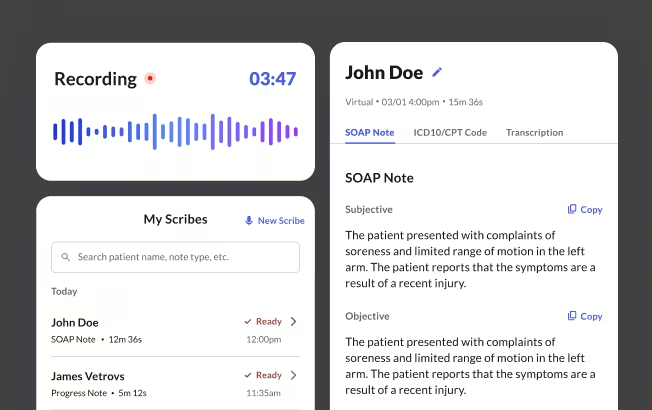
It is EMR-agnostic, with 60+ EHR integrations. Medium and large group practices get one-click sync, while solo and small practices (1–5 providers) use copy/paste into any system on this list. The workflow is Capture, Edit, Finalize, and nothing enters the chart unreviewed.
After End Recording, a structured SOAP note appears within seconds, with suggested ICD-10 and CPT codes generated. Transcription accuracy is 99.4%, and 90%+ of providers reduce clinical documentation time and digital fatigue. Pricing is transparent: $89/mo (most up-to-date pricing), or $59/mo billed annually, for solo and small practices after a 7-day unlimited trial, with custom pricing for groups.
Whichever platform you pick, you can try Commure Scribe against it on real encounters before committing.
For a ranked breakdown across specialties and practice sizes, see our guide to the best AI medical scribes.
This article is for informational and educational purposes only, does not constitute legal, medical, or professional advice, and does not guarantee any specific cost, rollout timeline, or purchasing outcome.
Frequently Asked Questions
Cloud EMR software built for small practices is the easiest to set up. SimplePractice and Tebra are designed for clinicians without IT support, and NextGen Office ships specialty blueprints that pre-configure workflows. Self-hosted OpenEMR and enterprise suites like Epic sit at the hard end of the rollout scale.
OpenEMR is the cheapest EMR software on license cost because the open-source license is free¹⁴. Hosting and support still cost money, so it is not free to run. Among paid options, SimplePractice publishes low per-clinician monthly tiers for behavioral health. Get all-in three-year totals before judging any platform as cheapest.
Yes, through Epic Community Connect. Independent practices join a sponsoring health system's Epic instance at lower cost instead of buying directly⁵. The trade-off is control: the sponsor's build choices, templates, and upgrade schedule apply. Practices outside a sponsor relationship will find ambulatory EMR software a more practical fit.
EMR software rollout time tracks system scope. Cloud EMR software for small practices can go live in weeks. Enterprise suites take many months because they touch clinical, billing, and operational workflows across departments. Data migration, interface building, and training drive most of the timeline, so staffing those tasks early shortens it.
Enterprise suites such as Epic, Oracle Health, and MEDITECH quote custom contracts. Most ambulatory EMR software sells per-provider subscriptions through quotes, while SimplePractice publishes its rates and OpenEMR is free to license. HealthIT.gov estimates upfront purchase and install at $15,000 to $70,000 per provider¹. Compare three-year all-in totals.
Sources
- HealthIT.gov. "How much is this going to cost me?" https://www.healthit.gov/faq/how-much-going-cost-purchase-and-install-electronic-health-record-ehr
- CDC National Center for Health Statistics. "National Electronic Health Records Survey Results." 2024. https://www.cdc.gov/nchs/nehrs/results/index.html
- Ratwani RM, Savage E, Will A, et al. "A usability and safety analysis of electronic health records: a multi-center study." Journal of the American Medical Informatics Association. 2018. https://academic.oup.com/jamia/article-abstract/25/9/1197/5047907
- AHRQ Digital Healthcare Research. "Improving Electronic Health Record Usability for Patient Safety." https://digital.ahrq.gov/program-overview/research-stories/improving-electronic-health-record-usability-patient-safety
- Epic Systems. "Software." https://www.epic.com/software/
- Oracle. "Oracle Unveils Next-Generation EHR." 2024. https://www.oracle.com/news/announcement/oracle-unveils-next-generation-ehr-2024-10-29/
- MEDITECH. "MEDITECH Expanse." https://ehr.meditech.com/ehr-solutions/meditech-expanse
- eClinicalWorks. https://www.eclinicalworks.com
- U.S. Department of Justice. "Electronic Health Records Vendor to Pay $155 Million to Settle False Claims Act Allegations." 2017. https://www.justice.gov/opa/pr/electronic-health-records-vendor-pay-155-million-settle-false-claims-act-allegations
- athenahealth. "Specialty practices." https://www.athenahealth.com/who-we-serve/specialty-practices
- NextGen Healthcare. "NextGen Office for Small Practices." https://www.nextgen.com/solutions/electronic-health-records/small-practices-nextgen-office
- AdvancedMD. "EMR/EHR Software." https://www.advancedmd.com/emr-ehr-software/
- SimplePractice. https://www.simplepractice.com
- OpenEMR. "OpenEMR Features." https://www.open-emr.org/wiki/index.php/OpenEMR_Features
- Tebra. "Kareo named Best in KLAS for small practice ambulatory electronic medical records/practice management solutions." 2021. https://www.tebra.com/press-release/kareo-named-best-in-klas-for-small-practice-ambulatory-electronic-medical-records-practice-management-solutions
- Office of the National Coordinator for Health IT. "National Trends in Hospital and Physician Adoption of Electronic Health Records." 2022. https://www.healthit.gov/data/quickstats/national-trends-hospital-and-physician-adoption-electronic-health-records/
- CMS. "CY 2024 Medicare Promoting Interoperability Program Requirements." 2024. https://www.cms.gov/files/document/2024-medicare-promoting-interoperability-requirements-infographic.pdf
- Kroth PJ, Morioka-Douglas N, Veres S, et al. "Association of Electronic Health Record Design and Use Factors With Clinician Stress and Burnout." JAMA Network Open. 2019. https://jamanetwork.com/journals/jamanetworkopen/fullarticle/2748054
- Rotenstein LS, Hendrix N, Phillips RL Jr, Adler-Milstein J. "Team and Electronic Health Record Features and Burnout Among Family Physicians." JAMA Network Open. 2024. https://jamanetwork.com/journals/jamanetworkopen/fullarticle/2825642

.jpeg)
.jpeg)

.jpeg)