



Medical Chart Template with Examples
A reusable chart template, three filled examples, and a printable blank to adapt for your practice.
Written by the Commure Scribe Team
Published: May 21, 2026
•
8 min read
A medical chart template is a reusable visit note layout. Clinicians fill it in differently for each visit. The template usually opens with a visit header, the chief complaint and the history of present illness (HPI). Next come review of systems; past, family and social history; and medications and allergies. The physical exam, an assessment with International Classification of Diseases (ICD-10) codes and a plan follow. Results with a dated sign-off close the note. The structure follows a Subjective, Objective, Assessment, Plan (SOAP) order and adapts to each specialty.
What You Need to Know
- Most chart templates share a common spine: header, history, exam, assessment, and plan, though the exact layout varies by specialty and practice.
- Below are three filled examples plus a printable blank you can adapt to your practice.
- The structure is SOAP-like. Use what fits the visit, skip what doesn't.
What is a medical chart template?
A medical chart template is a reusable layout for a visit note. The same parts, filled in differently each time¹. A good medical chart template can help keep your charting more steady. That makes it easier for the next doctor to follow care without rereading every prior note. It also helps ensure your charting supports the E/M level and other billing codes you submit³. And it keeps you from hunting for the right smart phrase at 9 pm.
The medical chart template below is SOAP-like. Adapt it to your specialty and how your group notes. For behavioral health visits charted as Data, Assessment, Plan (DAP) or similar formats, start from a progress note template with worked examples.
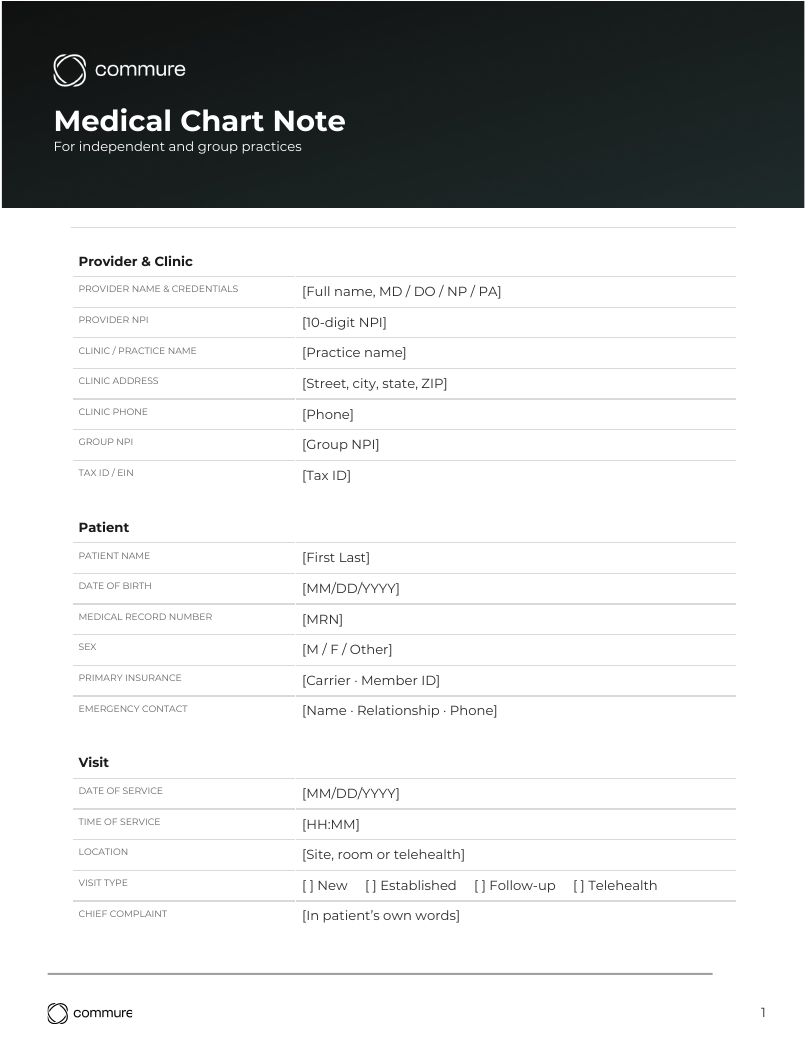
What belongs in a medical chart template?
These are common parts in many chart templates². Fill what's relevant to the visit.
- Visit header: patient name, date of birth (DOB), medical record number (MRN), visit date, time, location, visit type, provider name and signature
- Chief complaint: in the patient's words
- History of present illness: onset, location, duration, character, severity, timing
- Review of systems: the systems you actually reviewed
- Past, family, and social history: active problems, surgical history, family history, substance use, functional status
- Medications and allergies: current list with dose, route, frequency; allergies with reaction type
- Physical exam: vitals taken, exam by system relevant to the complaint
- Assessment: each active problem and your reasoning, with ICD-10 codes entered for each
- Plan: orders, medications, patient education, follow-up
- Results and sign-off: your read of returned results, a dated and time-stamped signature
How to fill each section of the medical chart template
The medical chart template is a structure. The actual charting is the practice. Here's how to fill each section of the medical chart template so the note is clinically useful and holds up on a billing audit.
Visit header
The header locks the chart to a specific patient, visit, and provider. Capture the patient identifiers, date and time, location, visit type, and a signed provider name. Visit type matters more than it looks. New versus established and in-person versus telehealth map to different CPT families or modifiers. Your recorded visit type should match what's submitted on the claim.
Chief complaint
Write the chief complaint in the patient's own words, in quotes when possible. "Back pain for three days" tells a different story than "chronic low back pain." The CC anchors the note. It also helps establish medical necessity for whatever you work up next.
History of present illness
OLDCARTS is a common structure for HPI: onset, location, duration, character, aggravating and relieving factors, timing, severity, and associated symptoms. You don't need every element every time. For current office E/M rules (codes 99202–99215), level selection is based on medical decision-making or total time. A clinically appropriate HPI still helps demonstrate medical necessity, even if it no longer drives the level directly.
Review of systems
Review the systems related to the chief complaint and document both pertinent positives and pertinent negatives. Compliance guidance often warns that excessive ROS and cloned notes can raise audit concerns, especially when the charting doesn't match the clinical scenario.
Past, family, and social history
Pull what's relevant to today's visit. Active problems and surgical history are almost always in scope. Family history matters for chronic disease screening and cancer risk talks. Social history (tobacco, alcohol, substance use, occupation, functional status) comes in when it changes the plan. Examples: smoking cessation counseling or a functional decline that triggers a referral.
Medications and allergies
List every current medication with dose, route, and frequency. Medication review is expected at most visits where you're making prescribing decisions, and a medication review (covering prescriptions, OTC drugs, vitamins, and supplements) is a documented component of the Medicare Annual Wellness Visit. For allergies, include the reaction type. "Penicillin, rash" is clinically more useful than "PCN allergy" when the next doctor is weighing a cephalosporin.
Physical exam
Document the vitals captured and the exam elements actually performed. Specialty visits often include a specific exam pattern that matches the complaint. A psychiatric visit often has a mental status exam. An ortho visit often has the joint exam with ROM and strength testing. A derm visit often has the skin exam. Charts where the exam elements don't match the complaint may be flagged in audit review.
Assessment
Each active problem gets a diagnosis or clinical impression and the clinical reasoning that connects history and exam to the diagnosis. An associated ICD-10 code is entered for each, often in a structured field rather than the narrative. Specificity matters. "E11.9 type 2 diabetes without complications" is a different picture than "E11.22 type 2 diabetes with diabetic chronic kidney disease" (with an added N18.x for the CKD stage). The more specific diagnosis supports the plan. It also helps justify the level of service.
Plan
The plan is where the visit becomes a record of what you did. Orders placed, medications started or changed, patient education delivered, follow-up interval, referrals made. The plan section summarizes what you did at the visit. For office E/M codes, the visit's CPT level is usually selected in a separate charting step, based on medical decision-making or total time. Either path is acceptable, and the charting should support whichever method you used.
Results and sign-off
Close the note with a date and time stamp on the signature. If labs or imaging came back between visits, acknowledge the result and document your interpretation or action. Examples: a follow-up order, a patient communication, a treatment change. Unaddressed results are a frequent focus in audits and malpractice cases, and many organizations treat them as a high-risk area.
Filled example: new primary care visit
This medical chart template is filled for a new primary care visit. The chief complaint is non-specific fatigue, layered with a prior abnormal cholesterol result. The value of the template here is the differential in the assessment. It shows how you connect a vague complaint to a structured diagnostic workup rather than chasing one finding. E/M codes in the examples are illustrative only. Actual level selection depends on recorded medical decision making (MDM) or total time under current rules.
Visit Header
- Patient: Maria Alvarez. DOB: 03/14/1972. MRN: 481920.
- Date: 04/23/2026. Location: Sunnyside Primary Care, Exam 2.
- Visit type: New primary care. Doctor: Dr. J. Okafor, MD.
Chief complaint
"I've been feeling really tired for about two months. My last doctor said my cholesterol was high."
HPI
- Two months of growing fatigue, worse in the afternoon.
- No fever or weight change. Poor sleep, reduced exercise.
- Prior provider flagged elevated total cholesterol at a retail clinic visit.
- No chest pain, shortness of breath, or lightheadedness.
Past, family, and social history
- No chronic conditions. Appendectomy, 2011.
- Mother with high cholesterol and type 2 diabetes.
- Non-smoker. Alcohol 2–3 drinks per week. Desk-based work.
Medications and allergies
- Medications: None.
- Allergies: NKDA.
Physical exam
- Vitals: BP 128/82. HR 78. RR 14. Temp 98.4°F. Weight 172 lb. Height 5'5". BMI 28.6.
- General: well-appearing, mildly fatigued affect.
- Cardiac: regular rate and rhythm, no murmurs.
- Lungs: clear. Abdomen: soft, non-tender. Neuro: grossly intact.
Assessment
- Fatigue, unclear (R53.83). Differential: hypothyroidism, anemia, sleep-related, depression.
- Mixed high cholesterol (E78.2). Elevated on prior labs, needs check.
- Overweight, adult (E66.3).
Plan
- Labs ordered: CBC, CMP, TSH, lipid panel, fasting glucose, HbA1c.
- PHQ-9 completed today, score 7.
- Lifestyle counseling on sleep, diet, and 150 min/week moderate activity.
- Follow-up in two weeks to review labs. Return sooner if symptoms worsen.
- CPT: 99203 (illustrative).
Results and sign-off
- Pending labs.
- Doctor signature: J. Okafor, MD.
Filled example: behavioral health follow-up
This medical chart template is filled for a brief established behavioral health follow-up. The mental status exam replaces the general physical exam. Behavioral health visits also tend to lean heavier on the plan section, since medication changes, therapy referrals, and crisis resources all get recorded here. The header has a 20-minute duration, which can support time-based coding when that method is used.
Visit Header
- Patient: David Chen. DOB: 07/22/1990. MRN: 267104.
- Date: 04/23/2026. Location: Riverside Behavioral Health, Telehealth.
- Visit type: Established, 20-minute follow-up. Doctor: L. Nguyen, PMHNP.
Chief complaint
"Anxiety is better on the new dose but I'm not sleeping well."
HPI
- Four weeks on escitalopram 10 mg daily for generalized anxiety disorder.
- Daytime anxiety down from 7/10 to 4/10.
- Early-morning awakening, 4–5 hours of sleep, no daytime napping.
- No suicidal or homicidal ideation.
Past, family, and social history
- GAD diagnosed six months ago. No prior psychiatric hospitalizations.
- Father with depression.
- Employed full-time in software. Supportive partner.
Medications and allergies
- Medications: Escitalopram 10 mg once daily. Multivitamin.
- Allergies: NKDA.
Mental status exam
- Alert, cooperative. Mood "anxious but better." Affect congruent.
- Speech regular rate and tone. Thought process linear.
- No perceptual disturbance. Insight and judgment intact.
Assessment
- Generalized anxiety disorder, partially responsive to SSRI (F41.1).
- Insomnia, likely medication-related (G47.00).
Plan
- Continue escitalopram 10 mg daily.
- Sleep hygiene handout reviewed and shared via portal.
- Consider dose change or adjunctive therapy if sleep does not improve in two weeks.
- Follow-up in three weeks. Crisis resources reviewed.
- CPT: 99213 (illustrative; under current rules, level may be selected by MDM or total time).
Results and sign-off
- N/A at this visit.
- Doctor signature: L. Nguyen, PMHNP.
Filled example: chronic disease follow-up
This medical chart template is filled for a 3-month diabetes check-in. Established chronic disease visits live or die on the plan and labs parts. The visit is essentially a loop: what changed since last visit, what labs to order, what referrals to make. The assessment shows every active diagnosis with an ICD-10 code, which helps support the level of service billed.
Visit Header
- Patient: Raymond Thompson. DOB: 11/08/1957. MRN: 309228.
- Date: 04/23/2026. Location: Sunnyside Primary Care, Exam 4.
- Visit type: Established, quarterly diabetes follow-up. Doctor: Dr. J. Okafor, MD.
Chief complaint
"Here for my three-month diabetes check-in."
HPI
- Type 2 diabetes for 12 years, on metformin and semaglutide.
- Home glucose logs show fasting values 110–140 mg/dL.
- No hypoglycemic events. Adherent to medications.
- Diet improved since last visit.
Past, family, and social history
- Type 2 diabetes (2014), hypertension (2018), high cholesterol (2015).
- Tonsillectomy, 1968.
- Former smoker, quit 2009. Retired. Walks 20 minutes daily.
Medications and allergies
- Metformin 1000 mg twice daily. Semaglutide 1 mg weekly.
- Lisinopril 20 mg daily. Atorvastatin 40 mg daily.
- Allergies: NKDA.
Physical exam
- Vitals: BP 132/78. HR 72. RR 14. Weight 198 lb. BMI 29.1.
- Cardiac: regular rate, no murmurs.
- Feet: no ulcerations, monofilament intact.
- Otherwise unremarkable.
Assessment
- Type 2 diabetes mellitus, controlled (E11.9). Last HbA1c 6.9%.
- Essential hypertension, controlled (I10).
- Mixed high cholesterol (E78.2).
Plan
- Continue current regimen.
- Labs ordered: HbA1c, CMP, lipid panel, urine microalbumin.
- Dilated eye exam referral placed. Foot exam recorded today.
- Diabetes self-management education reinforced.
- Follow-up in three months.
- CPT: 99214 (illustrative).
Results and sign-off
- Labs pending, referrals placed.
- Doctor signature: J. Okafor, MD.
Blank medical chart template
A printable, fillable blank medical chart template is open as a free companion file. The blank medical chart template covers the same nine parts as the examples above. It also has a practice-info block and a short compliance checklist you can use for chart audits. You can download by clicking here.
How Commure Scribe fills the medical chart template
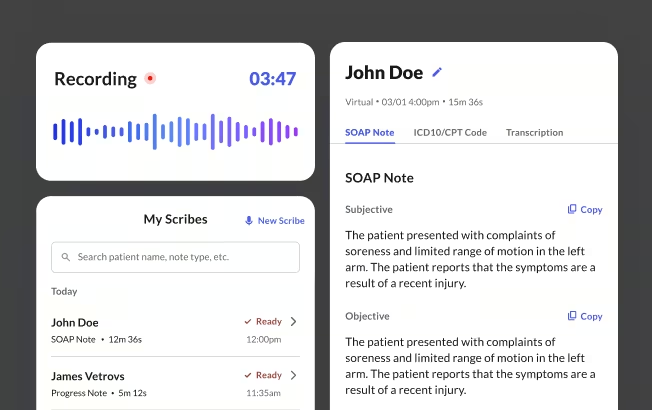
Commure Scribe is am ambient ai scribe that fills the medical chart template by listening to the visit. It drafts a structured SOAP-style note that maps to the template parts. The draft returns to you for review. You can then copy and paste the note into your EHR or use one-click sync where supported. The draft is built section by section. HPI lands in HPI. Exam findings land in the exam section. Assessment and plan land where the template expects them.
The workflow runs in three steps: Capture, Edit, and Finalize. Commure Scribe listens to the visit and builds the draft into the standard chart part. You review the draft where clinical judgment needs it. You can copy and paste the note into your EHR or use one-click sync where your EHR is supported. Commure Scribe syncs with 60+ EHRs, like AdvancedMD, athenahealth, and eClinicalWorks.
This article serves as educational content, not legal, medical, or billing advice. Example patients are fictional and E/M codes are illustrative.
Medical Chart Template Download
Download a copy of this template
Thanks! Your medical chart template is ready.
Click below to download.

Frequently Asked Questions
A medical chart template is a reusable structure for writing visit notes: the same parts, filled in visit after visit. It can help keep your charts more steady. It supports the billing code you submit. It also makes it easier for the next doctor to pick up care.
Common parts are visit header, chief complaint, HPI, past and social history, medications and allergies, physical exam, assessment with ICD-10, plan, and a signed sign-off. Fill what's relevant to the visit.
Yes. The free printable blank medical chart template linked above is the companion to this article. Same nine parts as the examples, plus a practice-info block and a compliance checklist.
An AI scribe listens to the visit, drafts a structured note mapped to the medical chart template parts, and returns it for your review. You can copy it into the EHR or use direct sync where supported. The scribe drafts; the doctor signs.
A general medical chart template can cover common elements across primary care, behavioral health, and chronic disease follow-up, as shown above. Most groups layer in specialty-specific fields on top of the core template. Psychiatry swaps in an MSE. Ortho adds exam diagrams. Procedural visits add pre/post-op parts.
Sources
- Institute of Medical and Business Careers. (2025). What is a medical chart. Retrieved from https://imbc.edu/online-health-sciences-healthcare-support-degree-a-s-t/healthcare-training/what-is-a-medical-chart/
- Hunter Business School. (2018). Guide to medical office records management procedure. Retrieved from https://hunterbusinessschool.edu/guide-to-medical-office-administration-records-management/
- Hall, M. A. (2017). Understanding medical records in the twenty-first century. Barry Law Review. Retrieved from https://lawpublications.barry.edu/cgi/viewcontent.cgi?article=1124&context=barrylrev
- Gliklich, R. E., Dreyer, N. A., & Leavy, M. B. (Eds.). (2014). Registries for evaluating patient outcomes: A user's guide (3rd ed.). Chapter 6: Data sources for registries. Agency for Healthcare Research and Quality. Retrieved from https://www.ncbi.nlm.nih.gov/books/NBK208611/