



Top 10 Free EHR Software for 2026
A clinician-oriented roundup of 10 free EHRs, with hosting, setup time, best-for use case, and pricing for each.
Written by the Commure Scribe Team
Published: June 5, 2026
•
11 min read
Updated June 5, 2026
The best free EHR depends on practice type and IT capacity. OpenEMR suits multi-specialty practices with in-house IT, and OpenMRS suits community clinics and global health programs. Hippocrate and CharmHealth suit solo physicians who want cloud setup on day one. CharmHealth stays free up to 50 encounters a month. Therapists can use Sessions Health, free for up to 3 clients, or CarePatron. Healthie suits virtual-first wellness and nutrition practices.
What You Need to Know About Free EHRs
- A free EHR is a clinical record system available at no license cost, usually as open-source self-hosted software or a vendor free tier with feature or volume caps.
- About 95% of office-based US doctors had adopted an EHR by 2024, so the question for new and growing practices is which one to pick¹.
- The 10 free EHR options below cover open-source, vendor free tiers, and specialty-specific platforms; pick by encounter volume, IT capacity, and specialty fit.
Pricing and free-tier limits change frequently. Confirm current details on each vendor's site.
Top 10 free EHR software in 2026
"Free" here means zero license cost. Self-hosted platforms still incur hosting, IT, and maintenance time. Vendor free tiers may charge for advanced features, integrations, or support. Hidden costs like setup, training, and workflow redesign apply to paid EHRs too. The "best for" and "skip if" lines below describe typical use-case fit, not vendor product limits.
1. OpenEMR
Cost: Free (self-hosted). Cloud hosting may add fees.
OpenEMR⁵ is an open-source free EHR and practice management system. It is widely used by solo practices, small clinics, and global health groups. These users want full control over their software stack. The active developer community ships frequent updates and security patches.
Core features include the following:
- Patient charting and scheduling
- Basic billing and claims
- Modular settings menu with toggleable features
- Custom interfaces and integrations
- Best for: practices with in-house or contracted IT that want full control and customization.
- Skip if: you need turnkey setup or built-in e-prescribing without external add-ons.
2. OpenMRS
Cost: Free (self-hosted). Cloud hosting may add fees.
OpenMRS⁶ is an open-source free EHR for resource-constrained settings². It is widely used in community clinics, small practices, and resource-constrained settings across the US and abroad. A flexible "concept dictionary" lets users manage patient data without changing the database structure.
Core features include the following:
- Custom templates and patient groups
- REST and Fast Healthcare Interoperability Resources (FHIR) APIs for integration
- Clinical decision support alerts and reminders
- Lab, pharmacy, and billing modules
- Best for: community clinics, public health programs, and groups with technical staff.
- Skip if: you want a polished out-of-box product or have no IT capacity.
3. Hippocrate
Cost: Free for solo practitioners. Paid plans start around $25/mo per provider.
Hippocrate⁷ is a cloud-based free EHR built for solo practice physicians. It puts charting, scheduling, lab and imaging links, e-prescribing, and telemedicine in one workspace. Provider collaboration tools support secure referrals between specialists.
Core features include the following:
- ICD-10 coding support
- Patient self-service portal and intake
- Appointment scheduling with reminders
- e-Prescribing and lab integrations
- Best for: solo physicians who want a turnkey cloud system without IT overhead.
- Skip if: you have multiple providers or expect to grow past solo soon.
4. FreeMED
Cost: Free (open-source).
FreeMED⁸ is an open-source free EHR and practice management system. It runs on PHP, Apache, and MySQL in any web browser. The modular structure supports multiple languages, including French, Japanese, and German.
Core features include the following:
- Scheduling and prescription writing
- Document management and PDF templating
- HL7 support and XML-RPC web services
- Internal messaging and external billing integrations
- Best for: clinics with technical staff and multilingual or international needs.
- Skip if: you need turnkey setup or active vendor support.
5. Ottehr
Cost: Free to get started. Technical setup may vary.
Ottehr⁹ is a modern, modular free EHR. It was first built as a reference project for a developer platform in healthcare. The system includes a patient portal for appointments, intake, and telehealth. The staff-facing EHR covers scheduling, charting, e-prescribing, and care plans.
Core features include the following:
- Telehealth and remote monitoring
- Patient messaging via SMS and chat
- Multi-location scheduling and queue tracking
- Modular, white-label-ready front end
- Best for: clinics with developer or IT teams that want to customize or build on the system.
- Skip if: you need an out-of-box clinical EHR with no engineering work.
6. Oscar EMR
Cost: Free (self-hosted or cloud).
Oscar EMR¹⁰ is an open-source free EHR developed at McMaster University. It is widely used by Canadian primary care practices and community clinics. A large developer community and active third-party support market back it.
Core features include the following:
- Patient records, scheduling, and billing
- e-Prescribing and secure messaging
- Chronic disease management tools
- Lab result viewing and drug database links
- Best for: primary care and community clinics willing to work with IT or a third-party support partner.
- Skip if: you need a turnkey vendor-supported product or US-specific billing tools out of the box.
7. Sessions Health
Cost: Free for up to 3 clients. Paid plans from $39/mo (30-day trial available).
Sessions Health¹¹ is a cloud-based free EHR built for mental health professionals. The platform centers on therapy workflows: progress notes, intake forms, and clinically focused templates. Users describe the layout as designed for therapists rather than retrofitted from a medical EHR.
Core features include the following:
- Scheduling, billing, and telehealth
- Progress notes and intake forms
- Secure messaging with clients
- Two-way calendar sync and electronic signatures
- Best for: solo therapists and small mental health practices testing the platform.
- Skip if: you have more than 3 active clients or need primary care features.
8. CharmHealth
Cost: Free for up to 50 patient encounters per month. Paid plans from $25/mo.
CharmHealth¹² is a cloud-based free EHR and practice management platform for small clinics. The free plan covers core EHR tools plus practice management. The system meets HIPAA guidelines when configured correctly. The platform works across devices and browsers.
Core features include the following:
- Patient charting and personalized templates
- Appointment scheduling and patient portal
- Basic practice management and analytics
- Visit-type charts for different specialties
- Best for: very small clinics, functional medicine, and integrative practices under 50 encounters per month.
- Skip if: you need higher volume, robust insurance billing, or advanced eRx without a paid upgrade.
9. CarePatron
Cost: Free plan with unlimited clients and limited features.
CarePatron¹³ is a cloud-based free EHR for solo practitioners and small teams. The free plan supports unlimited clients, which is unusual at this price point. The platform offers HIPAA-compliant document management with electronic signatures.
Core features include the following:
- Client scheduling and secure video calls
- Automated billing and payments
- Client portal with document sharing
- Note-taking, invoicing, and custom forms
- Best for: solo therapy, coaching, and wellness practices that want unlimited clients at no cost.
- Skip if: you need template flexibility, advanced insurance billing, or specialty clinical workflows.
10. Healthie
Cost: Free for up to 10 active clients. Paid plans from $49/mo.
Healthie¹⁴ is a cloud-based free EHR for wellness, nutrition, and mental health providers. The platform is virtual-first, with HIPAA-compliant tools designed for telehealth-centric practices.
Core features include the following:
- Charting, scheduling, and secure messaging
- Telehealth with 1-on-1 and group sessions
- Client portal with food and activity tracking
- Intake, Subjective, Objective, Assessment, Plan (SOAP) notes, and billing
- Integrations with Stripe, Zoom, and Fullscript
- Best for: virtual-first wellness, nutrition, and mental health practices with a small client base.
- Skip if: you have more than 10 active clients or need in-person clinical workflows.
Decision shortcuts by use case
Use these shortcuts to narrow the shortlist quickly:
- Solo therapist or counselor → Sessions Health (clinical mental-health workflow) or CarePatron (unlimited clients).
- Solo physician, turnkey cloud → Hippocrate (built for solo) or CharmHealth (under 50 encounters/mo).
- Functional medicine or integrative small clinic → CharmHealth (template flexibility for supplement protocols and visit types).
- Wellness, nutrition, or virtual-first practice → Healthie (group sessions, food and activity tracking).
- Primary care with IT capacity → Oscar EMR (chronic disease tools) or OpenEMR (modular).
- Community clinic or global health setting → OpenMRS (built for resource-constrained settings).
- Multi-specialty practice with IT → OpenEMR (modular and customizable).
- Multilingual or international clinic → FreeMED (multilingual support built in).
- Developer team building a custom EHR → Ottehr (modular, white-label-ready).
How to evaluate a free EHR before committing
Before any clinical use, run the same diligence on a free EHR as on a paid one. The license being zero does not change what the system has to do clinically, operationally, and legally. The free EHR vendor must meet the same baseline that any paid system would.
- ONC certification if the practice plans to participate in Medicare Promoting Interoperability or quality reporting programs³.
- Business Associate Agreement (BAA) signed by the vendor, covering HIPAA-protected health information.
- E-prescribing scope, including support for electronic prescribing of controlled substances (EPCS) where clinically needed.
- Data portability in HL7 FHIR or CCDA format, with structured patient-record export, not just PDF.
- Support model that matches clinic-day needs: community forums, email-only, or sponsor-routed.
- Change-of-terms language covering encounter caps, provider caps, and the vendor's right to retire the free tier.
Security and compliance with free EHR software
Free EHRs face the same rules as paid systems. A free EHR is not exempt from HIPAA or Office of the National Coordinator for Health Information Technology (ONC) rules where they apply. Federal guidance from Centers for Medicare & Medicaid Services (CMS) calls accurate documentation and strong audit controls core to safe EHR use⁴. Each tool above shares the same baseline. The vendor must sign a BAA, the system must be HIPAA-aligned, and data-export paths must be clear. None is "more compliant" than another by default.
- Software updates and security patches applied on a regular cadence.
- HIPAA-compliant hosting with encryption at rest and in transit, plus granular access controls.
- Role-based access so each user only sees the data their role requires.
- Audit logs of every patient-record access event, retained per HIPAA requirements.
- Periodic security audits and penetration testing.
- Staff training on phishing, password hygiene, and incident response.
How Commure Scribe pairs with any free EHR to cut documentation time
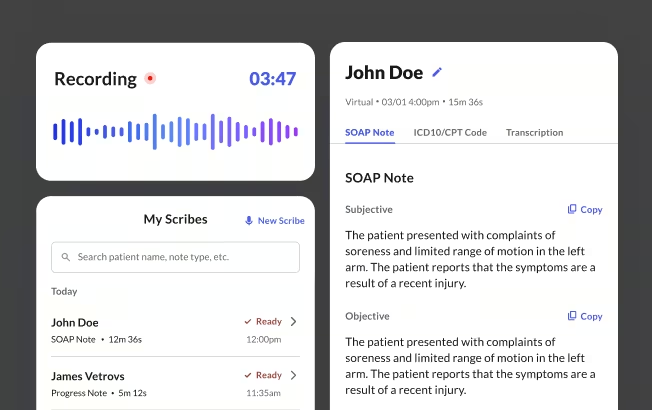
Commure Scribe is an ambient AI medical scribe that pairs with any free EHR. It captures the clinical encounter and drafts a structured note. The clinician always has the option to review, edit, and finalize the note before it enters the chart. It works with 60+ EHR integrations plus a copy/paste fallback. The existing free EHR stays in place and the ambient documentation layer sits on top.
Pairing Commure Scribe with the existing free EHR extends the runway. The practice keeps the free EHR in place and avoids a migration just to address charting time. 90%+ of providers reduce clinical documentation time and digital fatigue, and 91% report feeling less fatigued. For a ranked breakdown of options across vendors, see the best AI medical scribes guide.
Frequently Asked Questions
Yes, in two main forms. Open-source platforms like OpenEMR, OpenMRS, and Oscar EMR can be self-hosted at no license cost. Vendor free tiers like CharmHealth, Sessions Health, and Healthie offer no-cost plans with feature or volume caps. None are free of operating costs, since setup, training, and IT support still take time and money.
The right fit depends on encounter volume, technical capacity, and specialty. For a broader comparison beyond free options, see the best EMR software guide. Mental health practices often prefer Sessions Health for clinical-template fit. Wellness and nutrition practices lean toward Healthie. Primary care and small clinics with limited IT often pick CharmHealth or CarePatron for the turnkey setup. Practices with developer resources prefer OpenEMR or OpenMRS for the custom control.
Open-source platforms include features that support HIPAA compliance. Compliance depends on how the practice deploys and runs the system. Self-hosted EHRs need the practice to handle access controls, audit logs, encryption, backups, and breach reporting. Compliance is the practice's responsibility, not an attribute of the software alone.
Yes. Ambient AI scribes are EHR-agnostic and pair with most free or paid EHRs. The scribe captures the visit and drafts the note. The clinician reviews and finalizes the note in the EHR. This decouples charting workflow from EHR feature depth. That often matters more than license cost for clinician time.
The biggest risk of a free EHR is hidden cost. Limits the practice does not see at signup add up later. Encounter caps, paywalled features, retired free tiers, and weak support can each force a costly migration. Read the free EHR change-of-terms language before clinical use. Confirm data portability so chart histories can leave with the practice.
Sources
- CDC/NCHS. National Electronic Health Records Survey (NEHRS) Results, 2024 findings. 2025. https://www.cdc.gov/nchs/nehrs/results/index.html
- Purkayastha S, Allam R, Maity P, Gichoya JW. Comparison of Open-Source Electronic Health Record Systems Based on Functional and User Performance Criteria. Healthc Inform Res. 2019 Apr;25(2):89-98. doi: 10.4258/hir.2019.25.2.89. Epub 2019 Apr 30. PMID: 31131143; PMCID: PMC6517630. https://pmc.ncbi.nlm.nih.gov/articles/PMC6517630/
- CMS. CY 2024 Medicare Promoting Interoperability Program Requirements. 2024. https://www.cms.gov/files/document/2024-medicare-promoting-interoperability-requirements-infographic.pdf
- CMS Office of the Actuary. Electronic Health Records Demonstration Evaluation. 2010. https://www.cms.gov/research-statistics-data-and-systems/statistics-trends-and-reports/reports/downloads/felt-lisk_ehrd_final_2010.pdf
- OpenEMR. Open-source EHR and practice management. https://www.open-emr.org
- OpenMRS. Open-source medical record system. https://openmrs.org
- Hippocrate. Free EHR / EMR software. https://www.hippocrate.org
- FreeMED. Open-source medical record software. https://www.freemedsoftware.org
- Ottehr. Modular EHR and developer platform. https://ottehr.com
- Oscar EMR. Open-source EHR. https://oscarcanada.org
- Sessions Health. EHR for mental health professionals. https://www.sessionshealth.com
- CharmHealth. Cloud-based EHR and practice management. https://www.charmhealth.com
- CarePatron. Practice management platform. https://www.carepatron.com
- Healthie. EHR for wellness, nutrition, and mental health. https://www.gethealthie.com
.jpeg)

.jpeg)
.jpeg)
.jpeg)