



Best EHR for Behavioral Health Organizations: Guide (2026)
A guide for administrators and clinical leads at CMHCs, CCBHCs, SUD programs, and multi-site behavioral health groups choosing an EHR for behavioral health at scale.
Written by the Commure Scribe Team
Published: June 26, 2026
•
10 min read
Updated June 26, 2026
The best EHR for a behavioral health group depends on its service mix. Qualifacts CareLogic fits Certified Community Behavioral Health Clinics (CCBHCs) and large agencies. Netsmart myEvolv fits multi-service programs. Credible fits mid-to-large outpatient groups with complex payer mixes. Kipu fits substance use disorder (SUD) treatment, and Oracle Health suits health systems already on Cerner. ICANotes suits mid-size groups that need deep psychiatric charting, and Welligent suits public sector and crisis services.
What You Need to Know About EHRs for Behavioral Health
- Selecting an EHR for behavioral health at a larger organization requires evaluating CCBHC compliance reporting, Medicaid billing complexity, 42 CFR Part 2 SUD record handling, and multi-site workflow support that solo-practice platforms cannot provide.
- Only 20% of behavioral health organizations had fully adopted EHRs compared to 60%+ in general healthcare, leaving community mental health centers, SUD programs, and integrated care organizations at the sharpest end of the adoption gap.¹
- This guide covers EHR for behavioral health platforms built for CMHCs, CCBHCs, SUD treatment programs, health systems with behavioral health service lines, and multi-location groups with 25 or more providers.
Choosing an EHR for behavioral health at a larger organization is not the same problem as choosing software for a solo therapist or small private practice. For solo and small-group clinicians, see the guide to the best EHR for mental health private practice. This guide covers what an EHR for behavioral health must do for organizations operating at scale: CCBHC reporting, Medicaid billing complexity, multi-site configuration, state agency reporting, and 42 CFR Part 2 SUD compliance workflows built in by design.
How We Selected These EHRs
We evaluated each EHR for behavioral health against six criteria relevant to organizations with 25 or more providers: (1) behavioral health workflow specificity, including support for psychiatric evaluations, therapy progress notes, group encounter documentation, SOAP, DAP, and BIRP formats, and treatment plan workflows; (2) compliance with 42 CFR Part 2 SUD record requirements and CCBHC reporting standards; (3) Medicaid billing complexity support, including prior authorization workflows and multi-payer claim management; (4) multi-site and enterprise capabilities including staff roles, permissions hierarchies, and organizational reporting; (5) suitability for the organizations that account for the largest share of behavioral health encounters: CMHCs, CCBHCs, SUD programs, health systems with behavioral health service lines, and IDD providers; and (6) verified published pricing or transparent contact-for-quote positioning. We excluded platforms built primarily for solo or small private practice. SimplePractice and TherapyNotes are covered separately in the best EHR for mental health private practice guide.
The Best EHRs for Behavioral Health Organizations
1. Qualifacts CareLogic: Best for CCBHCs and Large Outpatient Behavioral Health Agencies
Qualifacts CareLogic is the most widely recommended EHR for behavioral health agencies operating under CCBHC certification, built for the compliance and reporting demands of large agency and CMHC environments serving complex Medicaid populations.
- Note formats: SOAP, DAP, BIRP, psychiatric evaluations, group session notes, treatment plan workflows, and progress note templates built for community behavioral health encounters.
- Billing: Medicaid billing complexity support including multi-payer claim management, prior authorization workflows, and revenue cycle tools designed for community behavioral health reimbursement environments.
- Compliance: CCBHC reporting module covering the eight CCBHC required service categories and federal reporting metrics; 42 CFR Part 2 consent tracking workflows for SUD-serving programs.
- Reporting/Integration: Outcomes tracking with population-level dashboards, state agency reporting tools, and application programming interface (API) integration for organizational data needs at the agency level.
- Limitations: CareLogic is purpose-built for large agencies and is not appropriate for small groups or solo providers. Implementation timelines are substantial and require dedicated project resources.
2. Netsmart myEvolv: Best for Multi-Service Behavioral Health Organizations
Netsmart myEvolv is an enterprise-grade EHR for behavioral health organizations delivering mental health, substance use disorder, IDD, and crisis services across multiple programs and locations.
- Note formats: Configurable documentation across MH, SUD, IDD, and crisis service lines; treatment plan workflows, psychiatric evaluations, care coordination notes, and case management documentation.
- Billing: Multi-payer billing including Medicaid, Medicare, commercial insurers, and state-funded programs; prior authorization workflows and denial management.
- Compliance: 42 CFR Part 2 SUD record handling; state reporting requirements for behavioral health agencies; ONC-certified health IT where applicable.
- Reporting/Integration: State agency reporting, population health analytics, care coordination dashboards, and API-level integration for health information exchange. myEvolv is one of the few behavioral health EHR platforms with broad IDD program support alongside MH and SUD.
- Limitations: Enterprise configuration complexity requires significant implementation investment. Organizations without a dedicated IT resource should plan for a longer go-live timeline.
3. Credible Behavioral Health (Qualifacts): Best for Mid-to-Large Outpatient Behavioral Health with Complex Payer Mix
Credible Behavioral Health, now part of the Qualifacts portfolio, is a purpose-built EHR for behavioral health organizations in the mid-to-large segment that need deep billing functionality alongside clinical documentation without the full complexity of an enterprise CMHC platform.
- Note formats: Outpatient behavioral health note templates covering therapy, psychiatric evaluation, group encounters, and co-occurring disorder documentation.
- Billing: Complex payer mix support including Medicaid managed care, commercial, and county-funded contracts; prior authorization and claims management built for multi-payer behavioral health billing.
- Compliance: HIPAA-compliant psychotherapy note handling with provider-controlled access; 42 CFR Part 2 consent documentation support for SUD-serving programs.
- Reporting/Integration: Program-level reporting dashboards, outcomes tracking, and integration with Qualifacts ecosystem tools. Positioned between the mid-market and enterprise segments.
- Limitations: Organizations with CCBHC certification requirements may find CareLogic a better fit for the full CCBHC reporting module. Credible is strongest for outpatient-only programs.
4. Kipu Health: Best for SUD and Addiction Treatment Programs
Kipu is the leading EHR for behavioral health programs focused on substance use disorder treatment, covering the full continuum from detox and residential through partial hospitalization (PHP), intensive outpatient (IOP), and community-based care levels.
- Note formats: ASAM criteria documentation, MAT (medication-assisted treatment) workflow notes, group therapy notes, detox and residential level-of-care documentation, and SUD-specific treatment plans.
- Billing: SUD billing across levels of care including residential and IOP CPT codes; prior authorization workflows for behavioral health and SUD payers.
- Compliance: 42 CFR Part 2 compliance for programs receiving federal assistance, with SUD record consent tracking built into the workflow to meet the 2024 Final Rule requirements. This is the most developed 42 CFR Part 2 implementation among the platforms reviewed.²
- Reporting/Integration: Multi-level-of-care workflow tracking, utilization review tools, and integration with pharmacy and lab partners. Kipu is one of the few behavioral health EHR platforms where 42 CFR Part 2 is a core design principle rather than an add-on.
- Limitations: Kipu is purpose-built for SUD treatment. Behavioral health organizations that do not deliver SUD services will find the clinical toolset narrower than a general behavioral health platform.
5. Oracle Health (Cerner) Behavioral Health: Best for Health Systems Adding Behavioral Health Service Lines
Oracle Health (formerly Cerner) offers a behavioral health module that functions as an EHR for behavioral health service lines within health systems and integrated delivery networks already operating on Cerner infrastructure.
- Note formats: Behavioral health documentation within the broader Oracle Health clinical environment, including psychiatric evaluations, inpatient and outpatient behavioral health notes, and co-occurring disorder documentation within the unified patient record.
- Billing: Full revenue cycle management within Oracle Health, with behavioral health CPT code support integrated into the enterprise billing environment.
- Compliance: HIPAA psychotherapy note protections within the Oracle Health platform; 42 CFR Part 2 support for SUD records within existing BAA and compliance frameworks.
- Reporting/Integration: Deep interoperability within the Oracle Health ecosystem, including unified patient records across behavioral health, primary care, and specialty lines; health information exchange through CommonWell and Carequality.
- Limitations: Oracle Health Behavioral Health is most valuable for organizations already on Cerner. Health systems evaluating a stand-alone behavioral health EHR from scratch may find purpose-built behavioral health platforms more cost-effective and faster to implement.
6. ICANotes: Best for Mid-Size Behavioral Health Organizations Needing Deep Psychiatric Documentation
ICANotes is a behavioral-health-only EHR for behavioral health organizations in the mid-size segment that need deep psychiatric documentation without enterprise implementation complexity, offering one of the most comprehensive clinical note template libraries available.
- Note formats: Extensive template library for behavioral health and psychiatry including psychiatric evaluations, therapy progress notes (SOAP, DAP, BIRP), group session notes, MAT notes, and safety assessment documentation.
- Billing: Behavioral health CPT code billing including psychiatry evaluation codes (90791, 90792) and psychotherapy codes (90832–90838), with prior authorization support.
- Compliance: HIPAA-compliant psychotherapy note handling with provider-controlled access; clinical documentation depth appropriate for mid-size behavioral health organizations navigating state licensing requirements.
- Reporting/Integration: Multi-provider scheduling, staff permissions, and group therapy billing that scales to mid-size organizations without requiring enterprise configuration. Not the primary choice for the solo-practice segment, which is covered in the best EHR for mental health private practice guide.
- Limitations: ICANotes has a steeper learning curve than simplified solo-practice platforms. Organizations requiring CCBHC reporting or enterprise state agency reporting should evaluate CareLogic or myEvolv.
7. Welligent: Best for Public Sector Behavioral Health and Crisis Services
Welligent is an EHR for behavioral health agencies operating in the public sector, including county behavioral health systems and organizations delivering crisis services where government reporting, county funding streams, and high-volume crisis encounter documentation are primary requirements.
- Note formats: Crisis services documentation, community behavioral health progress notes, case management notes, and program-level encounter documentation designed for public sector workflows.
- Billing: County-funded and government-contracted billing environments; Medicaid fee-for-service and managed care billing; encounter-based reporting for government contracts.
- Compliance: Public sector compliance requirements including state and county reporting mandates; 42 CFR Part 2 documentation support for SUD-serving public programs.
- Reporting/Integration: Government contract reporting, program utilization data, crisis services encounter reporting, and integration with county and state data systems. Welligent is the strongest option on this list for public-sector behavioral health specifically.
- Limitations: Welligent is designed for public sector organizations. Larger private behavioral health groups with complex commercial payer mixes may find CareLogic or myEvolv a better fit for their billing environment.
What Makes a Behavioral Health EHR Different from a General EHR
Standard EHRs are designed for primary care, E/M coding, and problem-oriented Subjective, Objective, Assessment, Plan (SOAP) notes. An EHR for behavioral health serving larger organizations must go further on multiple dimensions that general platforms are not designed to address.
Specialty note formats at scale. Psychiatric evaluations, therapy progress notes, group session notes, ASAM criteria documentation, and co-occurring disorder assessments each have distinct structures. An EHR for behavioral health used by a 50-provider CMHC needs configurable templates across all of these, not a generic primary care note adapted to fit.
Behavioral health billing complexity. Psychiatry and psychotherapy CPT codes (90791, 90792, 90832–90838) differ from standard E/M codes. At the organizational level, behavioral health billing also involves Medicaid managed care, county funding contracts, and prior authorization workflows for behavioral health payers. These are not incidental additions to a general EHR. For organizations serving Medicaid populations, billing accuracy is the revenue foundation.
42 CFR Part 2 compliance for SUD-serving programs. Providers at federally aided programs that deliver SUD treatment must meet 42 CFR Part 2. The 2024 Final Rule aligned Part 2 enforcement with HIPAA, introduced a new SUD counseling notes category with heightened protections, and required compliance by February 16, 2026.²·⁴ An EHR for behavioral health that serves SUD patients must support Part 2-compliant consent tracking. The 2024 rule requires documentation of the consent that authorized treatment or payment disclosures, not physical segregation of records. Not all behavioral health EHR platforms support this out of the box. Kipu is purpose-built for it. Netsmart myEvolv and Qualifacts CareLogic include it as part of their enterprise compliance frameworks.
CCBHC reporting. Certified Community Behavioral Health Clinics operate under a federal program model with eight required service categories and federal reporting metrics. An EHR for behavioral health serving a CCBHC must support this reporting module. General EHRs and most solo-practice platforms do not.
Psychotherapy note handling. HIPAA gives psychotherapy notes stronger protections than general clinical notes.³ The EHR must store them separately and give providers control over access. The 21st Century Cures Act requires near-immediate patient access to most clinical notes. This creates real compliance tension for behavioral health organizations where psychotherapy notes carry HIPAA protections. The behavioral health EHR must handle both requirements correctly.
Multi-site and enterprise capabilities. A CMHC operating across eight locations or a behavioral health group with 50 providers needs staff roles and permissions hierarchies, multi-site scheduling, organizational reporting, and audit trail functionality. These are standard enterprise requirements that solo-practice platforms do not offer.
How AI Scribing Reduces Documentation Burden in Behavioral Health
An AI scribe works alongside a behavioral health EHR to cut the time providers spend writing notes after visits. In high-volume settings where clinicians carry 40 or more active cases, after-hours documentation drives reduced caseloads and staff attrition.
The clinician records the encounter. The scribe generates a structured draft. The clinician reviews and approves before anything enters the chart. For behavioral health, that approval step is non-negotiable. Safety assessments and suicidality documentation require clinical judgment regardless of how the note was created.
How Commure Scribe Works with Behavioral Health EHRs
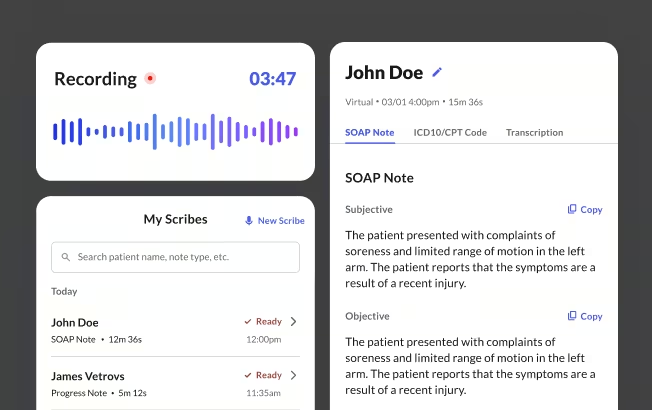
Commure Scribe reduces documentation time across behavioral health and psychiatry without requiring an EHR switch. After the provider clicks End Recording, a structured note appears with suggested ICD-10 and CPT codes. The provider reviews and approves before it enters the chart.
More than 90% of providers reduce clinical documentation time. 91% report feeling less fatigued. Commure Scribe integrates with Kipu and 60+ other EHR systems. It is HIPAA compliant, System and Organization Controls 2 (SOC 2) certified, and audio is never used for AI training. Organizations can start with a 7-day free trial.
42 CFR Part 2 Compliance: What to Ask Your EHR Vendor
42 CFR Part 2 applies to programs that receive federal assistance and provide SUD treatment.² The 2024 Final Rule brought Part 2 civil and criminal penalties in line with HIPAA enforcement and applied HIPAA Breach Notification rules to Part 2 breaches. It also created a new SUD counseling notes category with stronger protections similar to psychotherapy notes.² All covered programs were required to comply by February 16, 2026.⁴
Not all behavioral health EHR platforms support Part 2 requirements out of the box. Evaluating the right EHR for behavioral health programs that deliver SUD treatment requires specific vendor questions. Before selecting an EHR for behavioral health programs with SUD services, ask:
- Does the system support 42 CFR Part 2 consent workflows? Part 2 now allows a single consent covering treatment, payment, and operations. The EHR must capture and document this consent at the program level.²
- Does the EHR track which consent authorized which disclosure? The 2024 Final Rule requires tracking of the consent that authorized treatment or payment disclosures, not physical segregation of SUD records.
- Does the system apply HIPAA Breach Notification to Part 2 breaches? The 2024 Final Rule requires this.² Confirm the vendor's breach response covers Part 2 records explicitly.
- Does the vendor provide a Business Associate Agreement that covers Part 2? A BAA alone does not fulfill Part 2 obligations. Its absence is a red flag for any SUD-serving program.
Not all behavioral health programs are Part 2-covered. Part 2 applies only to programs that receive federal assistance for SUD treatment. Organizations that are unsure should confirm with their compliance officer before making any EHR for behavioral health purchase decisions based on Part 2 requirements alone.
This article is for informational and educational purposes only. It does not constitute legal, medical, or professional advice. It does not guarantee regulatory compliance with any specific EHR selection.
Frequently Asked Questions
There is no single best EHR for behavioral health. For CCBHCs and large community behavioral health agencies, Qualifacts CareLogic leads on CCBHC reporting and Medicaid billing. For multi-service organizations serving MH, SUD, IDD, and crisis populations, Netsmart myEvolv offers the broadest enterprise capabilities. SUD treatment programs should evaluate Kipu for its built-in 42 CFR Part 2 compliance and MAT workflow support. Health systems already on Oracle Health can extend behavioral health documentation within their existing Cerner infrastructure. Mid-size behavioral health organizations that need deep psychiatric documentation without enterprise complexity should consider ICANotes. Public sector agencies and crisis services programs should evaluate Welligent.
Qualifacts CareLogic and Netsmart myEvolv are the most widely deployed EHR for behavioral health platforms among community mental health centers and CCBHCs. Both are purpose-built for large agency environments with complex Medicaid billing and state reporting requirements.
An EHR for behavioral health includes tools that standard EHRs lack. These include therapy and psychiatric note templates, certified community behavioral health clinic (CCBHC) reporting modules, and behavioral health CPT billing. They also track 42 CFR Part 2 consent for substance use disorder records and keep psychotherapy notes separate under HIPAA. Standard EHRs are built for primary care problem-oriented documentation and E/M coding. Adapting a general EHR for a community mental health center or substance use treatment program requires workarounds that purpose-built platforms handle natively.
42 CFR Part 2 governs the privacy of SUD patient records at federally aided programs.² The 2024 Final Rule brought Part 2 enforcement in line with HIPAA. Covered programs were required to comply by February 16, 2026.⁴ Part 2 applies to the program, not the EHR. The EHR must support Part 2 workflows to make compliance operationally possible. Ask any behavioral health EHR vendor whether their system supports Part 2-compliant consent tracking and SUD counseling note protections before purchasing for a SUD-serving program.
Support varies by platform, and Qualifacts CareLogic and Netsmart myEvolv both include certified community behavioral health clinic (CCBHC) reporting modules. Organizations pursuing or keeping CCBHC certification should confirm reporting support with any vendor before selecting an EHR for behavioral health at the agency level.
Sources
- McGregor B, Mack D, Wrenn G, Shim RS, Holden K, Satcher D. "Improving Service Coordination and Reducing Mental Health Disparities Through Adoption of Electronic Health Records." Psychiatric Services. 2015;66(9):985–987. https://pmc.ncbi.nlm.nih.gov/articles/PMC4558322/
- U.S. HHS, Office for Civil Rights. "Fact Sheet: 42 CFR Part 2 Final Rule." 2024. https://www.hhs.gov/hipaa/for-professionals/regulatory-initiatives/fact-sheet-42-cfr-part-2-final-rule/index.html
- U.S. HHS. "Understanding Confidentiality of Substance Use Disorder (SUD) Patient Records." https://www.hhs.gov/hipaa/part-2/index.html
- Federal Register. "Confidentiality of Substance Use Disorder (SUD) Patient Records." 89 FR 12472. Feb 16, 2024. https://www.federalregister.gov/documents/2024/02/16/2024-02544/confidentiality-of-substance-use-disorder-sud-patient-records
- ONC. "Cures Act Final Rule." https://healthit.gov/regulations/cures-act-final-rule/
- Federal Register. "21st Century Cures Act: Establishment of Disincentives for Health Care Providers That Have Committed Information Blocking." July 1, 2024. https://www.federalregister.gov/documents/2024/07/01/2024-13793/21st-century-cures-act-establishment-of-disincentives-for-health-care-providers-that-have-committed

.jpeg)
.jpeg)
.jpeg)

.jpeg)