



Psychotherapy Notes Template: Free Editable Download
A structured SOAP format for individual, couples, family, and telehealth sessions
Written by the Commure Scribe Team
Published: June 12, 2026
•
4 min read
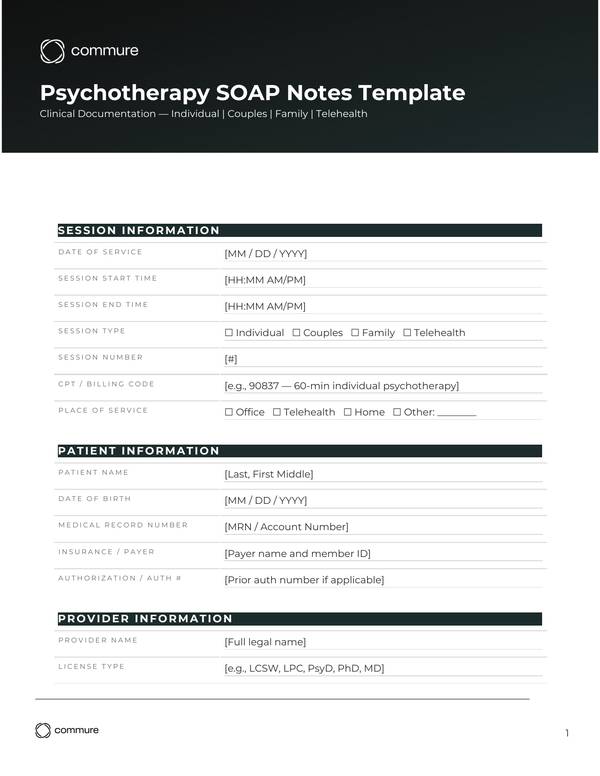
A psychotherapy notes template is a reusable form that records one session. It uses Subjective, Objective, Assessment, Plan (SOAP) format. Its 10 sections start with patient information, date and time of service, provider name and credentials, and chief complaint. The four SOAP fields follow, then a signature and date line and an amendment section. Licensed therapists, counselors and supervised clinicians in independent and group practices can use it. The form works for individual, couples, family and telehealth sessions.
What You Need to Know About Psychotherapy Notes Templates
- A psychotherapy notes template is a structured form that captures each therapy session in SOAP format: Subjective, Objective, Assessment, and Plan.
- Under HIPAA, psychotherapy notes get stronger privacy protection than standard medical records and require separate patient authorization before disclosure (45 CFR 164.508).
- Download the free SOAP template below to document sessions that meet Centers for Medicare & Medicaid Services (CMS) standards and hold up to payer audits.
Download the Free Psychotherapy Notes Template
Note: This template is for informational purposes only and does not constitute legal or medical advice. Have your compliance officer review it before clinical use.
Download the Psychotherapy Notes Template: editable DOCX, all 10 required sections included
What Is a Psychotherapy Notes Template?
A psychotherapy notes template is a reusable, fill-in-the-blank document that guides a clinician through recording everything a single therapy session needs to be clinically and administratively complete. This particular template covers outpatient individual, couples, family, and telehealth sessions. It works for licensed therapists, counselors, and supervised clinicians in independent and group practices.
The template does not replace clinical judgment. It is a starting point. You adapt each section to your specialty and your patients' needs.
This format is not designed for inpatient psychiatric care, medication management notes, or group therapy with multiple-participant records. Those settings follow different documentation standards.
The sections below explain what the template includes, how to fill it out, and what documentation rules apply.
What Does a Psychotherapy Notes Template Include?
A complete psychotherapy notes template includes 10 required sections: patient information, date and time of service, provider name and credentials, chief complaint, the four SOAP fields, a signature and date line, and an amendment section. Each one supports billing, documentation standards, or both.
- Patient information. Name, date of birth, and a unique record number. These fields link the note to the right person. Missing identifiers are one of the most common reasons claims get flagged.
- Date and time of service. Include the start and end time of the session. Time-based billing codes require documented session length. Without start and end times, you cannot support a time-based CPT code.
- Provider name and credentials. Full name, license type, license number, and National Provider Identifier (NPI). Supervised clinicians also include their supervisor's name and credentials.
- Chief complaint. Use the patient's own words. Write what they said, not your clinical interpretation. This field anchors the note to the patient's stated reason for the visit.
- Subjective (S). Document what the patient reports, including symptoms, mood, sleep, appetite, and any events since the last session.
- Objective (O). Record what you observed, including appearance, behavior, affect, thought process, and any scores from screening tools used during the session.
- Assessment (A). Your clinical impression. Include the current ICD-10 code and your view of progress toward treatment goals.
- Plan (P). What happens next. List interventions used, homework assigned, the next appointment date, and whether a safety plan was reviewed or activated.
- Signature and date. Sign and date the note when you complete it. Late entries must show both the original service date and the completion date.
- Amendment section. Use this to correct a completed note. Add a dated addendum. Never alter the original entry.
How Do You Fill Out a Psychotherapy Notes Template?
Fill out the psychotherapy notes template in the order the sections appear, completing the identifiers and service times before the session, jotting subjective and objective observations during it, and finishing the assessment, plan, and signature afterward. Working top to bottom this way keeps the note aligned with the flow of the session. Keep a therapy progress notes cheat sheet nearby, with phrase banks for each note section and a medical necessity checklist to run before you sign.
Before the session:
- Add patient information, date, and service times at the top.
- Confirm the session type: individual, couples, family, or telehealth.
- Note the session number and billing code.
During the session:
- Jot brief notes in the Subjective field as the conversation develops.
- Write the patient's own words in quotes when a statement is clinically significant.
- Document any screening tool scores you gather during the session.
After the session (most state licensing boards and payers recommend completing notes the same day or within 24 hours):
- Write the Assessment field with your clinical impression and current ICD-10 code.
- Fill in the Plan field with interventions used, homework assigned, and the next appointment date.
- Note whether you reviewed the safety plan.
- Sign and date the note.
Four mistakes to avoid:
- Do not copy the previous session's note and change the date. Cloned notes carry audit risk.
- Do not use vague language in the Plan section. "Continue treatment" is not a plan.
- Do not leave the Chief Complaint blank. If the patient had no specific complaint, write that.
- Do not sign a note you did not write. Supervised clinicians sign under their own credentials.
Telehealth sessions:
Add the platform used and a brief note confirming patient location and consent. Some payers and state boards require this documentation for telehealth visits.
What Are the Documentation Requirements for Psychotherapy Notes?
Psychotherapy notes must satisfy several overlapping rules at once: HIPAA's heightened privacy and separate-authorization standard, CMS requirements that the record support the level of service billed, state retention and confidentiality laws, and, for any substance use content, the stricter protections of 42 CFR Part 2. HIPAA gives psychotherapy notes stronger privacy protection than other medical records.
The HIPAA distinction:
Under HIPAA, "psychotherapy notes" are defined separately from standard progress notes (45 CFR 164.508).¹ Standard treatment, payment, and operations (TPO) authorization does not cover them. Before disclosing psychotherapy notes to any third party, including other providers, you must obtain separate written authorization from the patient. The one exception: the originator of the notes may use them for their own treatment of that patient without separate authorization (45 CFR 164.508(a)(2)). Progress notes sit on the other side of that line, and four worked therapy note examples by session type show what belongs in them.
Keep your psychotherapy notes separate from the rest of the medical record. HIPAA requires this separation to enforce those protections.¹ When a third party requests these notes, use the separate psychotherapy notes authorization that comes with the mental health release of information form.
CMS documentation standards:
For Medicare billing, CMS requires that clinical records support the level of service billed (42 CFR Part 410; CMS Medicare Claims Processing Manual, Chapter 12).² Your note must show the chief complaint, clinical findings, your assessment, and a plan of care. A note that is vague in any of these areas can result in a denial or a repayment request.
Retention:
HIPAA does not set a federal retention period for clinical records. The six-year requirement under 45 CFR 164.530 applies to your HIPAA compliance program documentation, including policies, procedures, and related records, not to patient session notes.¹ Clinical record retention is governed by state law. Many states set longer retention periods for mental health records, and some require keeping records for several years after a minor patient turns 18. Check your state's rules.
Substance use disorder records:
If your sessions involve any substance use disorder diagnosis, treatment, or referral, federal law under 42 CFR Part 2 applies. Part 2 imposes stricter protections than HIPAA and requires specific patient consent before disclosing SUD records. This consent goes beyond a standard HIPAA authorization. Part 2 is a federal requirement, not a state one, though many states add further protections on top of it.
State rules:
Requirements vary by state. Many states add protections beyond HIPAA for mental health records. Review your state's mental health confidentiality laws before setting your records policy.
Audit readiness:
A complete, signed psychotherapy notes template is your primary defense in a payer audit. Missing fields, unsigned entries, and vague plan sections are the most common findings. The template in this article is designed to prevent those gaps.
How Commure Scribe Works with Your Psychotherapy Notes
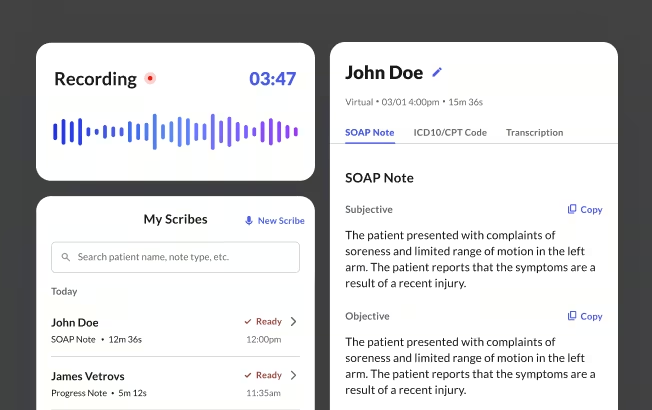
A therapy session requires your full attention. Filling out a psychotherapy notes template after the fact competes for that attention. Commure Scribe listens to the encounter and drafts your note straight into the template's SOAP structure. The Subjective section captures what the patient reports about mood, sleep, and events since the last session. The Objective section records your observations of appearance, affect, and thought process. The Assessment section holds your clinical impression with a suggested ICD-10 code, and the Plan section lists interventions, homework, and next steps for you to confirm.
When you click End Recording, the structured SOAP note appears within seconds, with suggested ICD-10 and CPT codes generated at the same time. Because the template follows the same SOAP structure Scribe outputs, the format stays consistent whether you fill it in by hand today or move to Scribe later. The clinician always reviews, adjusts, and signs before the note enters any record.
90%+ of providers report reduced clinical documentation time after switching to Commure Scribe, which works across specialties including behavioral health and psychiatry. Providers ready to stop filling notes manually can explore AI therapy notes.
Note: This template is for informational purposes only and does not constitute legal or medical advice. Have your compliance officer review it before clinical use.
Download the Psychotherapy Notes Template
This article is for general informational and educational purposes only. It does not constitute legal, medical, or professional advice and does not guarantee compliance. Requirements vary by state, payer, and clinical setting and can change over time. Verify current details with your own compliance officer, legal counsel, or the relevant authority before relying on this information.
Psychotherapy Notes Template Download
Download a copy of this template
Thanks! Your psychotherapy notes template is ready.
Click below to download.

Frequently Asked Questions
HIPAA defines psychotherapy notes as process notes kept separate from the medical record (45 CFR 164.508). They document a therapist's impressions during a session. Progress notes document diagnoses, symptoms, treatment plans, and session summaries. Progress notes are part of the standard medical record. Psychotherapy notes require separate patient authorization to share. Progress notes do not.
HIPAA does not set a federal retention period for clinical records. The six-year rule in 45 CFR 164.530 applies to HIPAA compliance program documentation, your policies and procedures, not patient notes. Clinical record retention is governed by state law. Many states set longer retention periods for mental health records. Some require keeping records for several years after a minor patient turns 18. Check your state's rules for the applicable period.
Yes. This psychotherapy notes template uses SOAP structure, which works across modalities. For CBT, add a field for automatic thoughts and cognitive distortions in the Subjective section. For DBT, add skills practiced and chain analysis in the Plan section. Keep all 10 required sections in place regardless of the modality.
This varies by state, license type, and payer. Most states require a supervisor co-signature on notes written by pre-licensed clinicians. Many payers require it for reimbursement. Check your state licensing board rules and your payer contracts before deciding on your co-signature policy.
A SOAP note has four sections: Subjective, Objective, Assessment, and Plan. A DAP note has three: Data, Assessment, and Plan. DAP combines subjective and objective observations into a single Data section. Both formats are widely accepted. SOAP is more common in medical settings and supports E&M billing level documentation more clearly.
Yes. Add the telehealth platform name and a brief note confirming the patient's location and consent to the session type. Some states and payers require you to document that the patient was physically located in a state where you are licensed to practice. Add that to the note for any cross-state telehealth session.
Sources
- U.S. Department of Health and Human Services. HIPAA Privacy Rule: Psychotherapy Notes. https://www.hhs.gov/hipaa/for-professionals/privacy/guidance/index.html
- Centers for Medicare & Medicaid Services. Medicare Claims Processing Manual, Chapter 12: Physicians/Nonphysician Practitioners. https://www.cms.gov/regulations-and-guidance/guidance/manuals/downloads/clm104c12.pdf
- American Medical Association. CPT Evaluation and Management: 2021 Office Visit Changes. https://www.ama-assn.org/practice-management/cpt/cpt-evaluation-and-management
- Substance Abuse and Mental Health Services Administration. 42 CFR Part 2: Confidentiality of Substance Use Disorder Patient Records. https://www.samhsa.gov/substance-use/treatment/statutes-regulations-guidelines