



AI Therapy Notes: What Therapists Need to Know Before Choosing a Tool
How AI is changing therapy documentation for therapists and what to test before you commit to a tool
Written by the Commure Scribe Team
Published: June 1, 2026
•
10 min read
Updated June 1, 2026
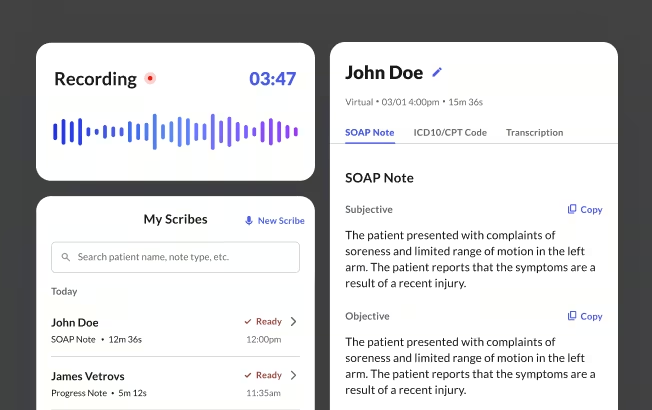
AI therapy notes are structured clinical drafts that software builds from a recorded therapy session. The tool turns speech into text, then sorts the content into the clinician's format. That format is usually Data, Assessment, Plan (DAP) or Subjective, Objective, Assessment, Plan (SOAP). The output is a draft note with assessment and plan sections, which differs from a raw transcript. The clinician reviews, edits and approves the note before it enters any record.
What you need to know about AI therapy notes
- Documentation burden in therapy practices is structural. Most practices have no dedicated administrative staff to absorb it.
- AI scribes consistently reduce documentation burden and improve clinician wellbeing.
- A randomized trial found a 9.5% reduction in note time for one of the two scribes tested. Secondary outcomes included burnout and task load scores.⁴
- Structure the first week or the AI therapy notes tool will not stick. A 2025 RCT found 15% of clinicians never adopted the tool even with access and support.⁴ This guide gives you the framework to avoid that outcome.
You finish your last session at 5 pm and you are still writing notes at 9. You are not behind because you work slowly. AI therapy notes are hard to generate well: narrative content, format-specific templates, and medico-legal stakes on every note. AI therapy notes tools are designed to change that. This guide covers what to look for and what to test. It covers how to know in the first week whether a tool is worth keeping.
How do the main AI therapy notes tools compare, and which fits your practice?
The AI therapy notes market in 2026 divides into three groups. Therapy-specific platforms for private practice. Analytics-led tools with telehealth. Enterprise platforms for large organizations. The right fit depends on practice size, billing, and how much customization your modality requires.
For a broader look at AI therapy notes tools across all specialties, see our guide to the best AI medical scribes in 2026.
Commure Scribe
Commure Scribe is purpose-built for AI therapy notes in behavioral health settings. It supports 25 specialties and 75,000+ clinicians across all practice sizes.
- Best fit. All practice sizes. Solo clinicians, group practices, and multi-location behavioral health organizations.
- Formats. SOAP notes with custom template builder. Clinicians adapt the output to their clinical voice. 90 languages with automatic detection. Up to 2 hours continuous recording per session.
- Compliance. HIPAA compliant. System and Organization Controls 2 (SOC 2) certified. Onshore data storage. Audio encrypted and retained per HIPAA requirements. Business associate agreement (BAA) included.
- Coding. Suggested ICD-10 and CPT codes in a separate tab after every session. Drawn from the full clinical context captured in the note.
- Trial. 7-day free trial. No credit card required. Find current pricing here for independent and groupd practices.
- EHR integration. Copy/paste into any web-based EHR for solo and small practices. One-click write-back for group practices. 60+ EHR integrations including SimplePractice, Tebra, eClinicalWorks, and Kipu.
Mentalyc
Mentalyc is purpose-built for mental health documentation. It offers 100+ therapy-specific templates and a 14-day trial.
- Templates. DAP, SOAP, BIRP, GIRP, eye movement desensitization and reprocessing (EMDR), couples, and family formats. More than 100 in total.
- Compliance. BAA, HIPAA, PHIPA, and SOC 2 Type II all confirmed. Recordings stored up to 3 days for note fixes, then deleted.⁸
- Trial. 14 days, 15 notes, full PRO access. No credit card required.
- Main limitation. Note caps apply at every paid tier. Per-note cost rises with caseload.
Upheal
Upheal combines AI note generation with session analytics. It is the only therapy-focused tool with built-in talking ratio, sentiment, and cadence tracking.
- Formats. SOAP, DAP, GIRP, BIRP, EMDR, and other standard behavioral health formats.
- Compliance. BAA, SOC 2, HIPAA, PHIPA, PIPEDA, and GDPR all confirmed. Audio deleted by default after note generation.⁹
- Best fit. Telehealth-heavy practices that want documentation and session insight in one platform.
- Main limitation. Session analytics require a paid plan. Free tier covers unlimited typed notes only.
Eleos Health
Eleos Health is an enterprise behavioral health platform. It serves 200+ organizations and 40,000+ providers across the US.¹⁰
- Deployment. Browser overlay on existing EHRs. No EHR replacement needed. Implementation takes 2–3 months with a dedicated sales engagement.
- Compliance scanning. Automated scanning across 100% of notes. Built for clinical quality improvement teams, not individual clinicians.
- Best fit. Mid-size to large behavioral health organizations with dedicated compliance and quality teams.
- Main limitation. No self-serve trial. Not suited to solo practices or small groups evaluating a tool quickly.
AutoNotes
AutoNotes is a form-based AI documentation tool. Clinicians select checkboxes and dropdowns after a session. No recording required.
- Formats. SOAP, DAP, BIRP, GIRP, EMDR, and other behavioral health note formats. Custom templates available.
- Compliance. BAA available. PHI permitted in the secured application, confirmed from AutoNotes’ Trust Center. HIPAA and PHIPA compliant.¹¹
- Best fit. Clinicians who prefer structured post-session input over ambient session recording.
- Main limitation. No ambient recording. Session context depends on what the clinician enters after the visit.
For practices billing insurance, the coding governance column matters. Tools with no stated coding methodology create claims risk. Confirm how any tool derives its code suggestions. Confirm how any tool you trial derives its code suggestions before using them for billing.
How much time do therapists actually spend on documentation, and why does it keep getting worse?
The AI therapy notes market exists because the documentation burden in therapy practices has grown. Administrative support has not kept pace. A widely cited benchmark: roughly two hours of documentation for every hour of care.1 Recent AI-scribe trials cite that ratio as background context. For a therapist with a full daily schedule, the arithmetic lands after dinner.
AMA data shows nearly two in three physicians now use some form of health AI.2 That figure is consistent with growing recognition of documentation burden across specialties. The adoption wave has reached behavioral health. But adoption alone is not the measure that matters. What matters is whether the AI therapy notes tool produces a note that accurately represents the clinical encounter. A therapy note carries medico-legal weight. Abbreviating or skipping sections feels risky for good reason.
The note structure itself creates a compounding problem. A DAP or SOAP note for a 50-minute session captures a lot. All must be present: patient-reported content, observations, affect, risk indicators, assessment, and treatment plan. Done manually across a full day, that is not a brief task. That backlog is what turns a 5 pm end time into 9 pm.
Why do most AI scribes still leave therapists rewriting notes from scratch?
Many early AI therapy notes tools were built for high-volume encounters: primary care, urgent care, hospital rounds. Therapy sessions are different in ways that directly affect note quality. The content is narrative. The structure varies by modality. The note must reflect a clinical relationship that a raw transcript cannot capture.
AMA data shows 20.9% of physicians still log more than eight hours weekly on after-hours documentation.3 That figure has not moved much as AI adoption has grown. Access to a tool is not the same as getting value from it. The AI therapy notes tools that move the needle understand the specific note structure the clinician needs. A generic template applied the same way to every specialty does not.
In a study across large health systems, researchers found AI scribes were associated with a 21% burnout reduction at Mass General Brigham. Emory reported a 31% wellbeing gain. The study was observational. Causality was not established.5 The authors suggested that less after-hours documentation and more in-room presence contributed. The study was observational. Causality was not established.
The failure mode of tools not built for behavioral health is specific. The AI fills in what a session should look like. Not what this session actually was. For ACT, DBT, somatic, or EMDR clinicians, a generic framing misrepresents the encounter. It does not just add editing time. It produces a note that does not accurately document the care delivered.
What are AI therapy notes, and how are they different from a transcript?
AI therapy notes are structured clinical documents. AI generates them after the session. They are ready for clinician review and approval. The AI records the session and converts speech to text. It then organizes the content into your clinical format, typically DAP or SOAP. The result is a structured draft note. Not a raw transcript of everything said. The clinician reviews, edits if needed, and finalizes before the note enters any record.
The distinction from transcription matters. A transcript of a 50-minute session produces thousands of words with no clinical structure. An AI therapy note produces a structured output: plan section, assessment, and relevant clinical detail organized correctly. If the note still needs full reconstruction, the AI therapy notes tool is a transcription service. Not an AI therapy notes tool. It is not an AI therapy notes tool.
What does an AI therapy note that actually works look like, and how is it different from transcription?
Transcription turns speech into text. An AI medical scribe turns a clinical conversation into a structured note. That distinction matters for AI therapy notes. A transcription of a 50-minute session produces thousands of words of raw content. An AI therapy notes tool produces a DAP or SOAP note. The relevant clinical detail is organized into the correct sections. The clinician reviews and finalizes before it enters any record.
The evidence on AI therapy notes tools has moved from anecdotal to controlled. A 2025 RCT found a 9.5% reduction in note time for one of the two scribes tested. Results varied by product.4 A study at UChicago Medicine found an 8.5% reduction in total EHR time. Time on note writing specifically fell by more than 15%.6 Both trials ran in large institutional settings. The effect in smaller outpatient practices may differ. These studies show that AI therapy notes tools can reduce documentation time in large systems. The mechanism is consistent: the AI drafts the structure, the clinician reviews and approves.
The note quality finding matters most for therapists. Clinicians who stay with an AI therapy notes tool long-term describe the same moment. They clicked End Recording. The structured note appeared within seconds. The plan section was more detailed than their manual notes at day's end. That is a quality claim, not a time-savings claim. It is the signal worth testing in a structured pilot.
How does AI therapy note software turn a session recording into a usable SOAP or DAP note?
Most AI therapy note tools follow the same three-step workflow. Record: the software captures the session. Edit: the AI generates a structured note for the clinician to review and adjust. Finish: the clinician approves the note before it enters any record. The clinician always has the option to review before finishing.
The patient presence benefit changes the session itself, not just the time after it. One large-scale analysis found 47% of patients said their doctor spent less time on a screen.7 For a therapist, that means staying present in the room. Eye contact instead of a keyboard. Listening instead of typing. The therapeutic relationship stays intact.
The first value moment happens immediately after clicking End Recording. Within seconds, a structured SOAP note appears. Suggested ICD-10 and CPT codes appear in a separate tab. The plan section is often more detailed than what a clinician writes at day's end. Clinicians describe it the same way. The note caught things they would have missed, not just saved time.
The workflow is the same regardless of visit type. The AI therapy notes tool supports in-person and telehealth sessions. It recognizes 90 languages with automatic detection. No manual language selection required. It captures multiple speakers. The note is the clinician's to review, edit, and finalize before it touches any record.
What should a therapist look for when choosing AI documentation software, and what are the red flags?
Note format support is the first filter. A tool that only generates SOAP notes is not built for behavioral health. Look for DAP notes, progress notes, treatment plans, and Behavior, Intervention, Response, Plan (BIRP) notes. The last is especially relevant for structured treatment programs. If the AI therapy notes tool cannot match your note format, editing becomes more work than writing manually.
- DAP note support. Data, Assessment, Plan format is standard across many outpatient therapy settings. Confirm the AI therapy notes tool supports your preferred note format natively. A relabeled SOAP output does not meet DAP documentation standards.
- SOAP note support. Required if your insurers or supervisors expect SOAP format. Confirm the sections match your specific requirements, not just a generic template.
- Custom templates and AI that learns your clinical voice. Your therapeutic approach may require sections that standard formats do not include. Confirm whether the AI therapy notes tool supports specialty templates. Also check whether it adapts to your phrasing over time rather than producing generic output.
- Multi-speaker recognition. Essential for couples sessions, family therapy, and group work. Confirm the AI therapy notes tool differentiates speakers accurately before using it in those contexts.
- Telehealth compatibility. Confirm the AI therapy notes tool works with your telehealth platform, both for audio capture and note generation.
- HIPAA compliance and data handling. Confirm how the vendor handles audio retention and encryption. Notes should be stored securely with no third-party data sharing. Confirm both explicitly before any clinical use.
Coding accuracy requires a separate evaluation if your practice bills ICD-10 or CPT codes. Coding-naive AI therapy notes tools can generate code suggestions that do not match the documented encounter. For a practice billing insurance, that creates claims and compliance risk. A coding error is not a software inconvenience. It is a denial or a compliance exposure. A note that fully captures the encounter may help reduce denial risk from insufficient documentation. No peer-reviewed data links AI-scribe use to reduced denial rates in outpatient therapy practices.
The omissions finding is the most practical red flag to test in your pilot. A 2025 RCT found omissions were a common inaccuracy in AI-generated notes. Pronoun errors and missed context were also reported.4 For AI therapy notes, the plan section carries the most risk. Missed follow-up items, undocumented safety plans, absent treatment goal progress. In your trial week, read the plan section first. Compare it against your session memory before assuming the note is complete.
Note format support. A tool that only generates SOAP notes is not built for behavioral health. Look for DAP notes, BIRP notes, progress notes, and treatment plans. If it lists only ‘progress notes’ with no format detail, assume it is SOAP-only.
- Red flag: Tool lists only ‘progress notes’ or ‘SOAP’ with no behavioral health specificity or format detail.
HIPAA compliance and audio handling. Audio retention creates PHI storage risk. The vendor’s HIPAA posture affects your practice, not just theirs. Confirm how long audio is retained, how it is encrypted, and who can access it.
- Red flag: Vague privacy language with no clear statement on audio retention, encryption standards, or HIPAA posture.
Custom templates and adaptive learning. Your modality may require sections that standard formats exclude. A tool that learns your phrasing produces more accurate first drafts over time. Confirm whether customization is available at your pricing tier.
- Red flag: Template customization locked at a higher tier with no adaptive learning of clinician phrasing.
Multi-speaker recognition. Couples, family, and group sessions require accurate speaker differentiation. The note must reflect what each person said, not a merged transcript.
- Red flag: Tool trained only on single-speaker dictation with no stated multi-speaker support.
Coding governance for ICD-10 and CPT billing. Coding-naive tools generate code suggestions without checking them against the documented encounter. That creates claims and compliance risk.
- Red flag: No stated methodology for how code suggestions are generated or reviewed against note content.
How do I start using AI therapy notes without disrupting my practice, and what should I test in the first week?
Implementation approach determines whether AI therapy notes become a clinical asset or an abandoned subscription. A 2025 RCT found that 15% of clinicians never adopted the tool, even with access and support. This was in a large institutional setting with access and support provided.4 Without a dedicated IT team, structure in the first week matters more. Not less.
The goal of the first week is not to optimize. It is to get one clean signal. Does the note reflect the session accurately enough to be worth editing rather than rewriting? Speed, template customization, and EHR integration all follow from that baseline.
Step 1: Before you begin. Choose one session type for your pilot. Pick your most structurally consistent session, typically an established patient follow-up rather than an intake. Familiar content makes note quality easier to evaluate against your own memory of the session.
Step 2: Session 1, Day 1. Record your first AI therapy notes session. Do not change how you conduct the session. The AI therapy notes tool should adapt to your workflow, not the other way around. Let it run without stopping to monitor the recording.
Step 3: Within 10 minutes of End Recording. Review the generated note before comparing it to your session notes. Read the plan section first. Are follow-up items, treatment goals, and any safety plan content present and accurate? Note any omissions.
Step 4: Before the note enters any record. Edit and finalize. Your review is not optional. Finalize only after you are satisfied the note accurately documents the care delivered.
Step 5: Days 2 through 5. Run multiple session types before drawing a conclusion. One session is not a reliable signal. By your third or fourth recording, you will have a clear read on accuracy.
Step 6: End of week 1. If the note quality holds, extend to a more complex session type. A new intake, a couples session, or one where a safety concern was addressed. These are the cases where plan section completeness matters most.
Frequently Asked Questions
Therapists can use AI to assist with clinical documentation. The clinician should have the option to review and approve every note before it enters any record. AI does not transfer responsibility for notes. The workflow is: record, review, edit, finalize. Some licensing boards have jurisdiction-specific guidance on AI use in behavioral health. Confirm before use.
AI-assisted therapy note automation records a session and generates a structured draft. Typical formats are DAP or SOAP. The clinician reviews, edits, and finalizes before it enters any record. The task shifts from writing to editing. Commure Scribe follows this workflow: Capture, Edit, Finalize.
Group AI therapy notes require accurate multi-speaker capture. A note that attributes a statement to the wrong participant misrepresents the clinical record. Confirm the AI therapy notes tool handles multi-speaker detection accurately before using it in group sessions. This AI therapy notes tool supports multi-speaker sessions. Test with your specific group configuration before deploying.
Check that the tool writes DAP, BIRP and SOAP notes in their own formats, not as a relabeled SOAP note. It should tell speakers apart in couples, family and group sessions and work with your telehealth platform. During a trial, read the plan section of each note first, since omissions there carry the most risk.
An AI therapy notes tool can be HIPAA compliant when the vendor signs a business associate agreement (BAA) and protects session audio. Before you record a client, ask how long audio is kept, how it is encrypted and who can access it. Treat vague privacy terms with no answer on audio retention as a red flag.
Sources
1 UCLA Health / Sinsky. UCLA Study Finds AI Scribes May Reduce Documentation Time. Sinsky et al. / AMA, 2025. https://www.uclahealth.org/news/release/ucla-study-finds-ai-scribes-may-reduce-documentation-time
2 American Medical Association. 2 in 3 Physicians Are Using Health AI. AMA, 2025. https://www.ama-assn.org/practice-management/digital-health/2-3-physicians-are-using-health-ai-78-2023
3 American Medical Association. Burnout Way Down; Pajama Time Stands Still. AMA Organizational Biopsy, 2024. https://www.ama-assn.org/practice-management/physician-health/burnout-way-down-pajama-time-stands-still
4 Lukac et al. AI Scribes in Clinical Practice (RCT). NEJM AI / UCLA, 2025. https://pmc.ncbi.nlm.nih.gov/articles/PMC12768499/
5 You et al. Ambient Documentation Technologies Reduce Physician Burnout. JAMA Network Open / MGB and Emory, 2025. https://www.massgeneralbrigham.org/en/about/newsroom/press-releases/ambient-documentation-technologies-reduce-physician-burnout
6 UChicago Medicine. Ambient AI Saves Time, Reduces Burnout, and Fosters Stronger Doctor-Patient Relationships. UChicago Medicine, 2025. https://www.uchicagomedicine.org/forefront/research-and-discoveries-articles/2025/november/ambient-ai-saves-time-reduces-burnout-and-fosters-stronger-doctor-patient-relationships
7 The Permanente Medical Group / NEJM Catalyst. AI Scribes Save Physicians Time, Improve Patient Interactions and Work Satisfaction. TPMG, 2025. https://permanente.org/analysis-ai-scribes-save-physicians-time-improve-patient-interactions-and-work-satisfaction/
8 Mentalyc. Features, Pricing, and Privacy. Mentalyc, 2026. https://www.mentalyc.com
9 Upheal. Privacy and Compliance. Upheal, 2026. https://www.upheal.io/privacy-and-compliance
10 Eleos Health. AI Platform for Behavioral Health. Eleos Health, 2026. https://eleos.health
11 AutoNotes. Trust Center. AutoNotes, 2026. https://www.autonotes.ai/trust-center/
.jpeg)
.jpeg)
.jpeg)



.jpeg)
.jpeg)