



Case Notes Template: Free Editable Clinical Format
A field-by-field walkthrough of a case-notes template with the regulatory requirements that drive each section.
Written by the Commure Scribe Team
Published: May 27, 2026
•
9 min read
Updated May 27, 2026
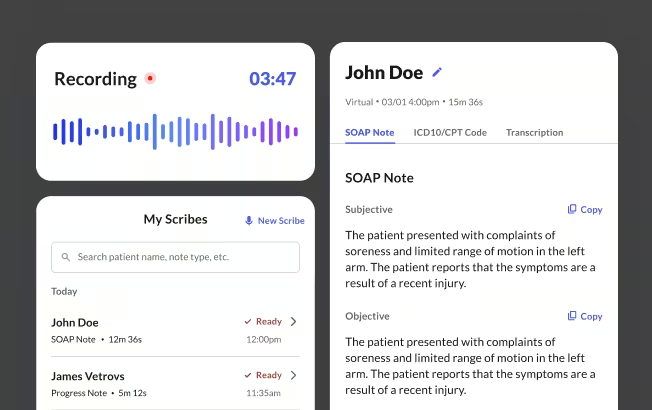
A case notes template is a reusable, structured form. It records each patient encounter and the care given. Its nine sections usually open with patient IDs, date and time of service, and provider credentials and signature. Next come the chief complaint and four Subjective, Objective, Assessment, Plan (SOAP) sections. An amendment section for late entries comes last. Outpatient clinicians in independent and group practices use it at each visit.
What you need to know about case notes templates
- A case notes template is a reusable structured form that documents each patient encounter and the care provided.
- Outpatient progress notes grew longer and more redundant over a decade, and template design is one fix.¹
- A complete case notes template covers patient identifiers, the SOAP body, signature, and an amendment section for late entries.
Download the case notes template
Note: This template is for informational purposes only and does not constitute legal or medical advice. Have your compliance officer review it before clinical use.
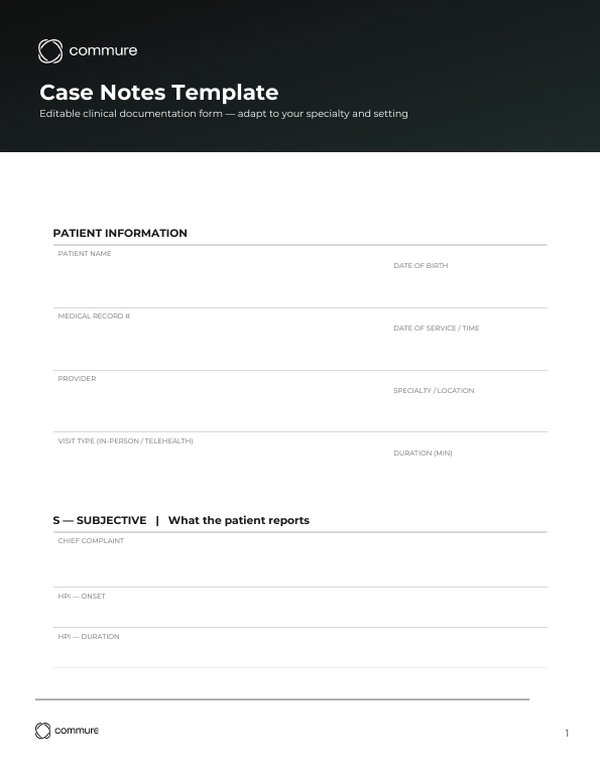
Customize it for your specialty and EHR before going live.
What is a case notes template?
Most outpatient case notes templates trace back to the SOAP format. Medical and allied health programs have taught it for decades.² Clinicians sometimes call them progress notes, chart notes, or encounter notes. The terms often refer to similar visit documentation, though structure can vary by EHR and specialty. In behavioral health, the equivalent visit record is often called a therapy progress note, with its own required elements and worked examples by session type.
The template lives at the intersection of clinical work and audit work. Clinicians use it to capture each visit. Centers for Medicare & Medicaid Services (CMS), payers, and state medical boards rely on it to confirm whether care was medically necessary, that the rendering provider authenticated the record, and a number of other coverage and coding requirements.³ ⁴
Most content outside that scope belongs in a different document. Psychotherapy process notes get extra HIPAA protection and stay separate. Insurance forms, lab orders, and discharge summaries each have their own template. A case notes template is a common artifact across outpatient practices, used at each visit.
A working case notes template sits on four foundations. Each required field has a clinical or compliance reason for being there. Clinicians need it to be quick to complete during real visits. And the structure has to hold up when an auditor asks why a service was billed.
Why do independent and group practices need a case notes template?
Outpatient case notes are getting longer, not shorter. Across one academic health center, progress notes grew longer and more redundant over a decade.¹ The authors of the study point to template design as one of the levers practices can pull to fix it.¹
Documentation burden hits clinicians in measurable ways. Most US office-based physicians say documentation time feels inappropriate for the visit.⁵ Physicians with high after-hours EHR time have nearly twice the odds of burnout compared with those with minimal home EHR time.⁶ Documentation time is also one of the strongest daily pressure points primary care clinicians describe.⁷
A case notes template is the most direct way to standardize what each clinician documents. American Academy of Family Physicians (AAFP) guidance on reducing documentation burden recommends redesigning note templates around what genuinely supports the visit.⁸ Asking clinicians to type less inside an unchanged form rarely works. When each clinician fills in the same fields in the same order, charts read predictably across the practice.
A standardized template pays back in three downstream workflows:
- Coders can find the elements they need to support the billed level of service.
- Auditors can confirm medical necessity without paging through free text.
- Cross-coverage gets faster because the next clinician knows where to look.
Template design is where the fix lives. Practices often try to solve note bloat by asking clinicians to type less. That approach rarely works. Researchers note that interventions to reduce note length and redundancy may need to address template design and training together.¹ The case notes template defines what is captured, what is auto-populated, and what gets cut.
What should a case notes template include?
A practical case notes template covers nine recommended sections. Each section maps to a clinical or compliance expectation drawn from CMS, HIPAA, and state board rules.³ Skipping one increases the risk that the note does not support the level of service billed.³
- Patient identifiers. Name, date of birth, and medical record number (MRN) or account number. This labels the chart so it is less likely to be misfiled.
- Date of service and time. Date appears on each encounter, with time recorded when billing is time-based. The note may not reliably anchor a claim or a care timeline without these.
- Provider name, credentials, and signature line. Name, license type, and a place to sign. Authentication tells an auditor who is responsible for the record.⁴
- Chief complaint or reason for visit. Why the patient came in, ideally in the patient's own words. This anchors the rest of the note to a specific clinical question.
- Subjective. Patient-reported symptoms, history, and functional status. This is what the patient tells the clinician.²
- Objective. Exam findings, vitals, lab and imaging results. This is what the clinician observes or measures.²
- Assessment. Diagnostic impression, clinical reasoning, and decision-making. Documentation here supports the medical-necessity claim.³
- Plan. Treatments, prescriptions, referrals, follow-up, and patient instructions. The plan needs enough detail for continuing care to read correctly.³
- Amendment or addendum section. A labeled space for late entries, each with a separate date stamp. Late edits without a clear stamp carry audit risk.⁴
**The Subjective, Objective, Assessment, and Plan sequence is the most common middle structure.**² Specialties may rename the sections or add fields, but the four-part clinical reasoning order stays consistent across most outpatient settings.²
How do you fill out a case notes template?
Filling out a case notes template should take less time than the visit itself. Practices that follow a consistent process keep notes complete and trim the after-hours work that drives burnout.⁶
Use the template top to bottom in the same order every visit. The pattern below works in most outpatient settings.
- Header fields first. Confirm the patient identifier match, the date, and the visit type before opening the encounter. Mismatches caught here prevent rework later.
- Chief complaint in the patient's words. Quote the patient when feasible. Diagnostic shorthand belongs in the Assessment section.
- Subjective. Capture symptoms in the order the patient describes them. Note the duration and what changes them.
- Objective. Record exam findings and any abnormal values that drive the plan. Pull in vitals, labs, and imaging from the EHR rather than retyping.
- Assessment. State the working diagnosis and the clinical reasoning in one or two sentences. Note what was ruled in or ruled out.
- Plan. Write each treatment, prescription, referral, and follow-up step on its own line. Include the patient instructions in plain language.
- Sign and date. The rendering provider signs at finalization. Authentication is what makes the note part of the legal record.⁴
**Two practical tips reduce note bloat at the fill-out stage.**¹ First, do not paste forward content from a previous visit unless it still applies and you have updated it. Second, write each field once at full length and let the template carry the structure across visits.
What documentation and compliance requirements apply to case notes?
**Two federal frameworks plus state-level rules set the floor for outpatient case notes documentation.**³ ¹⁰ HIPAA and CMS documentation rules come from federal regulators. State medical boards and Joint Commission standards add their own layers on top.
- HIPAA Privacy Rule (45 CFR 164.502-514). Notes contain PHI, so most uses and disclosures must follow the minimum necessary standard.¹⁰ That standard does not apply to disclosures for treatment between providers. Handling rules apply to electronic and paper notes alike.
- CMS documentation rules. Medicare expects documentation to support the level of service billed and to be authenticated by the rendering provider.³ The Conditions of Participation (42 CFR 482-485) set documentation standards for Medicare-participating facilities; many outpatient practices are not directly subject to them and should confirm which CMS rules apply to their setting.⁹
- State medical board rules. Each state sets its own documentation, retention, and amendment standards. Check your state's specific requirements before locking in a template.
Late entries and amendments need to be labeled. A correction or addition made after the original note needs the date of the change and the identity of the person making it. A note that looks like the original but is silently edited later puts the practice at risk during an audit.
**HIPAA sets a six-year floor for HIPAA compliance documentation, not clinical notes themselves.**¹⁰ 45 CFR 164.530(j) requires covered entities to keep HIPAA policies, procedures, and certain communications for at least six years. Medical record retention is largely set by state law and payer contracts, and many state rules exceed six years, with several requiring longer holds for pediatric records.
Templates support compliance, they do not guarantee it. Frame a case notes template in compliance language as "designed with HIPAA and CMS requirements in mind". Have your compliance officer or legal counsel review the template before clinical use.
How should you customize a case notes template for your practice?
Customization happens in three layers: specialty content, EHR integration, and governance. Specialty drives what fields appear in the body. EHR integration shapes how those fields get filled in. Governance settles who owns updates and how often the template gets reviewed.
- Specialty content. Add fields the specialty needs and remove fields it does not. Pediatric templates carry growth and immunization history; behavioral health templates carry risk and safety planning; physical therapy templates carry functional goals and measurable outcomes.
- EHR integration. Pull patient identifiers, vitals, and active problems from the chart rather than retyping them. Map each template field to a structured EHR field where one exists, so the note stays searchable and reportable later.
- Governance. Independent practices often have one clinician or office manager who owns the template, while group practices typically use a small review group with input from clinicians, coders, and compliance. Either way, lock in a review cadence at least once a year and after any major rule change.
Practice size shapes how big the customization job is. Independent and small group practices can often customize a starting template in a focused review. Multi-location groups balance specialty variation against a shared core that audits and reporting depend on.
An AI medical scribe can write inside an existing case notes template. The scribe drafts a structured note from the visit while the template carries the compliance structure, and the clinician reviews before anything finalizes. For a ranked breakdown by practice size and specialty, see the best AI medical scribes guide.
How Commure Scribe drafts notes inside your case notes template
Commure Scribe is an AI medical scribe used by 75,000+ clinicians across independent and group practices. The clinician runs the visit, and Commure Scribe drafts the Subjective, Objective, and Assessment sections inside the case notes template the practice already uses.
The first value moment lands within seconds. After the clinician clicks End Recording, a structured SOAP note appears. Suggested ICD-10 and CPT codes are generated from the conversation in a separate tab. Clinicians say the AI caught things they would have missed.
Three Commure Scribe features tie directly into a case notes template workflow:
- Custom template builder. Practices match Commure Scribe to the case notes template they already use, including specialty fields and required compliance sections.
- AI Copilot. Clinical decision support that surfaces inside the same drafting flow.
- Admin Copilot. Helps with documentation tasks generated from the encounter beyond the case note, including prior authorization requests and patient emails.
The Capture → Edit → Finalize workflow keeps the clinician in control. Commure Scribe is HIPAA compliant and System and Organization Controls 2 (SOC 2) certified. 90%+ of providers report reduced clinical documentation time and digital fatigue, and 91% report feeling less fatigued.
Disclaimer
This article and the linked case notes template are for informational and educational purposes only. They do not constitute legal, medical, or professional advice, and do not guarantee compliance with any specific regulation.
Case Notes Template Download
Download a copy of this template
Thanks! Your case notes template is ready.
Click below to download.

Sources
- Rule A, Bedrick S, Chiang MF, Hribar MR. Length and Redundancy of Outpatient Progress Notes Across a Decade at an Academic Medical Center. JAMA Network Open. 2021;4(7):e2115334. https://pmc.ncbi.nlm.nih.gov/articles/PMC8290305/
- Purdue University Online Writing Lab. SOAP Notes. https://owl.purdue.edu/owl/subject_specific_writing/healthcare_writing/soap_notes/index.html
- Centers for Medicare & Medicaid Services, Medicare Learning Network. Complying with Medical Record Documentation Requirements (MLN 909160). https://www.cms.gov/files/mln909160-complying-with-medical-record-documentation-requirements.pdf
- Florida State University College of Medicine. SOAP Notes Format in EMR (Documentation Job Aid). https://med.fsu.edu/sites/default/files/userFiles/file/MedInfo_SOAPnote_Jobaid.pdf
- Gaffney A, Himmelstein DU, Woolhandler S, et al. Medical Documentation Burden Among US Office-Based Physicians in 2019: A National Study. JAMA Internal Medicine. 2022;182(5):564-566. https://jamanetwork.com/journals/jamainternalmedicine/fullarticle/2790396
- Gardner RL, Cooper E, Haskell J, et al. Physician Stress and Burnout: The Impact of Health Information Technology. Journal of the American Medical Informatics Association. 2019;26(2):106-114. https://pmc.ncbi.nlm.nih.gov/articles/PMC7647171/
- Nguyen ML, Honcharov V, Ballard D, et al. Primary Care Physicians' Experiences With and Adaptations to Time Constraints. JAMA Network Open. 2024;7(4). https://jamanetwork.com/journals/jamanetworkopen/fullarticle/2818067
- American Academy of Family Physicians. Notes 2.0: Reducing Documentation Burden. Family Practice Management. 2022. https://www.aafp.org/pubs/fpm/issues/2022/0700/reducing-documentation-burden.html
- Electronic Code of Federal Regulations. 42 CFR Part 482, Conditions of Participation for Hospitals: Medical Records. https://www.ecfr.gov/current/title-42/chapter-IV/subchapter-G/part-482
- U.S. Department of Health and Human Services. HIPAA Privacy Rule (45 CFR 164.502-514). https://www.hhs.gov/hipaa/for-professionals/privacy/laws-regulations/index.html