



Progress Note Template: SOAP, DAP, and More (Free Download)
Free fillable SOAP, DAP, BIRP, and GIRP templates with worked examples and documentation best practices for outpatient clinicians.
Written by the Commure Scribe Team
Published: May 15, 2026
•
9 min read
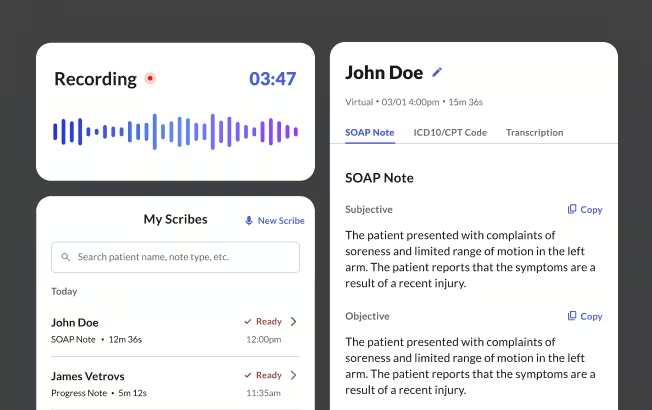
A progress note template is a structured form that walks clinicians through a visit note in a set order. Outpatient clinicians typically use the Subjective, Objective, Assessment, Plan (SOAP) format. Behavioral health clinicians use Data, Assessment, Plan (DAP) or Behavior, Intervention, Response, Plan (BIRP). Goals, Intervention, Response, Plan (GIRP) is a third behavioral health option. Each template captures patient ID, the presenting concern and findings. It also holds a coded diagnosis, a plan and the clinician's signature.
What you need to know about progress note templates
- A progress note template structures each patient encounter into consistent, billable, legally defensible documentation.
- The most widely used format is SOAP (Subjective, Objective, Assessment, Plan). DAP, BIRP, and GIRP are standard in behavioral health.
- A missing or vague Plan section is the most common reason a chart gets flagged in a payer audit.
What is a progress note template?
A progress note template is a structured form that guides clinicians through recording a patient encounter. It names the sections to complete, the type of information each section captures, and the order that information appears in the chart. Progress notes written without a template are slower to complete and harder for payers to audit. They are also more likely to miss documentation that affects reimbursement.
For any outpatient practice, a progress note template does more than reduce blank-screen anxiety. It makes notes consistent across a full schedule, defensible during payer review, and readable by the next clinician who opens the chart. To keep notes consistent across clinicians, standardize clinical notes across a practice with a format by visit type, non-negotiable fields, and a quarterly 20-note audit.
What are the essential components of a progress note?
Every progress note captures the same core clinical and administrative facts regardless of format. Format sets the order and grouping.
The standard components are:
- Patient identification. Name, date of birth, medical record number, date and time of visit.
- Chief complaint or presenting concern. The patient's own words about why they came in.
- Relevant history. Changes since the last visit, current medications, recent labs or imaging.
- Clinician findings. Observations, exam results, measurements, test results.
- Clinical impression. The diagnosis or differential, coded to ICD-10.
- Plan. Treatments ordered, referrals made, patient instructions, and the next visit or follow-up.
- Clinician signature. Credentials and date of finalization.
Missing any component creates audit exposure. For Medicare and most commercial payers, the plan section of a progress note must link to the diagnosis. A note with a clear chief complaint but a vague plan is among the most common reasons a chart gets flagged. Insufficient documentation drove 34.1% of E&M improper payments in the most recent Centers for Medicare & Medicaid Services (CMS) audit cycle.³ To see each component filled in, open the medical chart template examples for a new primary care visit, a behavioral health follow-up, and a chronic disease follow-up.
What are the types of progress note templates?
The right format depends on the setting, specialty, and payer. SOAP covers most clinical outpatient settings. DAP, BIRP, and GIRP are standard in behavioral health.
SOAP note template
SOAP notes are the standard format for primary care, urgent care, orthopedics, and most outpatient specialties. It divides documentation into four named sections. Each section maps directly to the components payers look for when auditing a claim. A 2025 study found that aligning note templates with updated CMS E&M guidelines reduced average note length by 882 characters without increasing documentation time.⁴
In the Subjective section, record what the patient reports: symptoms, duration, severity, and changes since the last visit. Include any relevant history the patient provides. Write in the patient's language where possible.
In the Objective section, record what you observe and measure: vital signs, physical exam findings, labs, imaging, and any other quantifiable data.
In the Assessment section, state your clinical impression. Name the diagnosis or working differential. Apply ICD-10 codes here.
In the Plan section, document every action: medications prescribed or changed, referrals, imaging ordered, patient instructions, and the follow-up timeline.
SOAP Progress Note Template — General Outpatient
Patient: ___________ | DOB: ___________ | MRN: ___________ | Visit date: ___________
Clinician: ___________ | Specialty: ___________ | Location: ___________ | Visit type: In-person / Telehealth
S — Subjective Chief complaint: ___________________________________ History of present illness: _________________________ Current medications: ______________________________ Allergies: _________________________________________ Review of systems: _________________________________
O — Objective Vitals: BP __ / __ | HR __ | RR __ | Temp __ | SpO2 __ | Wt __ Exam findings: _____________________________________ Labs / imaging / results: ___________________________
A — Assessment Diagnosis / impression: ____________________________ ICD-10 code(s): ____________________________________
P — Plan Medications: _______________________________________ Orders (labs, imaging, referrals): _________________ Patient instructions: _______________________________ Follow-up: _________________________________________
Clinician signature: ___________ Date: ___________

DAP note template
DAP notes are a widely used behavioral health format that combines patient-reported and clinician-observed data into a single Data section.
In the Data section, record both patient-reported concerns and your observations. Mood, affect, and behavioral observations go here alongside any measurements.
In the Assessment section, document your clinical interpretation of the session and any diagnostic impressions.
In the Plan section, record interventions used, homework assigned, and next session goals.
DAP Progress Note Template — Behavioral Health / Counseling
Patient: ___________ | DOB: ___________ | Session date: ___________
Clinician: ___________ | Session type: ___________ | Visit type: In-person / Telehealth | Duration: ___ min
D — Data Patient-reported concerns: _________________________ Clinician observations (mood, affect, behavior): ___ Risk assessment (SI/HI): ____________________________
A — Assessment Clinical impression / progress toward goals: _______ Diagnosis / ICD-10: _________________________________
P — Plan Interventions used this session: ___________________ Between-session assignments: _______________________ Next session goals: _________________________________
Clinician signature: ___________ Date: ___________

BIRP note template
BIRP (Behavior, Intervention, Response, Plan) is used in behavioral health settings where documenting the specific therapeutic technique and the patient's response to it is clinically and billing-relevant. A BIRP note template is common in substance use treatment, residential programs, and intensive outpatient settings.
BIRP Progress Note Template
Patient: ___________ | Session date: ___________ | Visit type: In-person / Telehealth | Duration: ___ min
B — Behavior Presenting behavior and patient-reported concerns: ________________________________________
I — Intervention Therapeutic techniques and interventions used: ____________________________________________
R — Response Patient's response to interventions during session: ____________________________________
P — Plan Treatment adjustments, next session goals, between-session work: ______________________
Clinician signature: ___________ Date: ___________

GIRP note template
GIRP (Goals, Intervention, Response, Plan) is used in settings where each progress note must tie back to a documented treatment plan goal. Common in behavioral health programs with formal treatment plans, rehabilitation settings, and any context where payers require explicit goal-to-session linkage. The defining difference from BIRP: the Goals section names the specific treatment plan objective being addressed before any intervention is recorded.
In the Goals section, state the specific goal from the treatment plan addressed in this session and document its current status: on track, behind, achieved, or revised.
In the Intervention section, document the technique used and the rationale for selecting it relative to that goal.
In the Response section, record the client's engagement and any observable evidence of progress toward the named goal.
In the Plan section, document between-session assignments tied to the goal, any revisions to the goal itself, and the next progress note focus.
GIRP Progress Note Template
Patient: ___________ | Session date: ___________ | Visit type: In-person / Telehealth | Duration: ___ min
G — Goals Treatment plan goal addressed this session: ________________________________________ Goal status: ☐ On track ☐ Behind ☐ Achieved ☐ Revised
I — Intervention Modality / technique and rationale: ________________________________________________
R — Response Client's response and evidence of progress toward goal: ____________________________
P — Plan Between-session practice tied to the goal: ________________________________________ Goal updates / next session focus: ________________________________________________
Clinician signature: ___________ Date: ___________

What does a good progress note look like? (Worked examples)
Worked examples show what strong progress note documentation looks like in practice. Read the plan sections closely: they show the detail payers expect.
Example 1: Acute visit (URI)
S: 34-year-old established patient presents with a 4-day history of sore throat, nasal congestion, and mild cough. No fever at home. No known sick contacts. Reports taking OTC acetaminophen with partial relief. No known drug allergies. Tetanus up to date.
O: Vitals: BP 118/72, HR 82, Temp 37.2°C, SpO2 99% on room air. Oropharynx mildly erythematous, no exudate, no tonsillar enlargement. Lymph nodes: no cervical adenopathy. Lungs: clear to auscultation bilaterally. Rapid strep: negative.
A: Viral upper respiratory infection (J06.9). Rapid strep negative. No antibiotics indicated.
P: Supportive care: hydration, rest, OTC analgesics as needed. Patient counseled on expected duration (7–10 days). Return precautions given: return if fever exceeds 38.5°C, symptoms worsen, or symptoms persist past 14 days. No follow-up scheduled unless symptoms worsen.
Example 2: Chronic disease follow-up (Type 2 diabetes)
S: 58-year-old established patient for routine diabetes follow-up. Reports good medication adherence. Home glucose 140–165 fasting. No hypoglycemic episodes. Some increase in fatigue over the past month. No polyuria, polydipsia, or vision changes.
O: Vitals: BP 136/84, HR 76, Wt 214 lbs (↑3 lbs from last visit). HbA1c: 7.8% (↑from 7.4% six months ago). Fasting glucose: 158 mg/dL. Foot exam: intact sensation bilaterally, no skin breakdown. Last ophthalmology visit: more than 18 months ago.
A: Type 2 diabetes mellitus, not adequately controlled (E11.65). Hypertension, borderline controlled (I10). Weight gain 3 lbs over 6 months. Overdue for ophthalmology referral.
P: Increase metformin to 1000 mg BID if tolerated. Continue lisinopril 10 mg daily, monitor BP at next visit. Ophthalmology referral placed today. Labs ordered: repeat HbA1c and CMP in 3 months. Patient counseled on carbohydrate monitoring, reviewed signs of hypoglycemia. Follow-up in 3 months or sooner if concerns arise.
How do you write a good progress note?
A progress note is a legal document, a billing record, and a handoff to the next clinician. All three uses have to work from the same text, which sets what belongs in a note and what does not.
Write to the plan, not the visit. A common audit finding in outpatient primary care is a progress note with a documented diagnosis and a mismatched plan. If hypertension is on the problem list, the note needs a blood pressure reading, a current medication, and a plan.
Use objective language in the Subjective section. "Patient states pain is 6/10" is objective. "Patient is in moderate pain" is a judgment. Use numbers, direct quotes, and measurable descriptions. Payers audit language, not intent.
Avoid copy-forward. Copying the previous progress note without updating it is the fastest path to an audit finding. If vitals are unchanged, confirm them. If the assessment is unchanged, say "consistent with prior assessment" and add today's findings.
Close the loop on every problem. Any condition coded in the Assessment section of a progress note needs at least one matching action in the Plan. A diagnosis without a plan is incomplete documentation and a common denial trigger.
Document at the time of the encounter. Notes completed well after the visit are harder to defend than same-day documentation. Research tracking primary care physicians from 2019 to 2023 found EHR documentation time increased across most task categories during that period.⁵
How do you adapt progress note templates to different visit types?
The SOAP progress note structure stays the same across visit types, but the depth of each section shifts. Solo and small outpatient practices often see acute visits, chronic follow-ups, preventive exams, and quick add-ons in the same half-day.
For acute, same-day visits: Lead with the chief complaint. Compress the history section to what is relevant to today's problem. The Assessment must state whether the condition is new or acute-on-chronic. The Plan must address return precautions.
For chronic disease follow-up: Expand the Objective section to show trends: HbA1c compared to the prior value, blood pressure against the treatment goal, weight versus last visit. The Assessment section should name progress toward the stated goal, not just repeat the diagnosis code.
For preventive and wellness visits: The Assessment section documents findings against age-appropriate screening benchmarks, not a presenting problem. Coding a preventive visit alongside an acute problem needs two visit codes, each with documented medical necessity clear enough to tell them apart.
For brief add-on visits (a quick medication check, a result call converted to in-person): compress all four sections to what is clinically relevant. A two-paragraph SOAP note for a 10-minute refill visit is appropriate. A two-paragraph note for a 40-minute complex follow-up is not.
What are the best practices for legally and billing-compliant progress notes?
A progress note that fails a payer audit costs more time than it saves. For a small outpatient practice, a single audit finding lands directly on the owner-operator.
Medical necessity must be explicit. The note has to show why the level of service billed was appropriate, not just that the visit happened. CMS documentation guidelines for E&M coding tie directly to the complexity of medical decision-making or total time documented.
Time-based billing needs a documented total. For E&M visits billed on time, the note must state the total time spent on the encounter. That includes record review and documentation, not just face-to-face time.
Avoid copy-forward for chronic conditions. Payers flag progress notes where the same language appears across multiple visits. If the plan reads "continue current medications" for six visits in a row, that pattern looks like template inflation, even when accurate.
Avoid vague language in the plan. "Follow up as needed" is not a documented plan. "Follow up in 3 months or sooner if worsening symptoms; return precautions given" is.
Countersignatures matter in multi-provider practices. Notes documented by a trainee must be reviewed and countersigned before finalization. The countersigning clinician is accountable for the content.
How do AI scribes fit into a progress note workflow?
Commure Scribe generates a structured progress note draft from the recorded encounter, matched to the clinician's preferred template format. After the visit ends, the clinician reviews, adjusts as needed, and finalizes before anything posts to the chart. The draft is structured to SOAP, DAP, BIRP, GIRP, or a custom configuration, whichever the clinician has set up. Suggested ICD-10 and CPT codes appear in a separate tab. Clinicians report the draft captures detail that gets dropped when typing and listening at the same time: follow-up instructions, patient questions, return precautions.
EHR compatibility: 60+ EHR integrations. One-click sync for medium and large group practices; copy/paste for independent and small practices. 99.4% transcription accuracy, 90 languages with automatic detection, no manual selection needed.
Data practices: HIPAA compliant, encrypted, System and Organization Controls 2 (SOC 2) certified, secure onshore data storage.
90%+ of providers report reducing clinical documentation time and digital fatigue. 91% report feeling less fatigued.
Progress Note Template Download
Download a copy of this template
Thanks! Your SOAP progress note is ready for you.
Click below to download.
Thanks! Your DAP progress note is ready for you.
Click below to download.
Thanks! Your BIRP progress note is ready for you.
Click below to download.
Thanks! Your GIRP progress note is ready for you.
Click below to download.

Frequently Asked Questions
Write to the plan, not the visit. Every diagnosis in the Assessment needs a matching action in the Plan. Use objective language: numbers, direct quotes, measurable findings. Document at the time of the encounter. Never copy-forward a prior note without confirming each finding is current.
Yes. DAP, BIRP, and GIRP. DAP and BIRP suit psychotherapy settings where the subjective/objective line is less distinct. GIRP is used where each session must link to a treatment plan goal, common in formal treatment plans and rehabilitation settings. All three templates are in the downloadable files above.
A SOAP-format primary care example includes the patient's symptoms and history (Subjective), clinician exam findings and vitals (Objective), a diagnosis with ICD-10 code (Assessment), and a specific action plan with follow-up (Plan). The worked examples above show a complete acute visit and a chronic disease follow-up.
SOAP stands for Subjective, Objective, Assessment, and Plan. Subjective captures what the patient reports. Objective captures clinician measurements and observations. Assessment states the diagnosis. Plan documents every action and next steps. It is the standard format in primary care, urgent care, and most outpatient specialties.
Patient identification, visit date, chief complaint, relevant history, clinician exam findings, diagnosis with ICD-10 code, a specific plan with orders and follow-up, and a clinician signature. For time-based billing, total encounter time must also be documented.
Sources
- CMS. Evaluation and Management Services. Centers for Medicare & Medicaid Services. Updated February 2026. https://www.cms.gov/training-education/medicare-learning-networkr-mln/compliance/medicare-provider-compliance-tips/evaluation-management-services
- AMA. CPT Evaluation and Management Office or Other Outpatient Services. American Medical Association. Updated 2025. https://www.ama-assn.org/practice-management/cpt/office-or-other-outpatient-services
- CMS. Complying with Medical Record Documentation Requirements. MLN909160. Centers for Medicare & Medicaid Services. October 2024. https://www.cms.gov/files/document/certmedrecdoc10workgroup.pdf
- Stern S, Lippert WC, Rigdon J, et al. Effects of aligning residency note templates with CMS evaluation and management documentation requirements. Applied Clinical Informatics. 2025;16(2):275–282. https://pubmed.ncbi.nlm.nih.gov/39572252/
- Arndt BG, Micek MA, Rule A, et al. More tethered to the EHR: EHR workload trends among academic primary care physicians, 2019–2023. Annals of Family Medicine. 2024;22(1):12–18. https://pmc.ncbi.nlm.nih.gov/articles/PMC11233089/