



BIRP Notes Template: Free Editable Format and Examples
Step-by-step guide to writing BIRP notes with a sample anxiety follow-up, a behavioral health compliance checklist, and a free editable template you can customize for your practice.
Written by the Commure Scribe Team
Published: May 25, 2026
•
8 min read
Updated May 25, 2026
Behavior, Intervention, Response, Plan (BIRP) notes are a four-section progress note format for behavioral health. Behavior records what the patient reported and showed, and Intervention records the clinician's techniques. Response records how the patient reacted, and Plan ties the next step to a treatment plan goal. In outpatient care, therapists, counselors and psychiatric medication management teams use them. Community mental health agencies and substance use programs use the format as well.
What You Need to Know About BIRP Notes
- BIRP notes are a four-section progress note format used in behavioral health: Behavior, Intervention, Response, and Plan.
- Structured note formats like BIRP may help clinicians improve note completeness and reduce documentation time when implemented well.⁴
- Download the free template below, then customize it to your specialty, EHR, and state mental health requirements.
Download the Free BIRP Notes Template
Note: This template is for informational purposes only and does not constitute legal or medical advice. Have your compliance officer review it before clinical use.
- Download the BIRP Notes Template. Editable behavioral health progress note template.
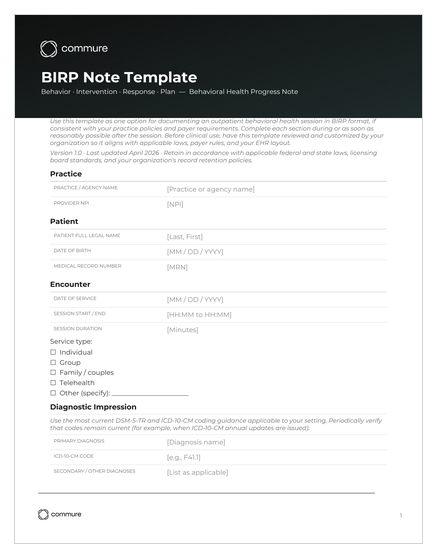
Customize the template to your state's mental health rules, your EHR's field structure, and your practice's risk-screen and consent workflows before using it with patients.
What Are BIRP Notes?
BIRP notes are commonly used therapy progress note in outpatient behavioral health. That includes solo therapy practices, community mental health agencies, group counseling clinics, substance use treatment programs, and psychiatric medication management.¹ Solo clinicians use them. Group practices also use them as a shared template across associates and supervisors.
Some agencies require BIRP because the four-section structure makes it easier to show medical necessity. Centers for Medicare & Medicaid Services (CMS) and Medicare contractors expect documentation that supports medical necessity, typically including diagnosis, symptoms, focused mental status findings, treatment plan, and progress toward goals.² A loose narrative note can miss those elements. A BIRP note prompts the clinician to capture each one in a named section.
The format also travels well across jobs. A clinician who works at three agencies can keep one mental model for charting instead of three. That same structure maps cleanly to EHR templates and supervision. BIRP notes also make audits and chart reviews faster, since reviewers know where to look for each part of a session.
Why Do Behavioral Health Clinicians Use BIRP Notes Instead of SOAP or DAP?
BIRP is one of several structured progress note formats. SOAP and DAP are two other options used in medical practice. BIRP fits behavioral health because it separates Behavior from Intervention. Other formats blur or collapse those two.¹
The four sections name what each part of a session contains:
- Behavior captures what the patient said, showed up doing, and reported.
- Intervention captures what the clinician did with that behavior, including techniques, prompts, and reflections.
- Response captures how the patient reacted in the room.
- Plan captures the next clinical step, often tied to a treatment plan goal.¹
Two practical effects flow from that split.
First, it clarifies medical necessity. Payers often look for a clear link between the patient's behavior, the clinician's intervention, and the response, which BIRP can make easier to show.²
Second, it supports supervision and license-track notes. A supervisor reading an associate's BIRP note can see clinical reasoning at each step. That matters in agencies where pre-licensed clinicians need supervisor review before billing.¹²
SOAP and DAP still have a place. The visit type drives the choice, not the agency.
BIRP vs SOAP vs DAP: How Do the Formats Compare?
BIRP, SOAP, and DAP are all structured progress note formats. BIRP separates Behavior from Intervention to track how a client responds to therapy. SOAP keeps the client's Subjective report separate from Objective findings. DAP merges observation and interpretation into one Data section for speed.¹
Pick BIRP when intervention and response tracking is the point of the note. Pick SOAP when you want the client's own report captured on its own. Pick DAP when you want a faster, lighter structure. Many clinicians keep one format across a caseload for consistency, then switch only when a visit type calls for it.
When Is a BIRP Note Most Helpful?
BIRP notes are most helpful when you want to show how a client responded to a specific intervention. The format puts Behavior and Intervention up front, so it fits therapy that tracks change over time.¹
BIRP tends to work well for:
- Behavior-focused therapy. When a treatment goal targets a specific behavior, the Behavior and Response sections show progress visit to visit.
- Intervention tracking. When you want to see which techniques move the needle, the Intervention and Response pairing makes that clear.
- Insurance documentation. Payers often look for a clear behavior-intervention-response link to support medical necessity.²
- Supervision and training. A supervisor can read an associate's clinical reasoning at each step, which helps with license-track review.
BIRP is a weaker fit when the client's own narrative is the main record you need. In that case, SOAP keeps the Subjective report separate.
What Should a BIRP Note Include?
A complete BIRP note is more than the four BIRP sections. Most organizations and payers expect progress notes to include identifiers, encounter details, and a provider signature to meet medical record and billing standards.¹²
A BIRP note for behavioral health should include:
- Patient identifiers. Name, date of birth, and medical record number. Use bracket placeholders in the template, not example names.
- Encounter details. Date of service, session start and stop times, and service type (individual, group, family, or telehealth).
- Provider identifiers. Name, license type and number, and signature line for the rendering clinician.²
- Diagnostic impression. The current working diagnosis with the Diagnostic and Statistical Manual of Mental Disorders, Fifth Edition, Text Revision (DSM-5-TR) or ICD-10-CM code. Codes are updated yearly, so check the current edition.²
- Behavior section. What the patient reported, showed up doing, and discussed during the session.
- Intervention section. The therapeutic techniques used and any homework or referrals offered.
- Response section. How the patient reacted to each intervention. Include behavioral, cognitive, and emotional shifts.
- Plan section. The next step, tied to a measurable treatment plan goal with a target review date.
- Risk screen. A short read on suicidal ideation, homicidal ideation, and self-harm. Including a brief risk screen is considered best practice in many mental health settings, especially when risk is present or has been an issue. Follow your organization's policies for frequency and scope.
- Safety plan reference. A pointer to the patient's safety plan if one is on file. Add a fresh safety plan when risk is present.
- Consent reference. A line that confirms current consent for treatment is on file.
- Notes-type marker. A flag for whether the entry is part of the medical record or a separate psychotherapy note. Psychotherapy notes get extra HIPAA protection.³
Common mistakes show up at the edges. Risk screens get skipped on routine visits. Codes drift to last year's edition. Signatures get added late without an addendum line. Build those guardrails into the template so the clinician sees them every time.
How Do You Write a BIRP Note in Practice?
Write the BIRP note while the session details are fresh. The longer the gap between the session and the note, the more reconstruction creeps in and the more time the note takes.⁴
A few field-level tips help:
- Behavior. Use observable, descriptive language. "Cried for two minutes when describing recent breakup" beats "Patient was sad."¹
- Intervention. Name the technique. "Used cognitive behavioral therapy (CBT) thought-record exercise" or "Practiced grounding skill" is more useful than "Discussed coping strategies."¹
- Response. Capture the in-session shift. "Reported reduced anxiety from 8/10 to 5/10 after grounding exercise" is concrete and trackable.¹
- Plan. Tie to a treatment plan goal with a date. "Continue weekly CBT sessions; review depression symptoms at next visit on [Date]" links the session to the bigger picture.²
A sample BIRP note for an anxiety follow-up looks like this:
Patient: [Patient Name] DOB: [DOB] MRN: [MRN]
Date of Service: [Date] Session: [Start–End] Type: Individual, 50 min
Diagnosis: Generalized Anxiety Disorder (F41.1)
Behavior: [Patient Name] reported a 7-day stretch of moderate sleep
disruption tied to work deadlines. Stated, "I keep waking up at 3 a.m.
and can't get back to sleep." Showed visible muscle tension in shoulders.
Denied suicidal or homicidal ideation.
Intervention: Reviewed sleep hygiene plan from prior session. Practiced
4-7-8 breathing exercise for two minutes. Introduced cognitive defusion
technique for nighttime worry thoughts.
Response: Reported feeling "noticeably calmer" after the breathing
exercise. Self-rated anxiety dropped from 7/10 to 4/10. Agreed to try
the defusion technique for one week.
Plan: Continue weekly CBT sessions for next four weeks. Patient will log
sleep and anxiety ratings nightly using the assigned worksheet. Review
progress at next session on [Date]. Safety plan on file; reviewed and
unchanged this visit.
Provider: [Clinician Name], [Credentials, License #] Signature: [Signature]
Keep the note tight. Many clinicians aim for roughly three to five concise lines per section once the template is set. Tight BIRP notes save time without losing clinical detail.
The examples below show how the same four-section structure flexes across common scenarios. Each uses bracket placeholders in place of real patient data.
A sample trauma (PTSD) follow-up looks like this:
Diagnosis: Post-Traumatic Stress Disorder (F43.10)
Behavior: [Patient Name] reported two nightmares this week and avoidance
of a route that passes the accident site. Showed startle response to a
sudden hallway noise. Denied suicidal or homicidal ideation.
Intervention: Continued trauma-focused CBT. Practiced a grounding script
for intrusion symptoms. Began graded exposure planning for the avoided route.
Response: Engaged with the grounding script and reported it "took the edge
off." Rated distress during exposure planning at 6/10, down from 8/10 last
session. Agreed to a small first exposure step.
Plan: Continue weekly trauma-focused CBT. Patient will attempt the first
exposure step once before the next visit on [Date]. Safety plan on file,
reviewed and unchanged.
Provider: [Clinician Name], [Credentials, License #] Signature: [Signature]
A sample depression follow-up looks like this:
Diagnosis: Major Depressive Disorder, recurrent, moderate (F33.1)
Behavior: [Patient Name] reported low mood five of seven days and reduced
interest in usual activities. PHQ-9 score 14, down from 18. Denied suicidal
ideation when asked directly.
Intervention: Reviewed behavioral activation plan. Set two small activity
goals for the week. Reinforced sleep and morning-light routine.
Response: Identified one activity already completed and described it as "a
small win." Agreed the activation plan felt manageable this week.
Plan: Continue weekly sessions with behavioral activation. Re-administer
Patient Health Questionnaire-9 (PHQ-9) at next visit on [Date]. Coordinate with prescriber on medication
review.
Provider: [Clinician Name], [Credentials, License #] Signature: [Signature]
A sample substance use disorder follow-up looks like this:
Diagnosis: Alcohol Use Disorder, moderate (F10.20)
Behavior: [Patient Name] reported two days of use this week, down from five,
and attended one support group. Identified a weekend social event as a
high-risk trigger. Denied withdrawal symptoms.
Intervention: Used motivational interviewing to reinforce change talk.
Reviewed the relapse-prevention plan and rehearsed refusal skills for the
upcoming event.
Response: Voiced increased confidence in declining a drink and set a
specific plan for the event. Engaged actively in the refusal-skills rehearsal.
Plan: Continue weekly sessions. Patient will use the refusal plan at the
weekend event and log any urges. Review at next visit on [Date]. Records
handled under 42 CFR Part 2.
Provider: [Clinician Name], [Credentials, License #] Signature: [Signature]
Writing BIRP notes faster. A few habits cut the time each note takes. Write while the session is fresh, not at the end of the day. Save a reusable BIRP template so the headers and risk fields are always there. Use short, concrete phrases over full paragraphs. Name the technique once rather than describing it at length. An AI scribe can draft the four sections from the session audio, leaving you to review and finalize rather than type from a blank page.
What Are the BIRP Note Variants (PIRP, GIRP, SIRP, and DARP)?
Several progress note formats share BIRP's structure but swap the first section. They keep the Intervention-Response-Plan spine, so a clinician comfortable with BIRP can move between them with little retraining.¹
- PIRP opens with Problem. The note starts with the problem addressed that session, then Intervention, Response, and Plan.
- GIRP opens with Goal. It ties the session to a treatment plan goal first, which suits goal-focused and managed-care settings. See our GIRP note template.
- SIRP opens with Situation. It frames the presenting situation before the intervention. See our SIRP notes template.
- DARP uses Data, Assessment, Response, Plan. It blends a DAP-style Data section with an explicit Response section.
The right variant depends on what your agency or payer asks for. If your setting leads with treatment plan goals, Goal, Intervention, Response, Plan (GIRP) may fit better. If it leads with the presenting situation, Situation, Intervention, Response, Plan (SIRP) may fit. The clinical content you capture stays largely the same.
What Are the Compliance Requirements for BIRP Notes?
BIRP notes touch HIPAA, Medicare, and state mental health law. The exact rules depend on the payer, the session type, and the state. A few baseline rules apply almost everywhere:
- Document medical necessity. CMS requires every behavioral health progress note to support the level of service billed. The note should show why the visit was needed, what was done, and what the next step is.²
- Sign and date the note. The rendering provider should sign and date each note. Late entries should be marked as addenda with the date the addendum was added.²
- Keep records securely. PHI in the BIRP note must be stored, sent, and accessed under the HIPAA Privacy and Security Rules (45 CFR 164.502 and 164.312).
- Distinguish psychotherapy notes from the medical record. Process notes the clinician keeps for personal use are not part of the chart. They get extra HIPAA protection and need a separate consent to release (45 CFR 164.508(a)(2)).³ Keep private process reflections out of the BIRP note, since progress notes and psychotherapy notes fall under different HIPAA disclosure rules.
Substance use treatment adds another layer. 42 CFR Part 2 protects the identity, diagnosis, prognosis, and treatment of any patient who gets substance use care from a Part 2 program. Sharing those records is held to stricter rules than standard HIPAA, particularly around redisclosure. The 2024 Final Rule took effect April 16, 2024 and set a compliance deadline of February 16, 2026. It also aligned Part 2 breach alerts more closely with HIPAA.⁵⁶
State law adds another layer. Many states set tighter mental health confidentiality rules than HIPAA.⁷ State rules can include separate consent for release of mental health records and special protections for minors. Check your state's specific requirements before adapting a template.
How Can You Customize Your BIRP Note Template?
A blank BIRP template is a starting point. Most practices change a few things to fit how they actually work. BIRP notes need to flex around specialty, EHR, and team workflow without losing the four-section structure.
Common adaptations:
- Specialty fit. Add fields a particular population needs. A SUD program may add a relapse-risk question. A child and family practice may add a guardian-present field and a behavioral observation grid for the child.
- EHR integration. Most behavioral health EHRs let you save BIRP as a custom template. Tools like SimplePractice, Tebra, and Kipu support custom progress note templates that can be configured to follow the BIRP structure.
- Multi-agency portability. Clinicians who work at more than one agency often keep one BIRP mental model. The agency's EHR field labels do the rest. Save the same template structure across systems and adjust only the required compliance fields per setting.
- Risk and safety triggers. Mark the risk screen and safety plan fields so they cannot be accidentally skipped in a quick note. Some EHRs allow required fields with a warning if left blank.
For larger groups, a shared template with locked compliance sections plus open clinical sections balances consistency with clinical judgment. Solo and small practices have more flexibility. They can still benefit from a saved master template that auto-fills the header.
AI scribes are reshaping the customization conversation. A BIRP-aware scribe can draft each section from the session audio.⁸ The clinician edits rather than writes from scratch. The clinician owns the clinical reasoning and the diagnoses, while the tool handles the typing.
How Commure Scribe Speeds Up Your BIRP Notes
Commure Scribe is an AI medical scribe used by 75,000+ clinicians across 25 specialties, including behavioral health. The workflow is Capture → Edit → Finalize. The clinician records the session on any device. Within seconds of clicking End Recording, a structured note appears with suggested ICD-10 and CPT codes. When BIRP is the active template, the four sections draft from the session audio.
The clinician always has the option to review, edit and finalize before anything posts. That keeps clinical reasoning, diagnoses, and the final BIRP notes in the clinician's hands. Clinicians report a 43-second average chart close time, which lets them put down the computer and actively listen during the next session.
Commure Scribe is HIPAA compliant, System and Organization Controls 2 (SOC 2) certified, with onshore data storage. Transcription runs at 99.4% accuracy across 90 languages with automatic detection. Medium and large group practices get one-click sync with one of 60+ EHR integrations. Solo and small behavioral health practices copy and paste the finalized note into their EHR.
The custom template builder lets a practice save a BIRP variant with its own risk-screen, safety-plan, and consent-reference fields. That variant then carries across associates and supervisors. Across the platform, 90%+ of providers reduce clinical documentation time and digital fatigue.
This article is for informational and educational purposes only. It does not constitute legal, medical, or professional advice, and does not guarantee compliance with any specific regulation.
BIRP Notes Template Download
Download a copy of this template
Thanks! Your BIRP notes template is ready.
Click below to download.

Frequently Asked Questions
BIRP stands for Behavior, Intervention, Response, and Plan. It is a four-section progress note format used in outpatient behavioral health. That includes therapy, substance use treatment, and psychiatric med visits. Each section has a defined scope so the note shows what happened and why.
SOAP separates Subjective from Objective, which fits primary care visits where vitals or labs anchor the objective data. BIRP separates Behavior from Intervention, which fits behavioral health where the clinician's action is the main intervention. Both formats document a visit. The right pick depends on the visit type.
Many clinicians aim for roughly three to five concise lines per section, or about one page total. The goal is enough detail to support medical necessity without padding. Long narrative notes take more time to write and to read. Tight BIRP notes cover the same ground faster.
Insurance payers do not mandate BIRP specifically. They require that progress notes support medical necessity for the level of service billed.² Many payers and agencies accept BIRP, SOAP, or DAP. Check your payer contracts and agency policies, since rules vary by payer and state.
Yes. The four-section structure is portable. Most EHRs let you save a custom progress note template that maps BIRP sections to their note types. Clinicians who work at multiple agencies often keep one BIRP master template. They adjust only the agency-specific fields and required signatures per setting.
Yes. If the practice is a 42 CFR Part 2 program, stricter consent rules apply.⁵⁶ The patient's identity, diagnosis, prognosis, and treatment of any SUD service get more protection than under standard HIPAA. Document the session in the same BIRP structure, but apply Part 2's redisclosure consent rules when sharing the note.
Sources
- CMS. Documentation Matters: Tips for Behavioral Health Practitioners. Centers for Medicare & Medicaid Services, Medicaid Integrity Program. https://www.cms.gov/medicare-medicaid-coordination/fraud-prevention/medicaid-integrity-program/education/resource-library/documentation-matters-fact-sheet-behavioral-health-practitioners
- CMS. Billing and Coding: Outpatient Psychiatry and Psychology Services (Article A57065). Centers for Medicare & Medicaid Services, 2026. https://www.cms.gov/medicare-coverage-database/view/article.aspx?articleid=57065&ver=30&keyword=Billing%20and%20Coding%3A%20Outpatient%20Psychiatry%20and%20Psychology%20Service&keywordType=starts&areaId=all&docType=NCA,CAL,NCD,MEDCAC,TA,MCD,6,3,5,1,F,P&contractOption=all&sortBy=relevance&bc=1
- U.S. Department of Health and Human Services. Does HIPAA provide extra protections for mental health information compared with other health information? HHS. https://www.hhs.gov/hipaa/for-professionals/faq/does-hipaa-provide-extra-protections-mental-health-information-compared-other-health.html
- Moy AJ, et al. Measurement of clinical documentation burden among physicians and nurses using EHRs: a scoping review. PMC8068426, 2021. https://pmc.ncbi.nlm.nih.gov/articles/PMC8068426/
- U.S. Department of Health and Human Services. Fact Sheet: 42 CFR Part 2 Final Rule. HHS Office for Civil Rights, 2024. https://www.hhs.gov/hipaa/for-professionals/regulatory-initiatives/fact-sheet-42-cfr-part-2-final-rule/index.html
- Electronic Code of Federal Regulations. 42 CFR Part 2: Confidentiality of Substance Use Disorder Patient Records. eCFR, 2026. https://www.ecfr.gov/current/title-42/chapter-I/subchapter-A/part-2
- American Psychological Association. Record Keeping Guidelines. APA, 2007 (reviewed). https://www.apa.org/practice/guidelines/record-keeping
- Levy DR, Moy AJ, et al. Toward a More Systematic Approach to Reducing Clinician Documentation Burden: A Scoping Review. Applied Clinical Informatics, 2024. PMC11152769. https://pmc.ncbi.nlm.nih.gov/articles/PMC11152769/