



Medical Form Template: 14 Free Downloads for Clinicians
14 free downloadable templates covering every stage of care, with required fields, compliance notes, and links to full template pages.
Written by the Commure Scribe Team
Published: June 26, 2026
•
9 min read
Updated June 26, 2026
This library holds 14 free medical form templates in five groups. Intake and registration covers new patient registration, patient intake and medical history forms. Clinical documentation covers history of present illness (HPI), physical examination and medical report templates. Consent and authorization covers HIPAA authorization, medical records release and medical consent forms. Administrative and billing covers a letter of medical necessity, medication log and discharge summary. Behavioral health covers psychotherapy notes and a mental health treatment plan.
What You Need to Know About Medical Form Templates
- Medical form templates are standardized documents clinicians use to capture patient information at every stage of care.
- According to American Medical Association (AMA) research, clinicians spend 36 minutes on EHR tasks for every 30-minute encounter.¹
- This library includes 14 free medical form templates in five categories, each with a downloadable file and field-by-field guidance.
What Are Medical Form Templates?
Medical form templates are standardized, reusable documents that capture patient information at every stage of care: registration, intake, consent, clinical charting, billing, and discharge. They work with paper, PDF, or digital formats and are not built into any EHR.
Federal law sets the floor for what patient-facing forms must include. The HIPAA Privacy Rule limits what forms can ask for. As a matter of HIPAA best practice, forms should collect only the minimum information needed for each specific purpose.² State laws often add restrictions on top. A form that meets federal standards may still need adjustments for your state.
Not all medical form template types carry the same legal weight. Consent and authorization forms must include specific federal elements to be valid. A form missing even one required element may be unenforceable. Intake forms carry different needs. Admin forms like discharge summaries have CMS-mandated completion timelines.
This library covers five medical form template categories. Each section links to a full individual template page. That page includes a downloadable file and field-by-field guidance.
Which Patient Intake and Registration Forms Does Your Team Need?
Registration and intake medical form templates are the first documents any patient fills out. The HIPAA Privacy Rule requires the Notice of Privacy Practices (NPP) to be given to patients at their first encounter (45 CFR 164.520).³ Covered entities must make a good-faith effort to get written acknowledgment of receipt. Care cannot be conditioned on the patient signing.
For covered entities receiving federal financial assistance (including any practice that accepts Medicare or Medicaid), Section 1557 of the ACA (2024 final rule) requires a Notice of Nondiscrimination and a language access notice in application forms, including intake paperwork. Review the current Department of Health and Human Services (HHS) guidance for placement and language requirements.
New Patient Registration Form
This medical form template captures the admin data needed before care begins. It documents demographics, insurance, emergency contacts, and consent to treat.
Key fields:
- Patient name, date of birth, address, and phone
- Insurance information (primary and secondary)
- Emergency contact name and relationship
- NPP acknowledgment and signature
- Consent to treatment
See the full new patient registration template →
Patient Intake Form
This medical form template collects clinical context before the encounter. Care teams review it for the patient's chief complaint, medications, and allergy history.
Key fields:
- Chief complaint (in the patient's own words)
- Current medications and dosages
- Known allergies and reactions
- Past surgeries and prior medical care
- Review of systems by body system
See the full patient intake form template →
Medical History Form
This medical form template covers more detail than a standard intake form. It records past diagnoses, chronic conditions, family health patterns, and prior care providers.
Key fields:
- Past diagnoses and dates
- Prior surgeries and procedures
- Chronic condition management
- Immunization history
- Family medical history (first-degree relatives)
See the full medical history form template →
What Clinical Documentation Forms Support Your Charting Workflow?
Clinical documentation medical form templates structure the encounter record for billing, care continuity, and clinical review. The 2021 Centers for Medicare & Medicaid Services (CMS) E/M Documentation Guidelines now base billing on medical decision-making (MDM), not element counting.⁴ Forms that capture MDM context directly support accurate coding.
History of Present Illness (HPI) Form
An HPI medical form template structures the patient's current complaint using eight standard elements. These elements support E/M coding and clinical reasoning.
Key fields:
- Location of symptom
- Quality (character of the symptom)
- Severity (0–10 scale or descriptive)
- Duration and timing
- Context (what makes it better or worse)
- Modifying factors
- Associated signs and symptoms
See the full HPI form template →
Physical Examination Form
This medical form template documents physical exam findings by organ system. It supports MDM documentation under the current CMS E/M guidelines.
Key fields:
- Vital signs
- General appearance
- Cardiovascular and respiratory findings
- Abdomen
- Musculoskeletal
- Neurological
- Skin findings
See the full physical examination form template →
Medical Report Template
A medical report template structures findings, assessment, and plan. Use it for referrals, specialist consultations, or post-procedure summaries.
Key fields:
- Referring provider and reason for consult
- Patient background summary
- Findings and assessment
- Current diagnoses (ICD-10 codes)
- Plan and recommendations
- Follow-up instructions and provider signature
Note: ICD-10, CPT, and HCPCS codes are updated annually. Confirm you are using the current-year edition before filing any claims.
See the full medical report template →
Which Consent and Authorization Forms Meet HIPAA Requirements?
Consent and authorization medical form templates have stricter legal needs than intake forms. A HIPAA authorization is only valid if it includes all required core elements and statements under 45 CFR 164.508.⁵ A form missing even one element is defective under law.
HIPAA Authorization Form
This medical form template authorizes the release of a patient's PHI (protected health information). PHI is any data that could identify that patient. The form names a recipient and states the purpose of the release.
Required elements under 45 CFR 164.508:
- Description of the PHI to be released
- Name of the person or organization releasing the information
- Name of the person or organization receiving the information
- Purpose of the release
- Expiration date or triggering event
- Patient signature, date, and notice of the right to revoke
- Statement that the released information may be subject to redisclosure by the recipient
- Statement that the patient's treatment cannot be conditioned on signing this authorization (limited exceptions apply)
See the full HIPAA authorization form template →
Medical Records Release Form
This medical form template requests a copy of medical records from another provider or facility. It is a specific type of HIPAA authorization. Use it for referrals, second opinions, and care coordination.
Key fields:
- Provider or facility releasing the records
- Record types requested (notes, labs, imaging)
- Date range for records
- Destination provider or facility
- Patient signature
Note: Requirements for records release vary by state. Consult your compliance officer before finalizing this form.
See the full medical records release form template →
Medical Consent Form
This medical form template documents a patient's informed agreement to a treatment or procedure. Consent is for treatment. A HIPAA authorization is for information sharing. They are not the same form.
Key fields:
- Description of the procedure or treatment
- Risks and benefits as explained to the patient
- Alternatives discussed
- Patient questions answered
- Patient signature and date
- Provider signature
Note: Informed consent rules vary by state. Review with your compliance officer.
See the full medical consent form template →
What Administrative and Billing Forms Keep Your Organization Compliant?
Administrative and billing medical form templates connect clinical decisions to payment and compliance timelines. For Medicare-participating organizations, CMS needs a completed discharge summary within 30 days of the care episode (42 CFR 482.24).⁶ If your organization sees uninsured or self-pay patients, the No Surprises Act (effective January 1, 2022) requires a written Good Faith Estimate of expected charges before services are provided.
Letter of Medical Necessity
This medical form template documents clinical justification for a service, treatment, or piece of equipment. Payers need it for prior authorization.
Key fields:
- Patient diagnosis (ICD-10 code)
- Requested service or equipment (CPT or HCPCS code)
- Clinical rationale in plain language
- Alternatives tried or not appropriate
- Duration of need
- Provider signature and NPI (National Provider Identifier)
Note: ICD-10, CPT, and HCPCS codes update each year. Confirm you are using the current edition before submitting.
See the full letter of medical necessity template →
Medication Log
This medical form template tracks all current medications, dosages, and schedules for a patient. Care teams use it for reconciliation at transitions of care and to catch drug interactions.
Key fields:
- Medication name (generic and brand)
- Dose, units, and route
- Frequency and schedule
- Prescribing provider
- Start date and end date
- Notes on side effects or adherence
See the full medication log template →
Discharge Summary Template
This medical form template documents the clinical course, diagnoses, treatments, and follow-up plan at the end of a care episode. Medicare-participating organizations must complete it within 30 days (42 CFR 482.24).⁶
Key fields:
- Admission and discharge dates
- Admitting and final diagnoses
- Procedures performed
- Medications at discharge
- Follow-up appointments and instructions
- Responsible provider signature
See the full discharge summary temlate →
Which Mental Health and Behavioral Health Forms Fill the Gaps in Your Library?
Mental health and behavioral health medical form templates need stronger privacy protections than most clinical forms. When SUD (substance use disorder) treatment is involved, 42 CFR Part 2 applies.⁷ This law is stricter than HIPAA. Unlike HIPAA, Part 2 requires patient consent before SUD records can be shared, even for treatment, payment, and operations purposes. When a client authorizes sharing their records, use a mental health release of information form with a separate psychotherapy notes authorization and a HIPAA validity check.
Psychotherapy Notes Template
This medical form template records the content and process of a therapy session. HIPAA gives psychotherapy notes special legal protections (45 CFR 164.508(a)(2)).⁵ They must be kept separate from the rest of the medical record. They need a separate patient authorization before they can be released.
Key fields:
- Session date and duration
- Patient's presenting concerns and mood
- Themes explored in session
- Clinician observations and interventions
- Patient response to interventions
- Risk assessment (if applicable)
- Plan for next session
Note: Psychotherapy notes are not the same as progress notes used for billing. Keep them in a separate file.
See the full psychotherapy notes template →
Mental Health Treatment Plan
This medical form template documents diagnoses, treatment goals, interventions, and a review schedule. Most payers and licensing boards need one for ongoing behavioral health services.
Key fields:
- Diagnoses (DSM-5 or ICD-10 codes)
- Presenting problems and functional limits
- Long-term goals (12-month horizon)
- Short-term objectives (measurable and time-bound)
- Interventions and frequency
- Crisis plan (if indicated)
- Review date (typically every 90 days)
- Patient and clinician signatures
Note: If your work involves SUD treatment, 42 CFR Part 2 requires patient consent before records can be shared, unlike HIPAA, which allows sharing for treatment, payment, and operations without consent.⁷ Consult your compliance officer.
See the full mental health treatment plan template →
How Commure Scribe Works With Your Clinical Forms
Medical form templates capture the structure of care. Intake forms collect demographics. Consent forms record patient agreement. Clinical documentation forms structure the encounter record. But no medical form template captures the clinical conversation itself.
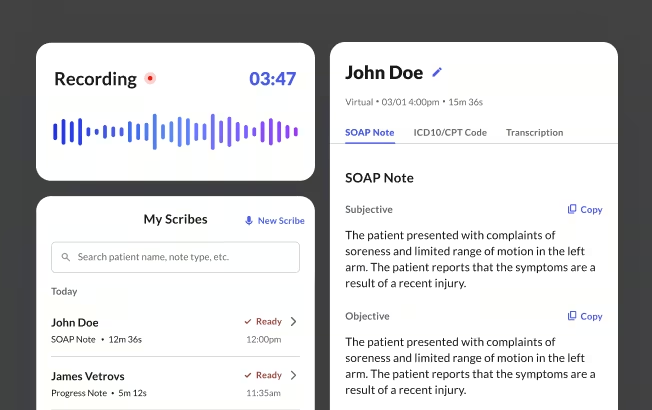
Commure Scribe is the documentation layer that fills that gap. When the clinician records an encounter, Scribe listens. Within seconds of recording ending, a structured note appears, highly accurate, with suggested ICD-10 and CPT codes generated alongside. The clinician reviews and finalizes before anything enters the record.
For intake and consent forms, Scribe handles what comes after the form is signed. The follow-up note reflects what happened in the room, building on the context the form set up.
For clinical documentation medical form templates (HPI, physical exam, medical report), Scribe drafts the note directly from the encounter. The note captures the full clinical context from the session.
The AI Copilot helps with documentation tasks generated from the same encounter beyond the clinical note, including prior authorization requests, work excuse letters and patient emails.
90%+ of providers who use Commure Scribe reduce clinical documentation time and digital fatigue. The tool covers 25 specialties, including family medicine, internal medicine, behavioral health, and pediatrics. It supports 90 languages with automatic language detection and connects to major EHRs including AdvancedMD, eClinicalWorks, Athenahealth, and SimplePractice.
Stop re-typing what your forms already captured
Forms gather the structure. Commure Scribe handles what comes next. It listens to the encounter and drafts the clinical note from the conversation, not from what was typed into a form. See Commure Scribe pricing. Solo plans include a 7-day free trial, no credit card needed.
This article is for informational and educational purposes only, does not constitute legal, medical, or professional advice, and does not guarantee compliance with any federal, state, or local regulation.
Frequently Asked Questions
Medical form templates fall into five main categories. These are patient intake and registration, clinical documentation, consent and authorization, administrative and billing, and mental health and behavioral health. Each category serves a distinct stage of care. This library covers 14 types, each with a full template page and downloadable file.
HIPAA best practices support collecting only the minimum information needed for each purpose, and state laws may restrict data collection further.² The NPP must be provided at the patient's first encounter, with a good-faith effort to get written acknowledgment of receipt (45 CFR 164.520).³ State laws may add requirements. Have your compliance officer review the form before use.
A registration form captures administrative data: demographics, insurance, and consent to treat. A medical history form captures clinical data: past diagnoses, surgeries, chronic conditions, and family health patterns. Registration creates the administrative record. A medical history form gives care teams the clinical context they need before the encounter.
Yes. Every medical form template in this library is available as a free download. The templates are starting points for your own forms. Consult a compliance officer or legal counsel before using any form with regulatory requirements, such as HIPAA authorization forms or informed consent documents.
Most states need separate informed consent for telehealth services. Requirements vary by state. Some states need specific disclosures about technology risks, data privacy, and the patient's right to in-person care. Check your state's telehealth laws and have your compliance officer review the form before use.