



Medical Report Template: Free Download for Clinical Use
Medical report template for CMS E/M documentation standards and nine recommended sections
Written by the Commure Scribe Team
Published: June 13, 2026
•
5 min read
What You Need to Know About Medical Report Templates
- A medical report template is a structured form that captures all key parts of a patient encounter.
- US physicians spend a mean of 1.77 hours per day completing documentation outside office hours.¹
- Download the free template below and have your compliance officer review it before using it clinically.
Download the Free Medical Report Template
Note: This template is for informational purposes only and does not constitute legal or medical advice. Have your compliance officer review it before clinical use.
- Download the Medical Report Template: editable DOCX, all nine recommended sections included
What Is a Medical Report Template and When Do You Need One?
A medical report template structures a full encounter record. It starts with the reason for the visit and ends with the provider's plan of care. It goes beyond a basic clinical notes entry. It also captures key compliance fields: provider credentials, date of service, and a space for amendments.
Templates are the backbone of clinical charting. They were used in 89% of visits at one academic center, with a median of two per encounter.² That reliance makes template design a quality issue, not just for ease.
You use a medical report template for any documented encounter. Initial visits, follow-ups, telehealth sessions, and referral consults all fit the same core structure. Independent and group practices use the same core fields. Specialty content varies. The core structure does not.
Starting in 2021, Centers for Medicare & Medicaid Services (CMS) changed how E/M visit codes are set. Medical decision-making (MDM) now determines the billing level, not the number of exam bullet points.³ A well-structured template supports that shift. It keeps records focused on clinical thinking, not checkbox volume. For the wider picture, a clinical documentation overview covers the 2021 CMS changes and the record types created during patient care.
How Is a Medical Report Template Used in Practice?
The nine-section structure fits most encounter types. Three settings show where field content differs most.
New patient visit. Fill all nine sections in full. Clinical history tends to be longer. The exam often covers more systems. Your clinical decision notes should reflect the full complexity of the case.
Telehealth visit. Core fields stay the same. Note the visit type and platform in the visit information section. Check your state's telehealth consent rules before the visit starts. Some states require a separate consent document.
Referral consultation. Add the referring provider's name and the specific clinical question to the clinical history or chief complaint section. Your assessment should address that question directly. Your plan should indicate what you communicated back to the referring provider. If you need to send a written response, use a separate referral letter template.
What Does This Medical Report Template Include?
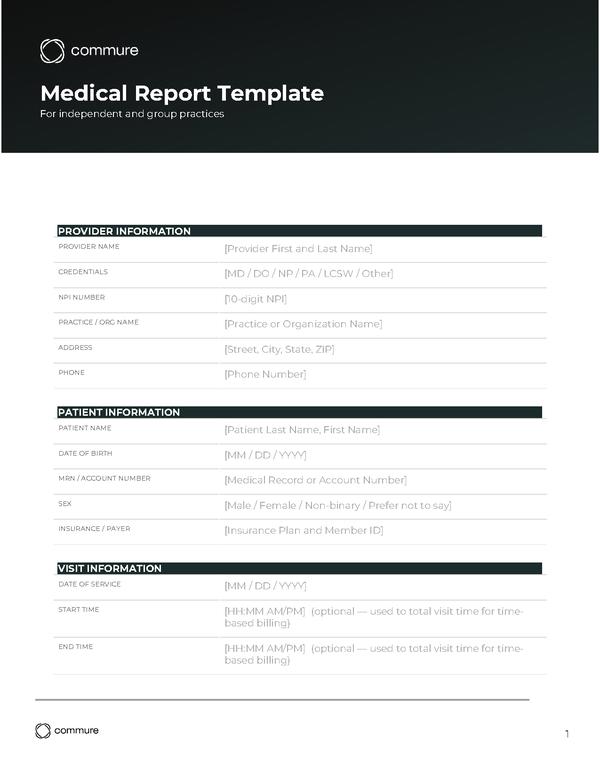
This medical report template has nine sections. Together they form a recommended structure for a complete encounter record, drawn from common documentation practice. Completing each one helps you avoid a denied claim, an audit flag, or an incomplete chart.
- Patient identifiers. Name, date of birth, and medical record or account number. These connect the record to the right patient. Common mistake: leaving the medical record number (MRN) blank when a name search returns multiple patients.
- Date and time of service. Date is always required. Add time only if billing by total time.³
- Chief complaint. The reason for the visit, in the patient's own words. Avoid diagnostic terms here. Common mistake: writing "diabetes follow-up" instead of "checking my blood sugar."
- Clinical history. Relevant past medical, surgical, and social history. Include only what is relevant to today's visit.
- Examination findings. Your observations during the encounter. A medically appropriate exam must appear in the record.³ The format is flexible.³
- Assessment. Your clinical impression and relevant ICD-10 codes. This section captures your clinical reasoning for MDM purposes.³
- Plan of care. What you ordered, referred, or recommended. Include follow-up timing.
- Provider credentials and signature. Name, credentials, and a dated signature line. The rendering provider must authenticate the record.⁵ Common mistake: cosigning without a separate signature date.
- Amendment section. A dated field for late entries or corrections. Amendments must be clearly identified, dated, and attributed to their author.⁵
Group practices use all nine sections across providers. Independent practices may rename fields. The recommended content stays the same.
Medical Report Template Variants
The nine-section template covers most documented encounters. Two shorter formats fit specific situations.
Narrative note format. Organizes the same fields into flowing prose blocks rather than discrete field rows. Useful for complex cases where a full history of present illness and clinical reasoning read better as connected paragraphs. Same nine elements, different layout.
Visit summary format. A condensed six-section option for follow-up visits and brief encounters. Covers patient and provider identifiers, chief complaint, assessment with ICD-10, plan and follow-up timing, and a signature block. Not suitable for new patients or billing levels that require full MDM documentation. For encounters requiring the full nine sections, use the standard progress note template instead.
How Do You Fill Out a Medical Report Template?
Fill the medical report template in visit order. Start at the top. Work down. This reduces the chance of a missing field.
Before the visit
- Verify patient identifiers against the registration record. Do not copy from a prior note.
During the visit
- Write the chief complaint in the patient's own words. Ask why they came in today. Write it as they said it. Example: "Chest tightness when I climb stairs" — not "chest pain" or "possible angina."
- Document exam findings as you observe them. Do not reconstruct from memory after the visit ends.
After the visit
- Complete the assessment before you sign. Use the most specific ICD-10 code available. Avoid unspecified codes. Use a more precise code when one applies. Example: E11.65 (Type 2 diabetes with hyperglycemia) rather than E11.9 (without complications).
- List each plan item separately. Note follow-up timing and the responsible party.
- Complete the note first. Then sign and date.⁵
For late entries or corrections
- Add a new entry below the original note. Include today's date and the words "late entry" or "addendum."⁵ Do not alter the original text.
Group practices often set documentation workflows across all providers. Independent practices may handle this field by field. The steps are the same either way.
Sample Completed Medical Report Template
Below is a fictional example showing all nine sections filled in for a real encounter type: an established-patient follow-up for Type 2 diabetes management. All patient and provider details are illustrative only.
PATIENT IDENTIFIERSP atient Name: Lopez, Maria G.Date of Birth: 03/12/1968MRN / Account Number: 4872931
DATE AND TIME OF SERVICE Date of Service: 06/30/2026Time: Not required. Visit billed by medical decision-making, not time.
CHIEF COMPLAINT"My blood sugar readings have been high in the mornings for the past three weeks, even when I stick to my diet."
CLINICAL HISTORY PMH: Type 2 diabetes mellitus (diagnosed 2014), hypertension, hyperlipidemia.Medications: Metformin 1000 mg BID, lisinopril 10 mg daily, atorvastatin 20 mg nightly.Social: Non-smoker. Works as a school administrator. Reports increased work stress over the past month. No recent dietary changes noted.Relevant to today: No new medications. No changes to insulin or other hypoglycemics since last visit. Home glucose log reviewed. Fasting readings 148–172 mg/dL over past 21 days.
EXAMINATION FINDINGS General: Alert and oriented, in no acute distress.Vitals: BP 138/82 mmHg, HR 76 bpm, Weight 172 lbs (stable from last visit).Feet: No ulcerations, sensation intact bilaterally to monofilament. Peripheral pulses palpable.Exam otherwise limited to systems relevant to today's visit per 2021 E/M guidelines.
ASSESSMENT Primary Diagnosis: Type 2 diabetes mellitus with hyperglycemia. E11.65.Secondary: Hypertension, essential. I10. Hyperlipidemia. E78.5.Clinical reasoning (MDM): Moderate complexity. Elevated fasting glucose without acute complications. Likely contributing factors include stress-related cortisol effect and possible dietary drift. HbA1c pending. Ordered today. Plan adjusted pending result. No signs of acute end-organ involvement.
PLAN OF CARE
- Order HbA1c. Results expected within 48 hours. Follow up by phone to review.
- Increase Metformin to 1000 mg TID if HbA1c ≥ 8.0% and patient tolerates. Hold pending lab.
- Counsel patient on stress and glycemic control. Provided written handout on stress management and blood glucose.
- Recheck fasting glucose log at next visit. Patient to continue home monitoring daily.
- Continue lisinopril and atorvastatin unchanged.
- Follow-up: 6 weeks or sooner if glucose readings do not improve. Responsible party: Dr. Chen for lab review; MA to schedule follow-up.
PROVIDER CREDENTIALS AND SIGNATUREProvider: Sarah Brown, MD, Internal MedicineNPI: 1234567890Practice: Northside Internal Medicine GroupSignature: [signed]Date Signed: 06/30/2026Time Signed: 3:42 PM
AMENDMENT SECTIONNo amendments.
All names, dates, and clinical details in this example are fictional and for illustrative purposes only. This is not a real patient record.
What Documentation Requirements Apply to Medical Reports?
Several rules shape medical report documentation. Which ones apply depends on your setting and payers. State rules add their own requirements.
CMS E/M documentation guidelines (2021)
Records must support the level of service billed.³ This connects to the MDM-based coding framework covered above. The 2023 extensions applied the same framework to all E/M settings.⁴ One related practice: copied or forwarded notes from a prior visit can carry audit risk.³ Document today's visit in today's note.
HIPAA Privacy Rule (45 CFR 164.502–514)
The minimum necessary standard limits how PHI is used and disclosed, though it does not apply to disclosures to or requests by a provider for treatment purposes (45 CFR 164.502(b)). Even where the rule does not require it, keeping each note focused on what is clinically relevant is good documentation practice. A clinical note does not need the full social or family history if it is not pertinent to today's visit. For a full compliance overview, see our HIPAA compliance checklist.
CMS Conditions of Participation (42 CFR 482.24)
For Medicare-participating hospitals, the Conditions of Participation require complete, authenticated medical records that document patient progress and support clinical decisions (42 CFR 482.24). This rule governs hospitals, not independent or group physician offices; for office-based practices it serves as a useful best-practice benchmark rather than the governing requirement.
State medical board requirements
Record retention periods vary by state. Federal program requirements and payer contracts may set minimum retention periods. Your state medical board sets the specific requirement. Contact them for details.
Independent and group practices should confirm which of these apply to their setting. Template structure helps either way. It puts each recommended element in a fixed place. That makes completion faster. It also makes audits easier.
How Commure Scribe Works With This Template
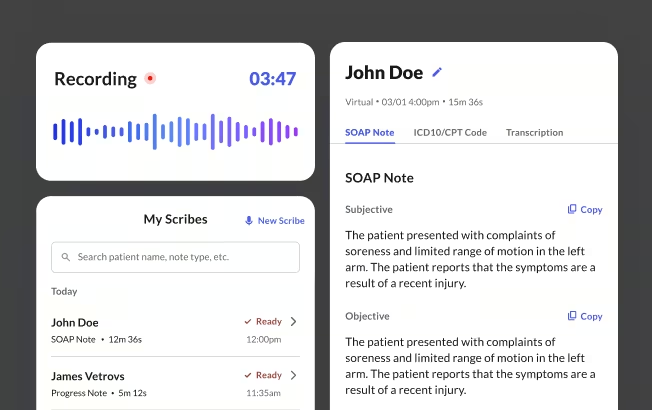
Commure Scribe is an AI medical scribe that generates the completed note from your clinical encounter: chief complaint, history, exam findings, assessment, plan, and suggested ICD-10 codes.
A Chrome extension overlays directly on your EHR. When the note is ready, copy it into your chart with one click. No tab switching. No retyping.
90%+ of providers report reduced charting time. Practices using Commure Scribe report a 25% reduction in denials on average.
This article is for informational and educational purposes only, does not constitute legal, medical, or professional advice, and does not guarantee regulatory compliance.
Medical Report Template Download
Download a copy of this template
Thanks! Your medical report template is ready for download.
Click below to download.

Frequently Asked Questions
Every medical report template should include nine elements: patient identifiers, date and time of service, chief complaint, clinical history, examination findings, assessment with ICD-10 codes, plan of care, provider credentials and signature, and an amendment section. Together these form a recommended structure that supports CMS E/M documentation and authentication expectations.³ ⁵
This medical report template is designed with HIPAA and CMS E/M documentation requirements in mind. It includes the elements needed to support the level of service billed and to authenticate the record. Have your compliance officer review it before clinical use. It does not constitute legal or professional advice.
This medical report template can be customized by adding specialty-specific fields to the examination and assessment sections. Add an exam checklist or a specialty-specific assessment scale as needed. Keep all nine recommended sections intact. Do not remove patient identifiers, the signature line, or the amendment section.
A SOAP note follows four sections: Subjective, Objective, Assessment, Plan. A medical report is broader. It includes patient demographics, provider credentials, a signature line, and an amendment section. A SOAP note is one type of medical report. Not every medical report follows SOAP format.
Yes. This medical report template works for both in-person and telehealth visits. The nine recommended sections apply the same way. Note the visit type in the date and time section. Check your state telehealth consent rules before the visit. They vary by state and may require a separate consent document.
State retention requirements vary. Federal rules set a floor. Your state medical board sets the specific period. Contact them before finalizing your documentation policy. Payer contracts and malpractice insurers may require a longer retention period than state law mandates.
Sources
- Gaffney A, Woolhandler S, Cai C, et al. Medical Documentation Burden Among US Office-Based Physicians in 2019: A National Study. JAMA Internal Medicine. 2022;182(5):564–566. https://pmc.ncbi.nlm.nih.gov/articles/PMC8961402/
- Rule A, Hribar MR. Frequent but fragmented: use of note templates to document outpatient visits at an academic health center. Journal of the American Medical Informatics Association. 2021;29(1):137–141. https://pmc.ncbi.nlm.nih.gov/articles/PMC8714279/
- Centers for Medicare & Medicaid Services. Evaluation and Management Services (MLN006764). https://www.cms.gov/files/document/mln006764-evaluation-management-services.pdf
- American Medical Association. CPT® Evaluation and Management. Updated Jan 26, 2026. https://www.ama-assn.org/practice-management/cpt/cpt-evaluation-and-management
- Centers for Medicare & Medicaid Services. Medicare Program Integrity Manual (Pub. 100-08), Chapter 3, §3.3.2.5, Amendments, Corrections and Delayed Entries in Medical Documentation. https://www.cms.gov/Regulations-and-Guidance/Guidance/Manuals/Downloads/pim83c03.pdf