



EMDR Treatment Plan Template (Free PDF)
A structured EMDR treatment plan with the eight phases, target and goal tracking, and a risk section.
Written by the Commure Scribe Team
Published: July 7, 2026
•
7 min read
Updated July 7, 2026
What You Need to Know About an EMDR Treatment Plan
- An eye movement desensitization and reprocessing (EMDR) treatment plan maps the eight-phase EMDR protocol to a client's trauma targets and goals.
- EMDR is recommended for PTSD by the APA and the VA and Department of Defense¹.
- This page gives a free EMDR treatment plan template plus how to write measurable goals.
Download the EMDR Treatment Plan Template PDF
Note: This template is for informational purposes only and does not constitute legal or medical advice. EMDR is delivered by trained clinicians. Have your compliance officer review the template before clinical use.
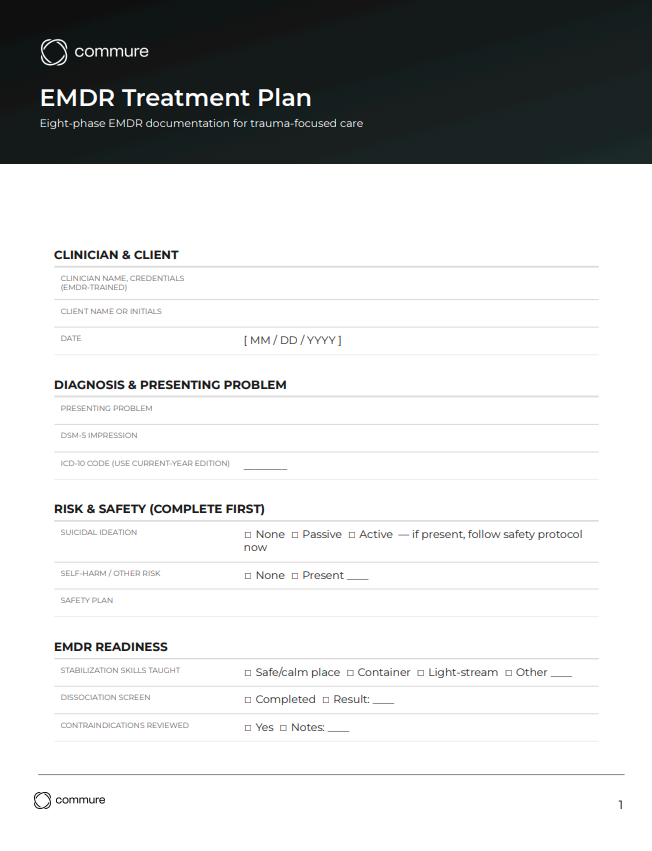
The template is a documentation structure. Use it within your EMDR training and clinical judgment.
What Is an EMDR Treatment Plan?
An EMDR treatment plan is a structured document for trauma therapy. It maps the eight-phase EMDR protocol to a client's specific trauma memories and goals¹. EMDR uses bilateral stimulation to reduce the charge of distressing memories³. The plan names the target memories, the baseline distress scores, and the measurable goals for treatment. It also sets out the stabilization and risk steps that trauma work requires. The sections below cover the eight phases, target and score tracking, how to write goals, and the risk basics.
The Eight Phases of EMDR
EMDR follows eight phases across a course of treatment². Your plan should reflect each one.
- Phase 1: History-taking. Gather trauma history and select target memories².
- Phase 2: Preparation. Teach coping and stabilization skills, such as a safe-place exercise².
- Phase 3: Assessment. Identify the image, negative belief, positive belief, and body sensations for a target².
- Phase 4: Desensitization. Process the target with bilateral stimulation until distress drops².
- Phase 5: Installation. Strengthen the positive belief about the self².
- Phase 6: Body scan. Check for and clear any leftover physical tension².
- Phase 7: Closure. Return the client to a calm, stable state at the end of each session².
- Phase 8: Reevaluation. Review progress at the next session and set the next target².
Phases 3 through 6 repeat for each target memory. The plan should list targets in order.
Targets, SUDS, and VOC
EMDR tracks progress with two simple scales. Record a baseline for each target memory.
- Three-pronged targets. Plan targets across the past, the present, and the future¹.
- SUDS. The Subjective Units of Disturbance scale rates distress from 0 to 10³.
- VOC. The Validity of Cognition scale rates how true a positive belief feels from 1 to 7³.
- Completion. A target is considered done when SUDS is 0, VOC is 7, and the body scan is clear³.
Record the starting SUDS and VOC for each target. Update them each session to show change over time.
How to Write Measurable EMDR Goals
Write goals that are specific and measurable, so progress is clear. Tie each goal to the scores and the client's daily life.
- Anchor to a target. Name the memory or trigger the goal addresses.
- Use the scores. For example, "reduce SUDS on the target memory from 8 to 0 over the course of treatment"³.
- Add a functional goal. Tie it to daily life, such as fewer intrusion symptoms or better sleep.
- Make it measurable. Use a number, a scale, or a clear behavior change.
- Set review points. Note when you will reassess, and update the EMDR treatment plan as targets resolve.
- Link the diagnosis. Connect goals to the Diagnostic and Statistical Manual of Mental Disorders, Fifth Edition (DSM-5) impression and ICD-10 code. For a broader plan, see the mental health treatment plan.
Risk, Stabilization, and Documentation Basics
Trauma work can surface distress and risk, so build safety into the plan. Document each step.
- Screen first. Check readiness, dissociation, and contraindications before reprocessing². Record baseline symptoms at intake with a trauma assessment template and its PTSD Checklist for DSM-5 (PCL-5) form.
- Plan stabilization. Note the coping skills taught in Phase 2, such as a safe-place or container exercise².
- Assess risk. Screen for suicidal thoughts and self-harm, and document a safety plan. A trauma timeline worksheet and biopsychosocial assessment can inform this.
- Protect privacy. A completed plan holds protected health information, or PHI. Store it under the HIPAA Privacy Rule and collect only what you need (45 CFR 164.502)⁵.
- Psychotherapy notes. Process notes get extra protection and need a separate authorization to disclose (45 CFR 164.508(a)(2))⁵. Session content goes in a therapy progress note instead, which lives in the chart and stays apart from these process notes.
- Use current codes. ICD-10 codes update each year, so use the current edition.
How Commure Scribe Fits the EMDR Workflow
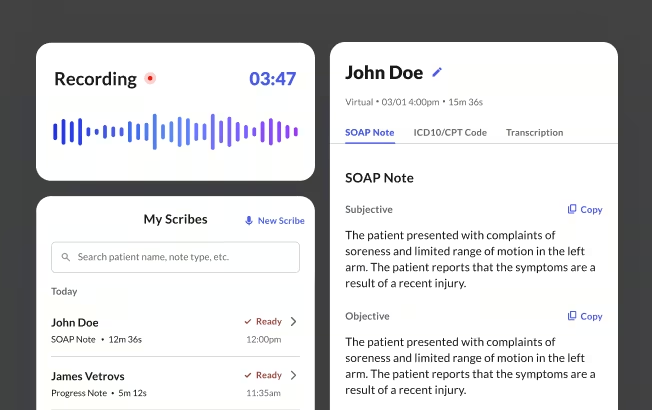
An EMDR treatment plan is built by the clinician, so Commure Scribe does not fill it out. It handles the documentation around it: the session note for each EMDR visit, including the targets worked and the scores. Right after you click End Recording, a structured note appears in seconds, with suggested ICD-10 and CPT codes in a separate tab. You always have the choice to review and finalize the note before it enters the chart.
For behavioral and mental health clinicians, that means you can put down the computer and stay present during reprocessing. Across 25 specialties, 90%+ of providers reduce clinical documentation time and digital fatigue. For a ranked breakdown, see the best AI medical scribes guide.
Stay present during reprocessing
EMDR sessions ask for your full attention, not a screen. If you would rather not retype each session into the chart by hand, an AI scribe drafts the note for you while you stay with the client. See Commure Scribe pricing and plans to find the fit for your team, including the free trial.
Disclaimer
This article is for informational and educational purposes only, does not constitute legal, medical, or professional advice, and does not guarantee regulatory compliance or treatment outcomes. EMDR should be delivered by clinicians with appropriate training.
EMDR Treatment Plan Template Download
Download a copy of this template
Thanks! Your EMDR treatment plan template is ready.
Click below to download.

Frequently Asked Questions
An EMDR treatment plan is a structured document that maps the eight-phase EMDR protocol to a client's trauma targets and goals. It records target memories, baseline SUDS and VOC scores, measurable goals, and a risk and stabilization plan. Trained clinicians use it to guide and document treatment.
The eight phases are history-taking, preparation, assessment, desensitization, installation, body scan, closure, and reevaluation. Phases 3 through 6 repeat for each target memory. The plan should reflect all eight phases.
SUDS is the Subjective Units of Disturbance scale, which rates distress from 0 to 10. VOC is the Validity of Cognition scale, which rates how true a positive belief feels from 1 to 7. A target is considered resolved when SUDS is 0 and VOC is 7.
Anchor each goal to a target memory or trigger, then make it measurable. Use the SUDS and VOC scores, such as reducing SUDS from 8 to 0, and add a functional goal tied to daily life. Set review points and update the plan as targets resolve.
Yes. Once it identifies a client, a completed EMDR treatment plan holds protected health information. Store and share it under the HIPAA Privacy Rule. Psychotherapy notes get extra protection and need a separate authorization to disclose.
Sources
- APA. Eye Movement Desensitization and Reprocessing (EMDR) Therapy. https://www.apa.org/ptsd-guideline/treatments/eye-movement-reprocessing
- APA. Exploring the 8 phases of EMDR. https://www.apa.org/topics/psychotherapy/emdr-phases
- Cleveland Clinic. EMDR Therapy: What It Is, Procedure & Effectiveness. https://my.clevelandclinic.org/health/treatments/22641-emdr-therapy
- VA National Center for PTSD. Eye Movement Desensitization and Reprocessing (EMDR) for PTSD. https://www.ptsd.va.gov/professional/treat/txessentials/emdr_pro.asp
- U.S. Department of Health and Human Services. HIPAA for Professionals: Privacy (45 CFR 164.502; psychotherapy notes 45 CFR 164.508(a)(2)). https://www.hhs.gov/hipaa/for-professionals/privacy/