



History of Present Illness Example: Free H&P Template
A walk-through of the eight HPI elements with three worked examples and a downloadable H&P template that scaffolds the HPI section.
Written by the Commure Scribe Team
Published: June 6, 2026
•
8 min read
Updated June 6, 2026
A history of present illness (HPI) is the narrative paragraph that follows the chief complaint. It walks the complaint through eight descriptors: Onset, Location, Duration, Character, Aggravating and alleviating factors, Radiation, Timing and Severity (OLDCARTS). A chest pain example reads: 'Patient presents with substernal chest pressure that started 90 minutes ago while shoveling snow. The 7/10 pressure radiates to the left arm, with associated diaphoresis and shortness of breath.' The free history and physical (H&P) template scaffolds this section.
What You Need to Know
- A history of present illness example is the worked clinical paragraph that follows the chief complaint, written by the provider through eight defined descriptors.
- Outpatient progress notes grew longer and more redundant over a decade, and template design is one fix.¹
- Use this H&P template, scaffolded to OLDCARTS with three worked history of present illness examples, as a starting point for your specialty.
Download the H&P template (with HPI section)
Note: These templates are for informational purposes only and do not constitute legal or medical advice. Have your compliance officer review them before clinical use.
Four editable templates (with three for specialties), each scaffolded to OLDCARTS and editable in Word.
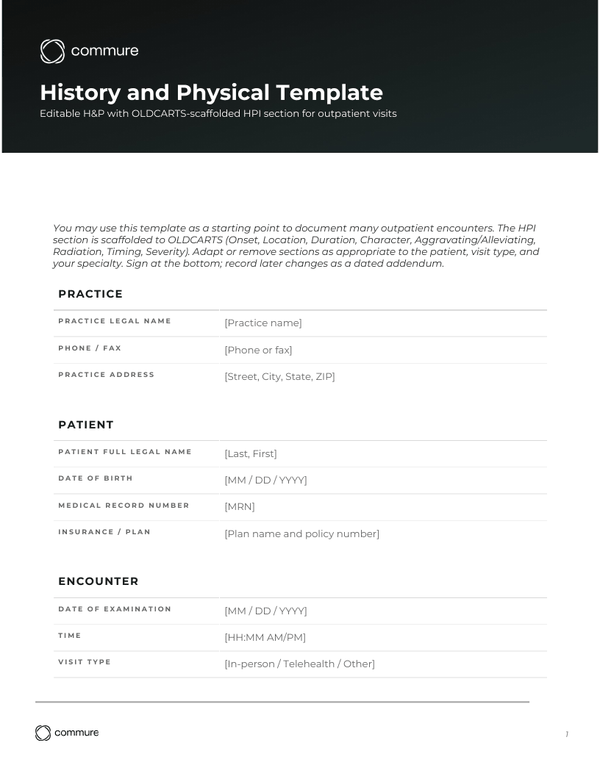
Download the H&P template (with HPI section)
An editable H&P template with an OLDCARTS-scaffolded history of present illness section, plus full Past Medical / Review of Systems / Physical Examination / Assessment / Plan blocks. .
Primary Care HPI Template
A standard outpatient H&P scaffold with the full eight-element OLDCARTS HPI section, full Review of Systems, and system-by-system Physical Examination. Fits routine primary care, internal medicine, and family medicine visits.
Behavioral Health HPI Template
The same OLDCARTS scaffold tuned for psychiatric visits — character, severity, and timing of psychiatric symptoms, medication response, psychosocial stressors, and a required SI/HI screen. The Physical Examination section is replaced by a Mental Status Examination.
Emergency Department HPI Template
An acute-focused HPI scaffold for ED visits, leading on onset, severity, mechanism, red-flag associated symptoms, and pre-arrival interventions. Vitals include ESI triage acuity, and the Physical Examination opens with a primary survey (ABCs).
Customize whichever variant fits your practice and EHR before going live.
What is a history of present illness?
The HPI sits at the front of most outpatient charts, just after the chief complaint. It lives in the Subjective section of a SOAP note and in the History block of an H&P.² The eight elements that make up an HPI have stayed constant even as the chart format around them moved from paper to EHR.
The HPI is one of the chart sections payers commonly review when assessing medical necessity. The assessment is another. Together they tell a reader why the visit happened and what reasoning drove the plan.
A single HPI often runs two to four sentences. Short does not mean shallow. A complete history of present illness example walks the chief complaint through the relevant descriptors and anchors the diagnostic shortlist.
What follows: six worked HPI examples, the eight elements behind them, a step-by-step way to write one, the reasoning, the rules that hinge on the HPI, and customization for your practice.
What does a good history of present illness example look like?
A good HPI reads like a tight narrative paragraph. The most applicable descriptors are covered by a short clause or two. The history of present illness examples below show how the same OLDCARTS scaffold produces different paragraphs across cardiac, neurologic, GI, musculoskeletal, behavioral-health, and pediatric presentations.
Example 1: Chest pain, 58-year-old patient.
Patient presents with substernal chest pressure that started 90 minutes ago while shoveling snow. The 7/10 pressure radiates to the left arm and feels like a heavy weight, with associated diaphoresis and shortness of breath. It has not changed with rest, and there are no prior episodes.
Example 2: Headache, 34-year-old patient.
Patient presents with a unilateral right-sided throbbing headache that started four hours ago, gradually building from a 3/10 to an 8/10 over the first hour. Pain is centered behind the right eye and radiates to the right temple. Light and noise make it worse, and lying in a dark room helps. Patient reports nausea without vomiting and a similar episode last month that resolved with sleep.
Example 3: Abdominal pain, 27-year-old patient.
Patient presents with sharp right lower quadrant abdominal pain that began around the umbilicus 18 hours ago and migrated to the RLQ in the past four hours. Pain is 7/10, constant, worse with walking and coughing, and not relieved by acetaminophen. Patient reports loss of appetite, one episode of vomiting, and a low-grade fever measured at home at 100.6°F.
Example 4: Low back pain, 42-year-old patient.
Patient presents with dull, aching pain in the lumbar region that has been present for six weeks and gradually worsening. Pain is 4/10 at rest and 7/10 with prolonged sitting, and does not radiate. Standing briefly and ibuprofen ease the pain. The pain is worse in the morning for the first hour after waking.
Example 5: Anxiety follow-up, 31-year-old patient on sertraline 50 mg.
Patient returns four weeks after starting sertraline 50 mg for generalized anxiety. Background worry has dropped from a daily 8/10 to a 4/10 by week three, and sleep onset has improved from 90 minutes to 30 minutes. Patient denies nausea, sexual side effects, and suicidal ideation, and still avoids work meetings.
Example 6: Pediatric fever, 4-year-old patient (history given by mother).
Mother reports that the patient has had a fever for two days, peaking at 102.4°F yesterday evening and currently 101.2°F at the time of visit. The fever is associated with a runny nose, a mild cough, and decreased oral intake but normal urine output. Acetaminophen brings the temperature down by about a degree for four hours. No rash, no ear pulling, no vomiting, and no exposure to known sick contacts.
Each history of present illness example covers six to eight OLDCARTS descriptors in three sentences or fewer. Different complaints lean on different descriptors. Chest pain leans on severity and radiation, headache on aggravating factors and timing, abdominal pain on migration pattern and associated symptoms, back pain on onset and alleviating factors, anxiety on side-effect screening and a measurable severity drop, and pediatric fever on quantified temperature and parent-reported context.
What should a complete HPI include?
Each example above passes the chief complaint through the same eight descriptors. The most widely taught version is OLDCARTS: Onset, Location, Duration, Character, Aggravating/alleviating factors, Radiation, Timing, and Severity.² A few elements may be N/A for a given complaint, but the relevant ones belong in the note.
The eight OLDCARTS descriptors:
- Onset. When the symptom first started. Specific is better ("two hours ago" or "after dinner Tuesday") than relative ("recent").
- Location. Where the symptom is. Pin to a body region or a specific structure.
- Duration. How long the symptom has been present, total. Timing (a separate element) covers the pattern.
- Character. What the symptom feels like (sharp, dull, pressing, burning). Use the patient's own words when they are clinically useful.
- Aggravating and alleviating factors. What makes the symptom worse and what makes it better.
- Radiation. Whether the symptom moves to another body region.
- Timing. Pattern of the symptom (constant, intermittent, worse in the morning, after meals).
- Severity. Use a 0–10 scale or impact-based language ("could not finish dinner").
The eight elements work whether the chief complaint is acute, chronic, or behavioral health-flavored. Not every visit requires all eight descriptors. Document the elements that are clinically relevant to the patient's presentation, and write the history of present illness example in plain language.
How to write a history of present illness step-by-step
Writing a strong HPI is a five-step move that takes the same arc on every visit. The steps below work for a paper template, an EHR dot phrase, or an AI medical scribe draft. Follow them in order and the paragraph almost writes itself.
- Start with the opening sentence. Lead with the patient's age, sex, and pertinent chronic conditions, then state the chief complaint in one short clause. Example: "A 58-year-old male with a history of hypertension presents with substernal chest pressure that began 90 minutes ago." This single sentence frames everything that follows.
- Walk the complaint through OLDCARTS. Cover Onset, Location, Duration, Character, Aggravating/alleviating factors, Radiation, Timing, and Severity in order. Skip any descriptor that does not apply, but consider every one. Pull the patient's own words when they capture character or severity better than clinical terms.
- Add the pertinent positives and negatives. Note associated symptoms that point toward the working diagnosis (a positive) and the ones the patient denies that rule it out (a negative). For chest pain that means diaphoresis, nausea, and dyspnea on the positive side, and denials of fever, cough, or recent trauma on the negative side.
- Close with context that changes the plan. Mention what the patient has already tried (rest, OTC meds, prior visits), prior episodes, and any red flags that bend the differential. This is where a history of present illness example earns its keep in audit defense — the next reader sees why this visit, today.
- Read the paragraph back as a story. A well-written HPI should make sense to a covering physician who has never met the patient. If a sentence does not advance the diagnostic story, cut it. Three to four sentences is usually the right length.
The five-step move keeps the HPI structured without making it formulaic. Each step ladders into the next, and the final paragraph reads like a clinical narrative rather than a checklist.
Why does the HPI matter for billing, diagnosis, and continuity?
A complete history of present illness example does three jobs at once. It supports documentation that underlies the billed E/M level and narrows the diagnostic shortlist before the exam. It also gives the next clinician enough context for hand-off care. A vague HPI weakens all three.
The HPI is one of the chart elements that supports E/M code selection. Under the 2021 Centers for Medicare & Medicaid Services (CMS) guidelines, E/M level is driven mostly by medical decision-making.³ A complete HPI still anchors the diagnostic story. A thin HPI ("patient here for follow-up") gives an auditor no way to defend the billed code.
The HPI is also where the diagnostic shortlist takes shape. Eight descriptors applied to a complaint like "chest pain" point a clinician toward an ACS workup or a costochondritis exam before the stethoscope comes out. The shortlist guides the physical exam that follows, the labs that get ordered, and what the assessment paragraph eventually says.
The HPI is also the section the next clinician reads first. A specialist, a covering provider, or a coder reconciling a claim relies on the HPI to compress the patient's story. The history of present illness example carries that load whenever the chart gets passed downstream.
The cost of a vague HPI compounds across the practice. Documentation time is one of the strongest pressure points clinicians describe in their day,⁸ and rework caused by ambiguous HPIs lands inside that pressure. Standardizing the history of present illness example through a shared template is a low-cost way to cut rework without trimming the encounter itself.
What documentation and compliance rules apply to the HPI?
Three layers of rules apply to the HPI in an outpatient chart. CMS office/outpatient E/M guidelines anchor billing for the visit. HIPAA and state medical boards govern how the data inside the HPI is stored, amended, and shared.
- CMS 2021 office/outpatient E/M guidelines. In 2021, CMS moved E/M coding for office and outpatient visits (CPT 99202–99215) away from counting history and exam bullets toward scoring medical decision-making complexity.³ A complete HPI still supports the diagnostic narrative, but it no longer drives the code by element count.
- AMA documentation standards. American Medical Association (AMA) guidance reinforces that documentation should reflect the actual encounter and support medically necessary services.⁷ A cloned or copy-forwarded history of present illness example that no longer matches the visit carries audit risk.
- HIPAA Privacy Rule (45 CFR 164.502-514). The HPI contains PHI by definition. The minimum necessary standard applies to disclosures for payment and healthcare operations (such as claims and audits), but not to disclosures for treatment, where clinicians can share what is needed for care.⁶
- HIPAA documentation retention is six years. 45 CFR 164.530(j) requires covered entities to keep HIPAA-related documentation (policies, signed authorizations, NPP acknowledgments) for at least six years.⁶ Medical record retention itself is governed by state law and CMS rules, with state requirements often longer, especially for pediatric records.
- Late entries appear as labeled addenda. Any change to the HPI after the note is signed should be a dated addendum, with the original entry unchanged.
Templates support compliance, they do not guarantee it. Frame an HPI template as part of a broader effort to standardize your clinical notes, with language like "designed with HIPAA and 2021 CMS E/M guidelines in mind". Have your compliance officer review the template before clinical use.
How do you customize an HPI template for your specialty?
Customization happens in three layers: by specialty, by EHR, and by who owns the template. Each layer touches a different part of the HPI workflow. Tight customization keeps the template usable without slowing the visit.
Adapt the history of present illness example to your specialty.
- Primary care HPIs lead with onset, location, and aggravating/alleviating factors across a wide complaint mix.
- Behavioral health HPIs lean on character, severity, and timing of psychiatric symptoms, plus a side-effect and SI screen on follow-ups.
- Physical therapy HPIs lead with location, severity, and aggravating/alleviating factors tied to functional movement.
Match the HPI template to your EHR. Most modern EHRs let you build the HPI as a smart phrase or "dot phrase" that pulls in OLDCARTS prompts. The Word or PDF template should map field-for-field to the EHR version, keeping the paper and digital templates in sync.
Plan for AI medical scribes inside the HPI. An AI medical scribe drafts the HPI from the visit conversation in the patient's own words and the clinician's clinical voice. The clinician reviews and edits before anything posts to the chart.
For the full chart context that holds the HPI, see the medical chart template guide. For a ranked breakdown by practice size and specialty, see the best AI medical scribes guide.
How Commure Scribe drafts the HPI inside your H&P template
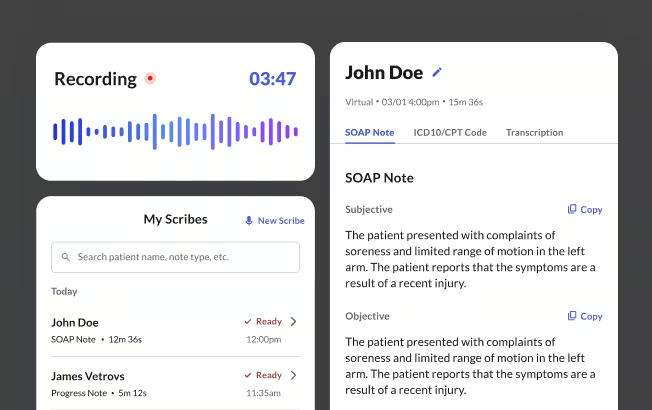
Commure Scribe drafts the HPI directly from the visit conversation, in four steps. The scribe transcribes the visit and extracts symptom descriptors that map to OLDCARTS. It writes those descriptors into the clinician's voice and drops the paragraph into the HPI section of the H&P template.
The four-step move fixes the three HPI failure modes the rationale section named:
- A vague HPI gets sharper because the descriptors come from the patient's words, not from a copy-forwarded boilerplate.
- Hand-off reading improves because the HPI lands in the same OLDCARTS structure every visit.
- Audit defense holds because the diagnostic story is written at the time of care, not rebuilt at night.
The custom template builder lets the practice keep its existing H&P shell. It tells Commure Scribe which fields make up the HPI section, including any in-house variations on OLDCARTS. The scribe then writes a history of present illness example into that scaffold every visit.
Disclaimer
This article and the linked H&P template are for informational and educational purposes only. They do not constitute legal, medical, or professional advice, and do not guarantee compliance with any specific regulation.
History of Present Illness Template Download
Download a copy of this template
Thanks! Your history of present illness template is ready.
Click below to download.
Thanks! Your primary care history of present illness template is ready.
Click below to download.
Thanks! Your behavioral health history of present illness template is ready.
Click below to download.
Thanks! Your emergency department history of present illness template is ready.
Click below to download.

Frequently Asked Questions
The chief complaint is one short phrase, ideally in the patient's own words, that names the reason for the visit. The history of present illness example is the narrative paragraph that follows and walks through eight descriptors of that complaint. The chief complaint anchors the visit; the HPI builds the case for what to do about it.
A history of present illness example covers eight OLDCARTS elements: Onset, Location, Duration, Character, Aggravating and alleviating factors, Radiation, Timing, and Severity. Each one captures a specific dimension of the chief complaint. A few may be N/A for a given visit, but every relevant element should appear in the note.
The HPI is a focused narrative about the chief complaint, walked through the OLDCARTS descriptors. The Review of Systems is a broader head-to-toe screen that asks about symptoms across body systems unrelated to the chief complaint. A history of present illness example for chest pain stays on the cardiopulmonary story. The ROS that follows asks about every system to surface anything the patient might not have mentioned.
OLDCARTS is the mnemonic for the eight history of present illness descriptors: Onset, Location, Duration, Character, Aggravating and alleviating factors, Radiation, Timing, and Severity. Some training programs use OLD CARTS or PQRST instead. Walk the chief complaint through each descriptor in order, then write the paragraph.
The 2021 CMS guidelines moved E/M coding away from counting history and exam bullets toward scoring medical decision-making complexity. The HPI no longer drives the code by element count. A complete history of present illness example still anchors the diagnostic narrative the auditor reads. A thin HPI gives the auditor no way to support the billed code.
Sources
- Rule A, Chiang MF, Hribar MR. Length and Redundancy of Outpatient Progress Notes Across a Decade at an Academic Health Center. JAMA Network Open. 2021;4(7):e2115334. https://pmc.ncbi.nlm.nih.gov/articles/PMC8290305/
- Purdue University Online Writing Lab. SOAP Notes (HPI structure). https://owl.purdue.edu/owl/subject_specific_writing/healthcare_writing/soap_notes/index.html
- Centers for Medicare & Medicaid Services. Physician Fee Schedule (PFS) Payment for Office/Outpatient Evaluation and Management (E/M) Visits, fact sheet. 2021. https://www.cms.gov/files/document/physician-fee-schedule-pfs-payment-officeoutpatient-evaluation-and-management-em-visits-fact-sheet.pdf
- Florida State University College of Medicine. SOAP Notes Format in EMR (Documentation Job Aid). https://med.fsu.edu/sites/default/files/userFiles/file/MedInfo_SOAPnote_Jobaid.pdf
- University of New Mexico School of Medicine. Template for Clinical SOAP Note Format. https://hsc.unm.edu/medicine/departments/family-community/_media/docs/patemplateclinsoapnote.pdf
- U.S. Department of Health and Human Services. HIPAA Privacy Rule (45 CFR 164.502-514). https://www.hhs.gov/hipaa/for-professionals/privacy/laws-regulations/index.html
- American Academy of Family Physicians. 2021 E/M Coding Changes: What family physicians need to know. Family Practice Management. 2021. https://www.aafp.org/pubs/fpm/issues/2022/0700/reducing-documentation-burden.html
- Tai-Seale M, et al. Primary Care Physicians' Experiences With and Adaptations to Time Constraints. JAMA Network Open. 2024;7(3). https://jamanetwork.com/journals/jamanetworkopen/fullarticle/2818067
- Shanafelt TD, et al. Medical Documentation Burden Among US Office-Based Physicians in 2019. JAMA Internal Medicine. 2022;182(7):730-740. https://jamanetwork.com/journals/jamainternalmedicine/fullarticle/2790396
- Apathy NC, Rotenstein L, Bates DW, Holmgren AJ. Documentation dynamics: Note composition, burden, and physician efficiency. Health Services Research. 2022. https://onlinelibrary.wiley.com/doi/10.1111/1475-6773.14097