



Clinical Notes: What to Include, How to Write Them, and Templates
A practical guide for independent and group practices: what every note needs, three copy-paste templates, and how to close charts before you leave the building.
Written by the Commure Scribe Team
Published: May 21, 2026
•
11 min read
A complete outpatient clinical note usually opens with patient IDs, visit metadata and the chief complaint (CC). History fields cover history of present illness (HPI), past medical history (PMH), medications and allergies. Review of systems (ROS), the physical exam, assessment, plan and follow-up instructions come next. This guide gives independent and group practices three copy-ready templates with those fields. They cover a Subjective, Objective, Assessment, Plan (SOAP) note, a chronic care follow-up note and a procedure note.
What You Need to Know About Clinical Notes
Clinical notes take longer to write than most clinicians expect. Primary care physicians spend 36.2 minutes in the EHR per 30-minute scheduled visit, including 6.2 minutes of after-hours charting per encounter.1
Long clinical notes predict more after-hours work, not more thorough care. Physicians in the top decile of note length spend 39% more time in the EHR after hours than their median peers.2
Clinical note bloat is structural. Across 1.7 billion outpatient notes, average length increased 8.1% from 2020 to 2023. Centers for Medicare & Medicaid Services (CMS) documentation reform did not reduce it.4
Standardization without an IT department is achievable with three agreements: format by visit type, non-negotiable fields, and a quarterly 20-note audit.
Ambient AI scribes address execution, not the standard. The clinician still reviews every clinical note. The difference is closing charts at 43 seconds on average instead of at 9 p.m.
What Are Clinical Notes?
Clinical notes are the written record of a patient encounter. They capture what the patient reported, what the clinician observed, and what was decided. They are the legal record of the visit and the handoff for any clinician who sees that patient next. They are also the basis for billing.
Every outpatient note answers four questions, regardless of format: Why did the patient come in? What did you find? What do you think is happening? What are you going to do about it? The structure you choose determines how fast you can write the note and how useful it is to whoever reads it.
What Should Clinical Notes Include?
A complete outpatient clinical note covers all of the fields below. Missing fields are not a shortcut. They create billing risk, care flow risk, and legal risk.
- Patient identifiers and visit metadata: Name, date of birth, date and time of visit, clinician name, and visit type.
- Chief complaint (CC): The patient's stated reason for the visit, in their own words or close to it.
- History of present illness (HPI): Duration, onset, character, severity, aggravating and relieving factors, and associated symptoms. A thorough HPI supports your clinical reasoning and medical decision-making, the primary driver of E&M level under current CMS guidelines.
- Past medical history (PMH): Confirmed diagnoses, prior surgeries, hospitalizations.
- Medications and allergies: Current medications with doses, and confirmed drug allergies with reaction type.
- Review of systems (ROS): Pertinent positive and negative findings across relevant organ systems.
- Physical examination: Vitals and findings organized by system, stated in plain, objective terms.
- Assessment: Your clinical interpretation, working diagnoses, and differential if applicable.
- Plan: Orders, prescriptions, referrals, patient education, and follow-up instructions.
- Follow-up and disposition: When the patient should return and under what circumstances to seek care sooner.
Clinical Notes Templates for Independent Practices
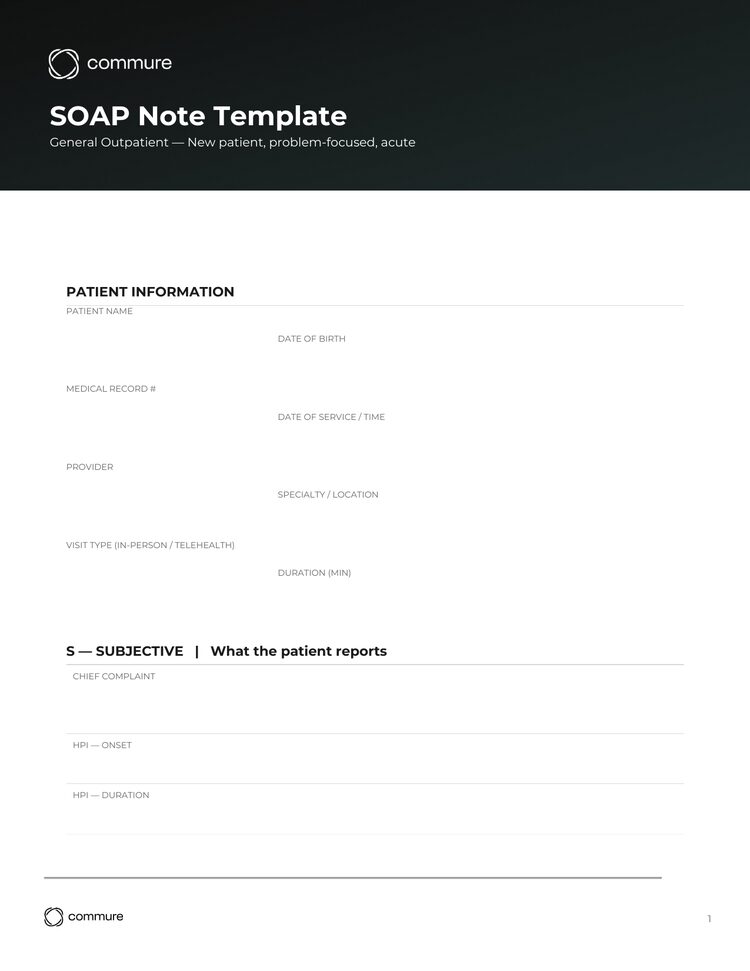
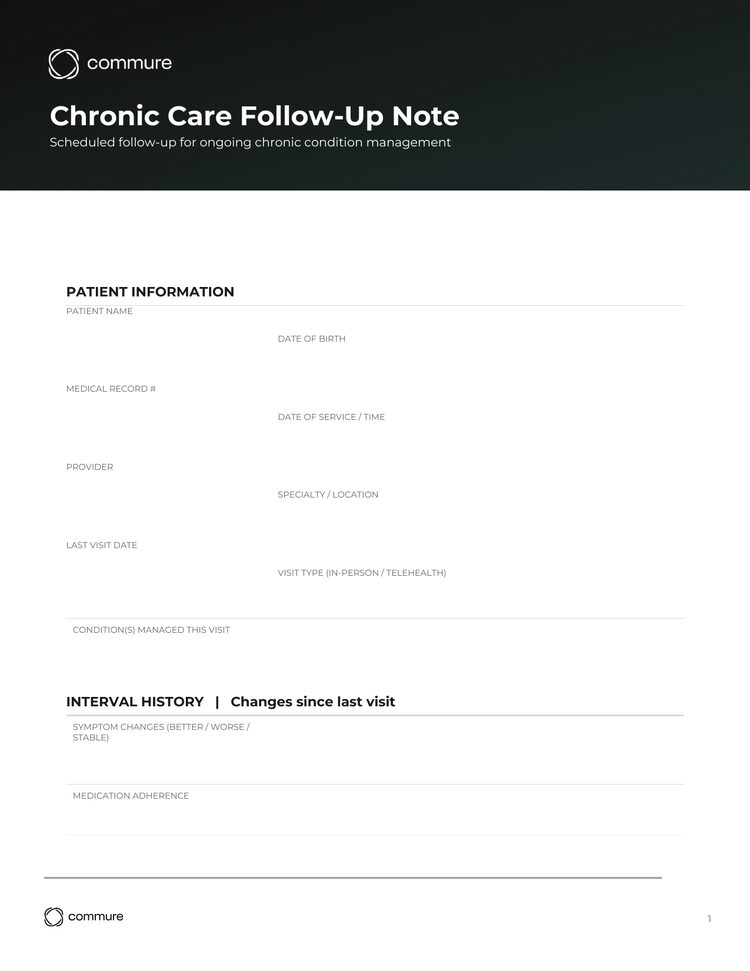
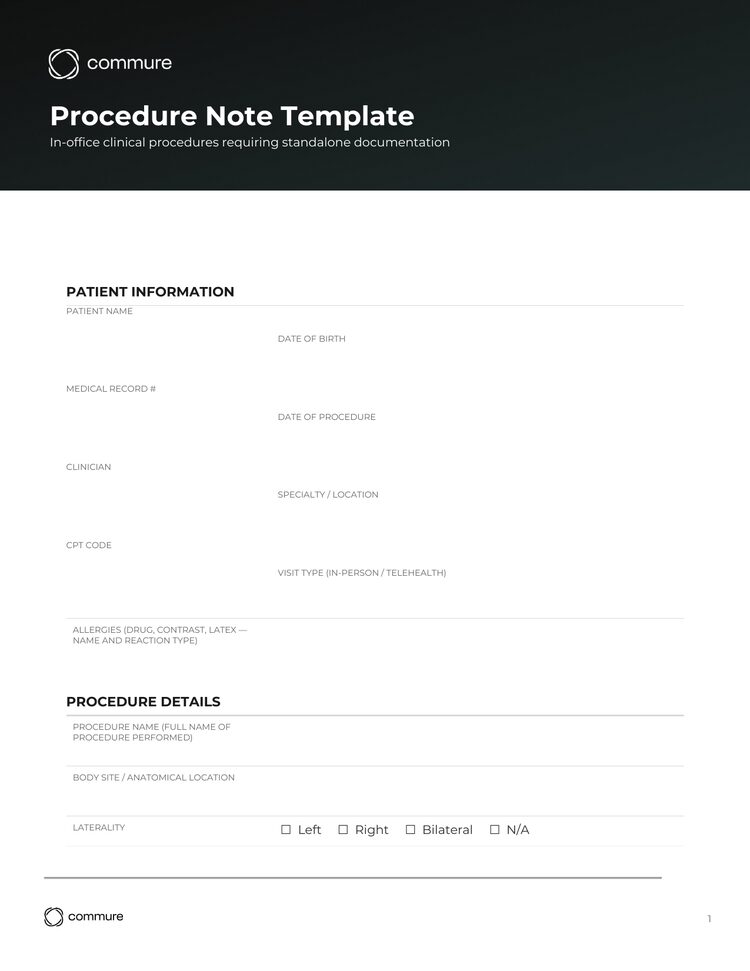
The three clinical notes templates below cover the most common outpatient visit types. They are designed to be adapted to your specialty, your EHR, and your clinical style. Use them as starting frameworks. For filled versions of similar fields, the medical chart template walks through primary care, behavioral health and chronic disease follow-up examples.
What Are the Main Types of Clinical Notes?
Most outpatient practices use a small set of note formats, matched to the type of visit. Knowing which format fits which situation reduces the friction of starting a note and determines which template above to reach for first. Download progress note templates in SOAP, DAP, BIRP and GIRP formats, with worked examples, to match a template to each visit type.
SOAP Notes
SOAP stands for Subjective, Objective, Assessment, and Plan. See our complete SOAP notes guide for a deeper look at the format. It is widely used across outpatient primary care, internal medicine, and many specialty practices. Subjective captures what the patient reports. Objective captures your findings. Assessment is your clinical interpretation. Plan is what you are going to do.
SOAP works well for problem-focused visits, chronic disease management, and any encounter where the reason is clear. It follows how clinicians reason through a problem, which is why it stays the default clinical notes format for most generalist practices. Dental practices can apply the same structure through a dental notes template in SOAP format that covers hygiene visits and new patient exams.
DAP Notes
DAP (Data, Assessment, Plan) is common in behavioral health settings where separating the subjective from the objective feels artificial. Data captures observable facts from the session. Assessment is the clinical interpretation. Plan is the intervention.
If your practice includes therapy or psychiatric services, DAP is often the format clinicians reach for first. It keeps the note focused on what was observed and what was decided, without the structural overhead of a full SOAP.
APSO Notes
APSO reverses the SOAP order. Assessment and Plan come first, followed by Subjective and Objective. The rationale is that the reader most often wants to know what you decided before reviewing the evidence.
Some EHRs make APSO the default; others do not support it natively. If your EHR offers it and your colleagues prefer it, APSO cuts the time a reader spends finding your decision.
Procedure Notes
Procedure notes document a specific intervention. They cover what was done, what materials were used, how the patient tolerated it, and what follow-up is needed. Shorter than problem-based notes, they still need to be complete enough to stand on their own for billing and legal purposes.
Chronic Care Follow-Up Notes
For patients returning for ongoing management of a stable condition, a templated follow-up structure saves time without losing quality. These notes focus on interval changes, current medications and adherence, relevant labs or vitals, and any plan adjustments.
Why Do Clinical Notes Matter Beyond the Visit?
Well-written clinical notes protect patients, the clinician, and the practice. A complete note lets a covering colleague or specialist understand what happened at your visit without calling you. A vague, delayed, or billing-inconsistent note creates audit risk and liability.
Documentation quality directly affects pay. The billed service level must be supported by the clinical note. For a deeper look at how documentation quality connects to reimbursement, see our clinical documentation improvement guide. Practices that rely on copy-paste face two risks: more charting load and notes that fail to support the billed code. Physicians in the top decile of copy-paste use closed 6.8 percentage points fewer visits same-day compared to the median.2
After-hours charting is a retention signal. A practice where clinicians finish notes at 9 or 10 p.m. can signal a retention problem building quietly. In 2024, the American Medical Association (AMA) found 22.5% of physicians spent more than eight hours per week on EHR tasks outside normal work hours. That figure worsened year over year, even as headline burnout rates fell.3
How Do You Write Clinical Notes Efficiently?
Efficient documentation is not about writing less. It is about writing the right things in a structure that takes less time to produce and less time to read. The difference between a tight workflow and a loose one is whether you leave the building with your notes closed.
Match the format to the visit type
Using a SOAP note for a chronic disease follow-up, when a focused follow-up template would do, adds time without adding value. The three templates above give you starting structures for the most common outpatient visit types. Match the format to the clinical situation.
Document during or immediately after the visit
Clinicians who wait until after the visit to chart must reconstruct the visit from memory. That takes longer and produces less accurate notes. Charting during or right after the visit, while details are fresh, produces faster close times and more complete records.
Keep notes proportional to visit complexity
Clinical note bloat is a structural problem, not a time pressure problem. Research across 1.7 billion outpatient notes found that average note length increased 8.1% from 2020 to 2023, even after CMS documentation reform.4 Physicians in the top decile of note length spent 39% more time in the EHR after hours than their median peers.2
Write clinical notes to what happened. A follow-up for stable hypertension should read differently from a new complex patient. A note that looks the same as the last three visits for the same patient is an audit flag.
Use objective, precise language
Avoid vague qualifiers ("patient appears uncomfortable", "significant improvement") and personal opinions about the patient. Describe what you observed and what the patient reported. If a finding is absent, document it as absent. "No lymphadenopathy" is a note. No charting of lymph nodes is a gap.
Close same-day when possible
Notes left open at the end of a clinic day get closed later with less accuracy. Building a consistent habit of closing each note before the next room call is the highest-leverage change in a charting workflow. The gap is usually not skill. It is the next patient arriving before the last note is closed.
What Are the Documentation Requirements and Compliance Considerations?
Clinical notes operate under overlapping requirements: CMS E&M coding guidelines, specialty-specific standards, and state licensing board rules. The medico-legal standard holds that uncharted findings are treated as findings that did not occur. In practices without a compliance team, these rules fall on the clinician and practice leaders directly.
- Timeliness: Many groups and some boards or payers need timely note completion, often within a few days of the visit. Confirm specific timelines with your state board, payers, and group policy. Delayed notes are a liability in audits and litigation.
- E&M level support: The billed level of service must be supported by the documented medical decision-making (MDM) complexity or total time spent. Since the 2021 CMS reform, MDM and time are the primary determinants for most office visits.
- Audit readiness: Notes should be written as if they will be reviewed. Payers audit for upcoding, template abuse, and copy-paste cloning. A note that looks identical to the previous three visits for the same patient is a flag.
- Consent and recordings: If you use any ambient recording technology, patient disclosure is needed before the recording begins. Requirements vary by state; consult legal counsel on the specific disclosure language appropriate for your jurisdiction.
How Do You Standardize Clinical Notes Across an Independent or Group Practice?
Standardizing documentation across an outpatient practice is a different problem than it is in a large health system. Mandating training weeks or IT work is not realistic for most practices. Agree on three things: which format to use for which visit type, what fields are non-negotiable, and how to maintain templates.
- Define your note formats by visit type: Map each visit type to a template and write it down. No meeting needed. SOAP for new and problem-focused visits, focused follow-up for chronic care, procedure note for any procedure.
- Identify your non-negotiable fields: Any peer or covering clinician needs: chief complaint, current medications, your assessment, and your plan. These four fields should never be blank or templated to a generic default.
- Audit quarterly, not annually: Clinical note quality drifts across practices. A 20-note spot audit every three months checks full fields, same-day closure rate, and E&M level support. It surfaces problems before they become denials or liability exposure.
- Account for owner-clinician dynamics: In a practice where the clinician is also the owner, clinical notes decisions are not just clinical. They are financial. Denials from insufficient documentation directly affect cash flow. A documentation standard is both a care quality decision and a business decision.
How Does Commure Scribe Populate Clinical Note Templates From Your Visits?
The templates and structure above define what good clinical notes contain. The harder problem for most practices is producing them consistently, visit after visit, without extending the workday. That is the execution gap ambient AI scribes close.
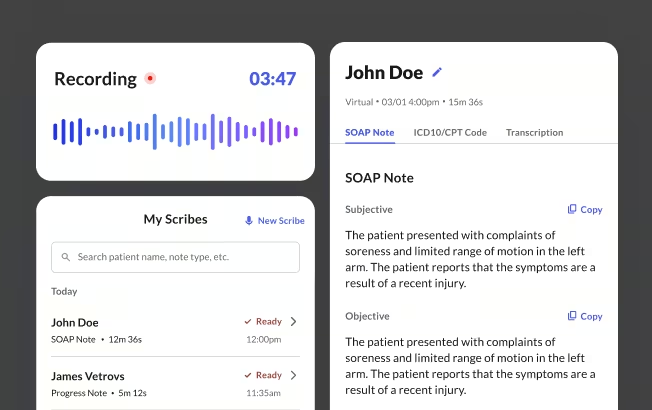
Commure Scribe captures the visit conversation and drafts the clinical note. For a complete overview of how AI medical scribe tools work across specialties, see our full guide. The workflow is Capture, Edit, Finalize. The clinician always has the option to review before anything enters the record. The tool handles the transcription and structure. The clinician handles the clinical judgment.
For a practice using SOAP templates, it generates a structured clinical note with fields populated from the ambient recording. Suggested ICD-10 and CPT codes appear in a separate tab. Clinical notes move into the EHR via copy/paste on all tiers. Enterprise deployments can add write-back integration.
90%+ of providers reduce clinical documentation time and digital fatigue, and 91% of providers report feeling less fatigued. Clinicians report an average chart close time of 43 seconds. Transcription accuracy is 99.4%.
For a checklist on what to verify before trusting any AI scribe with patient conversations, see our guide to HIPAA-compliant AI note taking.
How Do You Get Your Documentation Workflow Under Control?
A documentation overhaul does not need an IT project or a practice-wide mandate. The steps below work for independent and group practices at any size. Work through them in order.
- Week 1, 30 minutes: Agree on three note formats. Designate one format for new/problem-focused visits (SOAP), one for chronic care follow-ups, and one for procedures. Write it down in a shared document. This is the only meeting this process needs.
- Week 1, 15 minutes: Identify your four non-negotiable fields. Chief complaint, current medications, assessment, and plan. Confirm these are never left blank or templated to a generic default across your practice.
- Week 2, one clinic day: Test same-day closure as a habit. Close each note before moving to the next room. Track how many notes you close before leaving the building. That number is your baseline.
- Week 3, one clinic day: Run a 20-note audit. Pull 20 random recent clinical notes. Check full fields, same-day closure, and E&M level support. Note any fields that are missing or templated incorrectly.
- Week 4, 7-day pilot with an ambient AI scribe: Run Commure Scribe across a full clinic week. Measure chart close time and clinical notes closed before leaving the building. Compare to your baseline from Week 2.
- After the pilot: Confirm or adjust. If charts are closing faster and before you leave the building, build it into your workflow. If specific note types or visit lengths need template adjustments, configure them before converting.
Clinical Notes Template Download
Download a copy of this template
Thanks! Your procedure note template is ready.
Click below to download.
Thanks! Your chronic care follow-up template is ready.
Click below to download.
Thanks! Your SOAP note template is ready.
Click below to download.

Frequently Asked Questions
Write clinical notes to the specific visit. Match the format (SOAP, follow-up, procedure) to the visit type. Chart findings in plain terms, without vague qualifiers. Close same-day when possible. Keep note length in line with visit complexity. Avoid copy-paste as a default; it increases note length without increasing note quality and is tied to more after-hours EHR time.
Three common formats cover most outpatient visits. A SOAP note (Subjective, Objective, Assessment, Plan) works for problem-focused and new patient visits. A focused follow-up note works for chronic disease management. A procedure note covers any clinical procedure. Copy-paste clinical notes templates for all three are included in this guide.
Every clinical note needs patient identifiers, date and time, chief complaint, HPI, and past medical history. It also needs medications, allergies, review of systems, physical exam findings, assessment, and plan. The content must support the billed service level. Missing fields create audit risk and care continuity gaps.
SOAP stands for Subjective (what the patient reports), Objective (what you observe), Assessment (your diagnoses), and Plan (your next steps). It is a widely used outpatient format. Under current CMS guidelines, E&M level is based on medical decision-making or total time.
Sources
- Holmgren, A. J., Hendrix, N., Maisel, N., Everson, J., Bazemore, A., Phillips, R., Rotenstein, L. S., & Adler-Milstein, J. (2024). Electronic health record usability, satisfaction, and burnout for family physicians. JAMA Network Open, 7(8), e2426956. https://doi.org/10.1001/jamanetworkopen.2024.26956
- Apathy, N. C., Rotenstein, L., Bates, D. W., & Holmgren, A. J. (2022). Documentation dynamics: Note composition, burden, and physician efficiency. Health Services Research, 57(6), 1289–1302. https://doi.org/10.1111/1475-6773.14097
- American Medical Association. (2024, November 21). Doctors work fewer hours, but the EHR still follows them home. American Medical Association. https://www.ama-assn.org/practice-management/physician-health/doctors-work-fewer-hours-ehr-still-follows-them-home
- McCormack, J. (2023, August 28). Despite clinical documentation changes, “note bloat” remains. Journal of AHIMA. https://journal.ahima.org/page/despite-clinical-documentation-changes-note-bloat-remains
Topaz, M., Peltonen, L.M. & Zhang, Z. Beyond human ears: navigating the uncharted risks of AI scribes in clinical practice. npj Digit. Med. 8, 569 (2025). https://doi.org/10.1038/s41746-025-01895-6