



Medical Consent Form Template (Free, Printable)
Required elements, sample structure, EHR documentation, and AI scribe consent, in one template.
Written by the Commure Scribe Team
Published: June 4, 2026
•
10 min read
Updated June 4, 2026
A medical consent form template is a fillable form for independent and group practices. It records an adult outpatient's agreement to a specific procedure, treatment or clinical action. The form names the patient and gives procedure details with the responsible practitioner. One section records the nature, material risks, benefits and alternatives discussed. Another covers AI scribe recording consent, and signature blocks follow for the patient, interpreter, witness and clinician. Practices usually adapt the form to state law before clinical use.
What You Need to Know About Medical Consent Forms
- What it is. A medical consent form is a clinical document that records a patient's agreement to a specific procedure, treatment, or disclosure after a risk conversation has occurred.
- What goes on it. For hospitals, Centers for Medicare & Medicaid Services (CMS) 42 CFR § 482.24(c)(4)(v) requires properly executed informed consent forms; Joint Commission accreditation standards and state law shape required content, including the nature of the procedure, material risks, benefits, alternatives, and assessment of patient understanding.²
- When you need one. A consent record (signed form, documented conversation, or both) is generally expected for surgery, invasive procedures, off-label or high-risk medications, telehealth, research participation, third-party disclosures, and AI scribe or ambient recording use; details vary by state and practice setting.
- Is signing enough? No. The signed form is one piece of the consent record; courts and surveyors look at the documented conversation in the form, progress note, or EHR consent module.¹
- What about AI scribe consent? AI scribe or ambient recording use triggers a separate consent obligation, primarily under state recording laws (about a dozen states require all-party consent); HIPAA shapes notice, business associate agreement (BAA), and data-handling expectations.
Download the medical consent form template
Download the medical consent form template as a fillable Word document. The template is a reference for adult outpatient informed consent in independent and group practices. It is not legal advice; practices should adapt it to local law and have counsel review before clinical use.

What's in the template:
- Practice information block (facility, National Provider Identifier (NPI), DEA, medical director, compliance contact)
- Patient identification (legal name, MRN, DOB, interpreter need and mode)
- Procedure or treatment details (specific procedure, indication, site or laterality, responsible practitioner)
- Discussion documentation (nature of procedure, material risks, benefits, alternatives, patient questions, confirmation of understanding)
- AI scribe or ambient audio recording consent section
- Patient, interpreter, witness, and clinician signature blocks
- Optional reviewer sign-off for practice-level QA
- Per-section audit trail (completed by, date, evidence location in EHR, review flag)
- Compliance notes referencing CMS 42 CFR § 482.24(c)(4)(v), Joint Commission documentation expectations, state law, and retention rules
Complete the sections that apply to the encounter. Practice policy and state law determine which fields are required in any given case.
What is a medical consent form?
A medical consent form is a clinical document that records a patient's agreement to a specific procedure, treatment, or clinical action. The form captures the patient's signature along with the required elements defined by CMS, the Joint Commission, and state law. It stands alongside the documented consent conversation as evidence in any later compliance survey or malpractice review.
Two distinct document categories share the name. This medical consent form template covers clinical forms used in adult outpatient practice for procedural, medication, and documentation decisions. Caregiver authorization forms, which let a non-parent adult make medical decisions for a minor, are a separate lay-consumer document category not covered here.
This template page addresses the full working framework:
- Required elements on the form
- Trigger conditions for consent
- Template structure
- EHR documentation of the consent discussion
- Consent for AI scribe use
What are the required elements of a medical consent form?
Three sources shape what appears on a medical consent form. For hospital settings, CMS Conditions of Participation, Joint Commission standards, and state law together shape the required elements on a medical consent form. In non-hospital outpatient clinics, state law and payer or accreditor policies are primary.
CMS regulation 42 CFR § 482.24(c)(4)(v) requires properly executed informed consent forms. The regulation addresses documentation of informed consent in the medical record for procedures specified by medical staff or by federal or state law to require written consent.² A Revised Interpretive Guidelines memorandum issued April 1, 2024 clarified informed consent expectations for the medical consent form, particularly for sensitive examinations.
Commonly required fields on a hospital-grade consent form are:
- Facility name
- Specific procedure to be performed
- Name of the responsible practitioner
- Statement that risks, benefits, and reasonable alternatives were explained to the patient or representative
- Signature of the patient or representative
- Date and time of signature
The Joint Commission layers documentation onto the form itself. The informed consent discussion must be documented in the medical record.⁴ The record can be the form itself, a progress note, or a dedicated EHR consent module.
Documentation should cover these discussion elements:
- Nature of the procedure
- Risks and benefits
- Reasonable alternatives
- Patient's assessed understanding
A consent-form audit found routine gaps. A Bottrell survey summarized by Shoemaker and colleagues checked how often all four basic elements appeared together.¹ All four (nature, risks, benefits, alternatives) appeared together on only 26.4% of reviewed forms.
A commercial template alone does not guarantee compliance. A commercial medical consent form template or EHR-generated boilerplate does not, on its own, ensure a valid informed consent process. The form and accompanying documentation should reflect a valid informed consent process for the specific patient and procedure.
When is a medical consent form required?
Consent requirements are triggered by clinical risk. State law, practice-level risk policy, and (for hospitals) CMS Conditions of Participation and Joint Commission accreditation standards jointly define which activities require a medical consent form.⁴
Common outpatient situations that often require a medical consent form or specific consent documentation include:
- Surgery
- Invasive procedures
- Off-label or high-risk medication prescribing
- Research participation
- Telehealth visits
- Third-party disclosures of patient information
Details vary by state and setting.
Procedural triggers are the most clearly defined. Institutional policy, state law, and CMS guidance define when written consent is required. For hospital surgical or anesthesia services, 42 CFR § 482.51(b)(2) and related CMS guidance commonly require a written consent form.² In an outpatient office, common examples include:
- Same-day surgical procedures
- Endoscopies
- Biopsies
- Joint injections
- IUD placements
Off-label and high-risk prescribing triggers a separate documentation obligation. Off-label medication use, treatments with rare but serious adverse effects, and psychotherapy with novel interventions often require a documented risk disclosure.⁵ A signed form is not always required, but the conversation should appear in the record.
Disclosures, research, and AI documentation each carry their own consent obligations⁶:
- Telehealth services
- HIPAA authorization for release of information to third parties for non-TPO purposes (45 CFR § 164.508)
- Research participation under 45 CFR Part 46
- Use of an AI scribe or ambient documentation tool
Telehealth (per state telehealth law), HIPAA authorization for non-TPO disclosures, and research participation each require specific consent or authorization under federal or state rules. Use of an AI scribe or ambient documentation tool generally requires clear disclosure and consent consistent with state recording laws and HIPAA notice and data-handling rules. Some organizations use a specific written or electronic consent; others rely on documented verbal consent. For video and phone visits, a telehealth consent form template adds fields for patient location, recording choices, and verbal consent.
Caregiver authorization for a minor uses a separate form category. A caregiver authorization form lets a non-parent adult make medical decisions for a minor in the household. State-specific laws and case law govern those caregiver forms⁷, and they are a distinct document from the clinical consent for treatment form.
What should a medical consent form template include?
A compliant medical consent form template organizes required fields and required discussion elements on one page. For hospital settings, the fields commonly tied to CMS Conditions of Participation provide the baseline.² Joint Commission accreditation standards and the American Medical Association (AMA) ethical standard shape the narrative discussion elements (nature, risks, benefits, alternatives, patient understanding).⁵
A medical consent forms template should include four sections:
- Patient identification
- Procedure or treatment details
- Discussion documentation
- Signatures
Patient identification section:
- Patient name (legal and preferred)
- Date of birth
- Medical record number
- Date and time of consent
Procedure or treatment section:
- Specific procedure name, written out
- Clinical indication
- Site or laterality where relevant
- Name and credentials of the responsible practitioner
Discussion documentation section:
- Nature of the procedure in the patient's language
- Material risks discussed, named specifically
- Anticipated benefits
- Reasonable alternatives, including the option of no treatment when clinically appropriate
- Risks and benefits of each alternative
- Patient questions and the clinician's responses
- Confirmation the patient verbalized understanding
Signatures section:
- Patient or legal representative signature and relationship
- Interpreter name, language, and signature where applicable
- Witness signature
- Clinician attestation that the consent conversation occurred
- Date and time
The discussion documentation section is a common point of failure in legal or compliance review. Checking "risks and benefits discussed" is often not enough under the reasonable patient standard applied in most US states.³ The form should capture which specific risks were discussed in language the patient can be shown to have understood.
Practices should review their medical consent form template at least annually. State statutes and case law change, and EHR vendors update consent modules after CMS or Joint Commission guidance changes. This is a practice-level recommendation, not a regulatory mandate on a fixed schedule.
How should consent be documented in the EHR and progress note?
The medical consent form is one piece of documentation, and the progress note and EHR consent module complete the record. Many malpractice commentators note that detailed progress notes can be as important as, or more informative than, the signed form when reconstructing the consent process.⁸, ¹
Reviewers commonly examine the full medical record, not only the medical consent form. In malpractice cases, courts often look across the form, progress notes, and any EHR consent module entries; in compliance surveys, CMS and Joint Commission reviewers do the same for accredited hospitals.
A progress note for a consent discussion should capture five elements⁴, ⁵:
- Indication for the procedure or treatment
- Specific risks and benefits discussed
- Alternatives presented, including forgoing treatment
- Patient questions and the answers given
- Clinician's assessment that the patient understood
EHR consent modules vary in how well they support narrative documentation. Major outpatient EHRs offer consent templates, including AdvancedMD, athenahealth, eClinicalWorks, Elation, Practice Fusion, and Tebra.
Structured consent fields often fail on narrative content. Clinicians frequently report that those fields accept numerical or dropdown inputs and leave little space for patient-specific narrative. The detailed consent conversation then has to be entered in a free-text note field.
The durability of the consent record depends on linking the form, the note, and any electronic signature. CMS April 2024 Revised Interpretive Guidelines state that the medical consent form should be in the medical record before the procedure.² Practices should link the signed form, the progress note documenting the discussion, and any patient portal signature into a single audit trail.
What are the consent requirements for AI scribe and ambient documentation use?
An AI scribe or ambient documentation tool triggers a consent obligation separate from the underlying procedure or encounter. State audio-recording statutes are the primary driver; the HIPAA Privacy Rule (45 CFR Parts 160 and 164) shapes notice, business-associate, and data-handling obligations, and AMA ethical guidance addresses the physician's documentation duty.⁵ Practices that deploy an AI medical scribe without a documented consent workflow may carry new malpractice and regulatory exposure. Our HIPAA compliance checklist is good reference to start with.
State recording law is the first layer of consent. About a dozen states generally require all-party (two-party) consent before a conversation can be recorded, with several additional mixed or nuanced jurisdictions (for example, distinctions between in-person and phone recording). Lists vary across legal-practice guides; practices should confirm the current state-by-state rule with their counsel before deployment. Practices in all-party states should obtain explicit patient consent, documented alongside the medical consent form, before recording.
A defensible AI scribe consent workflow has three components:
- A written notice provided at intake
- Verbal or electronic confirmation at the start of each visit
- A documented record of disclosure and agreement in the EHR
The workflow should also handle refusal. Best practice when a patient declines AI recording is to switch to a non-recorded documentation method (for example, manual note taking) for that visit. The note should reflect the opt-out and, if disclosed, the patient's reason.
The consent notice should disclose three facts in plain language:
- What the tool does
- How long the recording is retained
- Who can access it
Unresolved liability for algorithmic documentation errors calls for an explicit clinician review step before the note is signed.⁵
For a ranked breakdown by practice size and specialty, see the best AI medical scribes guide.
How Commure Scribe works alongside a medical consent form
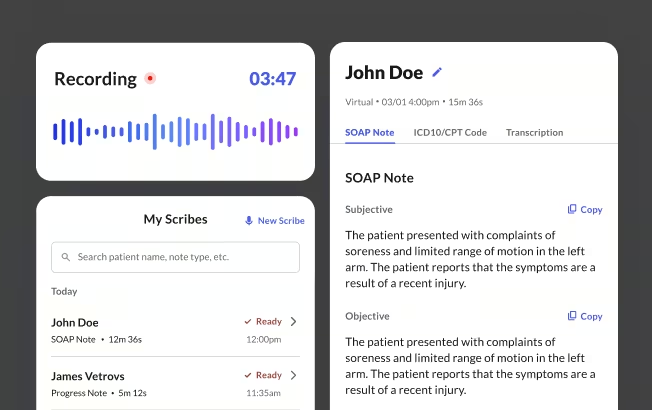
Commure Scribe does not replace the medical consent form. It supplements the form by capturing the consent conversation in the progress note. That documentation is what reviewers commonly examine when the form is silent on what was actually discussed. As of April 2026, Commure Scribe is an ambient AI medical scribe that advertises 99.4% transcription accuracy and is HIPAA compliant and System and Organization Controls 2 (SOC 2) certified.
The form-vs-conversation gap is what Scribe is built to close. A signed medical consent form proves the patient agreed to a procedure. It rarely proves the four discussion elements (nature, risks, benefits, alternatives) were actually covered with this patient, and the 26.4% audit failure rate sits in that gap.¹
Scribe captures the conversation around the signing. The narrative lands in the progress note alongside the signed medical consent form, so the form and the documented discussion sit in the same encounter record.
The workflow during a consent visit:
- Before the conversation. The medical consent form is presented to the patient. AI scribe consent is obtained separately, per the practice's AI / recording notice.
- During the conversation. Scribe runs ambiently while the clinician walks through the procedure, material risks, alternatives, and the patient's questions. The clinician is not typing.
- At End Recording. A draft progress note appears in seconds, capturing specific risks named, alternatives considered, and patient questions in the clinician's own voice. The clinician reviews, edits, and finalizes before anything posts.
- In the medical record. The signed form, the progress note documenting the discussion, and any EHR consent module entry sit together as one continuous consent record for CMS surveyors and Joint Commission reviewers.
What the documented conversation adds to the consent record:
- Replaces the legally weak "risks and benefits discussed" phrase with specific risks named in the patient's own framing
- Documents the patient's questions and the clinician's answers, a Joint Commission discussion element that forms commonly omit
- Captures alternatives considered, including the option of no treatment when clinically appropriate
- Preserves the non-delegable consent duty under AMA Opinion 2.1.1, since the physician reviews and signs the note⁵
What Scribe does not do. Scribe does not replace the signed consent form, the witness signature, the patient signature, or any state-law signature requirement. It does not generate the consent form itself.
The form's required fields still need to appear. The CMS-required fields and Joint Commission discussion elements still need to appear in the form, the note, or both. Practices remain responsible for completeness.
One added consent obligation. Scribe's use itself triggers a separate consent obligation, primarily under state recording laws (HIPAA shapes notice and BAA expectations). About a dozen states generally require all-party consent before recording, which should be obtained and documented before recording starts (see Section 5 of the template).
Disclaimer
This article is for informational and educational purposes only. It does not constitute legal, medical, or compliance advice, and does not guarantee regulatory compliance, malpractice protection, or any specific outcome. Practices should consult qualified counsel, their malpractice carrier, or their compliance officer before adopting any consent form, documentation workflow, or AI scribe consent protocol.
Medical Consent Form Template Download
Download a copy of this template
Thanks! Your medical consent form template is ready.
Click below to download.

Frequently Asked Questions
You typically need a signed consent form for procedures that carry clinical risk. Office examples include biopsies, joint injections and IUD placements. State law and your practice's risk policy set the exact list, and hospitals also follow CMS and Joint Commission rules. Telehealth visits, research participation and AI scribe use each carry their own consent rules.
A medical consent form typically documents four elements: the nature of the procedure, material risks, anticipated benefits, and reasonable alternatives. Each alternative should list its own risks and benefits. Many hospital policies and Joint Commission guidance expect these four elements in the consent documentation.⁴ CMS requires properly executed informed consent forms consistent with these standards and applicable state law.
A consent for treatment form is a general authorization document, typically signed at intake, that permits routine evaluation and care.³ Informed consent is a separate, procedure-specific process and record covering the discussion of risks, benefits, and alternatives for a named intervention.⁵
Verbal consent can be enough for low-risk in-office interventions when state law does not require a written form.⁸ Document the consent discussion in the progress note with the date, time, and elements discussed. Hospital surgical and anesthesia services under CMS rules require a written medical consent form.
A separate form is one option, and some practices use intake language or documented verbal consent instead. Many jurisdictions expect you to document patient consent to recording and AI scribe use, whichever route you choose. The process should meet state recording laws and the HIPAA Privacy Rule's notice and data-handling expectations.⁵ In all-party consent states, get and document patient agreement before recording, often at or before each visit.
Sources
- Shoemaker, S. J., Brach, C., Edwards, A., et al. (2018). Opportunities to improve informed consent with AHRQ training modules. The Joint Commission Journal on Quality and Patient Safety, 44(6), 335–347. Retrieved from https://pmc.ncbi.nlm.nih.gov/articles/PMC6022821/
- Centers for Medicare & Medicaid Services. (2024). Revised Hospital Informed Consent Interpretive Guidelines (April 1, 2024 Memorandum). 42 CFR § 482.13(b)(2); § 482.24(c)(4)(v); § 482.51(b)(2). Retrieved from https://www.ecfr.gov/current/title-42/chapter-IV/subchapter-G/part-482/subpart-C/section-482.24
- Thirumoorthy, T. (2023). Core concepts of consent in medical practice. Singapore Medical Journal, 64(6), 398–402. doi:10.4103/singaporemedj.SMJ-2023-044 (PMID: 37338501; PMCID: PMC10335635). Retrieved from https://pmc.ncbi.nlm.nih.gov/articles/PMC10335635/
- Shah, P., Thornton, I., Kopitnik, N. L., & Hipskind, J. E. (2024). Informed Consent. In StatPearls [Internet]. StatPearls Publishing. Retrieved from https://www.ncbi.nlm.nih.gov/books/NBK430827/
- American Medical Association. (2024). Informed Consent. AMA Code of Medical Ethics Opinion 2.1.1. Retrieved from https://code-medical-ethics.ama-assn.org/ethics-opinions/informed-consent
- U.S. Department of Health and Human Services, Office for Human Research Protections. Informed Consent FAQs. 45 CFR Part 46. Retrieved from https://www.hhs.gov/ohrp/regulations-and-policy/guidance/faq/informed-consent/index.html
- Cleveland Clinic. (2024). Informed Consent: What It Is & Why It's Important. Cleveland Clinic Health Library. Retrieved from https://my.clevelandclinic.org/health/articles/24268-informed-consent
- Deiter, P. (2008). Informed consent and consent forms. The Permanente Journal, 12(2), 53–54. Retrieved from https://pmc.ncbi.nlm.nih.gov/articles/PMC3042292/