



Free Discharge Summary Template: Every Section Included
Everything a physician or APP needs to complete a discharge summary correctly, including CMS compliance requirements and a free editable template.
Written by the Commure Scribe Team
Published: June 3, 2026
•
6 min read
Updated June 3, 2026
A discharge summary template is the form used to hand care to the next provider after an inpatient stay. A physician or advanced practice provider (APP) fills it in. Its eight parts start with patient demographics and dates, admitting and discharge diagnoses, and key findings and procedures. The hospital course, discharge medications with reconciliation, follow-up instructions, patient education and provider signature complete it. Under 42 CFR 482.24, the Centers for Medicare & Medicaid Services (CMS) requires one for Medicare and Medicaid inpatient stays.
What You Need to Know About Discharge Summary Templates
- A discharge summary template documents an inpatient stay and hands the patient's care off to the next provider.
- CMS requires a discharge summary for all Medicare and Medicaid inpatient stays as a Condition of Participation (42 CFR 482.24).¹
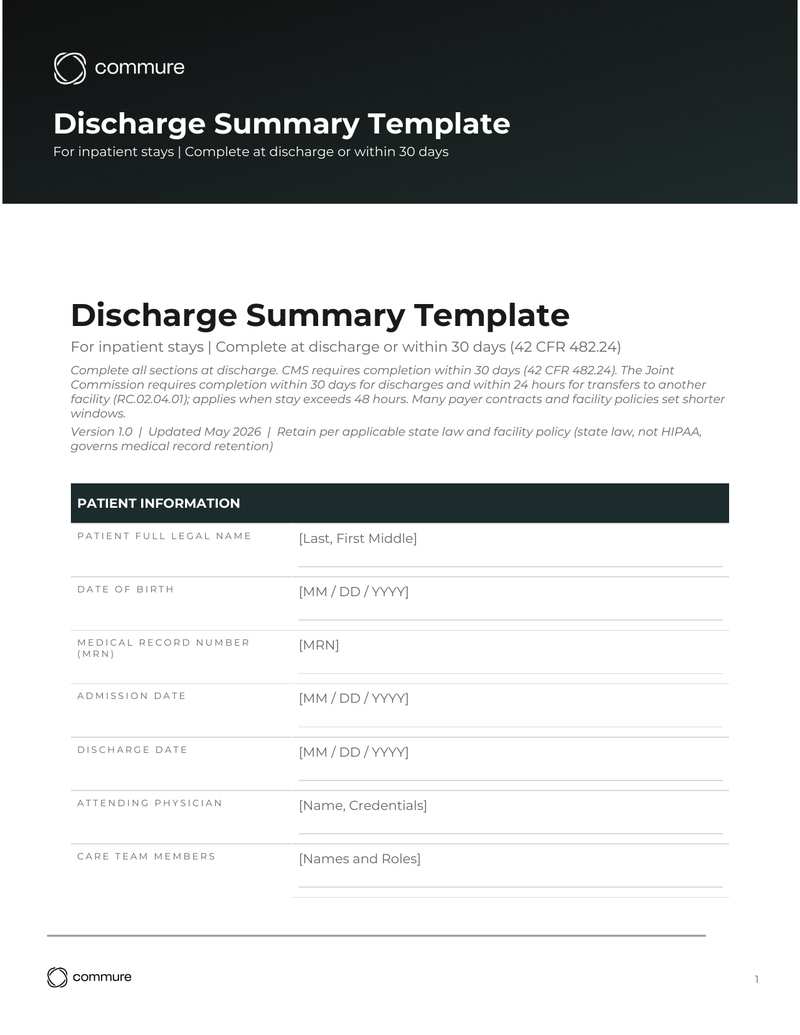
- This page includes a free, editable discharge summary template with all eight CMS and Joint Commission documentation elements ready to download.
Download the Free Discharge Summary Template
Note: This template is for informational purposes only and does not constitute legal or medical advice. Have your compliance officer review it before clinical use.
What Is a Discharge Summary?
A discharge summary template hands off the patient's care to the next provider. It is different from clinical notes and SOAP notes written during the stay. Those are written for the care team on the floor. A discharge summary template is written for whoever picks up care next. That person may be a primary care physician, a specialist, or a nurse at a skilled nursing facility. They may not have access to the full chart. The discharge summary is what they have.
The discharge summary template on this page covers the core form. It is the structured document a physician or APP completes at the end of an inpatient stay. It does not cover patient-facing discharge instructions, nursing discharge notes, or specialty-specific addenda. Those are separate documents. For the patient-facing counterpart generated at discharge, see the after-visit summary.
Many payer contracts and hospital policies set shorter windows, often 24 to 48 hours. CMS allows up to 30 days.¹ Completing the discharge summary template on the day of discharge gives the receiving provider the most complete picture. A timely discharge summary template reduces the risk of care gaps and medication errors at transitions.²
What Should a Discharge Summary Template Include?
A complete discharge summary template covers eight elements required by CMS and Joint Commission standards. Each one helps the receiving provider pick up care without a gap.
- Patient demographics and dates. Full name, date of birth, medical record number (MRN), and admission and discharge dates. Include the attending physician and care team. These fields let the next provider match the summary to the right patient and chart.
- Admitting and discharge diagnoses. The reason for admission and the confirmed diagnoses at discharge. List in order of clinical importance. The admitting diagnosis often differs from the discharge diagnosis after workup.
- Significant findings and procedures. Key lab values, imaging results, and any surgical or procedural interventions with dates. Focus on what changed the clinical picture or drove a major decision.
- Hospital course summary. A narrative of the admission: presenting findings, workup, treatment decisions, and clinical trajectory. Keep it long enough to tell the story. Aim for under two minutes to read.
- Discharge medications with reconciliation. Every medication the patient leaves with, including dose, frequency, and route. Flag any changes from the pre-admission list. Medication errors at care transitions are a common source of post-discharge adverse drug events.²
- Follow-up instructions. Named providers, specific timeframes, and any pending results that need action. Vague instructions leave gaps. Name the provider and give a timeframe.
- Patient education provided. What the patient and family were told about the diagnosis, medications, and warning signs. Note their response.
- Provider signature. The rendering provider's name, credentials, and date.
How Do You Complete Each Section?
Each field in the discharge summary template has one common mistake. Here is how to avoid it when completing the discharge summary template.
- Patient demographics. Double-check the MRN and date of birth against the chart. A wrong identifier can file the summary to the wrong patient record.
- Diagnoses. Write the discharge diagnosis first. Note any difference from the admitting diagnosis in the hospital course section. Use ICD-10 terms from the current-year edition.³
- Significant findings and procedures. Skip routine results that did not affect care. Include the test name, key value or finding, and the date. Procedure entries need a date and the performing provider.
- Hospital course. Write for a colleague who was not on the case. Avoid department-specific shorthand. One paragraph per major clinical problem works well for complex admissions.
- Medications. Note what changed from the pre-admission list and why. A stopped medication with no reason noted leaves the next provider guessing.
- Follow-up. Fill in a specific provider name and timeframe. If a result is pending, name it and say who is responsible for acting on it.
- Patient education. Describe what was discussed and the patient's response. "Patient instructed on insulin self-administration; verbalized understanding" is more useful than "patient educated on medications."
- Provider signature. Sign and date on the day of completion. The completion date matters for CMS audit purposes.
Discharge Summary Example
A completed discharge summary template example shows what each section looks like when filled in. The case below is fictional. It uses a common inpatient admission to illustrate how each field of the discharge summary template appears in practice.
Patient: Maria Santos | DOB: 04/12/1957 | MRN: 00492817Admission Date: 01/14/2026 | Discharge Date: 01/18/2026Attending Physician: James Okafor, MDCare Team: Respiratory therapy, case management
Admitting Diagnosis: Acute exacerbation of COPD (J44.1)Discharge Diagnosis (Primary): Acute exacerbation of COPD, resolved (J44.1)Discharge Diagnosis (Secondary): Hypertension, controlled (I10)
Significant Findings:
- ABG on admission: pH 7.32, pCO2 58, pO2 61 on room air (01/14)
- Chest X-ray: hyperinflation, no consolidation (01/14)
- ABG at discharge: pH 7.40, pCO2 45, pO2 67 on 2L nasal cannula (01/17)
- Spirometry deferred to outpatient
Procedures Performed: Nebulizer therapy initiated 01/14. Non-invasive positive pressure ventilation (BiPAP) trialed 01/14 to 01/15, successfully weaned.
Hospital Course: Ms. Santos presented with three days of worsening dyspnea, increased sputum production, and oxygen saturation of 84% on room air. Admission ABG confirmed hypercapnic respiratory failure. She was started on systemic corticosteroids, broad-spectrum antibiotics, and scheduled nebulizer treatments. She was trialed on BiPAP and weaned off by hospital day two. By day four she was ambulatory on 2L nasal cannula with oxygen saturation between 90% and 94%. She was discharged to home with home oxygen ordered and outpatient pulmonology follow-up confirmed.
Discharge Medications:
- Prednisone 40mg PO daily x 5 days [NEW: course for exacerbation]
- Azithromycin 250mg PO daily x 2 remaining days [NEW: antibiotic course]
- Tiotropium 18mcg inhaled daily [UNCHANGED]
- Albuterol/ipratropium 2.5mg/0.5mg nebulizer q4h PRN [CHANGED: frequency increased from PRN only]
- Lisinopril 10mg PO daily [UNCHANGED]
Follow-Up Appointments:
- Pulmonology: Dr. Anita Pham, within 2 weeks, (555) 202-4400
- Primary care: Dr. Luis Vega, within 1 week, (555) 101-3300
- Pending: sputum culture; Dr. Vega to call patient by 01/22/2026
Patient Education: Patient instructed on inhaler technique, prednisone taper, antibiotic course, and warning signs for return to ED. Patient demonstrated correct inhaler technique. Written instructions provided in English and Spanish. Daughter present and verbalized understanding of follow-up plan.
Provider Signature: James Okafor, MD | Date: 01/18/2026
What Are the CMS and Compliance Requirements?
A discharge summary is a federal requirement, not just a clinical best practice. CMS requires it for every inpatient stay at a hospital that takes Medicare or Medicaid. The requirement is in 42 CFR 482.24, the medical record services Condition of Participation.¹
Timing. CMS sets a 30-day outer limit for completion.¹ The Joint Commission requires completion within 30 days for discharges and within 24 hours for transfers to another facility.⁴ The Joint Commission discharge summary requirement applies when a patient stays longer than 48 hours. Many payer contracts and hospital policies set shorter windows. A late or missing summary can lead to a compliance finding during a survey.
Content. The regulation does not list exact fields. It requires that the medical record justify admission and continued hospitalization, support the diagnosis, and describe the patient's progress. A summary missing medications or follow-up details may not support the clinical picture in the inpatient notes. That creates audit risk.
Code currency. ICD-10 codes are updated every October 1.³ Any codes referenced in the summary or on the claim should come from the current-year edition. An outdated code can result in a claim denial.
State law. Some states require shorter completion windows. Some require specific content for transfers to post-acute care. Requirements vary by state. Check with your compliance officer before setting your policy.
Disclaimer. This discharge summary template is built to support compliance with 42 CFR 482.24. It is not legal advice. Have your compliance officer or legal counsel review it before clinical use.
Discharge Summary Template for Therapists and Mental Health Clinicians
The eight inpatient elements above are required by CMS and the Joint Commission. Those rules apply to hospitals. They do not apply to outpatient therapy and mental health practices.
A therapist discharge summary template serves a different purpose than the hospital version. Therapists and mental health clinicians use this discharge summary template to close a course of treatment documented in the mental health treatment plan. The document closes a course of treatment. It records what happened, whether goals were met, and what the client does next. State licensing boards, payer contracts, and facility policy govern the documentation requirements. They vary by license type and by state.
A therapist discharge summary template serves three practical functions. It supports continuity of care when the client transfers to a new provider. It protects the clinician if records are subpoenaed or requested in a claims audit. It gives the next provider a complete clinical picture without requiring access to individual therapy progress notes.
What a therapist discharge summary template should include:
- Client information. Full name, date of birth, and any relevant account or insurance number. Intake date and discharge date.
- Presenting concerns and diagnosis. The reason the client sought treatment. Include the Diagnostic and Statistical Manual of Mental Disorders, Fifth Edition (DSM-5) or ICD-10 diagnosis with code and description.
- Treatment summary. The modality used (CBT, dialectical behavior therapy (DBT), EMDR, motivational interviewing). Number of sessions. Duration of treatment.
- Progress toward treatment goals. Each goal from the treatment plan template. Note whether it was met, partially met, or not met. Include standardized scores when used (PHQ-9, Generalized Anxiety Disorder-7 (GAD-7), PCL-5) with intake and discharge values side by side.
- Discharge status. Whether the client completed treatment, was referred to a higher level of care, left against clinical recommendation, or stopped attending without formal termination.
- Risk assessment at discharge. Document suicidal ideation, self-harm, and homicidal ideation even when absent. Note any active safety plans in place.
- Aftercare plan. Referrals, community resources, self-care recommendations, and criteria for returning to therapy.
- Provider signature, license number, and date.
Therapist Discharge Summary Example
The fictional example below shows a completed therapist discharge summary template for a planned outpatient termination.
Client: Jordan Lee | DOB: 08/22/1994 | Account: 00188341Intake Date: 09/08/2025 | Discharge Date: 01/15/2026Clinician: Sarah Whitmore, LCSW | License: 087432
Presenting Concern and Diagnosis: Major depressive disorder, moderate (F32.1). Client presented with depressed mood, anhedonia, sleep disruption, and low motivation following job loss.
Treatment Summary: 18 individual sessions over 19 weeks. Primary modality: Cognitive Behavioral Therapy (CBT). Adjunct: behavioral activation and sleep hygiene psychoeducation. No medication management by this provider.
Progress Toward Treatment Goals:
- Goal 1: Reduce Patient Health Questionnaire-9 (PHQ-9) score below 10. Intake: 16. Discharge: 5. Met.
- Goal 2: Resume consistent employment. Client accepted new position in week 14. Met.
- Goal 3: Establish consistent sleep routine. Client reports 7-hour nights for past 6 weeks. Met.
Discharge Status: Planned termination. All three treatment goals met. Client initiated discussion of discharge. Mutual agreement reached in session 17.
Risk Assessment at Discharge: No suicidal ideation. No self-harm ideation. No homicidal ideation. No active safety plan required.
Aftercare Plan: Referred to community mindfulness group. Encouraged to return to therapy if PHQ-9 exceeds 10 or depressive symptoms recur. Self-monitoring plan reviewed in final session. Crisis line information provided.
Provider Signature: Sarah Whitmore, LCSW | Date: 01/15/2026
When to complete a therapist discharge summary template: Complete the discharge summary template at planned termination, at transfer to another clinician, and when a client stops attending without formal termination. For unplanned terminations, document the last contact date, outreach attempts, and the clinical rationale for closing the case. For substance use disorder clients, note whether 42 CFR Part 2 consent applies before sharing the discharge summary template with outside providers.
How Commure Scribe Fits Into the Discharge Summary Workflow
The hardest part of a discharge summary template is the hospital course. Most clinicians write it from memory and chart review, hours or days after the patient has left. A summary written from memory leaves gaps. Gaps create audit risk.
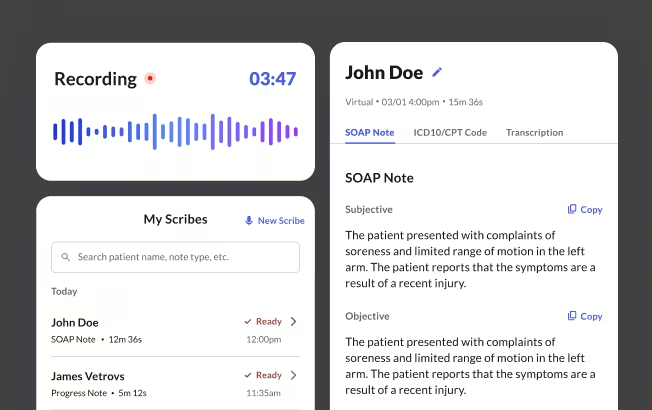
Commure Scribe captures the clinical context during the encounter in real time. When the discharge conversation happens, the AI is listening. The note it generates includes the hospital course narrative, medication reconciliation details, and follow-up instructions, the sections most likely to be missing or incomplete when written after the fact. For behavioral health providers, it can also support AI therapy notes and outpatient session documentation. The provider reviews, edits, and finalizes before anything enters the record.
90%+ of providers reduce clinical documentation time and digital fatigue. The tool supports 25 specialties and connects to 60+ EHR integrations. Try Commure Scribe with a 7-day trial. No credit card required.
Discharge Summary Template Download
Download a copy of this template
Thanks! Your discharge summary template is ready.
Click below to download.

Frequently Asked Questions
Eight elements make a complete discharge summary template, combining requirements from CMS (42 CFR 482.24 and 42 CFR 482.43) and Joint Commission standards. The first four are patient demographics and dates, admitting and discharge diagnoses, significant findings and procedures, and a hospital course narrative. The rest are discharge medications with reconciliation, follow-up instructions with named providers and timeframes, patient education documentation, and the provider's signature with date.
Yes. It is a Condition of Participation, not optional. CMS requires a discharge summary for all inpatient stays at hospitals participating in Medicare or Medicaid (42 CFR 482.24).¹ A missing or late discharge summary template can result in a compliance finding during a CMS or Joint Commission survey.
CMS allows up to 30 days, but most facilities set shorter windows. The Joint Commission requires 30 days for discharges and 24 hours for transfers, and applies the requirement when a patient stays longer than 48 hours.⁴ Many hospital policies and payer contracts set shorter deadlines. Check your facility policy and payer agreements for the applicable window.
A hospital discharge summary template is the complete clinical record of the inpatient stay. It covers diagnoses, hospital course, medications, and follow-up. A discharge note is a shorter same-day attestation some facilities use at discharge. Terminology and requirements vary by institution. When in doubt, check your medical staff bylaws.
An AI medical scribe can draft the clinical narrative sections of a discharge summary template. It can generate the hospital course, medication changes, and follow-up plan from the clinical encounter. The provider reviews, edits, and finalizes before anything enters the record. The clinician always has the option to review before the note is finalized.
Sources
- Centers for Medicare & Medicaid Services. Conditions of Participation: Medical Record Services. 42 CFR § 482.24. https://www.ecfr.gov/current/title-42/chapter-IV/subchapter-G/part-482/subpart-C/section-482.24. 2024.
- Agency for Healthcare Research and Quality. Medication Reconciliation. PSNet Patient Safety Network. https://psnet.ahrq.gov/primer/medication-reconciliation. Originally published 2019; updated 2024.
- Centers for Medicare & Medicaid Services. ICD-10-CM Official Guidelines for Coding and Reporting, FY 2027. https://www.cms.gov/files/document/fy-2027-icd-10-cm-coding-guidelines.pdf. 2026.
- The Joint Commission. Comprehensive Accreditation Manual for Hospitals: Record of Care Standard RC.02.04.01. https://www.jointcommission.org/standards/. 2024.