



Mental Health Treatment Plan Template: Free Editable Download
A field-by-field walk through what mental health treatment plan templates need under HIPAA, 42 CFR Part 2, and state law, with a free editable download.
Written by the Commure Scribe Team
Published: May 25, 2026
•
10 min read
Updated May 25, 2026
What You Need to Know About a Mental Health Treatment Plan Template
- A mental health treatment plan template is the structured, written document an outpatient practice fills in for each patient. It scopes the problems, sets SMART goals and measurable objectives, names interventions, and fixes a review schedule¹.
- Treatment plans must align with HIPAA (45 CFR 164.502–514), 42 CFR Part 2 when substance use disorder is involved, and state mental health confidentiality laws. Payers generally expect documented goals and a defined review interval to support medical necessity for ongoing care².
- The free editable mental health treatment plan template below covers all ten compliance elements and ships with PHQ-9 and Generalized Anxiety Disorder-7 (GAD-7) companion forms for measurement-based care.
What Is a Mental Health Treatment Plan Template?
A mental health treatment plan template captures the working agreement between clinician and patient. It scopes the problems, sets goals and measurable objectives, names the interventions, and fixes a timeline for review¹. The template lives across the course of care. The clinician updates it each time they revisit the plan with the patient¹.
Outpatient mental health practices also rely on the mental health treatment plan template to support medical necessity when an insurer asks for authorization². Payers look for clear goals and a defined review schedule in that documentation². Many state boards expect risk language to appear in the plan. Patients can request a copy of their plan under their HIPAA right of access.
The structure of a strong mental health treatment plan template is now well established. The fields are stable. What varies is how tightly each field gets filled in for the patient in front of you. The fields below mirror what most insurers and state boards expect, with room to adapt to your specialty and the way your practice runs.
Download the Mental Health Treatment Plan Template (with PHQ-9 and GAD-7)
Note: This mental health treatment plan template is for informational purposes only and does not constitute legal or medical advice. Have your compliance officer review it before clinical use.
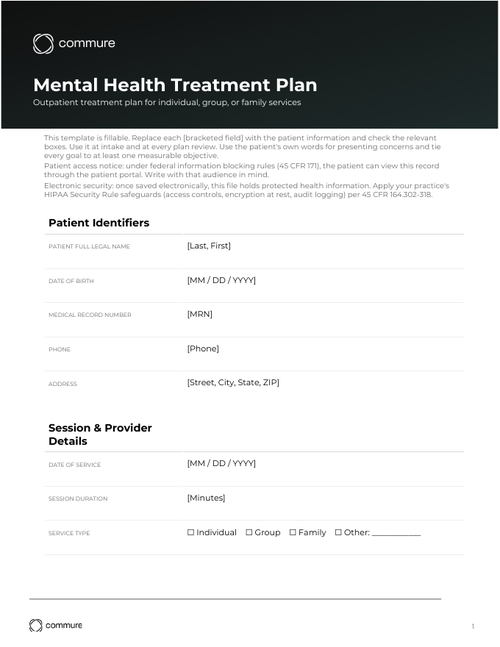
Download the free Mental Health Treatment Plan Template: fully editable Word document.
Download the PHQ-9 Depression Screening Form: complete 9-item depression screener with scoring guide and clinical-action thresholds.

Download the GAD-7 Anxiety Screening Form: complete 7-item anxiety screener with scoring guide and clinical-action thresholds.

Each form prints clean and is fully editable for your specialty, payer set, and EHR.
Why Do Mental Health Practices Need a Treatment Plan Template?
A mental health treatment plan template earns its place by doing three jobs at once. It gives the clinician and patient a shared scaffold for the work. It gives the practice an audit trail for payers and boards. And it gives outcomes a home in the plan, rather than a static document filed at intake¹.
As a clinical scaffold, the template forces a shared agreement on the goals, objectives, and interventions for the patient¹. Without that scaffold, sessions drift and goals get fuzzy. The template gives both sides something to revisit at each visit, with the review questions already in the form.
As an audit trail, the template carries the evidence insurers and state boards expect to see. Insurers require documented goals, objectives, interventions, and a review schedule before they authorize ongoing outpatient care². State boards expect risk assessment and safety planning to appear in the record¹. The template puts those elements in fixed fields so nothing gets missed during a busy day.
As a frame for measurement-based care, the template ties screening scores to objectives. Patient Health Questionnaire-9 (PHQ-9) and GAD-7 scores only move the clinical needle if they hook to specific objectives³. The template links a score threshold to an objective. It links the objective to an intervention. Group practices benefit twice over. Shared mental health treatment plan templates level the documentation across clinicians. That makes utilization review faster and reduces denials when payers request records².
What Should a Mental Health Treatment Plan Template Include?
Strong mental health treatment plan templates carry the same core elements, regardless of specialty or practice size¹. The required fields:
- Patient identifiers. [Patient Name], [Date of Birth], and [Medical Record Number]. These match the plan to the chart during an audit.
- Session and provider details. [Date of Service], [Session Duration], [Service Type] (individual, group, or family), and the provider's [Name], [License Type], and [License Number]¹.
- Diagnostic impression. A Diagnostic and Statistical Manual of Mental Disorders, Fifth Edition (DSM-5) or ICD-10 code with a working diagnosis. The diagnosis drives medical necessity and ties the plan to the billing record².
- Problem list with SMART goals and measurable objectives. SMART means specific, measurable, achievable, realistic, and timely⁴. Each goal needs at least one objective with a number or score attached. "Reduce depression symptoms" is not measurable. "PHQ-9 score below 10 by week 12" is.
- Interventions and timeline. The treatments planned for each problem (such as cognitive behavioral therapy (CBT), medication management, or family therapy) with frequency, target completion, and a defined review interval¹. Insurers check the review interval before they authorize continued care².
- Risk assessment and safety plan. Suicidal ideation, homicidal ideation, and self-harm screening with a graded response. A safety plan reference if any risk is present¹. State boards expect this section in every plan, regardless of risk level.
- Consent and psychotherapy notes notice. Signed consent for treatment. A line stating that psychotherapy process notes are kept separate from the medical record and require separate authorization for release (45 CFR 164.508(a)(2)).
The downloadable mental health treatment plan template above includes all of these as labeled fields, with specialty-specific edits layered on top.
How Do You Fill Out a Mental Health Treatment Plan Template?
Fill out the mental health treatment plan template in a fixed, top-to-bottom order. A clear order keeps fields from being missed during a long visit day. Follow these steps:
- Start with patient identifiers. Pull [Patient Name], [Date of Birth], and [Medical Record Number] from the chart. Front-desk data may carry typos.
- Record session details next. Add [Date of Service], [Session Duration], and [Service Type] from the visit log.
- Sign and credential the plan early. Add [Provider Name], [License Type], and [License Number] before you write clinical content. Doing this first stops a missed signature later.
- Capture the diagnosis with a DSM-5 or ICD-10 code. Write the code that supports medical necessity for the visit². If you carry forward a code from the last visit, confirm it still fits today.
- List problems in order of clinical priority. Use the patient's words for presenting concerns ("I can't sleep," "panic attacks at work"). Place diagnostic terms beside each problem. Keep the patient's wording in full. Draw those concerns from intake, where a biopsychosocial assessment template with a PHQ-9 companion form records the patient's history before the plan is written.
- Set SMART goals and at least one measurable objective per goal⁴. Tie each objective to a number, score, or behavior count. "PHQ-9 score below 10 by week 12." "Attend three group sessions per month."
- Pick interventions that match each problem. Name the modality (CBT, medication management, family therapy), the frequency, and the target review date¹. The review date is what insurers will look for².
- Finish with risk and safety. Screen for suicidal ideation, homicidal ideation, and self-harm at every plan update. If any risk is present, link to a written safety plan. Document the screening even when the patient denies risk.
Sign and date once the mental health treatment plan template is complete.
What Are the Compliance Requirements for Mental Health Treatment Plans?
Mental health treatment plans sit under three layers of rules. The rules come from HIPAA, 42 CFR Part 2, and state mental health law. Each layer has specific requirements for what must appear in the plan.
- HIPAA Privacy Rule (45 CFR 164.502–514). A mental health treatment plan template is part of the medical record⁵. Patients can ask to see and amend their plan (45 CFR 164.524 and 164.526)⁵. When you disclose the plan outside treatment, payment, or operations, share only the minimum necessary information (45 CFR 164.502(b)). Disclosures for treatment are exempt from that limit, so document the full clinical picture the plan needs.
- HIPAA psychotherapy notes (45 CFR 164.508(a)(2)). Process notes are the clinician's private session notes. They stay separate from the medical record⁵. Release of psychotherapy notes needs its own authorization⁵. A general patient release does not cover them. Session progress notes, by contrast, sit in the medical record with the plan, so keep private process reflections out of your therapy progress notes.
- 42 CFR Part 2. If the plan documents any substance use disorder treatment, extra rules apply⁶. Getting those records from a Part 2 program needs a Part 2 consent, which is more specific than a standard HIPAA authorization. Under the 2024 Part 2 final rule (enforcement began February 2026), a single patient consent can now cover all future treatment, payment, and operations uses, and recipients may redisclose under HIPAA⁶.
- State mental health confidentiality laws. Most states layer extra protections on top of HIPAA. Examples include separate consent for mental health records release and tighter rules for minor patients. Check your state's rules before you publish or amend a mental health treatment plan template.
- Patient access and information blocking. Under the 21st Century Cures Act, patients have a right to their electronic health information, and practices and their EHR vendors must not block access. Treatment plan data falls within that right.
- Medical necessity documentation. Medicare and most commercial payers expect the plan to show why treatment is medically necessary². Clear goals, interventions, and a review interval support that documentation.
The mental health treatment plan template gives a structured spot for each requirement. Keep the language accurate, the dates current, and the signatures in place. Have your compliance officer review the template once a year, or whenever a state law changes.
This is informational content. It is not legal advice. Have your compliance officer or legal counsel review the template before clinical use.
How Should You Customize a Treatment Plan Template for Your Practice?
The fields stay fixed. The language and frequency adapt to your practice. Three customization choices matter most:
- Specialty. Adjust the problem list and intervention vocabulary to your scope. A therapy-only practice will use "CBT, ACT, motivational interviewing" as intervention options. A psychiatry practice adds medication management with dose, target, and monitoring fields. A pediatric practice adds caregiver attendance, school coordination, and parental consent lines. A practice that treats substance use disorder needs a separate 42 CFR Part 2 consent block. A practice offering dialectical behavior therapy (DBT) can link plan objectives to the behaviors clients rate daily on a weekly DBT diary card template.
- EHR integration. Most outpatient EHRs have a problem list and a treatment plan object. Map your mental health treatment plan template fields to those objects so the same problem list flows from the visit note into the plan. Solo practices on lighter EHRs can use a Word or PDF template that lives next to the chart. Mid-size and large groups should set up the plan as a structured EHR form. That lets utilization review pull data without scanning notes. If you are still choosing a system, see our guide to the best EHR for a mental health private practice.
- Practice size. Solo and small practices (1–3 clinicians) should keep the template short. Keep the review interval short, too. The plan should never become its own admin task. Mid-size groups (5–20 clinicians) need a shared style guide for goals and objectives so audit results stay consistent across the team. Large groups (20–50+ clinicians) should layer in dashboards that aggregate score thresholds and review dates across the practice³.
Measurement-based care lives in two places. Add PHQ-9⁷ and GAD-7⁸ score fields next to the goals they support³. Include the screener in the visit checklist so a fresh score lands in the plan at every review cycle. The PHQ-9 and GAD-7 forms above give you the screening side. For the general (non-specialty) version, see the treatment plan template; for session-by-session documentation, see the progress note template.
How Commure Scribe Drafts the Treatment Plan from the Visit
A mental health treatment plan template gives the structure. The work that drains a day is filling each field accurately for every patient. Commure Scribe handles that work as the visit is happening, then hands the clinician a plan to review and finalize.
Commure Scribe is an AI medical scribe used by 75,000+ clinicians across 25 specialties, including behavioral health and psychiatry. It listens to the encounter and picks out the elements a treatment plan needs: presenting concern, problem list, working diagnosis, goals, objectives, interventions, timeline, and risk factors. The structured draft lands in the right fields. The clinician reviews, edits, and finalizes. For therapists weighing tools, our guide to AI therapy notes compares what to look for.
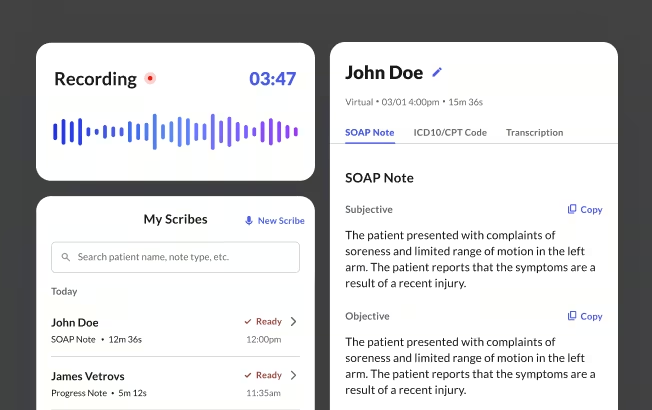
The first value moment lands the moment the clinician clicks End Recording. Within seconds, a structured note appears with suggested ICD-10 and CPT codes, capturing the full clinical context of the encounter. The clinician reviews and adjusts. For psychiatry and behavioral health practices, this matters most where the visit narrative is densest. In the assessment and plan sections of a mental health visit, 45 minutes of conversation has to compress into precise problem statements, measurable objectives, and risk language.
Three Commure Scribe details help keep a mental health treatment plan template compliant and consistent:
- 99.4% transcription accuracy with multi-speaker recognition for individual, group, and family sessions.
- 60+ EHR integrations. Solo and small practices (1–5 providers) use copy/paste. Medium and large group practices get one-click sync into the EHR's treatment plan and problem list objects.
- HIPAA-compliant, SOC 2 certified, with onshore data storage. Audio is encrypted in transit and at rest, never used for AI training, and retention follows HIPAA minimums.
In a typical outpatient mental health day, the practice shifts from drafting plans after dinner to reviewing draft plans during the visit. 90%+ of providers reduce clinical documentation time and digital fatigue, and 91% report feeling less fatigued. For a behavioral health group running utilization review, denial reductions matter. Commure Scribe practices report a 25% reduction in denials on average.
See how Commure Scribe drafts a mental health treatment plan template directly from the visit. Start a 7-day free trial.
Mental Health Treatment Plan Template Download
Download a copy of this template
Thanks! Your mental health treatment plan template is ready.
Click below to download.
Thanks! Your PHQ-9 depressing screening template is ready.
Click below to download.
Thanks! Your GAD-7 anxiety screening template is ready.
Click below to download.

Sources
- Substance Abuse and Mental Health Services Administration. Issue Brief: Person-Centered Planning. SAMHSA Library, PEP24-01-002. https://library.samhsa.gov/product/issue-brief-person-centered-planning/pep24-01-002
- Centers for Medicare & Medicaid Services. Evaluation and Management Services Guide (MLN006764). CMS. https://www.cms.gov/outreach-and-education/medicare-learning-network-mln/mlnproducts/downloads/eval-mgmt-serv-guide-icn006764.pdf
- U.S. Department of Veterans Affairs, Evidence Synthesis Program. Evidence Brief: Use of Patient Reported Outcome Measures for Measurement Based Care in Mental Health Shared Decision-Making. 2019. https://www.ncbi.nlm.nih.gov/books/NBK536143/
- Fairbanks J. Writing Behaviorally Stated Goals and Objectives. Troy University. http://spectrum.troy.edu/jfairbanks/WritingTreatmentPlans.pdf
- U.S. Department of Health and Human Services. HIPAA Privacy Rule. HHS. https://www.hhs.gov/hipaa/for-professionals/privacy/index.html
- U.S. Department of Health and Human Services, Office for Civil Rights. Understanding Confidentiality of Substance Use Disorder (SUD) Patient Records or "Part 2." https://www.hhs.gov/hipaa/part-2/index.html
- Kroenke K, Spitzer RL, Williams JB. The PHQ-9: Validity of a brief depression severity measure. Journal of General Internal Medicine. 2001;16(9):606-613. https://pubmed.ncbi.nlm.nih.gov/11556941/
- Spitzer RL, Kroenke K, Williams JB, Löwe B. A brief measure for assessing generalized anxiety disorder: the GAD-7. Archives of Internal Medicine. 2006;166(10):1092-1097. https://pubmed.ncbi.nlm.nih.gov/16717171/