



Treatment Plan Template: Free Editable Download
Free editable treatment plan template modeled on AHRQ, IHS, and selected state behavioral guidance.
Written by the Commure Scribe Team
Published: May 15, 2026
•
8 min read
Updated May 15, 2026
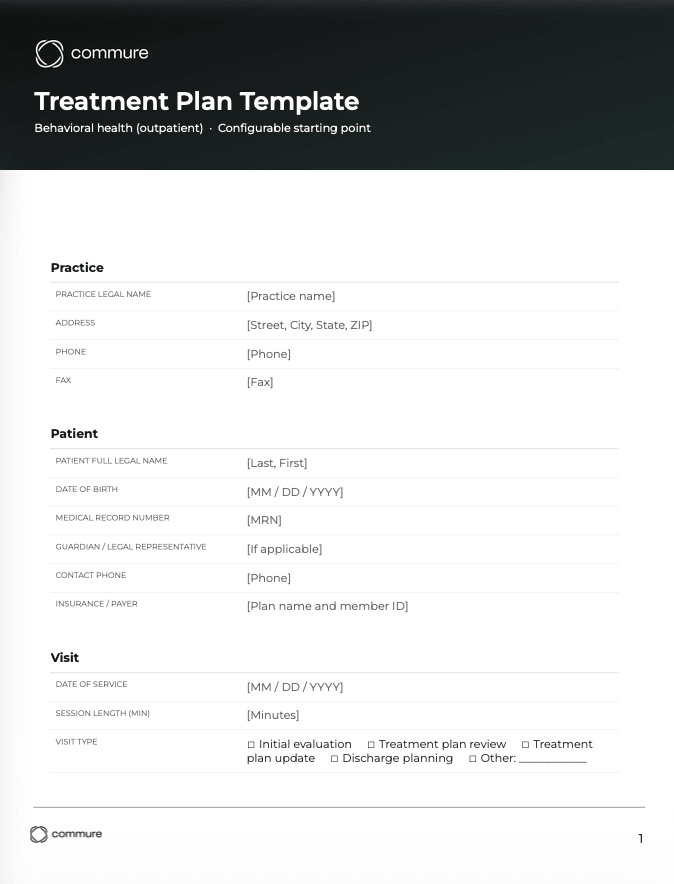
A treatment plan template is a form that records a patient's diagnosis, goals, interventions and review schedule. A common version opens with patient IDs, visit and provider details, presenting problems and risk assessment. Diagnoses use Diagnostic and Statistical Manual of Mental Disorders (DSM-5) codes. International Classification of Diseases (ICD-10) codes also work. One long-term goal carries measurable objectives, and each intervention lists how often and how long it runs. A review date and signatures with consent close the form. Behavioral health, primary care and specialty clinics can adapt it.
What You Need to Know About Treatment Plan Templates
- A treatment plan template is a structured form for a patient's diagnosis, goals, interventions, and review schedule.
- Across AHRQ, IHS, and several state behavioral guidelines, treatment plans tend to include similar core sections.
- The downloadable template includes commonly used fields to support HIPAA, Centers for Medicare & Medicaid Services (CMS), and state behavioral documentation.
↓ Jump to the free downloadable template
What Is a Treatment Plan Template?
Treatment plan templates show up across behavioral health, primary care, and specialty clinics. Each setting uses its own version. Behavioral health programs often use more detailed forms, and many state regulators set specific documentation rules for licensed programs.¹ The standards behind treatment plan templates are not new. The Agency for Healthcare Research and Quality (AHRQ) published its behavioral health treatment plan in 2016.² State agencies like the New York Office of Mental Health spell out what each plan should include for licensed clinics in that state.¹ The federal Indian Health Service teaches a treatment plan structure with similar core fields.³ Practices can use these examples as a reference. Final templates should still align with state, payer, and organizational rules. The structure that follows is based on behavioral health treatment plan guidance. It can often be adapted for primary care and specialty settings with clinical and regulatory review.
Why Independent and Group Practices Need a Treatment Plan Template
Treatment plan templates give a practice a shared structure for documenting the work being done with a patient. Without a shared format, goals and interventions may be documented inconsistently. That can create documentation and audit challenges down the line. The case for treatment plan templates is strongest in three places.
Defensible records. Payers review the plan when a claim is denied or appealed, and vague goals can lose at appeal. A clinical documentation improvement project at Nova Southeastern University reported that stronger documentation was associated with fewer chart denials.⁴
- Clinical clarity. A template prompts the clinician to name the diagnosis, the goal, and the next step in plain terms. The Indian Health Service trains clinicians to use goal frameworks such as SMART or RUMBA so anyone reading the plan knows what success looks like.³
- Team coordination. Group practices share patients across providers, and a template with set fields lets a covering clinician see the latest goal in seconds. Independent practices use the same fields to track a single case across visits.
Setting up treatment plan templates is usually a one-time effort. Poor documentation, by contrast, can create ongoing audit and denial risk. Practice size shapes how treatment plan templates are used. Many independent and group practices rely on similar core fields, even though their workflows differ. The form just gets distributed across more roles in larger groups.
What a Treatment Plan Template Should Include
Many treatment plan templates share similar core fields across solo and group practices. Resources from the New York Office of Mental Health and the AHRQ Behavioral Health Integration Academy list overlapping elements, though details vary by program and setting.¹,² A common template includes:
- Patient identifiers. [Patient Name], [Date of Birth], and a record number such as [MRN]. These tie the plan to the chart.
- Visit details. [Date of Service], session length, and service type (individual, group, or family). These support time-based billing.
- Provider information. [Provider Name], credentials, and license number. In many programs, the clinician who delivers the service signs the plan. Confirm signature rules with your state, payers, and compliance officer.
- Diagnosis. Space for a DSM-5 or ICD-10 code with a short description. Codes update each year, so leave the field open.
- Presenting problems. A short list of the issues that brought the patient in, in the patient's words where possible.
- Risk assessment. Fields for suicidal ideation, homicidal ideation, and self-harm risk, plus a safety plan reference. Many state regulators and behavioral health programs expect documentation of these risks and related safety planning where relevant. Check your state's rules for specific requirements.
- Goals and measurable objectives. One long-term goal with two or three short-term objectives, each with a target review date. The Indian Health Service trains clinicians to use goal frameworks such as SMART or RUMBA.³
- Interventions. The therapy modality, session frequency, and expected duration of services.
- Progress and review schedule. A date for the next review and a place to record changes between visits.
- Signatures and consent. [Patient Signature], [Provider Signature], and a line for consent to treatment per your policy. Where psychotherapy notes are used, document how those notes are kept separate from the general medical record, consistent with HIPAA definitions.
Omitting key fields such as diagnosis, goals, interventions, and review dates can make the plan harder to defend in an audit or appeal. Practices should tailor and document fields based on payer and regulatory expectations.
How to Fill Out a Treatment Plan Template
Treatment plan templates work best as a top-to-bottom walk-through during or right after the visit. New York's treatment planning rule requires documenting the patient's participation in planning.¹ Plans built collaboratively are easier to follow at the next session. Work through the treatment plan template in this order.
Start with identifiers and visit details. Fill in [Patient Name], [Date of Birth], [MRN], and [Date of Service] before the clinical content. Record service type and length once.
- Write the diagnosis next. Use the ICD-10 or DSM-5 code that drove the visit. Add a one-line plain description so anyone covering the case can read it.
- Document presenting problems in the patient's words. "Trouble sleeping for three weeks" is more useful than "insomnia." Direct quotes can clarify the patient's concerns for reviewers and help illustrate clinical reasoning. If intake used a biopsychosocial assessment template, pull the presenting problems and history from it so the plan builds on the same record.
- Reassess and document risk at regular intervals. Note the risk level for suicidal, homicidal, and self-harm ideation. Many programs document risk at each visit for higher-risk patients, and any time risk factors change.
- Write one long-term goal in the patient's voice. Add two or three short-term objectives that are measurable, each with a target review date. SMART criteria (specific, measurable, achievable, relevant, time-bound) are one common framework taught by the Indian Health Service.³
- List interventions, frequency, and duration. Name the therapy modality, how often it will happen, and for how long. "Weekly individual cognitive behavioral therapy for 12 weeks" is one acceptable form.
- Set the next review date. Many state agencies and accrediting bodies expect treatment plans to be reviewed and updated on a defined schedule. Check your state and payer rules for specific intervals.¹
- Sign and date the form. In many behavioral health programs, both [Patient Signature] and [Provider Signature] are expected. Confirm consent for treatment is on file and follow your state and payer rules for signature handling.
A worked SMART example shows the difference.
- Before. [Patient] wants to feel less anxious.
- After (SMART). [Patient] will reduce anxiety symptoms by at least 5 points on the Generalized Anxiety Disorder-7 (GAD-7) within 8 weeks. [Patient] will attend weekly cognitive behavioral therapy and complete daily breathing exercises, with progress reviewed at week 4 and week 8.
Save completed treatment plan templates in the chart so the team can see them next visit.
Documentation Compliance Requirements for Treatment Plans
Treatment plan templates live under several layers of rules. The right framing is "designed with these regulations in mind," not "fully compliant." A practice still needs its compliance officer or attorney to review the form. The main rules that shape treatment plan templates:
- HIPAA Privacy Rule. This rule sets limits on how patient information is shared and stored (45 CFR 164.502 to 164.514).⁵ Treatment plans are protected health information that staff access only for treatment, payment, or operations.
- Psychotherapy notes. Process notes in mental health get extra protection (45 CFR 164.508(a)(2)) and need separate written consent before release.⁵ The treatment plan itself is part of the medical record, not a psychotherapy note. Session-level therapy notes follow the same split: progress notes join the medical record, while psychotherapy notes stay separate.
- 42 CFR Part 2. This rule applies when the program meets the federal definition of a Part 2 program; not all clinicians treating substance use fall under Part 2.⁶ When it applies, it is stricter than HIPAA for those records, and redisclosure needs specific patient consent language.
- CMS Conditions of Participation. Medicare-participating clinics must keep records that support the level of service billed (42 CFR 482 to 485).⁷ A vague treatment plan can contribute to audit findings, even when other parts of the chart are more complete.
- State law. State mental health boards often add their own rules. New York OMH Part 599.10 requires specific fields and clinician signatures in licensed clinics, and requirements vary by state.¹
- Documentation integrity. Late entries and amendments must be marked as such with the date of the change. Cloned or copy-forwarded plans carry audit risk.⁷
Treatment plan templates help a practice meet these rules. They do not guarantee compliance. Have the compliance officer or counsel review the form before clinical use.
How to Customize Your Treatment Plan Template by Specialty and Practice Size
The fields, fill-out steps, and compliance rules in the sections above are the baseline. Treatment plan templates still need adjustments for the specialty using them and the size of the practice running the workflow. A behavioral health program captures different goal types than an oncology clinic, and a large group distributes the work across roles in ways a solo office does not. Two dimensions drive most edits: clinical specialty and practice size. The base structure stays the same. The fields, prompts, and formatting need small changes for each. Common specialty customizations of treatment plan templates:
- Behavioral health. Add prompts for trauma history, substance use screening, and risk re-check. Validated screens like Patient Health Questionnaire-9 (PHQ-9) and GAD-7 are widely available at no cost for routine clinical use, with minimal licensing constraints.⁸ Programs offering dialectical behavior therapy (DBT) can add a prompt for target behaviors the client rates each day on a weekly DBT diary card template.
- Primary care. Replace the long-term therapy goal field with a chronic care goal (for example, "A1C below 7 in six months"). Add a problem list link and keep the risk assessment for behavioral concerns.
- Oncology. Treatment plans often follow disease-specific templates that emphasize regimen, schedule, and supportive care rather than psychotherapy goals.⁹ Adapt this structure to your oncology program's protocols and accrediting-body requirements.
- Pediatrics. Add a guardian signature line and a section for school or developmental support. Note the age-of-consent rules for the practice's state.
- Physical therapy and rehab. Track functional goals with measurable units (range of motion, gait speed). Tie objectives to therapy frequency and discharge criteria.
Practice size matters too. Independent practices keep treatment plan templates short and use the same form across all visits. Group practices use role-based workflows. Front desk fills demographics. The medical assistant or nurse drafts the visit fields. The rendering clinician confirms and signs. Two more notes round out workable treatment plan templates.
- EHR integration. The blank DOCX is a starting point. Most EHRs let a practice import field labels into a custom note template so the same fields appear inside the chart.
- Annual code reviews. ICD-10 and CPT codes update each year. Schedule a yearly review of any printed codes in the template.⁷
Match treatment plan templates to your workflow. Maintain a clear version history so teams know which version is current. For specialty-specific structures, see the mental health treatment plan template and the related therapy progress notes cheat sheet.
How Commure Scribe Supports Treatment Plan Documentation
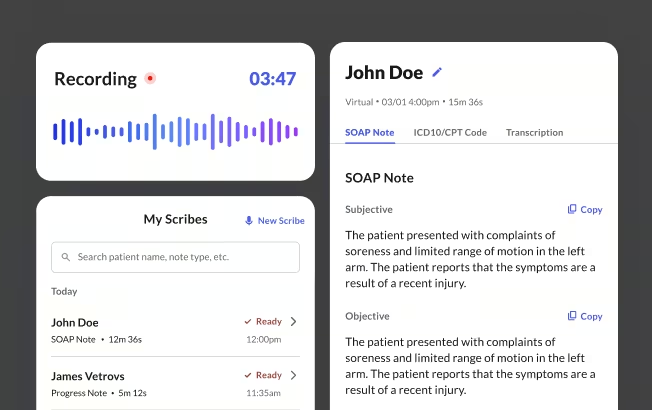
Treatment plan templates only work if the visits they describe are documented well. Commure Scribe is an AI medical scribe that captures the encounter and drafts a structured clinical note while the clinician stays present in the room. The note covers the patient's words, clinical reasoning, and the agreed plan, so the goals and interventions in treatment plan templates come from a verified record of the visit.
The workflow has three steps. Capture: the software records the session. Edit: the AI generates a structured note for the clinician to review and adjust. Finalize: the clinician approves the note before it enters any record. Within seconds of clicking End Recording, a structured SOAP note appears, with suggested ICD-10 and CPT codes available in a separate tab for the clinician to review.
The encounter note feeds treatment plan templates, not the other way around. Clinicians pull the diagnosis, presenting problems, and intervention details from the encounter note into the form. Each follow-up visit produces a fresh note, and the clinician adjusts goals, objectives, and review dates in the treatment plan template from there.
Commure Scribe is HIPAA compliant and SOC 2 certified, with onshore data storage. Audio and notes are encrypted in transit and at rest. Audio is used only for generating the clinical note, never for AI training. Practices of all sizes use it: copy/paste EHR integration for solo and small practices, and one-click sync with EHR for medium and large group practices.
Specialty templates and a custom template builder match a practice's clinical voice. The encounter note can mirror the field labels in the practice's treatment plan templates. That cuts the time clinicians spend reformatting notes to fit a group standard.
Download the Treatment Plan Template
Note: This template is for informational purposes only and does not constitute legal or medical advice. Have your compliance officer review it before clinical use. Download the free Treatment Plan Template. The DOCX is fully editable and ready to customize for your practice.
Treatment Plan Template Download
Download a copy of this template
Thanks! Your Treatment plan template is ready.
Click below to download
Frequently Asked Questions
A treatment plan should include patient identifiers, date of service, diagnosis, and presenting problems. It should also list a risk assessment, long-term goals with measurable objectives, interventions, frequency and duration, a review schedule, and signatures. Behavioral health plans add a safety plan reference and notes on how psychotherapy notes are kept separate from the medical record.
Many state behavioral health regulators require periodic treatment plan reviews and updates, and intervals vary by state and program. Update the plan when the diagnosis changes, the patient meets a goal, or the intervention shifts. Set a review date directly in the form so the next visit can confirm or revise it. Many practices set a standing review cadence so the schedule is automatic.
Treatment plans are not always required for every claim, but payers and Medicare contractors expect documentation that supports the level of service billed. CMS Conditions of Participation require adequate records for participating clinics, and behavioral health payers often request treatment plans during prior authorization or audit. Plans with vague goals are common audit findings.
Yes. The base structure can often be adapted across behavioral health, primary care, oncology, pediatrics, and physical therapy with specialty-specific changes and compliance review. Replace therapy goals with chronic care or functional goals, swap diagnostic codes for the specialty's standards, and add prompts the practice uses today. The DOCX is editable so the practice can adjust labels, sections, and signature lines.
The template was designed with the HIPAA Privacy Rule and CMS documentation requirements in mind, though a template alone cannot guarantee compliance. Compliance depends on how the practice uses, stores, and shares the completed form. Have a compliance officer or attorney review the template against state law and your workflow before clinical use.
Sources
- New York State Office of Mental Health. Part 599.10 Treatment Planning. https://omh.ny.gov/omhweb/policy_and_regulations/proposed/part-599-10-text.pdf
- Agency for Healthcare Research and Quality. Treatment Plan – Behavioral Health. 2016. https://integrationacademy.ahrq.gov/sites/default/files/2021-10/Treatment_plan_v1_7_16.pdf
- Indian Health Service. Integrated Behavioral Health: Treatment Plan. https://www.ihs.gov/rpms/training/course-materials/?p=rpmsTraining\Integrated+Behavioral+Health\IBH_Treatment_Plans.pdf
- Dolan G. A Clinical Documentation Practice Improvement to Increase Reimbursement. Nova Southeastern University. 2018. https://nsuworks.nova.edu/cgi/viewcontent.cgi?article=1058&context=hpd_con_stuetd
- U.S. Department of Health and Human Services. HIPAA Privacy Rule. https://www.hhs.gov/hipaa/for-professionals/privacy/laws-regulations/index.html
- Substance Abuse and Mental Health Services Administration. 42 CFR Part 2 Confidentiality FAQs. https://www.samhsa.gov/about-us/who-we-are/laws-regulations/confidentiality-regulations-faqs
- Centers for Medicare & Medicaid Services. Conditions for Coverage and Conditions of Participation. https://www.cms.gov/regulations-and-guidance/legislation/cfcsandcops
- Kroenke K, Spitzer RL, Williams JBW. The PHQ-9: Validity of a Brief Depression Severity Measure. Journal of General Internal Medicine. 2001. https://pmc.ncbi.nlm.nih.gov/articles/PMC1495268/
- Blayney DW, et al. Treatment plan and summary templates: the experience of one oncology practice. Journal of Oncology Practice. 2010. https://pmc.ncbi.nlm.nih.gov/articles/PMC2790680/