



What Are Emergency Scribes? Roles, Costs, and AI Alternatives
What emergency scribes do, what they cost, and how AI ambient scribes compare for settings that can't justify full-time staffing.
Written by the Commure Scribe Team
Published: May 8, 2026
•
8 min read
Updated May 8, 2026
What You Need to Know: Emergency scribes are trained documentation specialists who enter clinical information into the EHR in real time during patient encounters, so emergency physicians can keep their attention on care. Scribes are common in high-volume emergency departments where documentation speed directly affects throughput. For settings that cannot justify dedicated medical scribe staffing, AI ambient scribes provide real-time documentation support on demand without hiring, scheduling, or coverage gaps.
What are emergency scribes?
Emergency scribes are trained staff who work alongside emergency physicians, entering clinical notes into the EHR during each patient visit. The physician directs care. The scribe captures it. The physician reviews the note and signs off before it is final.
A physician managing chest pain, a trauma, and a pediatric fever at once cannot chart without losing time at the bedside. They handle the chart while the physician stays focused on the patient.
Is an emergency scribe a clinical role?
Emergency scribes are not clinicians. They do not make recommendations, interpret results, or communicate treatment information to patients. Their job is to follow the physician's verbal and exam cues and enter them as structured notes: the history of present illness, physical exam findings, test results, the assessment, and the plan.
Emergency scribes work full shifts alongside a single physician, shadow closely through each encounter, and maintain an open EHR throughout. They are not MAs, nurses, or residents. Medical assistants room the next patient. Nurses document their own assessments. Residents are learning, not scribing. They fill a role none of those team members are set up to fill: real-time charting for the attending physician, encounter by encounter.
What do emergency scribes do?
An emergency scribe's work follows the encounter from intake to sign-off.
Before the patient encounter
Medical scribes prepare the EHR encounter before the physician enters the room. In a busy department this means pulling up the chart, reviewing the triage summary and chief complaint, and having the documentation template open. Some emergency scribes also track order status across concurrent encounters and flag when lab or imaging results return.
During the encounter
Real-time capture is the core function. As the physician takes the history, conducts the exam, and works through the assessment with the patient or family, the scribe enters information directly into the chart. This includes the history of present illness, review of systems, physical exam findings, any orders placed, and the preliminary impression.
Scribes do not interpret. If the physician says "diffuse abdominal tenderness, guarding present, no rebound," the scribe documents exactly that. Clinical judgment belongs to the physician.
After the encounter
When the physician moves to the next patient, the scribe closes the current note. This means adding results that returned during the encounter, entering the final plan and disposition, and flagging the note for physician review. The physician reads, edits where needed, and signs.
This cycle repeats across an eight to twelve hour shift. An emergency scribe supporting a busy attending may move through fifteen to twenty encounters per shift, each requiring a complete, legally sound note.
An emergency department visit with a scribe, step by step
A 58-year-old presents with shortness of breath and chest tightness. The triage nurse documents vitals and the chief complaint. When the attending enters, the scribe opens the encounter and begins capturing the history: onset three hours ago, no prior cardiac history, takes lisinopril for hypertension, denies recent travel.
The attending examines the patient. The scribe documents: breath sounds decreased at the left base, no JVD, regular rate and rhythm. The attending orders a chest X-ray, EKG, troponin, and BNP. The scribe enters the order note. When results return, the scribe adds them in real time.
The attending decides to admit for further workup. The scribe drafts the assessment and plan section, noting the working diagnosis, rationale, and disposition. The attending reads the note, adjusts one line, and signs. The encounter is closed.
Why do hospitals and ED groups use emergency scribes?
Emergency scribes reduce charting time, improve note completeness, and help physicians see more patients per shift.
Reduced documentation time and burnout
Physicians in emergency settings report spending a substantial portion of each shift on documentation rather than direct care. Published research suggests charting time can equal or exceed direct patient time in some settings.¹ Scribes handle charting in parallel with care, so it does not stack up at the end of the shift.
American Medical Association (AMA) data from 2024 shows that 48.2% of physicians report symptoms of burnout, with after-hours documentation, sometimes called "pajama time," a persistent driver.³ An emergency scribe on every encounter reduces the charting that builds up during a shift and needs to be closed later.
Higher patient throughput without faster visits
The throughput gain from emergency scribes is not about compressing the visit. When a physician finishes a visit and the chart is already drafted, they move to the next patient immediately. That reduction in transition time adds up across a full shift without shortening any individual encounter.
More complete notes and better coding
The scribe has one job during the encounter: capture everything. A physician writing their own note hours later may compress the history, omit exam findings that felt routine, or abbreviate the assessment in ways that affect coding accuracy.
Gaps in the note have billing consequences. Missing detail in the assessment can lead to a lower-acuity code. Missing chronic conditions can reduce risk scores. Scribes capture the visit in real time, reducing those gaps.
What do emergency scribes cost?
Emergency scribe costs depend on staffing model, location, and visit volume.
Direct costs
In-house emergency scribes typically earn $16 to $18 per hour nationally, based on pay data from Indeed and PayScale as of early 2026, with rates varying by location and experience.² Full-time scribes add benefits on top of wages. Outsourced emergency scribe services charge per hour or shift and cover recruiting, training, and coverage, at rates that run higher depending on the vendor.
Hidden costs
Training is not a one-time event. They need training on the EHR, note templates, HIPAA rules, and department workflow. Turnover is common; many scribes are pre-med students who move on after a year. Each departure means restarting onboarding.
Coverage gaps add cost. When a scribe calls in sick, the physician handles all charting solo.
What are the common risks and limitations of emergency scribes?
Human scribes require staffing, and staffing introduces constraints.
Privacy and compliance
Patients should be told about the scribe and given the chance to decline. Most departments use a verbal notice or a posted sign, but the step adds time to each encounter. HIPAA training applies to all staff who handle patient data, and compliance depends on how well that training holds.
Variable documentation quality
Not all emergency scribes produce consistent notes. A scribe in week one charts differently than one with six months on the same department. Even experienced scribes have habits that need ongoing correction. Editing that draft takes time, and that time is part of the real cost.
Scheduling and coverage limits
Emergency scribes cannot work every shift. Illness, turnover, and schedule gaps leave physicians without coverage. When that happens in a setting built around scribes, output drops for the day.
Do urgent care and outpatient clinics need emergency scribes?
Most cannot access them, and many do not need the hospital staffing model. An urgent care physician seeing a full schedule, or a primary care physician managing a busy clinic day, faces the same structural problem as an emergency attending: documentation competes with care, and something gets compressed.
That time usually comes after hours. AMA data from 2024 shows a meaningful share of physicians spend more than eight hours per week on charting outside clinic time.³ Urgent care, walk-in, and outpatient settings rarely have the volume or budget to justify a full scribe program. The math only works with high, stable throughput.
For clinics with lower or variable volume, the human scribe model does not fit. The options most practices fall back on, voice dictation, in-room typing, or end-of-day charting, each cut into something. Dictation needs editing. In-room typing breaks the visit. Batch charting is still after-hours work. Another options is to compare human scribes with an ambient AI one.
Emergency scribes vs AI scribes: which fits your setting?
Emergency and outpatient settings have three main options.
High-volume emergency departments with stable throughput and a staffing budget have the strongest case for human emergency scribes. The gain per added patient needs to exceed the cost per scribe-shift.
Urgent care, walk-in, and outpatient settings for independents to group practices may find an AI ambient scribe a better fit. The monthly cost is fixed, coverage does not depend on staffing, and the tool works for telehealth.
How does Commure Scribe give you emergency-scribe-level documentation support without hiring scribes?
The main problem with human scribes in smaller settings is coverage: you need a person every shift, and people have schedules. Commure Scribe removes that constraint.
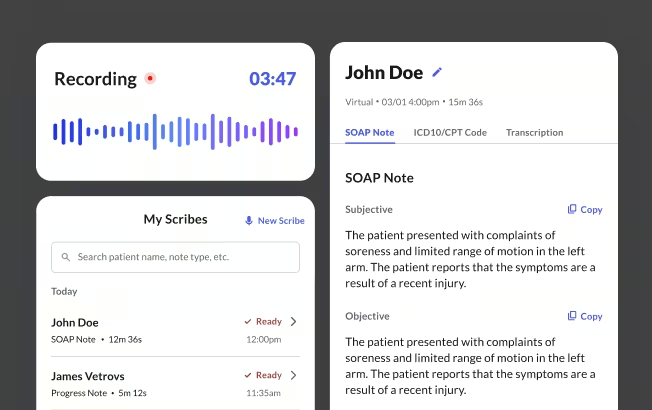
End the recording, and a structured SOAP note appears in seconds, with suggested ICD-10 and CPT codes in a separate tab for review. The clinician adjusts and approves before anything enters the chart. The workflow is Capture, Edit, Finalize. The clinician always has the option to review before finalizing.
Charts close before the end of the shift. Clinicians report an average chart close time of 43 seconds. 90% of providers report reduced clinical documentation time and digital fatigue; 91% report feeling less fatigued.
Setup needs no IT project. Commure Scribe runs on any device and supports in-person and telehealth visits. For small practices, notes move into the EHR via copy/paste. Group practices can access one-click EHR sync. Transcription accuracy is 99.4% across 90 languages, with auto language detection.
- 75,000+ clinicians
- 25 specialties with proven documentation time reduction
- 60+ EHR integrations including AdvancedMD, eClinicalWorks, Athenahealth
- HIPAA compliant, System and Organization Controls 2 (SOC 2) certified, onshore data storage
- Audio stored and encrypted per HIPAA requirements; not used for AI training
- Transcripts and notes can be permanently deleted by the user
- 7-day free trial, no credit card required
Frequently Asked Questions
ER scribes enter clinical information directly into the EHR during each patient encounter. They follow the physician through the department, document findings and orders in real time, and close the note once results and the final plan are entered. The physician reviews the draft and signs before it posts to the chart.
A human emergency scribe is a person who enters documentation during the encounter. An AI scribe uses ambient audio capture to generate a structured note that the physician reviews and finishes before it enters the chart. Human scribes require scheduling and have coverage gaps. AI scribes are available on any device, for any visit type, without staffing overhead.
There is no single national certification required to work as an emergency scribe. Most programs provide in-house training covering medical terminology, EHR navigation, HIPAA compliance, and department-specific documentation standards. Training length and depth vary significantly by employer and department.
For high-volume emergency departments with stable throughput, emergency scribes can increase patient volume per shift and reduce after-hours charting. The economics depend on whether the productivity gain per additional patient exceeds the cost per scribe-shift. For smaller settings with variable volume, an AI ambient scribe typically offers better unit economics without the staffing overhead.
Sources
- Arndt, B. G., Beasley, J. W., Watkinson, M. D., et al. (2017). Tethered to the EHR: Primary care physician workload assessment using EHR event log data and time-motion observations. Annals of Family Medicine, 15(5), 419–426. https://doi.org/10.1370/afm.2121
- Indeed. (2026, February 16). Medical scribe salary in United States (4,900+ salary profiles from job postings). https://www.indeed.com/career/medical-scribe/salaries; PayScale. (2025, October 17). Average hourly pay for a medical scribe (495 salary profiles). https://www.payscale.com/research/US/Job=Medical_Scribe/Hourly_Rate
- American Medical Association. (2024). 2024 AMA Organizational Biopsy: Physician burnout and well-being. https://www.ama-assn.org/practice-management/physician-health/burnout-way-down-pajama-time-stands-still
- Morey, J., Jones, D., Walker, L., Lindor, R., Schupbach, J., Mullan, A., & Heaton, H. (2025). Ambient artificial intelligence versus human scribes in the emergency department. Annals of Emergency Medicine. https://doi.org/10.1016/j.annemergmed.2025.10.006
- Tierney, A. A., Gayre, G., Hoberman, B., et al. (2025). Ambient artificial intelligence scribes: learnings after 1 year and over 2.5 million uses. NEJM Catalyst Innovations in Care Delivery. https://www.ama-assn.org/practice-management/digital-health/ai-scribes-save-15000-hours-and-restore-human-side-medicine
.jpeg)
.jpeg)
.jpeg)
.jpeg)



.jpeg)
.jpeg)