



4 Best AI Scribes for AdvancedMD (2026)
A methodology-first comparison of four AdvancedMD AI scribes, including the EHR's native AI, with a buyer framework to test before you commit.
Written by the Commure Scribe Team
Published: March 25, 2026
•
15 min read
Last updated: June 2026
What You Need to Know About the Best AI Scribe for AdvancedMD
- The best AI scribe for AdvancedMD turns visit audio into a structured note that lands inside AdvancedMD, either by copy-paste or direct write-back, depending on the tool.
- A 2026 JAMA multisite study of 8,581 ambulatory clinicians found AI scribe adopters documented 16 fewer minutes per 8 patient hours, with a study-estimated ~$167/mo in added billing revenue per clinician.²
- Compare tools on AdvancedMD integration type, coding automation, published pricing, and trial access, then pilot inside your live AdvancedMD setup before committing.
How Do the 4 Best AI Scribes for AdvancedMD Compare?
The table below maps each tool across four evaluation criteria. Integration type and coding support are the two columns most likely to narrow the field for any given practice evaluating an ai scribe for advancedmd.
Notes:
- Vendor sites change often. Confirm pricing and trial terms before committing.
- Freed AI's native push to AdvancedMD applies to Premier tier only. Lower-tier users copy-paste.
- Languages: most vendors do not publish language counts. Commure Scribe supports 90 languages with automatic detection and no manual selection.
The 4 Best AI Scribes for AdvancedMD: Profiles
1. AdvancedMD AI Clinical Assistant
The AdvancedMD AI Clinical Assistant launched in February 2026 as part of the Winter Product Release. It runs as a native embedded feature inside AdvancedMD, meaning no separate app, no integration setup, and no additional vendor login. Every subscription includes it at no extra cost.³ Confirmed features include ambient listening with five note formats, automated action items, pre-visit summaries, and AI transcription for telehealth visits.
The tool covers roughly 40% of the documentation workflow.³ Note generation and action items are in scope. Coding, charge slip creation, and RCM tasks are not. Mobile ambient listening is not available as of mid-2026.
- Pre-visit summaries pull from existing chart data including notes, labs, medications, and allergies.
- Available at no additional monthly cost; included with every AdvancedMD subscription.
- Five note formats are supported at launch, with AI transcription available for telehealth visits.
2. Commure Scribe
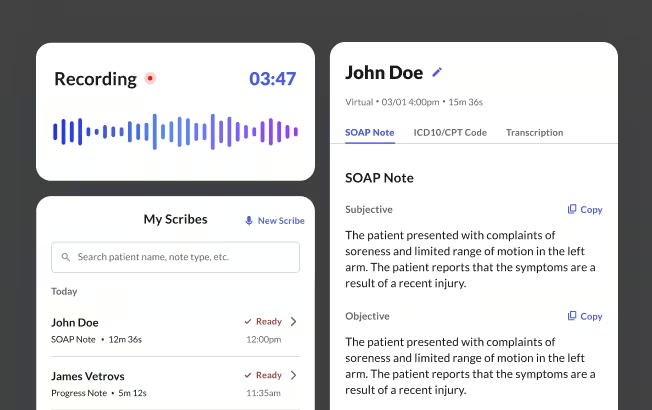
Commure Scribe is an AI medical scribe with API-based sync with AdvancedMD. Solo and small practices move notes by copy-paste. Medium and large groups can use one-click sync, which pushes chart content into AdvancedMD without a manual transfer step. Suggested ICD-10 and CPT codes are generated alongside each note at entry-level pricing, without requiring a tier upgrade. Commure Scribe detects 90 languages automatically with no manual selection before a visit. Transcription accuracy is 99.4%, measured across 25M+ patient encounters.
A 7-day unlimited trial is available with no credit card required, so the tool can be evaluated on real AdvancedMD visits before any commitment. For current pricing, see the Commure Scribe pricing page. Advanced integrations, admin controls, and group analytics are available on higher tiers.
- HIPAA compliant and SOC 2 certified; session audio is never used for AI training.
- 60+ EHR integrations supported; the workflow transfers if a practice changes platforms.
- The Capture, Edit, Finalize workflow keeps note review inside the scribe before pushing to AdvancedMD.
3. Freed AI
Freed AI offers AdvancedMD compatibility, though the tier structure determines how it functions in practice. Starter ($39/mo, up to 40 notes) and Core ($79/mo, unlimited notes) both use copy-paste workflows. Native write-back to AdvancedMD is available only on the Premier tier, priced at $104/mo billed annually or $119/mo billed monthly.⁴
Both the native AdvancedMD integration and ICD-10/CPT code suggestions are gated to that Premier tier. Practices evaluating Starter or Core should expect copy-paste and no code suggestions. Freed captures sessions in 90+ languages but generates notes in English only.⁴ All pricing is subject to change.⁴
- Native AdvancedMD write-back and ICD-10/CPT coding are available only on the Premier tier.⁴
- A 7-day free trial is available with no credit card required.⁴
4. ScribeHealth / HealOS
ScribeHealth, currently rebranding to HealOS, runs as a browser extension inside the AdvancedMD interface. This gives it access to chart fields on screen without requiring a separate API connection or IT configuration. Published pricing is $39/mo for unlimited sessions, and 20 free sessions per month are available before any charge applies. Clinicians stay inside the AdvancedMD tab throughout the workflow without switching apps.
ScribeHealth reports 98% accuracy for general medical terms and 95% for specialty terminology.⁵ ICD-10 and CPT coding are generated automatically from encounter context.⁵ Because the extension works on-screen rather than through an API, it has no named AdvancedMD integration in the traditional sense.
- Runs as a browser extension overlaid on the AdvancedMD tab; no API connection or IT configuration required.
- ICD-10 and CPT codes are auto-assigned from encounter context.⁵
- ScribeHealth is rebranding to HealOS; confirm current pricing and plans on the vendor site.
What Is an AI Scribe for AdvancedMD?
An advancedmd ai scribe captures patient visit audio and generates a structured clinical note. The clinician reviews and finalizes the note inside AdvancedMD. Until early 2026, every advancedmd ai documentation solution was a third-party add-on. That changed in February 2026 when AdvancedMD launched its own AI Clinical Assistant.
AdvancedMD included its AI Clinical Assistant at no extra cost in every subscription plan, changing the starting point for any AdvancedMD user evaluating documentation tools. The native AI handles ambient listening, note generation, action items, and pre-visit summaries. Third-party AI scribes fill gaps the native tool does not cover, including coding automation and mobile ambient listening.
How Were These AdvancedMD AI Scribes Evaluated?
Each tool was scored on five criteria: AdvancedMD integration type, coding support, published pricing, free trial access, and language coverage.
Integration type is graded on three tiers:
- Copy-paste: The scribe drafts the note in its own app. The clinician copies it into the AdvancedMD chart manually.
- Browser extension: The scribe runs as an overlay inside the AdvancedMD interface. The clinician fills in fields without switching apps, but no direct API connection exists.
- API write-back: The scribe connects directly to AdvancedMD and pushes structured data into specific chart fields, including Assessment, Plan, and billing sections. This removes the paste step entirely.
On vendor accuracy claims: Every vendor publishes its own accuracy percentage, but there is no shared test that all scribes use, so those numbers cannot be compared directly. The only independent benchmark is a 2025 randomized trial in NEJM AI, which found that omissions — missing clinical details — were the most common error in AI-generated notes.¹
The April 2026 JAMA multisite study of 8,581 ambulatory clinicians found AI scribe adopters documented 16 fewer minutes per 8 scheduled patient hours.² That study used Epic-integrated tools, not AdvancedMD-native tools.
The four tools: AdvancedMD AI Clinical Assistant, Commure Scribe, Freed AI, and ScribeHealth/HealOS.
Why Does AdvancedMD AI Scribe Integration Depth Matter?
Integration depth determines how many manual steps remain between a completed recording and a finalized AdvancedMD chart. Fewer steps means less friction per patient, and friction compounds across a full day of visits.
With a native embedded tool like the AdvancedMD AI Clinical Assistant, the recording starts and ends inside the same interface the clinician already uses. The note generates within AdvancedMD and routes to the correct chart automatically. There is no switching between apps and no copy-paste step.
With an API write-back tool like Commure Scribe, one-click sync pushes note content directly into the correct AdvancedMD chart fields. The clinician reviews the note in the scribe first, then pushes it to AdvancedMD. No copy-paste step is required at the group tier.
With a browser extension tool like ScribeHealth/HealOS, the scribe runs as an overlay inside the AdvancedMD tab. The clinician can fill in fields without leaving the browser, but no direct API channel exists between the scribe and the AdvancedMD database. Changes write to what the extension can see on-screen.
Copy-paste tools require the clinician to open both apps, select the note text, copy it, navigate to the correct AdvancedMD chart field, and paste. Each encounter adds several manual steps.
Mobile ambient listening is not available in the AdvancedMD AI Clinical Assistant as of mid-2026.
How to Choose the Best AdvancedMD AI Scribe for Your Practice
The right advancedmd ai scribe depends on three variables: workflow tolerance, coding automation economics, and what a fair evaluation period looks like. For practices comparing options across multiple EHRs, see the guide to the best AI medical scribes.
By practice size:
- Solo and 1–3 provider practices: The AMD AI Clinical Assistant is included at no cost. Third-party copy-paste tools add coding support and broader template options for practices that need them.
- Small group practices (4–10 providers): At this scale, the time cost of copy-paste accumulates across the team. API write-back tools remove per-provider manual steps. The JAMA 2026 study found AI scribe adopters documented 16 fewer minutes per 8 patient hours.² Researchers estimated that corresponds to roughly $167/mo in added billing revenue per clinician (Epic-integrated tools, not AdvancedMD-specific).
- Mid-to-large group practices (10+ providers): Commure Scribe's group tier provides one-click sync with AdvancedMD. Admin controls, group analytics, and custom integration are available at this tier.
By specialty:
AdvancedMD primarily serves primary care, dermatology, orthopedics, pain management, and mental health practices. All tools in this comparison are HIPAA-compliant AI note-taking solutions; confirm BAA terms with each vendor before deploying. Primary care has the strongest published evidence base for AI scribe impact. The AAFP confirms AI scribes reduce documentation burden in ambulatory primary care, with adoption rate as the primary variable in realizing time savings.⁶ Mental health and behavioral health notes tend to be longer and more nuanced; language detection and template flexibility matter more in those settings.
Pilot checklist:
When testing any advancedmd ai documentation tool, track these five measures on real visits:
- Field placement: Does the note content land in the right AdvancedMD fields, or does it need manual repositioning?
- Edit burden: How many words or sentences does the clinician change per note?
- Click count: How many actions does it take from End Recording to a signed chart?
- Coding accuracy: If the tool suggests codes, how often does the clinician accept them without editing?
- Time recovered: Compare documentation time per visit during the trial to the week before.
The JAMA 2026 benchmark is 16 fewer documentation minutes per 8 patient hours.²
Evaluate AdvancedMD scribes on your actual visits
Commure Scribe is one of the tools covered above; the best way to evaluate any advancedmd ai scribe is on real visits with real patients. Start the free 7-day trial and track the five pilot metrics from this article. Compare the result against the JAMA 2026 benchmark, then review see current Commure Scribe plans before committing.
This article is for informational and educational purposes only, does not constitute legal, medical, or professional advice, and does not guarantee any specific documentation, billing, or purchasing outcome. Pricing and features change; confirm details with each vendor before buying.
Frequently Asked Questions
Yes. The AI Clinical Assistant launched on February 19, 2026. It covers ambient listening, note generation, Action Items and pre-visit summaries. Mobile support arrived in the June 2026 Summer Release.
Commure Scribe generates ICD-10 and CPT suggestions at its entry price. Freed publishes ICD-10, CPT and E/M codes on a separate Codes tab, gated to Premier and copied by hand. DeepScribe supports ICD-10, E/M and HCC. HealOS publishes no coding output for AdvancedMD. The AI Clinical Assistant generates no codes, though AdvancedMD sells Computer-Assisted Coding separately.
HealOS offers 20 free sessions per month, with no card required. Commure Scribe and Freed each run a 7-day trial with no credit card. The AI Clinical Assistant is a paid add-on. No free tier is confirmed.
No. AdvancedMD sells it as an add-on at $100 per provider per month for unlimited encounters, or $0.99 per encounter. Its AI pages name no AI-specific free trial or promotion.
Yes. AdvancedMD publishes Connect APIs with full create, read, update and delete access, behind a Certified API Developer Agreement with licensing fees. Its HL7 FHIR APIs are read-only, so they serve certification rather than write-back. DeepScribe and DAX Copilot appear in AdvancedMD's marketplace; Commure Scribe, Freed and HealOS do not.
Where each section lands in the AdvancedMD chart, how much editing each note needs, and the click count from End Recording to a signed chart. Also check coding accuracy against your own coding of the same visits.
We run the same scored method on other platforms. See the eClinicalWorks AI scribe and best AI scribe for athenahealth comparisons, or the best AI medical scribes head-to-head across the whole category.
Sources
¹ Lukac SL, et al. "Randomized controlled trial of AI scribes in ambulatory care." NEJM AI. 2025. https://pmc.ncbi.nlm.nih.gov/articles/PMC12316405/
² Rotenstein L, Holmgren AJ, Thombley R, et al. "Changes in Clinician Time Expenditure and Visit Quantity With Adoption of Artificial Intelligence-Powered Scribes: A Multisite Study." JAMA. April 1, 2026. https://jamanetwork.com/journals/jama/article-abstract/2847319
³ AdvancedMD. "AI Clinical Assistant." AdvancedMD.com. 2026. https://www.advancedmd.com/ai/
⁴ Freed AI. "Best AI Scribes." GetFreed.ai. 2026. https://www.getfreed.ai/resources/best-ai-scribes
⁵ ScribeHealth. "Free AI Scribe & Progress Note Taker for AdvancedMD." ScribeHealth.ai. 2026. https://scribehealth.ai/integrations/advancedmd
⁶ Graham Center. "Artificial Intelligence Scribes in Ambulatory Primary Care." American Family Physician. April 2025. https://www.aafp.org/pubs/afp/issues/2025/0400/graham-center-artificial-intelligence-scribes.html
.jpeg)

.jpeg)
.jpeg)

.jpeg)