



Medication Log Template: Free Editable Printable Form
A printable, editable form with required fields, compliance notes, and practice-size workflow guidance.
Written by the Commure Scribe Team
Published: May 26, 2026
•
8 min read
Updated May 26, 2026
A medication log template is a structured form that tracks each medication a patient takes or receives. It captures patient identifiers and allergies. Each drug entry lists the generic name, dose, route, frequency and indication. Other fields hold the prescriber, start and stop dates, staff initials, refusals and the provider's signature. Clinicians, medical assistants and nurses use it at intake and at each follow-up visit. It also supports transitions of care such as hospital discharge.
What you need to know about medication log templates
- A medication log is a structured running record of every medication a patient takes, with dose, route, frequency, and timing¹.
- Standard medication log templates include fields for prescriptions, OTC drugs, supplements, dose, route, frequency, indication, and refusal notes² ⁴.
- Use a structured medication log template at intake, every follow-up, and care transitions to keep adherence, safety, and reconciliation accurate³.
Download the medication log template
Note: This template is for informational purposes only and does not constitute legal or medical advice. Have your compliance officer review it before clinical use.
- Download the Medication Log Template. Editable administrative form.
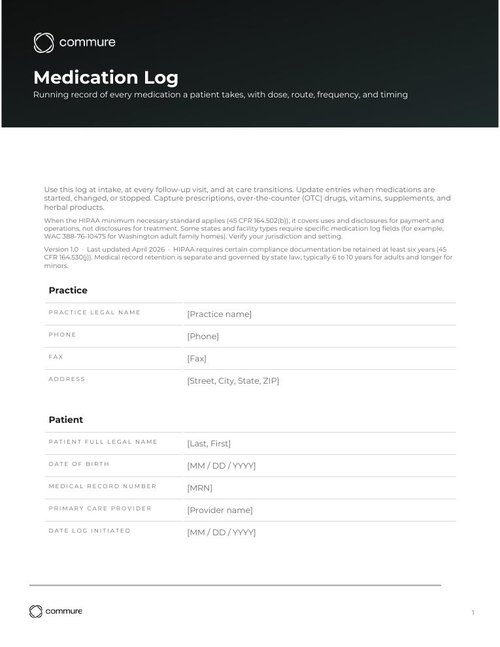
Customize the fields for your specialty, EHR, and state requirements before clinical use.
What is a medication log and when do practices need one?
A medication log is the running clinical record of every medication a patient takes or is given. Each new prescription, dose change, drug stop, and refused dose is documented over time¹.
The log lives alongside two related documents: the medication list and the medication administration record (MAR). The medication list shows what a patient takes today. The MAR tracks each dose given in a controlled setting. The log holds the running history behind both.
Practices use a medication log at three points in care:
- During intake, to capture all current prescriptions, over-the-counter (OTC) drugs, supplements, and herbal products²
- At each follow-up visit, to confirm changes since last contact¹
- At transitions of care, including hospital discharge and specialist hand-offs³
Some states require a medication log with specific fields in residential or facility-based care settings. Washington publishes a required form for adult family homes, and Tennessee publishes a similar facility form. Required fields include staff initials and refusal notes⁴ ⁵.
Required fields, update cadence, and ownership rules differ by practice size and care setting.
What should a medication log template include?
A complete medication log template holds 14 fields across five purposes: patient identity, medication identity, schedule and context, lifecycle dates, and administration and authentication.
Patient identifiers tie every entry to one person. The required fields are name, date of birth, and medical record or chart number⁴ ⁵ ⁶. Facility-based logs may add the patient's address or admission date⁴.
Medication identity captures what is being given. Three fields belong here:
- Drug name, recorded as the generic name where possible²
- Dose with units (10 mg, 5 mL, 1 patch, etc.)²
- Route, including oral, topical, inhaled, injected, or transdermal²
Generic names cut down on transcription errors. They matter most for patients with multiple prescribers. Brand names typically belong with non-substitutable formulations².
Schedule and context turn a list into a usable plan.
- Frequency and approximate administration times⁴ ²
- Indication or reason for the drug²
- Prescriber or ordering provider²
The indication field protects the patient. Drug names sometimes overlap. The indication guides future decisions about continuing the drug.
Lifecycle dates separate current therapy from prior therapy.
- Start date for each entry¹ ²
- Stop date or dose-change date for inactive entries¹
- Date of last reconciliation, signed by the reviewing clinician
These dates separate current drugs from stopped drugs¹.
A dedicated non-prescription section reduces missed entries. OTC drugs, vitamins, supplements, and herbal products belong in their own clearly labeled section². NIMH's clinical research template specifies "ALL products" by name to avoid ambiguity².
Administration and authentication fields close the loop.
- Initials of the staff member giving or assisting with each dose⁴
- Refusal field with reason for any held or refused dose⁴
- Allergies and adverse reactions, listed prominently at the top of the log
- Provider signature and date
Some states require initials and refusal documentation in residential or facility-based settings⁴. The same fields protect the practice during audits or adverse-event reviews.
How do you fill out a medication log template?
Filling out a medication log is recurring work. The entries change at every patient encounter and after each medication update. Record the same changes in the encounter's SOAP note so the log and the chart show matching dose, route and frequency.
At first visit, build the baseline.
- Ask the patient to bring all current pill bottles or a written list to the visit¹ ²
- Record every medication the patient names, including OTC drugs, vitamins, supplements, and herbal products²
- Use the generic name when one exists²
- Capture dose with units, route, frequency, and the reason for the drug²
- Note any allergies or adverse reactions before recording drug entries
At every follow-up visit, update what changed.
- Confirm each active entry with the patient, including dose and timing
- Add any prescription, OTC drug, or supplement started since the last visit¹
- Mark a stop date on any drug the patient stopped or the prescriber discontinued¹
- Sign and date the reconciliation field once the review is complete
At each administered dose, in facilities that track administration:
- Record the date and time of the dose
- Initial the entry as the staff member giving or assisting⁴
- If the patient refuses or holds a dose, complete the refusal field with the reason⁴
These field-level practices reduce errors.
- Write generic names in lowercase
- Reserve uppercase for proper-noun brand names²
- Date every change in pen on paper logs
- Use the system audit trail on electronic logs
Who owns the medication log in solo, small group, and 50+ practices?
Medication log ownership shifts with practice size. The work falls on different people depending on staffing patterns.
Solo and very small independent practices (1-3 clinicians)
- The clinician usually owns the full log: intake, reconciliation, and signature
- A single medical assistant (MA) often shares the load by capturing pill bottles or written lists at rooming
- No dedicated pharmacy or informatics staff. Log accuracy depends on the clinician's workflow discipline
The bottleneck here is time. Solo clinicians describe finishing notes and med-list cleanup after hours rather than during the visit.
Small groups (4-15 clinicians)
- Reconciliation work is often shared across a nursing pool or rooming team
- The MA or nurse populates the log entries. The clinician confirms and signs
- Staff turnover and varied documentation styles across providers make log consistency a regular issue
The bottleneck here is variation. Different clinicians use different abbreviations or skip the indication field. These habits make the log harder to read across the group.
Multispecialty and larger groups (15-50+ clinicians)
- Medication reconciliation is typically a defined role within a centralized intake team or pharmacy support function
- Templates and protocols are standardized at the organization level
- Informatics or quality teams audit log completeness against clinical documentation standards
The bottleneck here is integration. Large groups tend to have multiple EHR build versions. Ambient documentation systems need to map cleanly into structured medication fields.
In every practice size, the accuracy gap is the same. Capture during the encounter beats reconstruction after.
What regulatory and compliance requirements apply to medication logs?
Medication logs hold protected health information. HIPAA covers them. State rules add another layer of requirements.
HIPAA: Privacy Rule and Security Rule
- The Privacy Rule's minimum necessary standard applies when the log is used or shared for payment or operations. It does not apply to disclosures for treatment (45 CFR 164.502)⁷
- The Security Rule needs technical safeguards if the log is electronic, including access controls, audit trails, and encryption where appropriate (45 CFR 164.312)⁷
- Compliance documentation related to a medication log, like policies, procedures, and training records, must be kept for at least six years (45 CFR 164.530)⁷. Medical record retention itself is governed by state law and varies, with most states requiring six to ten years for adult records and longer for minor records
State requirements vary by setting and state.
- Some states publish their own medication log forms with mandatory fields. Washington needs daily logs with staff initials and refusal notes for adult family homes (WAC 388-76-10475)⁴
- Tennessee publishes Form PH-4217 with similar required structure⁵
- Other states leave the form to the practice. They still require accurate documentation as part of medical record standards
CMS rules apply when a practice bills Medicare or Medicaid.
- Documentation must support the level of care billed (CMS Conditions of Participation)⁸
- Documentation must be signed and dated by the rendering provider⁸
Three compliance habits matter for any medication log.
- Document what is on the form. Do not invent or carry forward entries
- Mark every change with the date and the person who made it
- Keep signed medical records per your state's retention law, typically six to ten years for adults and longer for minors. The HIPAA six-year rule applies to compliance documentation, not patient medical records (45 CFR 164.530)⁷
This medication log template is designed with the HIPAA Privacy Rule and Centers for Medicare & Medicaid Services (CMS) documentation standards in mind. Have your compliance officer review the form before clinical use.
How Commure Scribe builds your medication log during the visit
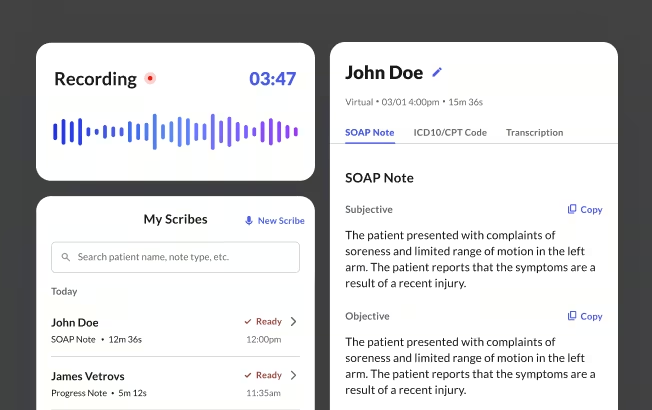
Commure Scribe is an AI medical scribe that captures the clinical encounter and drafts a structured note for review. The medication discussion that happens during the visit becomes part of that note. Patient-reported drugs, dose changes, OTC products, supplements, refusals, and discontinued medications appear in the medications section of the structured note.
The workflow runs in three steps:
- Capture. The clinician records the visit on any device. Commure Scribe handles in-person and telehealth visits and recognizes multiple speakers.
- Edit. The AI generates a structured note within seconds of End Recording, including suggested ICD-10 and CPT codes in a separate tab. The clinician reviews and adjusts.
- Finalize. The clinician approves the note before it enters any record.
For solo and small practices (1-5 providers), the medication section can be copied directly from the note into the medication log. For medium and large group practices, one-click sync moves the note into the EHR. The medication entries flow into structured medication fields.
Commure Scribe is HIPAA compliant. Audio is encrypted in transit and at rest with onshore data storage. Default audio retention is one year active and at least six years archived. Audio is not used for AI training.
90%+ of providers using Commure Scribe report reduced clinical documentation time and digital fatigue. 91% report feeling less fatigued. The medication log is one workflow that benefits. The clinician leaves the encounter with the medication discussion already structured, instead of reconstructing it after hours.
Medication Log Template Download
Download a copy of this template
Thanks! Your medication log template is ready.
Click below to download.

Sources
- National Institute of Diabetes and Digestive and Kidney Diseases. Concomitant Medication Log Manual of Operations (CMIA v1.0). NIDDK Central Repository, 2012. https://repository.niddk.nih.gov/media/studies/hbrn_immune_active/Manual%20of%20Operations/CMIA_Concomitant_Medication_Log_MOP_v1.0.pdf
- National Institute of Mental Health. NIMH Concomitant Medication Log Template (v.2026). NIMH Clinical Research Toolbox, 2026. https://www.nimh.nih.gov/sites/default/files/documents/funding/clinical-research/clinical-research-toolbox/documents/nimh-concomitant-medication-log-template-v-2026.docx
- National Center for Biotechnology Information / StatPearls. Medical Error Reduction and Prevention. NCBI Bookshelf, 2024. https://www.ncbi.nlm.nih.gov/books/NBK499956/
- Washington State Legislature. WAC 388-76-10475: Medication—Log. Washington Administrative Code, 2007. https://app.leg.wa.gov/wac/default.aspx?cite=388-76-10475
- Tennessee Department of Health. Medication Log (Form PH-4217). Office of the State Chief Medical Examiner, n.d. https://www.tn.gov/content/dam/tn/health/documents/officeofthestatechiefmedicalexaminersoffice/resourcesforthemedicalexaminer/OSCME_-_Medication_Log.pdf
- National Institute of Neurological Disorders and Stroke. Parkinson's Disease Medication Log (NIH Common Data Elements). https://cde.nlm.nih.gov/formView?tinyId=X1eWrJHSte
- U.S. Department of Health and Human Services. HIPAA Privacy and Security Rules. https://www.hhs.gov/hipaa/for-professionals/privacy/laws-regulations/index.html
- Centers for Medicare & Medicaid Services. Medicare Claims Processing Manual / Documentation Standards. https://www.cms.gov/regulations-and-guidance/guidance/manuals/internet-only-manuals-ioms