



DAP Notes: Template, Examples, and a Compliance Checklist for Outpatient Practices
A copy-ready Data, Assessment, Plan template with two worked examples and the documentation elements payers and accreditors expect.
Written by the Commure Scribe Team
Published: May 27, 2026
•
13 min read
Updated May 27, 2026
What you need to know about DAP notes
- DAP notes use three sections (Data, Assessment, Plan) to document outpatient mental and behavioral health sessions and can meet payer and accreditor expectations when they include the required documentation elements.
- Centers for Medicare & Medicaid Services (CMS) coverage guidance for outpatient psychiatry and psychology services expects progress notes to document elements such as diagnosis, symptoms, functional status, focused mental status, treatment plan, and progress to date.2
- Ambient AI scribe studies report about 20.4% less time in notes per appointment, which may make complete DAP notes easier to sustain at current clinician workloads.7
DAP notes are a three-section progress note format used across outpatient mental and behavioral health practices. DAP stands for Data, Assessment, and Plan. Each section documents a distinct part of a session, including what happened, the clinician's synthesis, and what comes next. Payers and accreditors focus on the required documentation elements rather than the specific format label, and DAP is one of several formats commonly used to meet those expectations.
What are DAP notes, and who uses them?
DAP notes are a therapy progress note format used in outpatient mental and behavioral health. DAP stands for Data, Assessment, and Plan. Data captures what happened in the session, including client statements, clinician observations, and the interventions used. Assessment records the clinician's synthesis: clinical impression, progress toward goals, and risk considerations. Plan documents next steps, including session focus, interventions, homework, and referrals.
The format fits session-based therapy and counseling work where subjective and objective information often blend. Many organizations allow clinically appropriate narrative progress notes; DAP is one of several common structures used to meet payer and accreditor expectations for outpatient mental and behavioral health care. Behavioral health teams can also use a BIRP notes template, which splits each progress note into four sections: Behavior, Intervention, Response, and Plan.
Understanding DAP notes well involves the structural rules for each section, a reusable template, and worked examples that show appropriate depth. Choosing between DAP and SOAP depends on the clinical context and the practice setting. Audit-ready DAP notes require documentation elements that support medical necessity and HIPAA-compliant record keeping.
What does each section of a DAP note capture?
Each section of a DAP note does distinct documentation work that lines up with what payers and accreditors expect a progress note to show.
Data captures what happened in the session. This includes the client's statements, presenting concerns, and any direct quotes that carry clinical weight. It also includes observable behavior, affect, speech, appearance, and mental status elements. A Data entry should record the interventions the clinician used during the session. Examples include a specific cognitive-behavioral technique, a grounding exercise, or a motivational interviewing sequence. Data stays descriptive; interpretation belongs in Assessment. For the mental status elements in Data, a mental state assessment template offers three filled examples, including outpatient mental health and telehealth visits.
Assessment records the clinician's synthesis of the session. This is where the clinician states progress toward treatment goals, change in symptom severity, response to interventions, risk evaluation, and any shift in clinical impression. CMS coverage guidance for outpatient psychiatry and psychology services lists expected progress-note elements. Progress notes should summarize, in the aggregate, diagnosis, symptoms, functional status, mental status, treatment plan, and progress to date.2 Assessment is often a focal point during payer review because it carries the medical-necessity narrative.
Plan documents what comes next. This covers the focus of the next session, specific interventions, and any homework the client agreed to complete. It also covers referrals to psychiatry or medical care, frequency of sessions, and goals for the next treatment interval. Plan entries should also note coordination steps when the client is seen by more than one clinician in a group practice.
Together, the three sections produce DAP notes that support payer review, peer audit, and clinical continuity across sessions.
How do you write a DAP note that meets payer expectations?
Writing a DAP note that meets payer expectations starts with capturing documentation elements that support medical necessity at session-level detail.
Begin with session basics. Record the date of service, start and stop times, modality, and frequency. CMS documentation guidance requires legible, complete, and authenticated medical records that identify the provider and date for each encounter.1 Incomplete documentation, such as missing dates, times, or signatures, is a common reason for outpatient mental and behavioral health claim denials.
In the Data section, write specific rather than general observations. "Client tearful, referenced ongoing conflict with spouse, reported poor sleep" is useful; "client appeared upset" is not. Quote client statements when they show clinical relevance, such as suicidal ideation or a clear change in presentation. Record the mental status elements relevant to the presenting diagnosis, such as mood, affect, speech, thought process, and judgment.
In the Assessment section, make the medical-necessity case. State progress or lack of progress toward specific treatment goals, current symptom severity, and response to the interventions used. Name the diagnostic code and any change in clinical impression. CMS coverage guidance expects psychotherapy progress notes to document therapeutic maneuvers that produced clinical change, such as behavior modification or supportive or interpretive interactions.2 Hedged or vague assessments do not support continued coverage.
In the Plan section, document the next concrete steps. Include the focus of the next session, the interventions planned, homework assigned, frequency of upcoming sessions, and any referrals. A frequency statement that aligns with the clinical picture matters when the plan of treatment is more intensive than a weekly standard.
Close with signature, credentials, and date. CMS requires authenticated records for outpatient mental health documentation, and payers often reject unsigned or late-signed DAP notes during audits.1
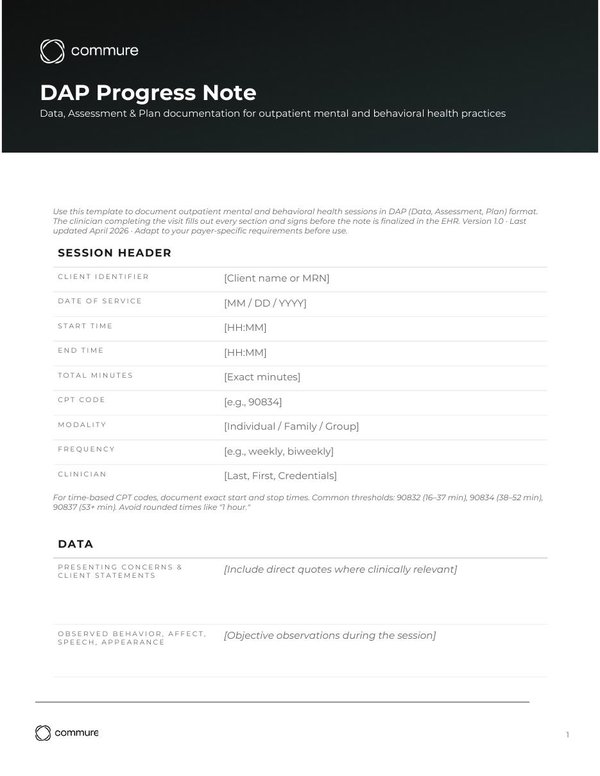
DAP note template (copy-ready for outpatient practices)
A reusable DAP note template gives an outpatient practice a shared structure for every session and cuts the per-note cognitive load for clinicians.
The template below aligns with key CMS documentation expectations and is designed to work in solo and group practices. Practices should adapt it to their payer-specific requirements before using it in production. Paste this DAP note into an EHR text field, save it as a smart-phrase, or use it as a document template. For practices that want a printable copy, save the rendered page as a PDF; this site does not host a separate dap note pdf download as a matter of UX choice.
DAP Note Template
Session Header
- Client identifier:
- Date of service:
- Start time / End time / Total minutes:
- CPT code:
- Modality (individual, family, group) / Frequency:
- Clinician name and credentials:
Data
- Presenting concerns and client statements (include direct quotes where clinically relevant):
- Observed behavior, affect, speech, appearance:
- Mental status elements relevant to diagnosis:
- Interventions used during the session:
Assessment
- Progress toward goals since last session:
- Current symptom severity or change:
- Risk evaluation (safety, suicidal or homicidal ideation, substance use risks if applicable):
- Current diagnostic impression and diagnostic code(s):
- Medical necessity statement (why continued treatment is indicated):
Plan
- Focus of next session:
- Specific interventions or modalities planned:
- Homework assigned:
- Next session frequency:
- Referrals or coordination steps:
Signature block
- Clinician signature, credentials, date
Two template design choices often help independent and group practices. First, keeping Assessment a separate field from Data can make the medical-necessity statement easier to locate during a payer audit. Second, including explicit fields for risk evaluation and diagnostic code can reduce the chance that a clinician skips them under time pressure. Payers do not mandate these specific structural choices; treat them as practice-level preferences that support audit readiness.
Many practices also save shortened smart-phrase versions for common clinical scenarios. Examples include a cognitive behavioral therapy (CBT) session for generalized anxiety or a medication-management follow-up. Each version comes with the Data, Assessment, and Plan fields pre-seeded with diagnosis-appropriate prompts.
What does a DAP note example look like in practice?
Two worked examples illustrate an appropriate level of detail for DAP notes that support clinical continuity and payer review. The first dap note example is a solo practitioner therapy session; the second dap notes example shows a prescriber-led visit in a group practice.
Example 1. Adult anxiety follow-up (solo practitioner)
Date: [date] | Start/End: 2:00 pm to 2:55 pm (55 minutes) | CPT: 90834 | Modality: Individual, weekly
Data: Client reported "another bad week" with three panic episodes since last session, each lasting about fifteen minutes. Client stated, "I'm still avoiding the freeway even though I want to drive to see my mom." Observed: alert, anxious affect, no acute distress, mood "anxious," speech normal, thought process linear, no SI/HI. Interventions used: psychoeducation on the panic cycle, a diaphragmatic breathing practice, and collaborative review of the exposure hierarchy.
Assessment: Diagnosis: Generalized Anxiety Disorder with panic features (F41.1). Symptom severity elevated from last session; avoidance behavior persisting. Client engaged well with exposure-hierarchy review and showed insight into avoidance patterns. Risk: no SI/HI, no self-harm. Medical necessity: continued outpatient psychotherapy indicated to reduce panic frequency and address persistent avoidance.
Plan: Next session focus on in-vivo exposure planning for freeway driving. Homework: daily diaphragmatic breathing log, one short drive on a surface street. Frequency: weekly. No referral needed at this time.
Clinician: Jane Doe, LCSW | Signed [date]
Example 2. Medication-management follow-up (group practice, PMHNP)
Date: [date] | Start/End: 10:15 am to 10:35 am (20 minutes) | CPT: 99213 plus 90833 add-on | Modality: Individual
Data: Client reported improved sleep onset since starting sertraline 50 mg four weeks ago. Client stated, "Mornings are still hard, but I'm not lying awake anymore." No reported side effects. PHQ-9 score 11, down from 17 at intake. Observed: mild psychomotor slowing, affect constricted, mood "a little better," thought process linear.
Assessment: Diagnosis: Major Depressive Disorder, moderate (F33.1). Partial response to sertraline at four weeks. Risk: passive SI endorsed at intake has resolved, no current SI/HI. Medical necessity: continued medication management indicated given partial response and ongoing mood symptoms.
Plan: Increase sertraline to 75 mg daily. Continue weekly psychotherapy with the group's staff therapist. Return visit in four weeks. Patient Health Questionnaire-9 (PHQ-9) at next visit.
Clinician: Alex Patel, PMHNP-BC | Signed [date]
DAP vs SOAP: which progress note format should your practice use?
Choosing between DAP and SOAP depends on the clinical context. In group practices it also depends on whether all clinicians can commit to the same format for peer review and audit.
DAP uses three sections: Data, Assessment, Plan. Data blends subjective and objective information in one section. This fits narrative therapy work where a client's words and the clinician's observations often overlap in the same sentence.
SOAP uses four sections: Subjective, Objective, Assessment, Plan. It separates client-reported information (Subjective) from clinician-observed data (Objective), which fits prescriber-led visits in primary care, psychiatry, and general medicine. SOAP also matches the structure of many EHR templates designed for medical rather than behavioral documentation. For a deeper dive on SOAP structure, see our SOAP notes guide.
A practical way to choose is by who is writing the note and what the visit is for. Therapists and counselors doing session-based psychotherapy often find DAP cleaner because Subjective and Objective rarely come apart during a 50-minute talk session. Prescribers and medical clinicians usually prefer SOAP because labs, vitals, and medication-related objective findings sit naturally in their own section.
For independent and group practices, accreditor and audit guidance generally favors consistency across clinicians over any specific note format. A mid-size group that writes a mix of DAP and SOAP notes makes peer review and internal audits harder. The inconsistency particularly affects clinical directors reviewing documentation quality across providers. A single documented house format often works better than leaving the choice to the individual clinician. Many groups use DAP notes for therapy sessions and SOAP notes for prescriber visits.
What makes a DAP note audit-ready?
An audit-ready DAP note carries specific documentation elements that align with HIPAA, CMS, and accreditor expectations. Audit readiness ultimately depends on payer-specific, state-specific, and accreditor-specific requirements as well as internal policy, so this template is a starting point rather than a comprehensive coverage guarantee.
HIPAA distinguishes psychotherapy notes from the progress record. Under Department of Health and Human Services (HHS) guidance, psychotherapy notes are the clinician's private process notes about a session, kept separate from the rest of the medical record. A standard DAP progress note is not a psychotherapy note and belongs in the designated record set.4 Keep the distinction explicit in practice policy so staff know that psychotherapy notes, not standard DAP progress notes, require separate storage and a patient authorization specific to psychotherapy notes before disclosure, subject to limited regulatory exceptions. To train staff on that line, a guide to writing therapy notes explains how progress notes differ from psychotherapy notes and includes four worked examples by session type.
CMS establishes medical-necessity documentation standards. Medicare guidance lists expected elements for progress notes in outpatient psychiatry and psychology services. Notes should summarize, in the aggregate, diagnosis, symptoms, functional status, mental status, treatment plan, and progress to date.2 DAP notes that skip these elements create audit risk. Medicaid documentation guidance sets a parallel expectation for behavioral health practitioners billing Medicaid.3 Because progress notes sit in the designated record set, patients also have a right under the 21st Century Cures Act information-blocking rule to access them electronically, so write them with that visibility in mind.11
Accreditation bodies add completeness and authentication requirements. Joint Commission standards for behavioral health require records to be complete and organized for timely review. Records must also be authenticated within the organization's defined timeframe.5 Late or unsigned DAP notes can generate accreditation findings even when the content is otherwise correct.
Federal research identifies documentation burden as a driver of error and burnout. AHRQ research identifies after-hours EHR work and note-composition time among the dimensions of documentation burden it measures.6 One ambient AI scribe study in JAMA Network Open reported about 20.4% less time in notes per appointment, with substantial reductions in after-hours documentation time also observed.7 These results come from clinician-experience evaluations in ambulatory settings. Reduced documentation burden may make it easier for clinicians to complete audit-ready DAP notes at current workloads. For a ranked breakdown by practice size and specialty, see the best AI medical scribes guide. For therapy-focused practices, compare AI therapy notes tools on HIPAA compliance and on whether each one was built for behavioral health documentation.
How Commure Scribe supports DAP-ready documentation
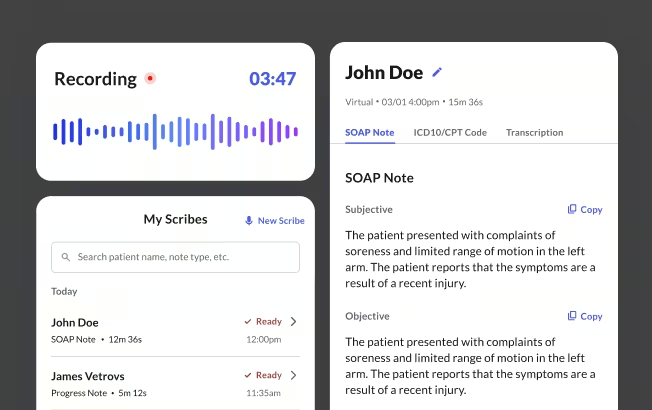
Commure Scribe is an ambient AI medical scribe built for outpatient practices in mental and behavioral health, primary care, and other ambulatory specialties. It listens to the patient encounter and produces a draft structured to your practice's chosen format, including DAP notes. The clinician reviews and finalizes the note inside the EHR workflow.
The workflow follows three steps: Capture, Edit, and Finalize. During Capture, the encounter audio is processed in real time. During Edit, Commure Scribe presents a structured draft with sections aligned to the chosen note format. The clinician reviews, adjusts, and signs the note during Finalize.
Compliance-aware DAP drafts. Commure Scribe is designed to help clinicians capture key elements that CMS guidance highlights for outpatient mental and behavioral health progress notes. Examples include session timing, observable mental status references, a medical-necessity statement in the Assessment section, and the next-session plan. Suggested ICD-10 and CPT codes appear in a separate tab so the clinician can confirm code selection before signing. Suggested codes do not auto-populate the DAP note, and the clinician remains responsible for the final note's completeness and accuracy.
EHR integration that fits independent and group practices. Commure Scribe supports integrations with leading outpatient EHRs commonly used in mental and behavioral health practices. The list includes leading EHRs like Kipu, SimplePractice, AdvancedMD, Cerbo, eClinicalWorks, and athenahealth.
The DAP note flows back into the structured fields the practice already uses for billing and audit retrieval.
Scope across practice sizes. In many supported EHRs, solo clinicians can get started with minimal IT involvement; deployment requirements vary by EHR and organizational policy. Commure Scribe also supports multi-provider configurations that small and mid-size group practices can use to streamline peer review and audit preparation. The Admin Copilot helps with documentation tasks generated from the encounter, such as drafting referral letters or after-visit summaries that the clinician reviews before sending.
DIsclaimer
Using this template and Commure Scribe does not guarantee compliance or audit success. Practices remain responsible for aligning documentation with their specific payers, regulators, and accrediting bodies.
DAP Notes Template Download
Download a copy of this template
Thanks! Your DAP notes template is ready.
Click below to download.

Sources
- Centers for Medicare & Medicaid Services. Complying with Medical Record Documentation Requirements. MLN Fact Sheet 909160. https://www.cms.gov/files/mln909160-complying-with-medical-record-documentation-requirements.pdf
- Centers for Medicare & Medicaid Services. LCD L34353: Outpatient Psychiatry and Psychology Services. https://www.cms.gov/medicare-coverage-database/view/lcd.aspx?lcdid=34353&ver=34&
- Centers for Medicare & Medicaid Services / Medicaid Integrity Group. Medicaid Documentation for Behavioral Health Practitioners. https://www.cms.gov/medicare-medicaid-coordination/fraud-prevention/medicaid-integrity-education/downloads/docmatters-behavioralhealth-factsheet.pdf
- U.S. Department of Health and Human Services. HIPAA Privacy Rule and Sharing Information Related to Mental Health. https://www.hhs.gov/sites/default/files/hipaa-privacy-rule-and-sharing-info-related-to-mental-health.pdf
- The Joint Commission. Do the standards specify the time frame for authentication of documentation? https://www.jointcommission.org/en-us/knowledge-library/support-center/standards-interpretation/standards-faqs/000001691
- Agency for Healthcare Research and Quality. Research Protocol: Documentation Burden. Content last reviewed September 2023. Effective Health Care Program, Agency for Healthcare Research and Quality, Rockville, MD. https://effectivehealthcare.ahrq.gov/products/documentation-burden/protocol
- Duggan MJ, Gervase J, Schoenbaum A, et al. Clinician Experiences With Ambient Scribe Technology to Assist With Documentation Burden and Efficiency. JAMA Network Open. 2025;8(2):e2460637. doi:10.1001/jamanetworkopen.2024.60637
- Tierney AA, Gayre G, Hoberman B, et al. Ambient Artificial Intelligence Scribes to Alleviate the Burden of Clinical Documentation. NEJM Catalyst. 2024. https://catalyst.nejm.org/doi/full/10.1056/CAT.23.0404
- Olson KD, Meeker D, Troup M, et al. Use of Ambient AI Scribes to Reduce Administrative Burden and Professional Burnout. JAMA Network Open. 2025;8(10):e2534976. doi:10.1001/jamanetworkopen.2025.34976. https://pmc.ncbi.nlm.nih.gov/articles/PMC12492056/
- Substance Abuse and Mental Health Services Administration. Certified Community Behavioral Health Clinic Certification Criteria. 2023. https://www.samhsa.gov/sites/default/files/ccbhc-criteria-2023.pdf
- Office of the National Coordinator for Health Information Technology. ONC's Cures Act Final Rule. HealthIT.gov. https://www.healthit.gov/curesrule/