



What Is a Medical Scribe? Roles, Types, and AI Alternatives Explained
From in-person scribes to AI ambient documentation: what the role does, who fills it, and how to choose the right model for your practice.
Written by the Commure Scribe Team
Published: May 1, 2026
•
11 min read
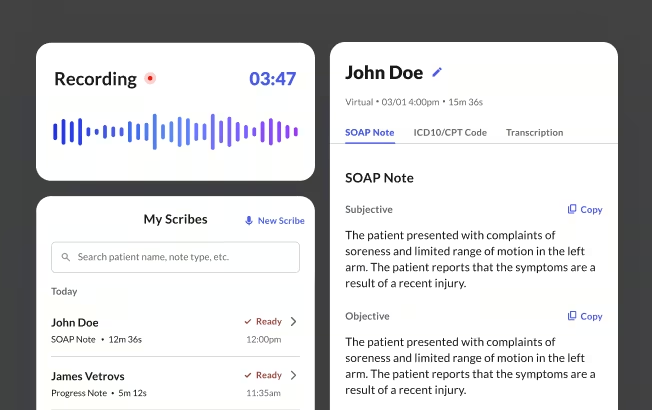
A medical scribe is a trained documentation specialist who records the clinical visit in real time. The scribe enters a structured note into the electronic health record (EHR). The physician then reviews and signs it. Scribes document the history of present illness, review of systems, exam findings, assessment and plan. Of the three scribe models, in-person scribes sit in the exam room and virtual scribes join from off-site. AI scribes generate the note from ambient audio.
What you need to know about medical scribes
- A medical scribe documents the clinical encounter in real time, so the physician can stay present with the patient instead of charting.
- Three types exist: in-person, virtual, and AI-powered. Each has a different cost structure and workflow fit.
- In 2024, 22.5% of physicians spent more than 8 hours per week on after-hours EHR work, up from 20.9% the year before.3
If you have ever finished a patient visit and immediately reached for your keyboard, you already understand what a medical scribe is solving. A medical scribe handles clinical documentation in real time, capturing what was said during the encounter so the physician does not have to reconstruct it from memory at 9pm. This guide covers the definition of a medical scribe, the types available in 2026, the specific duties they perform, and how AI has changed the model for solo and group practices.
What does a medical scribe actually do?
A medical scribe is a trained documentation specialist who transcribes the clinical encounter in real time and enters structured information into the electronic health record. The scribe follows the physician through each visit, or listens remotely, and translates the conversation into a compliant clinical note.
Scribes document the history of present illness (HPI), review of systems (ROS), physical examination findings, assessment, plan, and, where applicable, medication orders and procedure notes. The physician sees the same patients, makes the same clinical decisions, and signs the note.
What scribes do not do: make clinical decisions, interpret diagnostic results, or modify a note without direction. The physician reviews and finalizes every entry. Scribes operate as documentation support, not clinical staff.
What tasks does a scribe handle in a typical visit?
The following tasks fall to the scribe in a standard encounter.
- History of present illness (HPI): onset, duration, quality, severity, location, context, modifying factors, and associated signs and symptoms
- Review of systems (ROS): systematic inquiry across relevant body systems
- Physical examination: findings as dictated or spoken by the physician
- Assessment and plan: diagnosis, differentials, treatment decisions, referrals, and follow-up
- Order documentation: labs, imaging, prescriptions, and referral paperwork
- After-visit summary and patient instructions where applicable
Who works as a medical scribe, and how do you become one?
About one in three medical students had prior scribe experience before starting medical school, according to a peer-reviewed study of 333 students at one US medical school.1 The role gives pre-health students direct exposure to clinical decision-making, medical terminology, and real patient encounters. A 2018 study published in the Journal of General Internal Medicine found that applicants with scribe experience had a higher acceptance rate into medical school.
Requirements are minimal. Most positions need a high school diploma, working knowledge of medical terminology, and a typing speed fast enough to keep pace with a clinical visit. Employers typically provide paid training, which runs four to eight weeks depending on the setting and specialty.
Pay is typically hourly and entry-level, reflecting the role as a stepping stone. Most scribes work less than one year before moving on to health professional programs or other healthcare roles.
Career paths go in two directions: toward medical or PA school, or toward healthcare administration and health information management.
Why do physicians need a scribe in the first place?
EHR documentation now rivals patient care in time cost. Primary care physicians spend about 36 minutes in the EHR for every scheduled 30-minute visit, including more than 6 minutes of after-hours work per encounter, according to a 2024 cross-sectional study of 307 primary care physicians across 31 practices.4
After-hours charting has not improved. In 2024, 22.5% of physicians reported spending more than 8 hours per week on EHR tasks outside normal work hours, up from 20.9% the year before.3 On Reddit, physicians in communities like r/FamilyMedicine describe finishing notes at 10pm, carrying backlogs of 80 or more, and charting on weekends to stay current.
The burden falls hardest where there is no dedicated staff to absorb it. A solo physician or small group handles the charting overflow personally, with no documentation coordinator or administrative backup to share the load.
What are the three types of medical scribes?
Each model handles documentation differently in terms of cost, workflow, and how the physician interacts with the process.
In-person scribes
In-person scribes sit in the exam room and type notes directly into the EHR as the visit unfolds. The scribe listens to the physician-patient conversation and documents the HPI, ROS, physical exam findings, and plan in real time. The completed note is ready for physician review and sign-off within minutes of the encounter. This model is common in emergency departments and high-volume outpatient settings. The cost is fixed: salary, benefits, and workspace, plus the operational burden of recruiting and replacing scribes when they leave for health professional programs. Emergency departments weighing that expense can compare emergency scribes with AI alternatives on role, cost, and coverage gaps.
Virtual scribes
Virtual scribes connect remotely via a live audio or video feed and document the encounter from an offsite location, entering notes into the EHR in real time. The workflow mirrors in-person scribing from the physician's perspective: the scribe listens, documents, and has the note ready for review at visit end. Remote delivery lowers cost relative to in-person and removes the need for additional exam room space. Audio quality and connection stability are the main variables that affect accuracy.
AI scribes (ambient documentation)
AI medical scribes use ambient microphones and language models to listen to the encounter, identify clinically relevant content, and generate a structured Subjective, Objective, Assessment, Plan (SOAP) note when the recording ends. No one types during the visit. The workflow has three steps: record, edit, and finish. The software captures the session. The AI generates a structured note for the clinician to review and adjust. The clinician approves the note before it enters any record. The note is generated from the conversation, not a template. The AI maps spoken clinical language to the correct sections of the note, so the output reflects what was actually said in the room.
Any AI scribe handling protected health information must operate under a signed Business Associate Agreement (BAA), and audio should be stored on encrypted servers that do not use recordings for AI training. A 2025 randomized controlled trial comparing two AI scribes found both reduced per-note documentation time, with one product outperforming the other in note completeness.5 Clinician editing is still needed after every note. The clinician can stay present in the room during the visit, paying attention to the patient instead of the screen.
Where is the medical scribe role heading?
AI scribes now account for roughly 30% of physician practices in the US, according to a 2025 policy brief published in npj Digital Medicine by researchers at Columbia University.6 Industry estimates suggest venture funding for ambient scribe companies doubled from $390 million in 2023 to $800 million in 2024, a pace described as among the fastest technology adoption curves in healthcare history.
Adoption is not limited to large systems or younger physicians. In a TPMG analysis of 7,260 physicians, there was no correlation between a physician's age and likelihood of adopting AI scribes. The average user was approximately 47 years old. A 2025 multicenter quality improvement study of 263 ambulatory clinicians across 6 health systems found burnout dropped from 51.9% to 38.8% after 30 days of ambient AI scribe use, with improvements in cognitive task load and after-hours documentation time.2 When a physician is not typing during the visit, the conversation runs differently. Follow-up questions get asked. The therapeutic relationship benefits from the physician's attention being in the room rather than on the keyboard.
The role of the human medical scribe is changing, not disappearing. Demand for in-person scribes in high-volume settings remains. Virtual scribes have grown as a lower-cost model. AI scribes are increasingly the entry point, with human scribes retained for complex encounters, QA oversight, or settings where ambient recording is not appropriate.
Open questions remain. Researchers at Columbia noted in 2025 that adoption is outpacing clinical validation.6 A replicated finding across multiple tools shows that AI-generated notes tend to be longer than manually written ones, which can add review burden rather than reduce it. Accuracy varies by vendor, specialty, and encounter complexity.
What should you look for when evaluating an AI medical scribe?
With roughly 60 products in the market as of 2025, the differences between tools matter more than the category claim. These are the variables that affect whether an AI scribe actually reduces documentation time in your specific practice.
- EHR integration level: copy-paste into any web-based EHR, or one-click sync with your specific system? The note needs to land in the chart without extra steps.
- HIPAA compliance: does the vendor sign a BAA? Is audio stored on encrypted servers and excluded from AI training?
- Editing load: how much correction does the average note require? Ask for data from practices in your specialty, not general averages.
- Language support: if your practice sees non-English-speaking patients, verify both language coverage and accuracy in those specific languages.
- Accuracy error profile: AI scribes produce different error types than human scribes. Ask how the tool handles omissions and ambiguous clinical language.
- Trial terms: can you test on real encounters before committing? A 7-day trial on actual patient visits tells you more than a demo.
How Commure Scribe measures up
Commure Scribe is an ambient AI medical scribe for independent and group practices. The workflow is Capture, Edit, and Finalize. The physician starts a recording at the beginning of the encounter. Commure Scribe identifies clinical content and generates a structured SOAP note when the recording ends. The physician reviews, edits as needed, and finalizes before anything posts.
After clicking End Recording, a structured note appears in seconds: HPI, ROS, physical exam, assessment, and plan. Suggested ICD-10 and CPT codes appear in a separate tab for review. Commure Scribe supports 90 languages with automatic detection, and 90% of providers report reduced clinical documentation time and digital fatigue.
Commure Scribe integrates with 60+ EHRs, including AdvancedMD, eClinicalWorks, Athenahealth, Elation, SimplePractice, WebPT, Practice Fusion, Tebra, Cerbo, and Kipu. Independent clinicians and small practices use copy/paste. Medium and large group practices can access one-click sync.
A 7-day free trial is available, and no credit card required. Pricing for is available here.
The bottom line on what a medical scribe does
A medical scribe, whether human or AI, exists to close the gap between what happens in the exam room and what ends up in the chart. The version of the medical scribe role that made sense in 2015 has been substantially replaced by ambient AI tools that generate structured notes from the conversation itself.
The evidence on AI scribes is real but varied. Studies at large health systems show consistent reductions in after-hours charting and clinician burnout. The relevant question for any practice is whether the tool works with your EHR, handles your specialty, and reduces the specific hours you are currently spending on documentation after the clinic day ends.
Frequently Asked Questions
No. A transcriptionist converts recorded audio into typed text after the fact. A medical scribe works in real time, either during the encounter or immediately after, and produces a structured clinical note in the correct format for the EHR. AI scribes automate this process but still require physician review before the note is finalized. The distinction matters for compliance: a transcription is a raw record; a medical scribe produces a legal clinical document.
In-person medical scribes in the US typically earn in the mid-teens to low-twenties per hour, plus benefits and overhead, translating to tens of thousands of dollars annually for a full-time position. AI scribes for individual providers scale by provider count rather than patient volume, and may cost less for practices that cannot support a full-time scribe salary.
It depends on the tool, the encounter type, and the recording conditions. Among the first randomized trials on ambient AI scribes identified in major databases, the available RCT evidence found real but modest per-note time savings, not elimination of editing.5 Expect a few minutes of review and correction per note, particularly for complex or multi-problem encounters.
Sources
- Hewlett, W. H., Woleben, C. M., Alford, J., Santen, S. A., Buckley, P., & Feldman, M. (2020). Impact of scribe experience on undergraduate medical education. Medical Science Educator, 30(4), 1363-1366. https://doi.org/10.1007/s40670-020-01055-3
- Olson, K. D., Meeker, D., Troup, M., Barker, T. D., Nguyen, V. H., Manders, J. B., Stults, C. D., Jones, V. G., Shah, S. D., Shah, T., & Schwamm, L. H. (2025). Use of ambient AI scribes to reduce administrative burden and professional burnout. JAMA Network Open, 8(10), e2534976. https://doi.org/10.1001/jamanetworkopen.2025.34976
- American Medical Association. (2024, December 31). Doctors work fewer hours, but the EHR still follows them home. https://www.ama-assn.org/practice-management/physician-health/doctors-work-fewer-hours-ehr-still-follows-them-home
- Holmgren, A. J., Hendrix, N., Maisel, N., Everson, J., Bazemore, A., Rotenstein, L., Phillips, R. L., & Adler-Milstein, J. (2024). Electronic health record usability, satisfaction, and burnout for family physicians. JAMA Network Open, 7(8), e2426956. https://doi.org/10.1001/jamanetworkopen.2024.26956
- Lukac, P. J., Turner, W., Vangala, S., Chin, A. T., Khalili, J., Shih, Y.-C. T., Sarkisian, C., Cheng, E. M., & Mafi, J. N. (2025). Ambient AI scribes in clinical practice: A randomized trial. NEJM AI, 2(12), aioa2501000. https://doi.org/10.1056/aioa2501000
- Topaz, M., Peltonen, L. M., & Zhang, Z. (2025). Beyond human ears: Navigating the uncharted risks of AI scribes in clinical practice. npj Digital Medicine, 8, 569. https://doi.org/10.1038/s41746-025-01895-6
.jpeg)
.jpeg)
.jpeg)
.jpeg)



.jpeg)
.jpeg)