



AI Scribes vs. Medical Scribes: Which Actually Fixes Your Documentation Problem?
A side-by-side look at cost, accuracy, scalability, and workflow fit for outpatient practices of every size.
Written by the Commure Scribe Team
Published: March 25, 2026
•
8 min read
Updated March 25, 2026
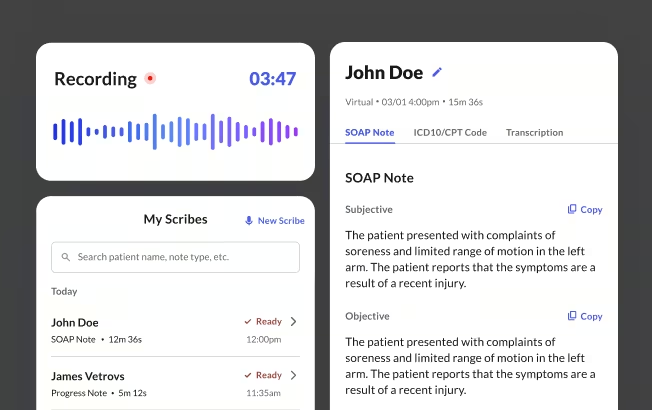
An AI scribe is software that listens to the visit, drafts a structured note and suggests billing codes. Practices pay a flat monthly fee per provider. A medical scribe is a person who documents the visit in real time, with costs that scale with headcount. An AI scribe fits practices whose main pain is after-hours charting or inconsistent notes across providers. A human scribe fits encounters that need real-time clarification or hands-on procedural support, and a hybrid approach can cover both.
Why AI scribes and medical scribes both exist and why the choice matters
Documentation is the biggest administrative burden in outpatient medicine. Multiple studies show that documentation and EHR work, especially work done outside of clinic hours, are major drivers of physician burnout.¹˒⁵ The tools clinicians use force them to split focus between the patient and the screen.
An internist with a full schedule finishes the last visit at five and opens the EHR after dinner. A practice manager watches charting delays turn into coding backlogs and denied claims. Documentation burden is a structural problem with how clinical data moves from the visit to the chart.
Where medical scribes fall short compared to AI scribes
Physicians prefer human scribes most for complex encounters where multiple problems or evolving plans need to be captured in real time.⁵ A trained scribe can ask questions, track tasks, and adjust the note mid-visit, something AI scribes do not yet do.⁸ Experienced scribes pick up on body language, tone, and room dynamics, and learn to match the clinician's style over time.⁵˒⁸
The problem is everything around the visit. Hiring, training, and keeping scribes adds weight, especially for practices without HR staff. Scribes leave for medical school, grad programs, or better pay. Each exit means a new ramp-up and weeks of lower note quality. For a practice without deep bench strength, one departure can leave a gap with no backup. A virtual medical scribe works remotely, live or asynchronously, which removes the in-room seat but still leaves a human role to hire and retain.
Scaling makes it worse. A multi-site practice needs consistent notes across locations, specialties, and visit types. Human scribes vary in skill and style. Keeping output consistent takes oversight and time. A safety study found that well-supervised scribes reduce documentation errors,⁹ but that supervision is itself a cost. Studies of ambient AI scribes show significant reductions in documentation time, including cuts in after-hours charting and measurable time saved per visit.²˒⁶
What a high-functioning AI scribe vs. medical scribe workflow looks like
Most clinicians write notes in stages. Before the visit, they review old charts and lab results. During the visit, they type into the EHR while talking to the patient. Afterward, they fill in details about the exam and treatment plan. The day ends with signing notes and checking billing codes. When there is too much work, clinicians log in from home at night to finish charts.
An AI scribe changes this sequence. The clinician can put down the computer and listen to the patient. The AI records in the background and pulls clinical content from multiple speakers. The clinician checks the output and edits where needed. The day ends with a finished note and suggested billing codes. A 2025 study in PMC found that ambient AI scribes improve note structure and completeness compared with dictation or manual entry.³
How do AI scribes and medical scribes compare on cost, accuracy, and scalability?
The choice between an AI scribe and a human one depends on what a practice needs most. A 2025 study comparing ambient AI and human scribes in outpatient care found that clinicians reported similar or better satisfaction with AI for documentation support.⁶ Some clinicians still prefer a human scribe for complex visits or hands-on task support. AI scribes offer a steady cost and work the same way every time, regardless of how many providers a practice has.
The comparison below is based on internal modeling and publicly available pricing. It is meant as a directional framework only, not a substitute for a detailed quote from each vendor.
For many practices, cost is the deciding factor. For practices with multiple providers or locations, the consistency and zero-turnover gains add up.
Which should you choose?
- AI scribe fits best when your pain is after-hours charting, you need consistent output across providers, you lack HR staff to manage scribe hiring, or you want automated ICD-10/CPT coding built into the documentation workflow.
- Human scribe fits best when your encounters need real-time clinical clarification, physical task support during procedures, or complex documentation that ambient audio capture cannot cover.⁶
- A hybrid approach works when your practice handles a mix of routine visits and high-complexity encounters. AI covers the volume, a human scribe covers the exceptions.
How AI scribes like Commure Scribe stack up against medical scribes in practice
Commure Scribe is one example of the category. Tap Record. Run the visit. Tap End Recording. A structured Subjective, Objective, Assessment, Plan (SOAP) note appears in about 43 seconds with suggested ICD-10 and CPT codes for clinician review. It connects with commonly used EHRs including AdvancedMD, athenahealth,and eClinicalWorks. For a full vendor-by-vendor comparison, see our AI medical scribe guide.
How should your practice evaluate AI scribes vs. medical scribes?
A structured evaluation helps a practice compare options on its own terms.
- Name your top pain point. After-hours charting, note quality, coding accuracy, or staffing cost.
- Pick one clinician to pilot an AI scribe on real visits within the trial window.
- Compare the AI note against a manual note for the same visit type. Check completeness, plan detail, and coding.
- If notes are sign-ready with few edits, add providers across specialties.
- For multi-provider practices, test EHR integration depth and rollout governance before a full deployment.
Industry data suggests AI scribes are a growing strategy to cut after-hours charting, a trend that holds across primary care, psychiatry, and physical therapy.
Frequently Asked Questions
AI scribes handle most visit-based charting today. Human scribes still fill roles that need real-time support or complex procedural notes. For outpatient practices focused on visit notes and coding, AI covers the full workflow. The choice comes down to cost, staffing stability, and whether your needs are visit-based or procedural.
Accuracy varies by vendor, audio quality, and language mix. Look for a stated accuracy rate, multi-speaker support, and a review step before the note is final. Commure Scribe reports 99.4% accuracy across 90+ languages. The clinician always reviews and edits before the note reaches the chart.
Compliance depends on how the vendor handles audio, note storage, and third-party access. Ask whether audio is stored or deleted, where notes live, and whether the platform is SOC 2 certified. Commure Scribe is HIPAA compliant and SOC 2 certified with onshore storage, encrypted audio, and no third-party data sharing. Consult your own compliance counsel on consent requirements.
No single source counts every AI scribe user across all companies. Use is growing quickly since 2023 in primary care, other medical specialties, and allied health like physical therapy. One recent article estimates that AI scribes are now used in about 30% of physician practices, and some large health systems report thousands of clinicians using them in everyday care.
Three main risks stand out: errors the clinician misses in review, data privacy gaps from weak vendor security, and workflow disruption if the tool does not fit your EHR. Commure Scribe requires clinician review before any note is final. It is HIPAA compliant and SOC 2 certified. It integrates with named EHRs through copy/paste or one-click sync (Enterprise).
Integration depth ranges from copy-paste to native sync with specific EHRs. Ask whether the tool offers copy/paste, a direct write-back, or both. Commure Scribe offers copy/paste on all tiers. One-click EHR sync is available at the Enterprise tier for AdvancedMD, Athenahealth, eClinicalWorks, Elation, SimplePractice, Cerbo, WebPT, Practice Fusion, Tebra, and Kipu.
Sources
- American Medical Association. AI Scribes for Clinicians: How Ambient Listening in Medicine Works. AMA Digital Health, 2024. https://www.ama-assn.org/practice-management/digital-health/ai-scribes-clinicians-how-ambient-listening-medicine-works-and
- American Academy of Family Physicians. Artificial Intelligence Scribes Shape Health Care Delivery. American Family Physician, 2025. https://www.aafp.org/pubs/afp/issues/2025/0400/graham-center-artificial-intelligence-scribes.html
- PMC. The Impact of AI Scribes on Streamlining Clinical Documentation. PubMed Central, 2025. https://pmc.ncbi.nlm.nih.gov/articles/PMC12193156/
- PubMed. Ambient Artificial Intelligence Versus Human Scribes in Clinical Documentation. 2025. https://pubmed.ncbi.nlm.nih.gov/41251650/
- Olson, K. D., Meeker, D., Troup, M., et al. (2025). Use of ambient AI scribes to reduce administrative burden and professional burnout. JAMA Network Open, 8(10), e2534976. https://doi.org/10.1001/jamanetworkopen.2025.34976
- Topaz, M., Peltonen, L. M., & Zhang, Z. (2025). Beyond human ears: Navigating the uncharted risks of AI scribes in clinical practice. npj Digital Medicine, 8, 569. https://doi.org/10.1038/s41746-025-01895-6
.jpeg)
.jpeg)
.jpeg)
.jpeg)



.jpeg)