



Ambient Listening in Outpatient Clinics: A Practical Guide for Clinicians
A practical guide to ambient AI documentation for solo and group outpatient practices covering technology, workflow, compliance, and evaluation.
Written by the Commure Scribe Team
Published: April 10, 2026
•
13 min read
Updated April 10, 2026
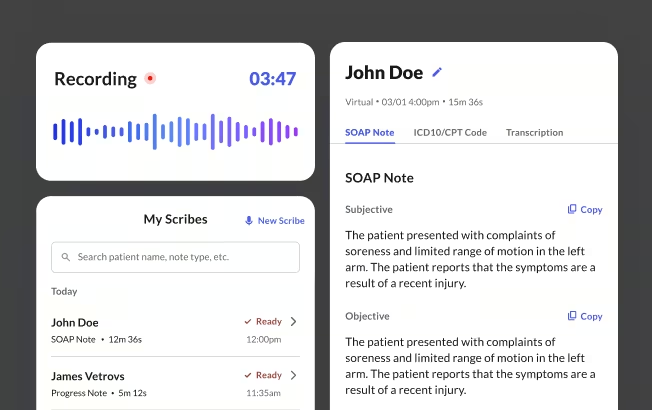
Ambient listening is AI that captures what the patient and clinician say during a visit, with no dictation or typing. From what they say, it drafts a structured clinical note. Speech recognition turns the audio into text, and speaker diarization separates who said what. A large language model then maps the content into a note format such as Subjective, Objective, Assessment, Plan (SOAP). The clinician reviews, edits and signs the draft before it enters the electronic health record (EHR).
What You Need to Know About Ambient Listening
- Ambient listening is AI that captures the patient-provider conversation and drafts a structured clinical note, which the clinician reviews and signs. Adoption turns on three things: how the note reaches the electronic health record (EHR), whether the vendor signs a business associate agreement (BAA), and how much editing the draft needs before signature.
- Studies show reduced after-hours charting and burnout. AI-generated notes run longer, not shorter. Review for redundancy, not just accuracy.
- HIPAA compliance requires a signed BAA, patient consent, and accurate documentation. Certification alone is not sufficient.
Most outpatient clinicians spend more time documenting than seeing patients. Primary care physicians average 36.2 minutes in the EHR for every scheduled 30-minute visit. 6.2 of those minutes fall after hours.1 By 2024, 22.5% of physicians logged more than eight hours per week on the EHR outside normal work hours. Burnout has edged lower, but charting burden has not.2
Ambient listening is the technology designed to change that ratio. This guide explains what it is, how it works, and what to evaluate before adopting it in a solo or group outpatient practice.
What Is Ambient Listening in Healthcare?
Ambient listening is AI that captures the patient-provider conversation in real time and generates a structured clinical note, with no dictation or typing during the visit. The clinician reviews the draft after the encounter, edits it, and finalizes it into the electronic health record (EHR). Ambient scribes including Commure Scribe, Abridge, Nabla and Suki all work this way. The differ in how the finished note reaches the chart.
Ambient listening refers to AI that passively captures the patient-provider conversation and generates a draft clinical note. The clinician does not dictate or type during the visit. They review the draft, edit as needed, and finalize it into the record.
The key distinction from earlier documentation tools: ambient listening does not require the clinician to stop and dictate. The conversation flows normally while the AI works in the background.
Older dictation systems required the clinician to pause, direct attention to the device, and verbally describe findings and plans. Templates required clicking through structured fields. Both pulled attention away from the patient. Ambient listening does not.
A 2026 study of 22 physicians found that 68% reported positive effects on patient engagement.3 Clinicians noted more eye contact and greater focus during visits. When the AI is capturing the visit, the clinician can stay present in the room.
How Does Ambient Listening Work?
Ambient listening uses three technologies working in sequence: automatic speech recognition converts the conversation to text, speaker diarization separates who said what, and a large language model maps that output into a structured clinical note. Each layer affects note quality in a distinct way.
Automatic speech recognition (ASR) converts audio to text in real time. Modern ASR systems are designed to handle medical terminology and overlapping speakers better than earlier medical dictation tools, though performance varies by recording environment.
Speaker diarization identifies who is speaking when, separating clinician statements from patient statements. The clinician's examination findings belong in the Objective section. The patient's reported symptoms belong in the Subjective section. When diarization misattributes speech, the error flows directly into the note structure.
Natural language processing (NLP) and large language models (LLMs) convert the raw transcript into a structured clinical note. The model interprets clinical meaning, maps findings to standard formats (SOAP, DAP, or custom templates), and generates an Assessment and Plan from what was discussed.
Modern LLM-based scribes have an error rate of about 1 to 3%.4 Older automated speech recognition tools ran 7 to 11%. LLM errors differ from word-level transcription mistakes. They include hallucinations (details not discussed), critical omissions, and context errors that are harder to catch on a rushed review. The clinician review step is not optional, even at high accuracy rates.
The workflow, in practice: obtain patient consent and open the recording interface. Let the visit proceed normally. End the recording, review the draft note, edit as needed, and paste or sync it into the EHR. Most tools deliver a draft within 30 to 90 seconds of the encounter ending.
What Are the Benefits of Ambient Listening for Clinicians?
The evidence on ambient AI scribes points to four consistent benefits: reduced after-hours charting, lower burnout, better patient engagement, and more complete plan sections. A note-length tradeoff accompanies all four. AI-generated notes run longer, and that carries its own documentation cost if notes are not reviewed for redundancy.
After-hours documentation time: A multicenter study of 263 clinicians across six health systems found burnout dropped from 51.9% to 38.8% after 30 days of ambient AI scribe use.5 That equals 74% lower odds of burnout. After-hours charting time fell significantly.
Documentation volume: The Permanente Medical Group analyzed 7,260 physicians over 63 weeks and 2.5 million patient encounters.6 Total charting time savings came to 15,791 hours. High users saved 2.5 times more per note than occasional users.
Patient engagement: When the clinician can stay present in the room, the encounter changes. The patient speaks to someone paying attention rather than someone typing. For psychiatry and behavioral health, this matters especially: the therapeutic relationship stays intact when the provider is listening, not charting.
Patient satisfaction: A 2026 study of 49 providers over two years found ambient scribe use correlated with better scores across three validated Press Ganey domains.7
Note quality: AI-generated notes are longer than what clinicians typically write manually. Multiple studies find note length increasing even as charting time falls.8 Whether that length reflects more complete documentation or more redundant content depends on the visit and the clinician's review. The plan section in particular should be checked for completeness and for any inferred conclusions not explicitly discussed.
One consistent finding warrants attention: AI-generated notes are longer, not shorter.8 One analysis of 1.7 billion notes found length increased 8.1% even as time per note fell 11.1%.8 Notes in the top decile of length carry 39% more after-hours EHR time.9 Review each note for redundancy, not just accuracy.
How Does Ambient Listening Fit Into the Clinical Workflow?
Most ambient listening tools follow a three-phase workflow: Capture during the visit, Edit immediately after, and Finalize before the note enters the chart. Clinicians commonly report that post-visit review adds a few minutes per note, though this varies by encounter complexity and specialty.
Capture: Before the visit begins, inform the patient that AI will be used to assist with documentation and obtain verbal or written consent. Open the recording interface, confirm it is active, and proceed with the encounter as normal. Do not change your clinical approach.
Edit: After the encounter, review the draft note. Check the Subjective section for accuracy of the patient's reported history. Check the Assessment and Plan for completeness, including that diagnoses are correctly coded and the plan reflects what was discussed.
Finalize: Copy the note into the EHR or use a direct integration if available. Sign the note. The clinician is the author of record.
How Does Ambient Listening Work Across Specialties?
Ambient listening is in active use across many common outpatient specialties. The sections below describe how the technology is designed to work in each setting, and where clinicians should focus their review before signing notes.
Family medicine and internal medicine: Multi-problem visits are where ambient scribes are most commonly used in primary care in internal and family medicine. The tool is designed to track each problem as it comes up, map symptoms to the Subjective, exam findings to the Objective, and generate a plan entry for each issue. The main structural risk is consolidation: if the patient circles back to an earlier problem, the model may create a second entry rather than updating the first. Review the plan section to confirm each issue is addressed once.
Psychiatry and behavioral health: Ambient scribes are designed to capture the arc of a structured assessment, including presenting symptoms, mental status findings, and the treatment plan in psychiatry and behaviorial health. For structured formats such as an intake with a mental status examination (MSE) and risk assessment, the output is typically easier to review than for exploratory or therapy visits, where the model may infer clinical conclusions from what was discussed rather than deferring to the clinician's judgment. Confirm the plan section reflects what was agreed, not what the AI interpreted.
Pediatrics: Ambient scribes are designed to attribute speech to each speaker in a multi-person encounter. In a pediatric visit with a parent or caregiver present, the tool is intended to assign the parent's reported history to the Subjective and the clinician's findings to the Objective. Speaker attribution is one of the areas where performance varies most across tools and recording conditions. Test in live encounters with a caregiver in the room before committing. Confirm that developmental history and the reason for visit reflect the caregiver's account, not the child's.
OB-GYN: Prenatal visits and new OB intakes involve structured history-taking alongside physical examination. The tool is designed to capture obstetric history from the interview and map gestational age, prior pregnancies, and current symptoms to the Subjective. On complex visits, review the Subjective and Objective sections separately to confirm exam findings and reported history have not been placed in the same section.
Orthopedics and physical medicine: For standard clinic visits, ambient scribes are designed to capture the chief complaint, mechanism of injury, functional limitations, and plan. Post-operative visits and procedure notes have different format requirements than a standard SOAP note. Confirm whether the tool you are evaluating supports custom templates for these visit types, and set them up before going live.
Is Ambient Listening HIPAA Compliant?
There is no formal HIPAA certification. A vendor claiming to be HIPAA compliant is not the same as a vendor who has implemented the required safeguards. Whether a tool is compliant in practice depends on the BAA, how audio and note data are handled, where data is processed, and whether patient consent is obtained. A clinician who skips any of these steps carries the liability, not the vendor.
Ask these questions before signing any agreement.
- Does the vendor sign a Business Associate Agreement (BAA)? This is required for any vendor that handles PHI on your behalf. Do not proceed without one.
- Is audio stored or processed and discarded? The distinction is material. Some tools delete audio after the note is generated. Others retain it, encrypted, for variable periods. If audio is stored, confirm the retention period and your rights to request deletion.
- Where is data processed? US-based infrastructure under HIPAA jurisdiction is a baseline requirement for most practices. Confirm processing location, not just storage location.
- What is the breach notification timeline and process?
Patient consent
Patient consent is always recommended before using ambient listening in a clinical encounter. Most practices use a brief verbal disclosure at the start of the visit. A typical script looks something like this:
"I use an AI tool to help me document our visit today. It listens to our conversation so I can focus on you rather than typing. Do you have any questions or concerns about that?"
Have this language reviewed by your healthcare attorney before use. Some states require written consent or posted notice. Two-party consent states have additional requirements for audio recording.
Two 2025 lawsuits are relevant context here.10 Sharp HealthCare and Heartland Dental both faced claims that patients were not adequately informed of ambient recording. Plaintiffs also alleged AI-generated hallucinations appeared in records as factual documentation. The cases are unresolved. They reinforce that consent and clinician review are both required, not optional.
What Should Clinicians Evaluate Before Adopting an Ambient Listening Tool?
The six factors that matter most when evaluating an ambient scribe are accuracy in your actual clinical environment, note quality across a range of visit types, how the note gets into the chart, language support, data handling practices, and trial terms. Vendor demos typically show favorable conditions. A genuine evaluation tests the tool in the practice settings where it will actually be used.
Accuracy in your clinical environment: Demos are run in quiet conference rooms. Your exam rooms are not quiet. Test the tool in live patient encounters with ambient noise, multiple speakers, and complex multi-problem visits before committing.
Note quality, not just note speed: Time savings are measurable quickly. Note quality takes longer to evaluate. Review the Assessment and Plan section across a range of visit types before drawing conclusions. Look for hallucinated details, missing follow-up items, and misattributed history.
EHR integration specifics: Copy/paste into a web-based EHR is available on most tools. One-click sync is typically enterprise-tier. Confirm exactly how the note reaches your chart and whether it requires manual steps.
Language support: If your patient population includes non-English speakers, confirm which languages the tool supports and whether the output note is in English or the source language.
Data handling: Confirm the audio policy (stored or deleted after transcription) and review the BAA before the trial period ends.
Trial terms: A single demo session is not enough to evaluate note quality across real encounter types. Use the trial period across a range of visits before deciding.
Commure Scribe for Solo and Group Practices
Commure Scribe is one scribe alternative worth evaluating against the criteria above (for our full review of top options, read this guide). It generates a structured SOAP note in roughly 43 seconds after the encounter ends and suggests ICD-10 and CPT codes for review but as with any ambient scribe, the Assessment and Plan section warrants the closest scrutiny during your trial.
On accuracy, the tool reports 99.4% transcription accuracy with multi-speaker recognition and up to two hours of continuous recording per session. Test it in your actual exam rooms, not just a demo environment. For EHR integration, one-click sync is available for 60+ systems including athenahealth, eClinicalWorks, Elation, SimplePractice, and Tebra. Coppy-paste works on all tiers with any web-based EHR. The tool supports 90+ languages with automatic detection and runs across in-person and telehealth visits on any device.
Frequently Asked Questions
Dictation requires the clinician to pause and verbally describe findings, usually after the patient leaves or during the encounter. Ambient listening captures the conversation as it happens, without the clinician directing the recording or changing workflow.
Most web-based EHRs accept notes via copy/paste from any ambient scribe tool. Deeper integrations, including one-click sync and bidirectional data exchange, require API-level partnerships between the scribe vendor and the EHR. Epic, athenahealth, and eClinicalWorks are among the most commonly integrated systems. Confirm current integration status directly with any vendor before purchasing.
A tool can be HIPAA compliant and still present compliance risk if implemented incorrectly. A signed BAA, appropriate data handling, patient consent, and accurate documentation are all required. Certification alone is not sufficient.
A human scribe is physically present or works remotely via video, taking notes in real time. Human scribes handle contextual nuance well but require hiring, scheduling, and onboarding. AI scribes are available on demand, work across multiple rooms simultaneously, and do not require a staffing commitment. The tradeoff is that the clinician reviews and edits each draft before it enters the chart.
Sources
1. Rotenstein et al. JAMA Network Open. 2024. https://jamanetwork.com/journals/jamanetworkopen/fullarticle/2822959
2. American Medical Association Physician Burnout Report. 2024. https://www.ama-assn.org/practice-management/physician-health/doctors-work-fewer-hours-ehr-still-follows-them-home
3. Jen Van Tiem, Elizabeth Cramer, Christopher Iverson, Korey Kennelty, Noah Andrys, Julie Lee, Lindsey Knake, Jason Misurac, James Blum, Heather Schacht Reisinger, Listening to the note: clinician perspectives on ambient artificial intelligence scribes in medical documentation, Journal of the American Medical Informatics Association, Volume 33, Issue 2, February 2026, Pages 255–262, https://doi.org/10.1093/jamia/ocaf214
4. Topaz, M., Peltonen, L.M. & Zhang, Z. Beyond human ears: navigating the uncharted risks of AI scribes in clinical practice. npj Digit. Med. 8, 569 (2025). https://doi.org/10.1038/s41746-025-01895-6
5. Olson KD, Meeker D, Troup M, Barker TD, Nguyen VH, Manders JB, Stults CD, Jones VG, Shah SD, Shah T, Schwamm LH. Use of Ambient AI Scribes to Reduce Administrative Burden and Professional Burnout. JAMA Netw Open. 2025 Oct 1;8(10):e2534976. https://pubmed.ncbi.nlm.nih.gov/41037268/
6. The Permanente Medical Group. NEJM Catalyst. 2025. https://www.ama-assn.org/practice-management/digital-health/ai-scribes-save-15000-hours-and-restore-human-side-medicine
7. Davis E, Davis S, Haralambides K, Gleber C, Nicandri G. Ambient AI Documentation and Patient Satisfaction in Outpatient Care: Retrospective Pilot Study. JMIR AI 2026;5:e78830. https://ai.jmir.org/2026/1/e78830
8. Epic Research / Butler. AHIMA. 2023. https://journal.ahima.org/page/despite-clinical-documentation-changes-note-bloat-remains
9. Apathy NC, Rotenstein L, Bates DW, Holmgren AJ. Documentation dynamics: Note composition, burden, and physician efficiency. Health Serv Res. 2023;58(3):674-685. doi:10.1111/1475-6773.14097. https://onlinelibrary.wiley.com/doi/10.1111/1475-6773.14097
10. Reuters Legal / Practical Law. January 2026. https://www.reuters.com/legal/litigation/health-care-ambient-scribes-offer-promise-create-new-legal-frontiers--pracin-2026-01-23
.jpeg)
.jpeg)
.jpeg)



.jpeg)
.jpeg)