



Medical Transcription in 2026: Why AI Scribes Are Replacing Traditional Services
Comparing approaches to clinical documentation: traditional transcription services and ambient AI scribes
Written by the Commure Scribe Team
Published: March 25, 2026
•
8 min read
Updated March 25, 2026
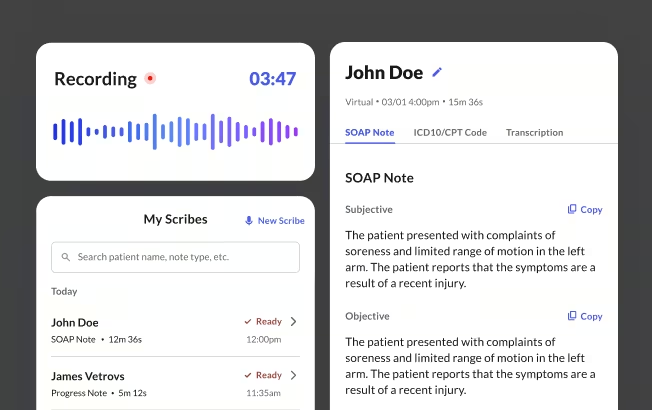
Medical transcription turns a clinician's recorded dictation into a typed document. Vendors typically return it in 24 to 48 hours. The file carries no billing codes and needs a manual EHR import. Ambient AI scribes capture the live visit and draft a structured note within seconds after the recording ends. A Columbia University study estimated roughly 30% of physician practices had adopted AI scribes by 2025. Operative, radiology and pathology reports remain better suited to dictation with human review.
What You Need to Know
- Traditional medical transcription converts dictation into a typed document, returned hours later with no billing codes and no direct EHR delivery. Ambient AI scribing captures the live visit and generates a structured note within seconds of the recording ending.
- The difference clinicians notice most is not speed. It is note quality. Many clinicians report that AI-generated plan and assessment sections feel more complete than notes written under time pressure.
- Research from RCTs and multi-system studies shows AI scribe users spend measurably less time on documentation, with some studies linking adoption to reduced burnout and increased revenue per physician.
What is medical transcription, and how has it changed?
Medical transcription is the process of converting spoken clinical dictation into a written document. For most of its history, a physician dictated after the patient left the room. A human transcriptionist received the audio file and typed the note. The completed document came back hours or days later. That workflow was built for paper charts and phone systems. It has not kept pace with same-day billing cycles, EHR workflows, or the documentation volume modern practices carry.
The category covers more report types than most clinicians realize. Traditional transcription handles a wide range of documents, including:
- Operative reports, which detail surgical procedures including preoperative and postoperative diagnoses, the surgical approach, instrument counts, and patient status after leaving the operating room
- Radiology reports, dictated by radiologists after imaging studies including X-rays, CT scans, MRI, and ultrasound
- Pathology reports, covering lab analysis of tissue samples and their diagnostic findings
- Discharge summaries, compiling the full record from admission through discharge
- Consultation reports, summarizing specialist findings for referring providers
- Office notes, including progress notes, chart notes, referral letters, and patient-facing documents from outpatient visits
The standard workflow has five steps. A provider dictates into a phone system, app, or digital recorder. The audio file transfers to a transcription service. A human transcriptionist, or an AI-assisted transcriptionist in hybrid services, converts the audio to text. A QA reviewer checks the output before delivery. The completed document goes back to the practice for import into the EHR.
Turnaround time is where traditional transcription shows its main constraint. Vendors typically advertise routine report delivery in 24 to 48 hours, with STAT requests at 2 to 4 hours at a higher rate. For operative notes and radiology reports, that lag is workable. For the outpatient progress note a clinician needs to close before leaving the building, it is not.
The category has split in two directions. One path is traditional transcription, which remains unchanged and still fits certain use cases well. The other is ambient AI scribing.
Adoption of AI scribing has shifted quickly. The American Medical Association (AMA) found roughly two-thirds of US physicians were using health AI in 2024. That is up 78% from 2023.¹ Health-system and academic reports suggest a growing share are using AI scribes specifically for documentation, with one Columbia University study estimating roughly 30% of physician practices had adopted AI scribes by 2025.⁴
The underlying documentation burden has not changed, regardless of tool. Studies suggest physicians can spend around two hours on documentation for every hour of direct patient care.³ More recent data shows EHR time has stayed high or increased slightly since 2020..³
When is traditional transcription still the right tool?
Not every documentation task is a good fit for ambient AI. Two report types remain better suited to traditional transcription. Practices that handle high volumes of either should factor this into their evaluation.
Operative reports require detail that ambient AI cannot fully capture on its own. The AI records what is spoken. In an operating room, the surgeon must speak critical details aloud for any ambient tool to capture them. This includes instrument counts, sponge counts, blood loss estimates, and real-time findings. A peer-reviewed surgical review notes that procedural findings must be spoken aloud to be recorded by AI. For operative documentation, dictation with human transcription review remains the more reliable approach.¹¹
Radiology and pathology reports involve structured technical findings with no ambient patient conversation to capture. A radiologist reviewing imaging and dictating findings is already in a dictation workflow. There is no encounter to listen to. Clinicians who stay in a dictation workflow can compare medical dictation software on accuracy, EHR integration, coding support, and price.
Why do so many physicians still feel buried in charts even when they use transcription tools?
The documentation burden has not disappeared. It has shifted later in the day. Clinicians frequently describe finishing notes long after clinic ends. The AMA calls this pattern "pajama-time charting."⁵
AMA data shows 20.9% of physicians spend more than eight hours per week on documentation outside clinic hours.⁵ A 2024 AMA report found physicians averaged a 57.8-hour workweek. Of that, 13 hours went to indirect care: orders, documentation, test review, and referrals.
Traditional transcription creates two rounds of work, not one. The workflow looks like this:
- The clinician dictates at the end of the visit or end of the day
- The typed note comes back hours later
- The clinician reviews every line for errors
- They reformat sections that do not match the EHR template
- They manually insert the content into the correct fields
When accuracy is poor, the review step erases most of the time saved.
Traditional transcription was built for a world where the note could wait a day. Most practices cannot absorb that lag in billing, denial management, or clinical continuity.
One multi-system study linked ambient AI to a 21% drop in burnout at Mass General Brigham. At Emory, wellbeing improved by 31%. The burnout and wellbeing improvements cited here come from studies of ambient documentation, not traditional transcription.⁶
What is the difference between medical transcription and an AI medical scribe?
Medical transcription converts recorded dictation into text. An AI medical scribe captures the live encounter and produces a structured clinical note automatically. These are different tools solving different problems.
The comparison below is based on internal modeling and publicly available information. It is meant as a directional framework only, not a substitute for a detailed evaluation of each service.
Research supports the shift. A randomized trial from UCLA in NEJM AI found ambient AI scribe users spent 9.5% less time on notes than a control group.⁷ That is among the first RCT evidence of a measurable documentation time reduction. A UChicago Medicine study found AI scribe users had 8.5% less total EHR time and more than 15% less time on note-writing.⁸
The difference clinicians notice most is not speed. It is note quality. Many clinicians report high satisfaction with AI-generated plan sections, particularly around structure and completeness.
How does AI-powered medical transcription work in a real clinic visit?
Ambient AI scribes are built to fit into the visit without adding steps. The clinician opens an app on any device and starts recording when the patient enters. From that point, the clinician can stay present in the room, eye contact instead of a keyboard, listening instead of typing. The system handles the rest in real time. Most tools support automatic language detection and multi-speaker recognition.
Leading products support sessions long enough to cover extended consultations and behavioral health visits without interruption. Commure Scribe captures up to two hours of continuous audio per session with automatic detection across 90-plus languages.
The note generates the moment the visit ends. When the clinician stops recording, the AI creates a structured clinical note within seconds. Many ambient AI scribes output structured formats such as SOAP or DAP, with sections already organized.
The plan and assessment sections are where clinicians most often notice a difference. Many report that the AI captures clinical details they might have compressed under time pressure. This is the moment clinicians describe as "the AI caught things I would have missed." Commure Scribe populates ICD-10 and CPT codes on paid tiers. The clinician reviews and signs off before the note enters the chart.
Every ambient AI scribe should require clinician review before a note enters the chart.
The standard workflow:
- Capture the encounter
- Generate a draft note
- Clinician edits and signs off
Some tools retain recordings for model training or quality review. Others discard them right away. Commure Scribe retains audio in encrypted storage for compliance purposes, with access limited to trained staff. Notes are stored with no third-party data sharing.
Ambient AI scribes can also adapt to how a clinician documents over time. Most tools offer specialty-specific templates as a starting point. More advanced tools track phrasing patterns and adjust outputs to match how a clinician writes. Commure Scribe offers specialty-specific templates for Family Medicine, Internal Medicine, Psychiatry, Pediatrics, Behavioral Health, Dentistry, and Physical Therapy.
Some ambient AI scribes go beyond the clinical note to handle administrative work from the same encounter. From a single recorded visit, certain tools can produce:
- Patient-facing documents such as appointment summaries, care instructions, and work excuse letters
- Referral letters drafted from the encounter content
- Prior authorization requests without requiring the clinician to dictate separately
Commure Scribe's AI Copilot generates patient emails, work excuse letters, and prior auth requests from the same recording. For a busy clinician, that means leaving the building with charts closed and prior auths drafted. For a clinical director managing a group, it means consistent note structure across all providers.
Patients notice the difference too. At The Permanente Medical Group, 47% of patients said their doctor spent less time on the computer.⁹
What should smaller and larger medical practices look for differently when evaluating medical speech recognition software?
The right criteria depend on who owns the problem and who approves the solution. In a smaller practice, the clinician is often the buyer, the champion, and the main user. In a larger group, the clinician champion also needs to convince the administrator who controls software spend.
For smaller practices and independent clinicians, focus on:
- Note quality first. Does the generated plan section capture clinical detail more completely than your manual notes?
- Accuracy for your specialty. Does the tool handle your terminology, your accent, and your speaking style?
- EHR delivery. Does it sync with your system, or does it require copy-paste?
- Privacy and compliance. How long is audio retained, and who can access it? Where are notes stored?
- Administrative documents. Does the tool generate prior auth requests, patient letters, and work excuse notes from the visit, or only the clinical note?
- Trial terms. Is there a trial long enough to test with real patients and no credit card required?
- Support. Is there live phone support when something goes wrong during a clinic day, or only a ticket queue?
For larger and multisite group practices, add:
- Consistency across providers. Does note structure stay consistent when multiple clinicians use the tool differently?
- EHR integration depth. One-click sync versus browser extension versus manual import matters at scale.
- Error monitoring. How does the system flag issues, and who reviews them? A clinical trial found that omissions are the most common error type in AI-generated notes, making clinician review essential at every level.⁷
- Billing accuracy. More complete notes generally reduce claim denials from insufficient documentation. That effect compounds across a large provider panel.
- Rollout support. Is there live onboarding? Can the tool handle mixed in-person and telehealth schedules?
- Patient throughput. In specialties where documentation is the main time constraint, freeing that time can translate into additional patient capacity. Some studies suggest modest patient volume gains when documentation time drops.¹⁰
- Revenue impact. A JAMA Network Open study found AI scribe users at UCSF had 5.8% more work units and $3,044 more revenue per physician per year.¹⁰ Factor that into the total cost of ownership.
- Coding accuracy. Tools without billing code awareness can miss billable elements or add unsupported content. AAPC documents this as a real failure mode.² Coding-aware design matters at scale.
The note has to be better than what you would have written yourself. If the AI output takes more editing than dictating from scratch, it adds work rather than saves it.
How does Commure Scribe improve on traditional medical transcription?
Commure Scribe is an ambient AI medical scribe for US outpatient practices of all sizes. It captures encounters in real time and generates structured Subjective, Objective, Assessment, Plan (SOAP) notes within seconds. Notes go to the EHR through one-click sync or copy/paste.
Note quality is what clinicians report first. Many clinicians report that plan sections feel more complete than what they would write under time pressure. That perceived completeness supports billing accuracy and can reduce claim denials.
Clinician-reported outcomes include:
- 90% spending less time spent on documentation
- 91% feeling less fatigued
Suggested ICD-10 and CPT codes are generated on paid tiers from the clinical context of the encounter. This removes the need for manual code lookups.
AI Copilot handles administrative work beyond the clinical note. Commure Scribe generates patient emails, work excuse letters, and prior authorization requests from the same encounter recording. Traditional transcription services do not cover this work.
For practices where documentation limits patient access, removing that constraint can affect capacity. Some studies suggest modest patient volume gains when documentation time drops.¹⁰
Commure Scribe is HIPAA compliant and System and Organization Controls 2 (SOC 2) certified. Audio is encrypted and retained per HIPAA compliance requirements. Notes are retained on onshore servers with no third-party data sharing.
Commure Scribe integrates with 60+ EHRs, including AdvancedMD, Athenahealth, eClinicalWorks, Elation, SimplePractice, WebPT, Cerbo, Practice Fusion, Tebra, and Kipu.
Pricing is based on practice size. For solo clinicians and small practices (1–5 clinicians): $89/month or $59/month billed annually. Includes unlimited transcription, custom templates, AI Copilot, ICD-10/CPT coding, and copy/paste. For medium and large practices (6–100+ clinicians): custom pricing with deep EHR integration, custom AI workflows, live onboarding, and ROI analytics. A 7-day trial is available with no credit card required.
How do you trial an AI medical scribe and know if it's working within a week?
A structured trial removes the guesswork. You get a clear signal within your 7-day window. The steps below apply to any practice size.
- Day 1: Sign up. No credit card required for the 7-day trial.
- Day 1–2: Run your first three visits. Do not change your usual pace or phrasing.
- Day 1–2: Review each generated note before finalizing. Note where edits are needed and what the AI captured that you might have shortened.
- Day 2–5: Track chart close time for visits with and without the scribe.
- Day 3–5: For group practices: have a small group of clinicians trial independently, then compare note structure and edit time.
- Day 5–7: Assess. Are notes better structured than your manual notes? Is chart close time shorter? Is after-hours charting reduced?
The signal you are looking for is not just time saved. It is whether the AI caught clinical details or billing-relevant content your manual notes might have missed.
Frequently Asked Questions
Most traditional transcription services do not generate billing codes. Some ambient AI scribes do, and some do not. Tools that transcribe without billing code awareness can miss billable elements or add unsupported content, a failure mode documented by AAPC. Commure Scribe generates ICD-10 and CPT codes automatically on paid tiers, pulling from the clinical context of the encounter.
Accuracy varies across tools and specialties. A 2025 randomized controlled trial in NEJM AI found omissions, not outright errors, are the most common problem in AI-generated notes. Clinician review before finalizing is essential regardless of which tool you use. Commure Scribe's verified transcription accuracy is 99.4%, with automatic detection across 90-plus languages and multi-speaker recognition.
Traditional transcription returns a typed document hours later with no billing codes and no EHR delivery. Ambient AI scribing captures the live visit and generates a structured note in seconds. The clinician reviews the draft and finalizes it before it enters the chart. Commure Scribe generates ICD-10 and CPT codes on paid tiers from the clinical context of the encounter.
AI medical scribe pricing typically covers a time-limited trial, a per-clinician subscription, and enterprise custom pricing. Automated billing codes and EHR integration usually sit behind paid tiers. Commure Scribe offers a 7-day trial with no credit card required. See the pricing page for current tier details before committing.
HIPAA compliance is a baseline for any AI scribe, not a differentiator. Ask whether audio is stored or discarded, whether notes sit on onshore servers, and whether the platform is SOC 2 certified. Review consent language with legal counsel. Commure Scribe is HIPAA compliant, SOC 2 certified, stores audio encrypted, and retains notes onshore with no third-party sharing.
Ambient AI scribes generate notes in seconds because the note is built during the visit, not after it. Traditional transcription cannot match this because generation begins only after the patient leaves. Clinicians using Commure Scribe report an average chart close time of 43 seconds, with ICD-10 and CPT codes already populated on paid tiers.
The most common errors in AI-generated clinical notes are omissions, not mistranscriptions. A 2025 trial in NEJM AI confirmed this. Review effort should concentrate on the plan and assessment sections. Clinician sign-off before finalizing is essential regardless of which tool you use. Commure Scribe's verified transcription accuracy is 99.4%, and no note is finalized without clinician review.
Some retain audio for model training. Others discard it immediately after generating the note. Confirm whether audio is stored, where notes are held, and whether data is shared with third parties. Commure Scribe stores audio encrypted, uses it only to generate the clinical note, and stores notes on onshore servers with no third-party data sharing.
The trajectory points toward ambient AI handling outpatient encounter documentation, with human transcription concentrating in procedural and surgical report types. Some tools now generate billing codes, prior authorization requests, and patient documents from the same recorded encounter. For practices evaluating their documentation stack, the question is which tasks produce the most after-hours work today.
For most outpatient encounters, ambient AI scribes handle documentation faster and with less post-visit effort than traditional transcription. Human transcriptionists remain better suited for operative notes and procedure reports requiring verbatim accuracy. Many practices use AI scribes for daily encounter notes and retain transcriptionists for specialized report types.
Sources
- American Medical Association. 2025 AMA Digital Health Survey: Two-thirds of physicians now using health AI, up 78% from 2023. https://www.ama-assn.org/practice-management/digital-health/2-3-physicians-are-using-health-ai-78-2023
- AAPC. A Case Against Coding-Naive AI Scribes. 2024. https://www.aapc.com/blog/91318-a-case-against-coding-naive-ai-scribes/
- UCLA Health. UCLA Study Finds AI Scribes May Reduce Documentation Time. 2025. https://www.uclahealth.org/news/release/ucla-study-finds-ai-scribes-may-reduce-documentation-time
- Topaz M, et al. npj Digital Medicine / Columbia University. 2025. https://www.nature.com/articles/s41746-025-01895-6
- American Medical Association. Burnout Way Down, Pajama Time Stands Still. AMA Organizational Biopsy, 2024. https://www.ama-assn.org/practice-management/physician-health/burnout-way-down-pajama-time-stands-still — workweek breakdown (57.8 hours, 13 hours indirect care) from: American Medical Association. Doctors Work Fewer Hours — EHR Still Follows Them Home. 2024. https://www.ama-assn.org/practice-management/physician-health/doctors-work-fewer-hours-ehr-still-follows-them-home
- You S, et al. Ambient Documentation Technologies Reduce Physician Burnout. JAMA Network Open, 2025. https://www.massgeneralbrigham.org/en/about/newsroom/press-releases/ambient-documentation-technologies-reduce-physician-burnout
- Lukac A, et al. Randomized Controlled Trial: Nabla Ambient AI Scribe. NEJM AI, 2025. https://pmc.ncbi.nlm.nih.gov/articles/PMC12768499/
- UChicago Medicine. Ambient AI Saves Time, Reduces Burnout and Fosters Stronger Doctor-Patient Relationships. 2025. https://www.uchicagomedicine.org/forefront/research-and-discoveries-articles/2025/november/ambient-ai-saves-time-reduces-burnout-and-fosters-stronger-doctor-patient-relationships
- The Permanente Medical Group. Analysis: AI Scribes Save Physicians Time, Improve Patient Interactions and Work Satisfaction. NEJM Catalyst, 2025. https://permanente.org/analysis-ai-scribes-save-physicians-time-improve-patient-interactions-and-work-satisfaction/
- Holmgren AJ, et al. AI Scribes Associated With Increased Physician Productivity and Revenue. JAMA Network Open, 2025. https://docit.ucsf.edu/news/ucsf-study-finds-ai-scribes-associated-increased-physician-productivity-and-revenue
.jpeg)
.jpeg)
.jpeg)
.jpeg)



.jpeg)
.jpeg)