



Best Medical Dictation Software for Doctors in 2026
True dictation software compared on accuracy, EHR fit, and pricing, plus a plain-language explanation of when an ambient AI scribe is the better choice.
Written by the Commure Scribe Team
Published: April 10, 2026
•
8 min read
Updated April 10, 2026
Dragon Medical One is the strongest pure medical dictation software for doctors. Its published price is $99 per month. Voice control works across 200+ electronic health record (EHR) platforms, with 30+ specialty vocabularies. Philips SpeechLive suits dictate-and-transcribe teams, and nVoq fits multi-site outpatient and post-acute groups. Amazon Transcribe Medical is a speech-to-text application programming interface (API) for developer teams. Clinicians who want a note drafted from the visit talk need an ambient AI scribe instead.
What You Need to Know About Medical Dictation Software
- Medical dictation software converts a clinician's spoken words into text. The clinician narrates every sentence of the note out loud.
- Ambient AI scribes are a different category: they listen to the visit conversation and generate the note automatically. The clinician reviews a draft (they do not narrate it).
- This guide covers true dictation tools (Dragon Medical One, Philips SpeechLive, nVoq, Amazon Transcribe Medical) and explains when an ambient AI scribe is the better fit.
Dictation Software vs. Ambient AI Scribes: Which Do You Actually Need?
Before comparing products, the most useful thing this guide can do is name the category split. Many clinicians searching for "medical dictation software" are actually looking for an ambient AI scribe, and buying the wrong category wastes a trial period.
Medical dictation software (Dragon Medical One, Philips SpeechLive, nVoq) converts spoken words to text. The clinician composes every sentence of the note out loud. The software transcribes it. The clinician still writes the note; the software removes the typing. Traditional medical transcription services follow the same dictation-first approach, and they solve a different problem from ambient AI scribes that draft the note from the visit.
Ambient AI scribes (Commure Scribe, Freed, Nabla, DeepScribe, Abridge) listen to the clinical conversation and generate a structured note automatically. The clinician reviews and approves a draft. The AI writes the note; the clinician edits and finalizes it.
A 2025 peer-reviewed commentary in npj Digital Medicine compared the two classes directly¹. It reported error rates of roughly 1–3% for modern ambient AI scribes, versus 7–11% for automated speech recognition dictation systems¹. The two approaches also fail differently: dictation errors are visible word mistakes the clinician catches proofreading; ambient errors include omissions and context misattribution, which require a structured review step¹.
Choose dictation software if:
- You want exact control over every word in the note
- Your workflow involves field-by-field EHR navigation by voice
- You prefer to compose the note yourself rather than review an AI draft
Choose an ambient AI scribe if:
- You want to stay present with the patient during the visit
- You want the note drafted automatically from the conversation
- You see a high volume of conversation-heavy visits (primary care, behavioral health, pediatrics)
If you are looking for an ambient AI scribe, skip to the ambient AI scribe section below, or see the full best AI medical scribes comparison.
How Do the Top Medical Dictation Tools Compare?
The Best Medical Dictation Software: Tool Profiles
1. Dragon Medical One
Dragon Medical One is the incumbent medical dictation software and the strongest pure dictation tool available. The Nuance product, now under Microsoft, claims 99% accuracy and 550,000+ users². It ships 30+ specialty vocabularies and a cloud voice profile that follows the clinician across devices².
Its standout feature is voice control of the EHR itself. Clinicians can navigate fields, insert templates, and launch commands by voice across 200+ EHR platforms². Audio streams in real time and is not stored, per Nuance². The platform is HITRUST CSF certified².
For a full review, see the Dragon Medical One comparison page.
Pros
- Voice-command EHR navigation is the most mature available². It covers field entry, templates, and app commands.
- 200+ EHR integrations are listed². Citrix and VMware virtual environments are supported².
- Pricing is published at $99/mo³. That is low for enterprise-grade dictation software.
- HITRUST CSF certified².
Cons
- The workflow is active dictation. The clinician composes the note out loud, sentence by sentence.
- A Windows client is required. Mac-based care teams need a workaround.
- No suggested coding output. Billing teams work from the raw note.
- Trials run through distributor partners. Terms vary by partner.
2. Philips SpeechLive
Philips SpeechLive is classic medical dictation software delivered as a cloud workflow. According to Philips, clinicians dictate through a mobile app or browser recorder⁴. The recording flows to speech recognition or to a transcription queue⁴. It suits practices that still run an author-to-typist workflow, or teams with existing Philips dictation hardware.
Teams weighing outside typists can compare costs in the medical transcription outsourcing guide.
Pros
- The dictate-send-transcribe workflow is familiar⁴. Teams with typing staff adopt it without retraining.
- Browser-based recorder with no thick desktop client⁴.
- Pairs with Philips dictation microphones⁴. Many organizations already own that hardware.
Cons
- No medical vocabulary tuning is published. The product is not healthcare-specific by design.
- No EHR integration. Finished documents move to the chart manually.
- Detailed US pricing is not published. Request a current per-user quote from Philips.
3. nVoq (SayIt)
nVoq is a cloud-based medical dictation platform built for multi-site outpatient and post-acute settings. Unlike Dragon Medical One, nVoq is designed as an enterprise-grade cloud service without a thick client requirement. It supports HL7 and API-based integration for health systems that need structured output, not just a text block.
nVoq positions itself for organizations that want centrally managed voice profiles across a distributed workforce, with compliance controls suited to HIPAA-covered entities.
Pros
- Cloud-native architecture. No per-device client installation required.
- HL7 and API integration options for structured EHR delivery.
- Built for multi-site deployments with centralized profile management.
Cons
- Pricing is not published. Requires a sales conversation.
- No self-serve trial. Evaluation runs through the vendor.
- Less brand recognition than Dragon Medical One, which can affect clinician adoption.
4. Amazon Transcribe Medical
Amazon Transcribe Medical is a speech-to-text API, not turnkey dictation software for clinicians. According to AWS, the service converts medical speech to text in batch or real time⁵. Developer teams use it to add dictation features to their own products; it is not something a solo clinician downloads and starts charting with.
The service is HIPAA-eligible and stateless⁵. It stores neither inbound audio nor output text⁵.
Pros
- Usage-based pricing with no license. AWS examples show about $2.25 per 30-minute note⁶.
- 60 free audio minutes per month for the first 12 months⁶.
- Specialty models for primary care, cardiology, oncology, and radiology⁵.
- Stateless processing⁵. No audio or text retained by the service⁵.
Cons
- API-only. A development team is needed to turn it into a usable tool.
- No note structuring, templating, or coding. Output is a raw transcript.
- Costs scale with volume. Heavy clinical use can exceed a flat subscription.
Looking for an Ambient AI Scribe Instead?
If the goal is a drafted note from the visit conversation (not a transcription of words spoken out loud) is an ambient AI scribe, not dictation software. These are different products serving different workflows.
The ambient AI scribe market includes Freed, Nabla, DeepScribe, Abridge, and Commure Scribe, among others. For a full comparison of those tools by EHR fit, pricing, trial access, and specialty coverage, see the best AI medical scribes guide.
Commure Scribe: ambient AI scribe for practices on any EHR
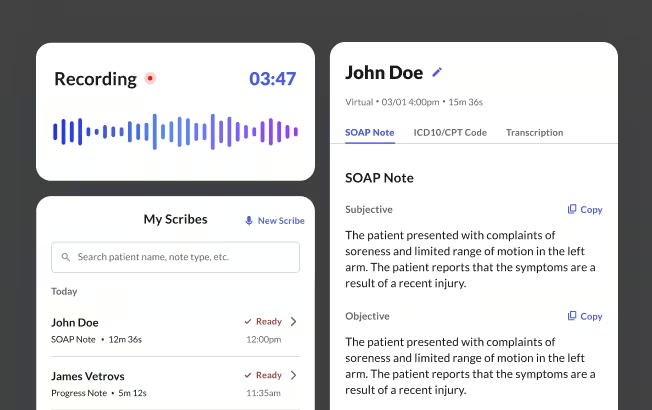
Commure Scribe is not dictation software. It is an ambient AI scribe: it records the visit conversation and drafts a structured note automatically. The clinician reviews and finalizes before anything enters the chart. It is listed because many clinicians searching for dictation software also consider AI scribes.
Key facts: 75,000+ clinicians, 99.4% transcription accuracy, 90 languages with automatic detection, 60+ EHR integrations, suggested ICD-10 and CPT codes at every tier. The workflow is not dictation; clinicians do not narrate the note. The AI generates it from the conversation.
Solo and small practices (1–5 providers) pay $89/mo (most up-to-date pricing), or $59/mo billed annually, with a 7-day unlimited trial and no credit card. Medium and large group practices get custom pricing with one-click EHR sync and live onboarding.
How Much Does Medical Dictation Software Cost?
Published pricing for true medical dictation software runs from about $99/mo (Dragon Medical One) to usage-based billing (Amazon Transcribe Medical). Philips SpeechLive and nVoq require a quote.
- Dragon Medical One: $99/mo, published³. Trials through distributor partners.
- Philips SpeechLive: Per-user subscription; contact Philips for US pricing⁴.
- nVoq: Custom; contact nVoq.
- Amazon Transcribe Medical: ~$2.25 per 30-minute note; 60 free minutes/month for 12 months⁶.
Annual billing discounts are common across this category. Quote-only contracts often bundle onboarding and integration work that subscription tools leave to the buyer.
How Was the Best Medical Dictation Software Evaluated?
Each dictation tool was scored on four criteria using vendor product pages, published pricing, and peer-reviewed evidence where available. No vendor paid for placement.
- Accuracy evidence. Vendor accuracy claims were separated from independent evidence and labeled as such throughout.
- Workflow fit. Each tool was classified as dictation, cloud dictation, or developer API and judged against its own category.
- EHR integration. The review checked how text reaches the chart: direct field dictation, document export, API, or structured HL7 output.
- Pricing transparency. Published per-user pricing scored higher than quote-required models.
This article is for informational and educational purposes only, does not constitute legal, medical, or professional advice, and does not guarantee any purchasing outcome or software performance.
Frequently Asked Questions
Dragon Medical One supports direct dictation and voice navigation across 200+ EHR platforms². Philips SpeechLive and nVoq integrate via document export or HL7/API; text lands in the chart but does not navigate EHR fields. Amazon Transcribe Medical requires custom engineering to connect to any EHR.
Vendor-reported accuracy for Dragon Medical One runs near 99%². Independent research on ambient AI scribes (a different category) found error rates of 1–3%, compared to 7–11% for automated speech recognition dictation systems¹. Accuracy varies by specialty, accent, and audio quality regardless of tool.
Dragon Medical One remains the strongest pure medical dictation software for clinicians who want voice-command EHR control across a wide range of platforms². Whether it is the best option depends on the workflow. Clinicians who want a note drafted from the visit conversation (not one they narrate) are looking for an ambient AI scribe, not dictation software.
Dragon Medical One is HIPAA compliant and HITRUST CSF certified². Amazon Transcribe Medical is HIPAA-eligible; compliance obligations fall on the team building with it⁵. Philips and nVoq state HIPAA compliance; confirm BAA terms before purchasing. Always verify audio retention and data storage location with the vendor.
Amazon Transcribe Medical offers 60 free audio minutes per month for the first 12 months⁶. Philips and Dragon Medical One do not offer a permanent free tier; Dragon offers trials through distributor partners. Most ambient AI scribes (a different product category) offer 7-day free trials.
Sources
- Topaz et al., "Beyond human ears: navigating the uncharted risks of AI scribes in clinical practice," npj Digital Medicine, https://www.nature.com/articles/s41746-025-01895-6, 2025
- Nuance (Microsoft), Dragon Medical One product information, https://www.nuance.com
- Dragon Medical One pricing (Nuance authorized distributor), https://www.dragon-medical.one
- Philips, SpeechLive cloud dictation and transcription, https://www.dictation.philips.com
- Amazon Web Services, Amazon Transcribe Medical, https://aws.amazon.com/transcribe/medical/
- Amazon Web Services, Amazon Transcribe pricing, https://aws.amazon.com/transcribe/pricing/
.jpeg)
.jpeg)


.jpeg)
.jpeg)
.jpeg)
.jpeg)