



Medical Transcription Outsourcing Guide for Independent and Group Practices
How outsourced transcription works, what it costs, and when AI medical scribing is the better fit for solo and group practices.
Written by the Commure Scribe Team
Published: May 1, 2026
•
12 min read
Medical transcription outsourcing sends a clinician's recorded dictation to a third-party service. Trained transcriptionists there return a structured written report, typically within 4 to 24 hours. Vendors price per line, per word, per minute of audio or at a flat monthly rate. Each vendor must sign a Business Associate Agreement (BAA) before it receives patient audio. Outsourcing suits high-volume practices with a dictation setup in place. AI medical scribes suit practices that need same-day chart closure.
What You Need to Know
- Medical transcription outsourcing sends clinician dictations to a third-party service that converts them into structured clinical notes, usually within 24 hours.
- For practices with in-house transcription staff, outsourcing can reduce overhead but introduces turnaround lag and per-line cost structures that add up at lower volumes.
- AI medical scribing has emerged as a real-time alternative that generates structured notes during the visit, without the staffing or contract overhead.
Primary care physicians spend 36.2 minutes on EHR work for every 30-minute patient visit. More than one in five logs over eight hours a week on the EHR outside normal work hours.
Medical transcription outsourcing and AI medical scribing both address that problem. They work differently, cost differently, and suit different practice types.
What is medical transcription outsourcing?
Medical transcription outsourcing is a subset of medical transcription, the broader practice of converting spoken clinical dictation into written documents. In the outsourcing model, the clinician records a dictation and sends the audio to a third-party service. Trained transcriptionists convert it into a structured written report.
What typically gets outsourced:
- Encounter summaries and progress notes
- Discharge summaries and operative reports
- Referral letters and consultation notes
- Radiology and pathology reports
The clinician dictates by phone, handheld recorder, or dictation app and uploads the audio file to the transcription vendor's platform. A transcriptionist processes the recording and returns a formatted note, typically within 4–24 hours. Some vendors offer expedited "stat" turnaround for urgent cases, at a premium.
Voice recognition software (such as Dragon Medical One) converts speech to text but produces raw transcript, not a structured clinical note. AI medical scribing tools record the live conversation and generate a structured Subjective, Objective, Assessment, Plan (SOAP) note immediately after the visit ends. Medical transcription outsourcing sits between the two: structured output, but not in real time.
How does outsourced medical transcription work, and is it HIPAA compliant?
The standard workflow runs from dictation to completed note in 4–24 hours. What varies by vendor is the delivery method, accuracy tier, and whether the note integrates directly into your EHR.
HIPAA compliance. Any transcription vendor handling PHI must sign a Business Associate Agreement (BAA) before you transmit patient audio. A BAA holds the vendor accountable for how it stores, uses, and protects PHI.
Do not send patient audio to a service without a signed BAA. Established vendors include BAAs as standard; verify this before contracting.
Standard compliance features to confirm with any vendor: end-to-end encryption in transit and at rest, HIPAA-trained transcriptionists, US data residency, and a documented incident response policy. Some vendors also carry HITRUST or System and Organization Controls 2 (SOC 2) attestation.
Medical transcription outsourcing means your patient audio leaves your environment. It is processed by a third party and retained according to the vendor's own policy. Ask specifically about audio retention periods and deletion timelines before signing.
What does medical transcription outsourcing cost?
The pricing model structure matters as much as the rate. Medical transcription outsourcing vendors typically price on per-line, per-word, per-minute, or flat monthly models. A per-line price that looks low can become unpredictable at the volumes most independent practices generate. Most vendors price on one of four models:
Disclosure: Rate structures vary significantly by vendor, volume tier, turnaround speed, and specialty. The table above describes pricing models, not verified market rates. Request a detailed quote from each vendor before comparing.
Volume thresholds matter across practice sizes. Per-line pricing is designed for high-volume operations. At lower volumes, the per-line rate looks reasonable while the monthly total stays unpredictable. Many independent and small group practices don't generate the volume per-line contracts are built around. Confirm whether a minimum fee applies before signing.
Vendor savings claims for medical transcription outsourcing are baseline-dependent. Most cite eliminated salary, benefits, and HR overhead for in-house transcription staff. That math holds for practices currently employing a transcriptionist. For practices that never have, the comparison baseline is different and the savings percentage doesn't apply.
What are the benefits and limitations for solo and group practices?
Medical transcription outsourcing solves some documentation problems and creates others.
Four things it does well:
- No transcription staffing overhead. You don't hire, train, or manage a transcriptionist. For practices where documentation volume doesn't justify a dedicated staff member, this is a real operational simplification.
- Accuracy floor. Most established vendors advertise accuracy rates of 99%+. Human transcriptionists are also better equipped than earlier voice recognition tools to handle accents, background noise, and specialty vocabulary, though independent comparisons are limited.
- Scalability. Volume spikes, such as a locum tenens covering extra days or a new provider joining, don't require staffing adjustments. You pay for what you use.
- Note formatting handled. Vendors typically promise to adapt to your templates and specialty-specific structure over time. Whether that reduces editing burden depends on how consistently the clinician dictates and how well the vendor's QC tracks your preferences.
Four places where the model creates friction:
- Turnaround lag. Standard turnaround time (TAT) of 12–24 hours means notes aren't available same-day. Same-day chart closure affects billing cycles, collections, and continuity of care. A 24-hour delay is a workflow constraint, not a minor inconvenience.
- Editing still required. Vendors advertise accuracy rates of 99%+, but errors still occur. The clinician must review every note before signing. Whether that review time is less than writing from scratch depends on note length and specialty.
- Clinical voice dependency. Transcriptionists work from what you dictate. If you don't articulate the context: a patient's hesitation, a discrepant physical exam finding, a drug interaction you caught and mentally flagged, it doesn't end up in the note.
- Data leaves your environment. Patient audio and transcription outputs are processed by a third party. For clinicians with high patient privacy sensitivity in psychiatry, behavioral health, and sensitive specialties, this warrants explicit consideration.
When does medical transcription outsourcing not make sense for your practice?
Most vendor content skips this question. Four scenarios where medical transcription outsourcing is the wrong fit:
Your volume is too low. Per-line and per-minute pricing structures are built for operations running high daily dictation volumes. For practices with modest panels, the per-unit cost looks reasonable but the full workflow cost, including clinician time dictating and reviewing, can outweigh the return. Ask any vendor what a typical monthly bill looks like at your actual encounter volume before signing.
Your specialty requires real-time documentation. Psychiatry, behavioral health, and pediatrics produce notes where the sequence of conversation, tone, and real-time clinical reasoning are load-bearing. A 24-hour transcript reconstructed from medical dictation can lose that texture, particularly when the clinician's dictation compresses a nuanced exchange into a summary.
You need same-day chart closure. A 12–24-hour TAT puts same-day chart closure at risk. Stat turnaround can close the gap, but typically at premium rates that reduce the cost advantage.
Your visits are short and templated. For high-volume, templated visit types (annual wellness exams, follow-up medication checks), the documentation per encounter tends to be brief. Adding a dictation step, upload, and 24-hour review cycle can introduce more process overhead than the note itself warrants.
The right question for any practice evaluating medical transcription outsourcing: does your encounter volume match what per-unit pricing is built for?
How does practice size affect the decision?
The case for medical transcription outsourcing looks different depending on how many providers you have. The volume assumptions, staffing context, and billing priorities vary enough across the practice size range that a single answer doesn't hold.
Independent and small practices typically don't employ a dedicated transcriptionist and generate moderate daily dictation volume. For this group, the cost case for medical transcription outsourcing is harder to make. Per-line minimums can exceed the value at low volumes, and the dictation-upload-review workflow adds steps that an AI scribe eliminates entirely. The more common friction point is documentation running into evenings, not staffing overhead. A 7-day AI scribe trial answers that problem directly at no cost.
Mid-size and larger group practices are more likely to have existing transcription infrastructure and higher daily encounter volume. A practice manager or administrator is typically involved in the decision. At this size, the staffing savings case becomes real if the practice currently employs transcriptionists. The turnaround constraint matters more too: with multiple providers closing charts simultaneously, a 24-hour delay compounds across the panel. Groups at this size should evaluate whether per-provider AI scribe pricing offers a simpler cost structure than per-line billing.
How does AI medical scribing compare to medical transcription outsourcing?
AI medical scribes record the live patient-clinician conversation and generate a structured clinical note within seconds of the visit ending.
The clinician can stay present during the visit rather than composing documentation while the patient is still talking. With medical transcription outsourcing, those incidental details depend entirely on what the clinician remembers to dictate afterward.
No AI scribe eliminates the need for clinician review. The most frequent error is not mistranscription, but content that never made it into the note. The workflow is Capture, Edit, Finalize.
The comparison below is based on publicly available pricing and vendor documentation. It is meant as a directional framework only, not a substitute for a detailed quote from each vendor.
For a full comparison of transcription approaches including report types, AI adoption data, and specialty fit, see our Medical Transcription Guide.
Commure Scribe: AI scribing that works inside your EHR
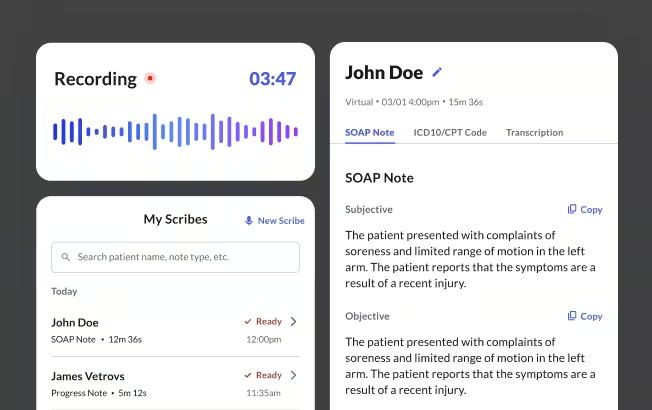
Commure Scribe is an AI medical scribe that records the visit and generates a structured SOAP note when the clinician ends the recording. Clinicians report a review cycle of about 43 seconds. No dictation, no upload, no turnaround wait.
Medical transcription outsourcing requires the clinician to do the cognitive work twice: once during the visit and again in dictation form afterward. Commure Scribe removes the second step entirely.
Note quality is the consistent differentiator. The plan section captures more than the clinician would have written themselves. The AI catches nuances compressed in post-visit dictation: a passing complaint early in the visit, a medication clarification mid-conversation.
Transcription accuracy is 99.4%. The tool supports 90 languages with automatic detection.
91% of providers report feeling less fatigued after adoption. 90% report spending less time on documentation.
Commure Scribe integrates with 60+ EHRs, including AdvancedMD, Athenahealth, eClinicalWorks, Elation, SimplePractice, Tebra, and WebPT. Copy/paste is available on all tiers; write-back integration on Enterprise.
Supported specialties: Family Medicine, Internal Medicine, Psychiatry, Pediatrics, Behavioral Health, Dentistry, and Physical Therapy.
Audio is stored and encrypted, not used for AI training, and retained per HIPAA requirements. Transcripts and notes can be permanently deleted at any time. No third-party data sharing. HIPAA compliant and SOC 2 certified.
A 7-day free trial is available, no credit card required. Pricing scales by practice size, from solo clinicians through to 100+ clinicians.
Frequently Asked Questions
Medical transcription outsourcing sends recorded clinical dictations to a third-party service where transcriptionists convert audio into structured clinical documentation. Completed notes are returned to the practice's EHR, typically within 4–24 hours.
The main benefits: No in-house transcription staff to hire or manage. Accuracy floor of 99%+ from experienced human transcriptionists. Scalability without staffing adjustments. Note formatting handled to your templates and specialty conventions.
Most vendors price per line, per word, or per minute of audio, with some offering flat monthly rates for lower-volume practices. Rates vary by vendor, volume tier, turnaround speed, and specialty. Practices with smaller panels should request a quote based on actual encounter count and compare it against subscription-based AI scribe options.
Medical transcription outsourcing can be HIPAA compliant, provided the vendor signs a BAA before any patient audio is transmitted. Verify end-to-end encryption, US-based data residency, HIPAA-trained staff, and a documented incident response policy. Never transmit patient audio without a signed BAA.
Sources
- Holmgren, A. J., Hendrix, N., Maisel, N., Everson, J., Bazemore, A., Rotenstein, L. S., Phillips, R., & Adler-Milstein, J. (2024). Electronic health record usability, satisfaction, and burnout for family physicians. JAMA Network Open, 7(8), Article e2426956. https://doi.org/10.1001/jamanetworkopen.2024.26956
- AMA Physician Burnout Report (2024) American Medical Association. (2024, December 10). Doctors work fewer hours, but the EHR still follows them home. https://www.ama-assn.org/practice-management/physician-health/doctors-work-fewer-hours-ehr-still-follows-them-home
- Lukac, P. J., Turner, W., Vangala, S., Chin, A. T., Khalili, J., Shih, Y.-C. T., Sarkisian, C., Cheng, E. M., & Mafi, J. N. (2025). Ambient AI scribes in clinical practice: A randomized trial. NEJM AI, 2(12), Article aioa2501000. https://doi.org/10.1056/aioa2501000.
- Topaz, M., Peltonen, L.M. & Zhang, Z. Beyond human ears: navigating the uncharted risks of AI scribes in clinical practice. npj Digit. Med. 8, 569 (2025). https://doi.org/10.1038/s41746-025-01895-6
.jpeg)
.jpeg)
.jpeg)
.jpeg)



.jpeg)
.jpeg)