



Best AI Scribes for Psychiatry in 2026: 6 Tools Compared
Six AI scribes compared on psychiatric note structure, risk documentation, compliance posture, EHR fit, and real monthly cost.
Written by the Commure Scribe Team
Published: March 26, 2026
•
17 min read
The six AI scribes compared for psychiatry are Commure Scribe, JotPsych, Mentalyc, Medwriter, PMHScribe and Heidi Health. Commure Scribe ranks first as a multispecialty scribe that records up to two hours per session. Its template builder creates mental status exam (MSE) and risk sections. Medwriter ships a psychiatry template with MSE, risk and crisis plan sections, and Mentalyc offers per-member group notes. JotPsych targets billing and audit support, PMHScribe fits psychiatric nurse practitioners, and Heidi offers a free tier.
What You Need to Know About the Best AI Scribe for Psychiatry
- The best AI scribe for psychiatry drafts MSE-structured, billing-ready psychiatric notes from recorded sessions for clinician review.
- A 2026 JAMA multisite cohort tied AI scribe use to 16 fewer documentation minutes per eight patient hours³.
- Compare psychiatric note formats, coding, EHR fit, privacy posture, and price, then trial your top two tools.
How Do the Top 6 Psychiatry AI Scribes Compare?
The table below compares the six tools on note formats, coding, EHR fit, published pricing, and trial access. Prices are published by each vendor and change often. Confirm current figures on each vendor's pricing page before buying.
All six tools publish pricing or offer a free tier. JotPsych, Mentalyc, Medwriter, and PMHScribe focus specifically on behavioral health billing and documentation structures. Few publish behavioral health note formats beyond Subjective, Objective, Assessment, Plan (SOAP), which matters for therapy billing.
What Are the Best AI Scribes for Psychiatry in 2026?
The six tools below were selected for documented psychiatric or behavioral health functionality. Each profile describes what the tool does in a psychiatric context, followed by its limitations.
1. Commure Scribe
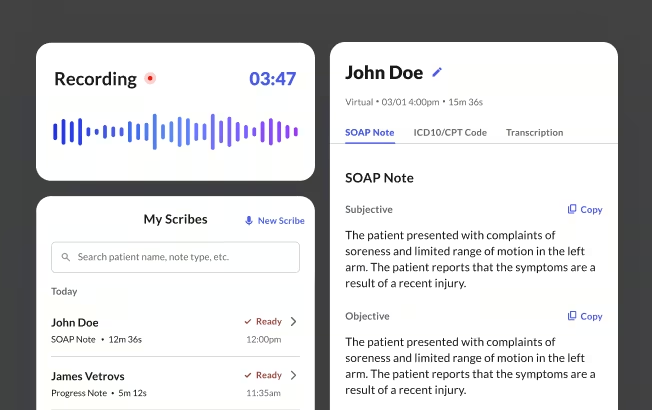
Commure Scribe is a multispecialty ambient AI scribe applied to psychiatry and behavioral health. Initial psychiatric evaluations can run 60–90 minutes and span MSE, medication history, risk assessment, and treatment planning. Commure records up to 2 hours per session, covering the full evaluation. Specialty templates and a custom template builder let psychiatrists shape MSE and risk sections to their own phrasing. Suggested ICD-10 and CPT codes appear in a separate tab.
Commure is a multispecialty tool rather than a psychiatry-only build, so MSE and risk-assessment structure comes from the template builder rather than a preset psychiatric form. The trade-off: a practice that also sees other specialties runs one scribe across the whole panel instead of a psychiatry-only tool plus a second scribe for everything else.
The platform offers 60+ EHR integrations, though one-click sync is a group-plan feature. Solo and small practices copy notes out. It is HIPAA compliant and System and Organization Controls 2 (SOC 2) certified, and audio is not used for AI training.
Solo and small practices pay $89/mo or $59/mo billed annually. The 7-day trial needs no credit card.
- 99.4% transcription accuracy.
- 90+ languages with automatic detection.
2. JotPsych
JotPsych is built specifically for behavioral health reimbursement. Its notes pair with code suggestions, payer alignment, and audit-risk flags that highlight missing documentation elements. JotPsych templates are designed to support audit defense for psychiatric follow-up visits⁴.
Tiers run from a free trial up to $269/mo for the Everything plan, with custom pricing for 7+ seats. It generates notes from 16 languages with English output. The audit and billing claims on JotPsych's site lack independent published validation.
- Tiers run $135/mo to $269/mo. Group pricing for 7+ seats.
- Free trial with no credit card required.
3. Mentalyc
Mentalyc supports a broad set of note formats: SOAP, DAP, BIRP, GIRP, PIRP, PIE, and intake notes⁵. It produces a separate note for each participant in group therapy sessions. Risk detection and safety-plan prompts run on every tier.
It began as a therapy-first tool. Psychiatry and medication-management modalities came later and require the Pro tier or above. On non-team tiers, monthly note counts are capped, which can limit high-volume prescribers. CPT codes are auto-computed from the Pro tier up, and the 14-day trial requires no credit card.
- Tiers run $19.99–$119.99/mo by note volume.
- Team plan removes monthly note caps.
4. Medwriter
Medwriter's psychiatry template mirrors a complete psychiatric evaluation: MSE, biopsychosocial history, risk assessment, assessment scales, and a crisis plan section⁶. Standard at $99/mo includes unlimited sessions, a business associate agreement (BAA), and ICD-10 code suggestions.
The Pro plan adds E/M support, prior authorization drafting, and denial appeals, though pricing requires a sales conversation. The EHR integration runs through a Chrome Extension rather than a named application programming interface (API), and notes delete automatically after a configurable retention period.
- Free trial available, no credit card required.
- Pro plan adds custom templates and patient instruction drafting.
5. PMHScribe
PMHScribe was built by a psychiatric nurse practitioner for psychiatric mental health nurse practitioner (PMHNP) and psychiatrist workflows⁷. It generates initial psychiatric evaluations, medication management notes, and psychotherapy add-on notes in SOAP, DAP, and BIRP formats. Psychotherapy add-on notes support time-based therapy billing alongside E/M visits.
Pricing is $79/mo for counseling and $99/mo for psychiatry, with a free trial available and no credit card required. There are no named EHR integrations, so notes move by copy-out. Group features for practices larger than 50 clinicians are still in development.
- Unlimited recording time on all plans.
- Letter and statement drafting included on all tiers.
- ICD codes included on the psychiatry plan.
6. Heidi Health
Heidi Health offers the only permanent free tier on this list, with no session limit and no time clock⁹. Mental health is among its listed specialties. It covers SOAP, BIRP, and session-note formats. Audio is transcribed during the visit and deleted afterward.
Heidi publishes no risk or MSE-specific templates. The full EHR integration and coding features are on paid tiers, with the Practice tier at $180/user/mo for Embed and Connect modes. For BAA coverage below the enterprise tier, confirm terms directly with Heidi Health. The 14-day paid trial requires no credit card.
- Free tier includes unlimited AI documentation and clinical evidence with citations.
- EHR integration available as an add-on on paid plans.
Why Is Psychiatry Documentation Different for AI Scribes?
The search for the best AI scribe for psychiatry starts with what makes psychiatric notes different. Psychiatric notes carry structures and risks that general medical notes do not.
A mental status exam reads behavior, affect, and thought process, not just spoken symptoms. Risk language around suicide and self-harm needs to be precise, because those words carry legal weight.
Therapy content is also more protected than other clinical data. HIPAA gives psychotherapy notes a separate, stricter shield¹, and substance use records fall under their own federal rule².
A general-purpose tool trained on primary care visits can miss these demands. It may compress a 50-minute session into a brief paragraph. It may flatten risk statements into vague summaries.
It may also store audio in ways that conflict with consent norms in mental health care. That is why an AI scribe for psychiatry is judged on different criteria than a family medicine scribe.
The tools compared here split into two camps. Psychiatry-native vendors build MSE and risk templates first. Broad-platform vendors bring broader EHR connections and enterprise security.
The best AI scribe for psychiatry depends on note formats, billing support, privacy posture, and price. That is how the comparison below is organized.
How Were These AI Scribes for Psychiatry Evaluated?
Each AI scribe for psychiatry was scored on five criteria. They map to how psychiatric care is charted and billed.
The criteria draw on peer-reviewed evidence where it exists. A 2026 multisite JAMA cohort of 8,581 clinicians tied AI scribe use to 13.4 fewer minutes of EHR time per eight patient hours³.
Evidence at that level covers the category, not any single psychiatry product. So vendor claims below are hedged and attributed.
The five criteria:
- Psychiatric note formats. Initial psychiatric evaluations, MSE sections, SOAP, DAP, and BIRP notes. Therapy add-on notes too. Generic SOAP output scored lower.
- Coding support. Suggested ICD-10 and CPT output for psychiatry. E/M plus psychotherapy add-on codes. Codes change yearly, so check current editions before billing.
- EHR fit. Named integrations, browser push, or copy and paste. Honest fit with the systems mental health groups run.
- Privacy posture. BAA access and audio retention policy. Whether the vendor states PHI is excluded from AI training.
- Pricing and trial access. Published prices and self-serve trials scored higher than sales-gated quotes. Most solo buyers want to test first.
Each fact about a specific psychiatry AI scribe comes from that vendor's site or a dated third-party check. Where a vendor publishes no figure, the profile says so rather than guessing. No single AI scribe for psychiatry won on every criterion, which is why the profiles flag trade-offs.
How Do AI Scribes Handle the MSE and Risk Assessment?
An AI scribe for psychiatry drafts the spoken parts of an MSE reliably and the observed parts less consistently. That split defines how psychiatrists should use them.
The mental status exam spans ten standard domains. They include appearance, behavior, speech, mood, affect, thought process, thought content, perception, cognition, and insight and judgment. A scribe hears speech, mood statements, and thought content from the audio.
It cannot see flat affect, psychomotor slowing, or poor grooming. Those observed domains still come from the clinician.
Most tools handle this gap in one of two ways:
- Structured prompts. Psychiatry-native templates leave labeled MSE fields for the clinician to dictate or fill, such as Medwriter's MSE and assessment-scale sections⁷.
- Spoken-summary capture. The clinician voices observations aloud at the end of the session. The scribe folds them into the draft.
Risk language carries higher stakes for any psychiatry AI scribe. Suicidal ideation, intent, plan, access to means, and protective factors should appear in the note in precise terms. The published research base flags a real failure mode here.
The first randomized trial of ambient scribes found inaccuracies were occasional but omissions were common⁸. An omitted denial of suicidal ideation is a clinical and legal gap.
Some psychiatry AI scribe vendors add risk-specific behavior. Mentalyc states its system detects risk content and prompts safety-plan fields⁶. Medwriter's template includes dedicated risk assessment and crisis plan sections⁷.
No AI scribe for psychiatry removes the clinician's duty here. Each draft that touches risk needs line-by-line review before signing. Ambient scribes draft the note. The clinician confirms ideation language, the safety plan, and the disposition. To check a draft against a finished note, a psychiatric SOAP note example shows where the MSE, risk assessment, and Diagnostic and Statistical Manual of Mental Disorders, Fifth Edition (DSM-5) diagnosis fields belong.
The same review discipline applies to AI therapy notes for psychotherapy sessions. No vendor on this list claims the review step can be skipped.
What About Group Therapy Notes and 42 CFR Part 2?
Group sessions and substance use disorder records raise the two hardest compliance questions for an AI scribe for psychiatry. Both deserve direct vendor answers before any purchase.
Group therapy first. A group session needs a separate note for each member, scoped to that member's progress.
Recording the room also captures other patients' voices and disclosures. That raises consent questions beyond a one-on-one visit.
Few scribes support this workflow natively. Mentalyc states its group-practice tier drafts a collective group note plus an individual note per member⁶. For most other tools, the practical path is a dictated recap per member after the session.
Each group member should consent to recording before any ambient capture. Consent rules vary by state, so check your state's specific recording and consent laws.
Substance use disorder records sit under 42 CFR Part 2, a federal confidentiality rule that the HHS Office for Civil Rights (OCR) enforces². Part 2 restricts use and disclosure of SUD treatment records from Part 2 programs². It generally needs patient consent for disclosure².
HHS finalized changes in 2024 that align parts of the rule more closely with HIPAA¹. Three practical questions matter for an AI scribe in an SUD or dual-diagnosis setting:
- Data location. Ask where recordings and transcripts live. Ask who can access them.
- Record segregation. Ask whether SUD content can be excluded from notes that flow to other systems.
- BAA scope. Ask whether the vendor's BAA addresses Part 2 program obligations.
No psychiatry AI scribe on this list publishes a Part 2 conformance statement. Treat any vendor pitch as "designed with HIPAA in mind," not as proof of Part 2 alignment. Have your compliance officer or legal counsel review the data flow before deploying a scribe in a Part 2 program.
What Should Psychiatrists Ask Vendors Before Buying?
Five questions separate marketing claims from operational fit when buying an AI scribe for psychiatry. Ambient scribes are not FDA-reviewed devices.
Peer-reviewed commentary classifies them as exempt admin tools, so vendor diligence replaces regulatory review¹⁰. Ask each vendor on your shortlist:
- How does the tool structure an MSE and a risk assessment? Ask for a sample psychiatric evaluation note. Check whether risk language stays specific or gets flattened.
- What happens to audio and transcripts? Ask for retention periods, deletion options, and whether PHI trains the AI. Get the answer in writing.
- Will you sign a BAA at my tier? Some vendors gate organization-wide BAAs to enterprise plans. Confirm coverage at the plan you would buy.
- How do notes reach my EHR? Copy and paste, browser extension, and API sync carry different workflow costs. Test the path with your actual system.
- What does a real month cost? Note caps, coding add-ons, and gated tiers change the effective price. Price the plan that includes the features you need.
Then run a structured trial. Most of these AI scribes for psychiatry offer a free trial or free tier. Use it on a representative week: an intake, follow-ups, a therapy add-on visit, and one complex risk case.
Review each draft line by line and time your own edits. The best AI scribe for psychiatry is the one that needs the fewest corrections on your hardest notes, whatever the ranking says.
If your EHR decision is still open, the best EHR for a mental health private practice guide covers that side of the stack. A therapy progress notes quick reference also helps standardize what you ask each tool to produce. For an overview of how ambient scribes work, see the AI medical scribe guide. For a comparison across specialties, see best AI medical scribes.
How Does Commure Scribe Fit a Psychiatric Practice?
Commure Scribe is built for practices that need documentation to hold up under payer review. The Capture–Edit–Finalize workflow keeps the clinician in control of every note before it enters the chart. That is where MSE observations and risk language get confirmed.
For practices managing behavioral health treatment plans, the custom template builder lets each clinician structure plan sections to match an existing workflow rather than adapting to a generic format.
Current solo and small-practice pricing is on the Commure Scribe pricing page. The 7-day trial needs no credit card. Try Commure Scribe for psychiatry on a representative week: an intake, follow-ups, and one complex risk case.
This article is for informational and educational purposes only, does not constitute legal, medical, or professional advice, and does not guarantee compliance with HIPAA, 42 CFR Part 2, or any payer's documentation requirements.
Frequently Asked Questions
Partly: an AI scribe for psychiatry captures spoken MSE content such as mood statements, speech patterns, and thought content from session audio. Observed domains like affect, grooming, and psychomotor activity still come from the clinician, dictated aloud or entered into labeled MSE fields. Psychiatry-native tools such as Medwriter offer structured MSE template sections⁷.
No vendor on this list publishes a Part 2 conformance statement. Part 2 is SAMHSA's confidentiality rule for substance use disorder records, and it generally needs patient consent for disclosure². Treat scribe tools as designed with HIPAA in mind and have legal counsel review any Part 2 program deployment.
Mostly not natively for AI scribes for psychiatry, though Mentalyc states its group-practice tier drafts a collective group note plus individual notes per member⁶. With most other tools, clinicians dictate a recap per member after the session. Each group member should consent to recording first, and recording consent rules vary by state.
Only with clinician review, since no AI scribe for psychiatry should finalize a risk note unreviewed. The published randomized trial of ambient scribes found omissions were more common than inaccuracies⁸. An omitted ideation denial is a serious gap, so clinicians should read every risk-related draft line by line. Some tools, such as Mentalyc, prompt safety-plan fields when risk content appears⁶.
Published pricing for an AI scribe for psychiatry runs from $19.99/mo at Mentalyc's entry tier⁵ to $99/mo at PMHScribe and Medwriter⁶ ⁷. Heidi Health has a permanent free tier⁹. Note caps and coding add-ons change the effective price.
Yes: a psychiatry AI scribe processes protected health information, which makes the vendor a business associate under HIPAA¹. A signed business associate agreement should be in place before any patient audio is recorded. Confirm the BAA covers your specific plan tier, since some vendors gate organization-wide BAAs to enterprise contracts.
Sources
- U.S. Department of Health and Human Services. HIPAA Privacy Rule. https://www.hhs.gov/hipaa
- U.S. Department of Health and Human Services, Office for Civil Rights. Understanding Confidentiality of Substance Use Disorder (SUD) Patient Records or "Part 2." https://www.hhs.gov/hipaa/part-2/index.html
- Rotenstein LS, Holmgren AJ, Thombley R, et al. Changes in Clinician Time Expenditure and Visit Quantity With Adoption of Artificial Intelligence–Powered Scribes: A Multisite Study. JAMA. 2026;335(16):1408–1417. https://jamanetwork.com/journals/jama/article-abstract/2847319
- JotPsych. Behavioral Health AI Documentation Platform. https://www.jotpsych.com
- Mentalyc. Pricing. https://www.mentalyc.com/pricing
- Medwriter. AI Scribe for Psychiatrists. https://www.medwriter.ai/scribe/psychiatrists
- PMHScribe. AI Scribe for Psychiatry and Mental Health Clinicians. https://pmhscribe.com
- Lukac et al. NEJM AI. 2025. https://pmc.ncbi.nlm.nih.gov/articles/PMC12768499/
- Heidi Health. Pricing. https://www.heidihealth.com/en-us/pricing
- Topaz et al. npj Digital Medicine. 2025. https://www.nature.com/articles/s41746-025-01895-6
.jpeg)
.jpeg)
.jpeg)

.jpeg)
.jpeg)
.jpeg)
.jpeg)