



DAX Copilot Review: Evidence, Pricing, and Who It Fits
An evidence-based look at what the only randomized trial on DAX Copilot found, where it falls short on EHRs and languages, and who it actually fits.
Written by the Commure Scribe Team
Published: April 24, 2026
•
14 min read
Updated August 20, 2026
DAX Copilot, now sold as Dragon Copilot, is Microsoft's ambient AI scribe. It fits large health systems on Epic, where it writes the note inside the chart. In a 2025 randomized trial of 238 UCLA Health physicians, it improved burnout and task load. Its 1.7% reduction in time in notes was not statistically significant. Microsoft publishes no per-seat price. Authorized resellers list about $369 to $600 per provider per month, plus a setup fee.
What You Need to Know About DAX Copilot
- Nuance DAX Copilot is Microsoft's ambient AI scribe, built around deep Epic integration and sold through enterprise channels only. It was rebranded as Dragon Copilot in March 2025.
- A 2025 randomized trial found this Microsoft AI scribe significantly improved burnout and cognitive load. Documentation time reduction was 1.7% and was not statistically significant.
- Clinicians evaluating DAX Copilot alternatives will find the most meaningful gaps in language auto-detection, suggested coding, and self-serve access. This DAX Copilot review covers each gap, and the final sections compare DAX Copilot vs Commure Scribe directly on each dimension.
DAX Copilot is the market leader in enterprise ambient documentation. That position deserves a real review, not a feature table. This article covers what the clinical evidence actually shows, where DAX works well, and where it does not. For clinicians who run into DAX's gaps, the final sections explain how Commure Scribe addresses each one directly.
What Is DAX Copilot?
DAX stands for Dragon Ambient eXperience. Microsoft acquired it from Nuance Communications in 2022. In March 2025, Microsoft combined DAX ambient capture with Dragon Medical One voice dictation under the Dragon Copilot brand.
The core workflow matches other AI medical scribes. The clinician starts a recording at the beginning of the encounter. The software listens to the conversation. It generates a structured clinical note for review. The clinician finalizes the note before it enters the chart. Microsoft Dragon Copilot is one of 10 tools scored in the best AI medical scribes comparison on cost, EHR write-back, and quality controls.
DAX Copilot's defining feature is its depth of integration with Epic. For health systems running Epic, DAX generates the note inside the chart environment without copy-paste. That integration removes a step most other scribes require.
Microsoft reports 600+ healthcare organizations have deployed DAX Copilot.¹ The deployment base is concentrated in large health systems.
One important distinction: DAX Copilot and Dragon Medical One are separate products. DAX is the ambient capture layer. Dragon Medical One is the voice dictation product that adds non-Epic EHR integration. Many DAX capabilities require a Dragon Medical One license. The combined offering is Dragon Copilot.
What Does the Evidence Actually Show?
Most ambient scribe marketing leads with documentation time savings. The clinical trial evidence on DAX Copilot specifically is more nuanced.
The strongest study is a randomized controlled trial published in NEJM AI in 2025.² It enrolled 238 physicians across 14 specialties at UCLA Health. Physicians were randomized to DAX Copilot, Nabla, or usual care from November 2024 through January 2025. No vendor funded the trial.
Results on burnout and task load were significant. The DAX arm showed a +2.8 point improvement on the Mini-Z burnout scale. Physician task load dropped by 39.9 points. Those are meaningful clinical findings.
Documentation time was a different story. The DAX arm showed 1.7% less time-in-note vs. control. That result was not statistically significant (P = 0.66). DAX was used in 33.5% of encounters in the trial arm.
A pre/post study in JAMA Network Open (2025) found ambient scribes cut after-hours documentation by 54 minutes and cognitive task load by 2.64 points.³ That study evaluated Abridge, not DAX Copilot. It is useful context for the category, not evidence for DAX specifically.
The honest read: DAX Copilot produces a real benefit for clinician wellbeing. The documentation time savings in most DAX marketing are not supported by the only randomized trial testing it directly.
Where DAX Copilot Works Well
DAX Copilot earns its market position in a specific context: large health systems running Epic.
Epic-native integration. For clinicians on Epic, the note is generated directly inside the chart. No copy-paste, no tab switching. That frictionless handoff is the clearest differentiator DAX has over other scribes in the category.
Enterprise compliance infrastructure. DAX runs on Microsoft Azure. It carries HIPAA-compliant infrastructure and HITRUST CSF certification inherited from the Azure ecosystem. For health system compliance teams, the Microsoft stack is familiar and well-documented.
Complex multi-problem encounters. Clinicians using DAX within Epic template structures, configured by health system IT, report strong performance on complex visits. When the note structure is built around the specialty workflow, DAX produces organized output.
Microsoft ecosystem integration. For organizations running Microsoft 365 and Azure, DAX integrates with the broader Microsoft Cloud for Healthcare. That matters for health system CIOs managing enterprise contracts.
Scale of deployment. 600+ organizations deployed is a meaningful track record. The product has been tested in large clinical environments at scale.
Where DAX Copilot Falls Short
DAX Copilot's gaps are consistent and well-documented. They cluster around four areas: language, EHR reach, coding, and access.
Language support requires a manual step and has accuracy caveats beyond English and Spanish.
DAX Copilot supports English and Spanish natively. An admin-enabled Multilingual recording mode adds 50+ additional languages, including Arabic, Chinese, French, Hindi, Japanese, Korean, Portuguese, and others.⁴ However, the product does not auto-detect language. The clinician must manually select a language in settings before recording begins. That selection cannot be changed mid-session for the same recording. If the clinician forgets to switch to Spanish or another language, the system reads the dialogue phonetically as English. Notes are always generated in English, regardless of encounter language. Voice commands are English only.
Microsoft's own documentation notes that note accuracy for multilingual recordings "might not be as accurate as documentation generated from conversations recorded in English or Spanish" and recommends clinicians review multilingual notes carefully. Multilingual mode must be enabled by an organization's IT administrator before clinicians can access it.⁴
Epic integration is the strongest; non-Epic EHRs require separate steps or licensing.
DAX Copilot's deepest integration is with Epic: the note generates inside the Epic chart with no copy-paste step. Dragon Copilot has since expanded to additional EHRs, including athenahealth (announced December 2025) and Cerner, and authorized resellers list 40+ supported systems.⁴ However, these integrations typically require enterprise sales engagement and IT setup regardless of EHR. The seamless chart-embed experience that defines DAX's value proposition is specifically documented for Epic. Non-Epic EHR paths vary in depth of integration and require direct confirmation with Microsoft or resellers before committing.
Coding automation is not a confirmed DAX Copilot feature.
DAX Copilot does not publish ICD-10 or CPT code generation on vendor documentation.⁴ Dragon Copilot's newer versions include coding accessible by voice query. That differs from suggested codes appearing at note creation. Practices looking for ICD-10 and CPT codes at the end of an encounter will not find that in current DAX Copilot documentation.
Access requires an enterprise sales process.
There is no self-serve trial for DAX Copilot. Evaluation requires Microsoft enterprise sales engagement, a procurement process, a setup fee, and an IT deployment before the clinician sees the product in their environment.
For independent practices, small groups, or clinicians who want to test a tool before committing to an enterprise contract, this model is a real barrier. Dictation Direct lists $369 per provider per month with a 12-month commitment. DictationOne lists approximately $600 per provider per month. Both require a setup fee.⁴
Mobile platform support has expanded, but verify before committing.
The original DAX Copilot was iOS only.⁴ With the Dragon Copilot rebrand in March 2025, Microsoft expanded platform support to include Android, macOS, Windows, and a full-featured web app. Verify current device support and feature parity across platforms with Microsoft before evaluation, as capabilities may vary by platform and EHR environment.
How Commure Scribe Addresses Each Gap
The gaps above are specific to DAX Copilot's product design and deployment model. Commure Scribe was built around a different set of constraints. Each gap has a direct answer.
On language: 90 languages with automatic detection, no admin setup required.
Commure Scribe supports 90 languages with automatic detection. No manual selection is required before the encounter, and no IT administrator needs to enable the feature. The system identifies the language in the conversation and generates the note accordingly.
For practices serving language-diverse patient populations, this removes the manual selection step that DAX Copilot requires and the accuracy caveats Microsoft attaches to its multilingual mode. Clinicians do not need to remember to switch a setting before each affected encounter.
On EHR integration: 60+ verified integrations, self-serve, no IT setup.
Commure Scribe has verified 60+ EHR integrations, including AdvancedMD, Athenahealth, eClinicalWorks, , SimplePractice, and Tebra, among others.
The distinction from Dragon Copilot's expanding EHR list is access model and setup. Solo and small practices can activate Commure Scribe and use copy-paste with any browser-based EHR the same day, with no sales call and no IT involvement. Medium and large group practices access one-click sync with supported EHRs. Dragon Copilot's EHR integrations, regardless of which EHR, require enterprise sales engagement before any hands-on evaluation begins.
On coding: suggested ICD-10 and CPT codes at every encounter.
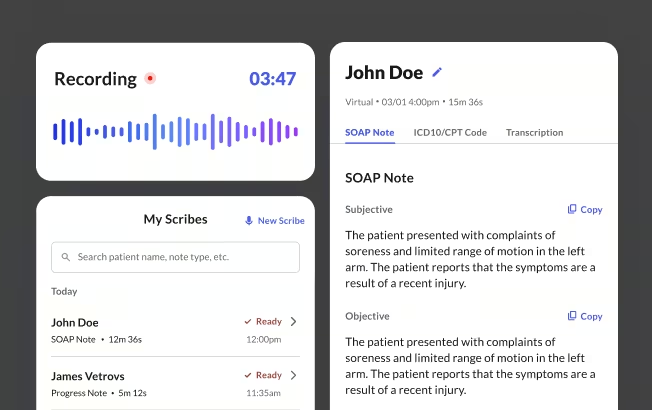
Commure Scribe generates suggested ICD-10 and CPT codes from the clinical encounter. Codes appear in a separate tab alongside the note for the clinician to review before finalizing. The workflow is Capture, Edit, Finalize. The clinician reviews suggested codes before the note enters the chart.
This is a different workflow from a voice-query coding step. The codes are there when the clinician opens the note.
On access and pricing: 7-day trial, $59 per month annual, no credit card.
Solo and small practices pay $89 per month (monthly) or $59 per month billed annually. Full scribe pricing details are published on Commure Scribe.
That tier includes unlimited transcription, custom templates, AI Copilot, and suggested ICD-10/CPT codes. Copy-paste EHR integration is included.
Medium and large group practices access custom pricing with one-click EHR sync, custom AI workflows, live onboarding, and ROI analytics.
A 7-day unlimited trial is available at no cost and requires no credit card.
On devices: any device.
Commure Scribe runs on any device via browser: mobile, tablet, or desktop. No iOS requirement.
What the evidence shows for Commure Scribe.
90%+ of providers reduce clinical documentation time and digital fatigue. 91% of providers report feeling less fatigued. Clinicians report an average chart close time of 43 seconds. Commure Scribe supports 25M+ patient encounters annually across 75,000+ clinicians and 25 specialties, with a 25% reduction in denials on average.
See the complete guide to AI medical scribes for a full evaluation framework covering every major tool in the category.
Frequently Asked Questions
DAX Copilot offers deep Epic integration for health system deployment. Access requires enterprise sales engagement. ICD-10 coding is query-based, CPT support is unconfirmed, Spanish requires a manual toggle, and audio is stored for up to 30 days. Commure Scribe covers 60+ EHR integrations. It auto-populates ICD-10/CPT at note creation. It supports 90+ languages with automatic detection. Audio is stored encrypted and used only to generate the clinical note. A self-serve 7-day trial is available at $59/mo annual.
DAX Copilot captures the audio of a clinical encounter and transcribes the conversation. It structures the output into a clinical note format such as SOAP. The clinician reviews the note before it is finalized. No ambient scribe writes directly into the chart without a human review step. DAX is embedded in the Epic workflow. It requires a Dragon Medical One license for full feature access.
DAX Copilot does not publish per-seat pricing. Dictation Direct (trydax.com), an authorized reseller, lists $369/mo per provider plus a $700 setup fee on a 12-month commitment. DictationOne, a second authorized reseller, lists $600/mo per user (per DictationOne website, March 2026). Commure Scribe offers a 7-day trial with no credit card required.
DAX Copilot is Microsoft’s ambient AI documentation product, built by Nuance Communications, which Microsoft acquired in 2022. It is designed mainly for health systems using Epic. The tool listens to a clinical encounter and generates a structured note without dictating or typing. Other tools in the same category serve independent and group practices across a wider range of EHRs. Commure Scribe works with athenahealth, eClinicalWorks, AdvancedMD, and SimplePractice, among others.
Commure Scribe is designed for self-serve access at every practice size. The 7-day trial requires no credit card and no sales conversation. It works on any device via browser. Larger practices can move to Scribe Enterprise with live onboarding. DAX Copilot requires enterprise sales engagement before any evaluation begins.
Sources
- Microsoft. Dragon Copilot product page. https://www.microsoft.com/en-us/health-solutions/clinical-workflow/dragon-copilot .
- Lukac PJ, et al. "Ambient AI Scribes in Clinical Practice: A Randomized Trial." NEJM AI. 2025;2(12). DOI: 10.1056/AIoa2501000. https://pmc.ncbi.nlm.nih.gov/articles/PMC12768499/
- Olson KD, et al. "Use of Ambient AI Scribes to Reduce Administrative Burden and Professional Burnout." JAMA Network Open. 2025;8(10):e2534976. https://jamanetwork.com/journals/jamanetworkopen/fullarticle/2839542. Pre/post multicenter QI study. Evaluated Abridge, not DAX Copilot or Commure Scribe.
- Nuance/Microsoft DAX Copilot vendor documentation and authorized reseller pricing. Sources: support.microsoft.com/en-us/dax-copilot, trydax.com/pricing; dictationone.com
.jpeg)
.jpeg)
.jpeg)

.jpeg)
.jpeg)
.jpeg)
.jpeg)