



Best AI Scribe for Pediatrics (2026): 5 Tools Compared
Five AI scribes compared on well-child templates, multi-speaker capture, language support, and EHR fit for pediatric practices.
Written by the Commure Scribe Team
Published: April 17, 2026
•
8 min read
What You Need to Know About the Best AI Scribe for Pediatrics
- The best AI scribe for pediatrics separates parent, child, and clinician voices and supports well-child visit structure.
- Published pediatric studies show mixed results, with well-child notes flagged as the consistent gap across tools.
- Two of the tools reviewed ship Bright Futures-aligned templates; the rest need configuration or a workaround.
How Do the 5 Best AI Scribes for Pediatrics Compare?
The table below compares the five best AI scribes for pediatrics on the four evaluation criteria plus published pricing. It is built from public pricing pages and verified first-party feature claims. Treat it as a directional framework, not a substitute for a trial in your own practice.
No tool in this comparison publishes Bright Futures-aligned well-child structure out of the box; all require template configuration. Pricing spans from a free plan (Heidi) to enterprise-only contracts (Abridge). EHR fit splits the field: copy-paste tools suit solo practices, while integration-first tools suit groups already on Epic or athenahealth.
What Are the 5 Best AI Scribes for Pediatrics in 2026?
The profiles below apply the four criteria to each contender for the best AI scribe for pediatrics. Claims trace to a vendor page, a verified third party, or published research. Pricing changes often, so confirm current rates before signing.
1. Commure Scribe
Commure Scribe is an AI scribe for pediatrics that recognizes multiple speakers in the encounter. It supports 90 languages with automatic detection and offers 60+ EHR integrations. Its custom template builder lets pediatricians shape note structure to their clinical voice. There is no prebuilt format to adapt to. Solo and small practices pay $89/mo or $59/mo billed annually (current pricing); a 7-day trial needs no credit card.
Pros:
- Multi-speaker recognition is built into the core transcription engine. The transcript separates parent-reported history from clinician observations. That separation is what breaks most general-purpose tools in a pediatric exam room.
- Language detection is automatic across 90 languages. A Spanish-language visit needs no manual toggle.
- EHR coverage spans 60+ integrations, including eClinicalWorks, Athenahealth, Elation, and Practice Fusion. Solo and small practices use copy-paste. Medium and large groups can access one-click sync.
- Custom templates cover well-child, sick-visit, immunization, and ADHD follow-up formats. The AI learns the clinician's phrasing over time.
Cons:
- No out-of-box Bright Futures template ships with the product. A pediatrician builds that structure in the template builder instead. Teams that want a vendor-defined format on day one will start faster elsewhere.
2. Freed AI
Freed AI is one of the most widely used ambient tools in outpatient medicine. As an AI scribe for pediatrics, it offers a specialty template and a simple workflow. It fits pediatricians who see mostly acute sick visits. Its well-child limits grow as WCV volume rises.
Pros:
- The pediatrics template is available on every tier⁴. It handles common acute visits well: ear infections, respiratory illness, rashes, GI complaints.
- Freed supports 90+ languages with automatic detection⁴. Notes are produced in English.
- Onboarding is fast. Most clinicians record their first visit within an hour of signup. Pricing is published: $39/month Starter with a 40-note cap, $79/month Core, $119/month Premier⁴.
Cons:
- There is no Bright Futures-structured well-child template. Freed's pediatric output carries well-child content as narrative. Age-specific fields for milestones, growth percentiles, and immunization scheduling are absent.
- Parent attribution can slip when caregiver involvement is heavy. Parent statements may occasionally be credited to the patient or clinician.
- ICD-10 and CPT suggestions sit on the $119/mo Premier tier⁴. Confirm current tier coverage on the Freed pricing page before buying.
- EHR integration is copy-paste on Starter and Core. The Chrome Extension for EHR push is a Premier-only feature⁴. Practices that need one-click sync will need the top tier or a different tool.
3. Sunoh.ai
Sunoh.ai is an EHR-agnostic AI scribe for pediatrics with explicit multi-speaker support. It captures patient, parent, clinician, and interpreter in the same room⁶. It publishes a dedicated pediatrics page and a named pediatric practice customer.
Pros:
- Four-speaker capture is documented for pediatric encounters⁶. Mixed English-Spanish visits, including dialect variation, are supported.
- Pediatric visit types are listed by the vendor⁶. They include well-child checks, sick visits, immunizations, developmental screening, and behavioral assessments.
- A named pediatric customer exists: Priority Care Pediatrics in Kansas City⁷. The 25-provider practice serves over 30,000 patients.
- Native integrations with eClinicalWorks and Epic are listed⁶. Practices on other EHRs use copy-paste.
Cons:
- Language range is narrower: English, Portuguese, and 20 Spanish dialects⁶. Families beyond those languages are not covered.
- No Bright Futures structure ships out of the box. Templates are customizable but not pre-set to the AAP periodicity schedule.
- Pricing is $149/month flat rate⁶. No trial and no audio retention terms are published. Capterra reviews flag occasional ICD-10 substitution errors, so check coding output in a pilot.
4. Heidi Health
Heidi Health is an ambient scribe with a large template library and the lowest entry cost in this review.
Pros:
- Heidi publishes an ongoing free plan⁸. Paid scribe plans start at $110/user/month (Clinician, billed annually) with a 14-day free trial. A zero-cost pilot is possible on the free plan.
- Heidi reports 110 languages⁸. That is the widest vendor-reported range in this review.
Cons:
- No pediatric template structure is published. Heidi offers custom templates but no Bright Futures-aligned well-child format. Pediatric multi-speaker performance data is also unpublished, so test fit in a trial.
- Coding sits at the top. Suggested ICD-10/CPT output is an enterprise-tier feature⁸.
- Epic via SMART on FHIR, athenahealth, and eClinicalWorks are listed integrations⁸; Connect mode enables bidirectional sync. Confirm live integration status and BAA terms for your plan tier before committing.
5. Abridge
Abridge is an enterprise AI scribe for pediatrics and other specialties, built Epic-first for health systems. Named pediatric customers include Akron Children's and Dayton Children's Hospital⁹. An athenahealth partnership extends its reach to smaller practices.
Pros:
- Linked evidence is unique here. Clinicians can highlight any note section and trace it to the original transcript or audio⁹.
- Pediatric deployments run at scale. Children's hospitals on the customer list signal production pediatric use⁹.
- Specialty range is wide. According to Abridge, the platform covers 50+ specialties and 28 languages⁹.
Cons:
- Enterprise sales is the sole path. There is no self-serve signup, no published pricing, and no individual plan.
- Epic comes first. Practices not on Epic or athenahealth have no confirmed integration path.
- Audio is retained for 30 days per Abridge's privacy policy.⁹
Why Do Pediatric Visits Break General-Purpose AI Scribes?
Pediatric encounters strain speech capture in ways adult visits do not. A parent gives the history, a toddler cries over it, and the clinician narrates the exam at the same time. If an AI scribe for pediatrics cannot tell those voices apart, parent-reported symptoms land in the note as clinician findings. That misattribution is a chart accuracy problem, not a cosmetic one.
The visit mix adds a second strain. Well-child visits follow the Bright Futures periodicity schedule¹. Each age has its own fields for growth, milestones, screening, and vaccines. A generic SOAP draft captures that content as narrative, which the clinician then reshapes by hand. Sick visits, immunization visits, and adolescent visits each need different structure from a pediatric AI scribe. Adolescent notes add confidentiality handling on top.
Peer-reviewed pediatric studies now exist for this category² ³. Vendor claims about any AI medical scribe can be tested against published data. The evaluation criteria, the five-tool comparison, and the trial guidance below build on that evidence rather than marketing pages.
How Were These Pediatric AI Scribes Evaluated?
Each candidate for the best AI scribe for pediatrics was scored on four criteria drawn from how pediatric charting actually fails. The criteria favor verifiable vendor claims and published research, not marketing language. Four questions drove the scoring.
- Well-child template structure. Does the tool generate age-specific notes aligned to Bright Futures? Or does it produce a generic SOAP draft the clinician reshapes? Template depth is the widest gap in the category.
- Multi-speaker capture. Does the transcript correctly attribute parent history, child statements, and clinician observations? This is the core technical test in this specialty.
- Language support. Can the tool detect a non-English visit without a manual toggle? Multilingual practices should treat this as a screening test.
- EHR fit and pricing. Does the vendor publish pricing and support common pediatric EHRs? Hidden pricing costs evaluation time before any chart time is saved.
Tools were excluded if no pediatric-specific evidence existed from a first-party or verified third-party source. Published research on AI scribes for pediatrics shaped the weighting. A 6-month study of 84 pediatric providers found mean savings of about 2.8 minutes per appointment². A 12-week study of 39 clinicians found no aggregate EHR efficiency gain. It flagged well-child notes as the area with the least gain³. Both results point the evaluation toward well-child structure, where tools differ most.
How Do AI Scribes Handle Well-Child and Immunization Documentation?
Most AI scribes for pediatrics draft the narrative parts of a well-child visit reliably and the structured parts less consistently. Knowing where that line falls tells you what to test in a pediatric AI scribe.
The narrative side covers history, exam findings, and anticipatory guidance. The AAP's Bright Futures guidelines define what each age visit should address¹. That spans developmental surveillance through safety counseling. A pediatric AI scribe can capture that conversation as it happens. Developmental screening sits closer to the line. A spoken summary of an ASQ or M-CHAT result can be drafted. The scored instrument itself still gets entered as structured data.
The structured side is where vaccines live, and it resists ambient capture. A complete immunization record needs several discrete fields. Each is listed below.
- CVX code for the vaccine given. It comes from the CDC's code set¹⁰. Codes update through the year. Confirm the current edition rather than relying on a stored list.
- Lot number and manufacturer. Staff read these from the vial. They are not spoken in conversation.
- Vaccine Information Statement (VIS) edition date. The date the VIS was given to the parent is also required.
- Administration details. Site, route, dose, and the administering staff member all get recorded.
- Export to the state immunization information system (IIS). Most practices handle this through the EHR, not the scribe.
No AI scribe for pediatrics in this review claims to populate CVX codes, lot numbers, or IIS submissions from audio alone. The practical split: the ambient tool drafts the visit narrative, and the EHR's immunization module handles structured fields and registry export. Tools with dedicated immunization sections shorten the gap. They give that data a labeled home in the note.
What About Adolescent Confidentiality and Medicaid Documentation?
Adolescent visits and Medicaid well-child requirements add charting rules that an AI scribe does not solve on its own. Both deserve a place in any evaluation.
Adolescent confidentiality is the harder problem. Minors can consent to certain services without a parent in many states. The covered services and age thresholds vary by state, so check your state's specific rules. The chart consequence is real. Confidential history from a one-on-one teen conversation should not flow into a note a parent can read through the portal. Before recording adolescent visits, confirm three things with the vendor. Each appears below.
- How the tool handles a recording with a parent-present segment and a confidential segment. Ask for a demo of that exact case.
- Whether the clinician can split or redact sections before the note finalizes. Manual redaction after the fact is error-prone.
- How portal release rules in your EHR interact with the generated note. The note and the release setting travel separately.
Medicaid adds its own layer. The EPSDT benefit entitles children under 21 to periodic screening, vision, dental, and hearing services¹¹. The visit note has to show those components were delivered. HEDIS quality measures, such as well-child visit rates and immunization status, are scored from what the chart proves. A pediatric AI scribe draft that omits the developmental screening discussion can cost the practice a quality hit. During a trial, compare a generated EPSDT visit note against your state's screening component checklist. Requirements vary by state Medicaid program, so use your own state's form as the standard.
How Should a Pediatric Practice Trial an AI Scribe?
A useful trial of any AI scribe for pediatrics mirrors the real visit mix. Sick visits are where most tools perform their best, so they make a poor first test. The best choice for your your practice is the one that survives the visit types that expose gaps.
- Start with a well-child visit, not an acute visit. Growth data, milestones, vaccine discussion, and anticipatory guidance reveal template depth fast.
- Run a multi-speaker encounter where a parent is the primary historian. Check that parent statements land as caregiver history, not clinician findings.
- Include a multilingual visit if your panel calls for one. Confirm the tool detects the language without a manual toggle.
- Add an adolescent visit with a confidential segment. Review how the draft handles the one-on-one portion before anything reaches the chart.
- Track edit time, not accuracy percentages. The signal that matters is how long the clinician spends reviewing and fixing a draft well-child note. Saved drafting time that reappears as editing time is not saved.
Confirm the BAA before going live with patients. Each vendor in this review offers one, or should. Where audio retention terms are not published, get them in writing first. A 7-day trial covers a full clinic week. That is enough to run each visit type above at least once. If the trial also surfaces gaps in your record system, the best EMR for small practice guide covers that adjacent decision.
Where Does Commure Scribe Fit as an AI Scribe for Pediatrics?
Commure Scribe approaches the pediatric problem through documentation time reduction with the clinician always in the loop. The workflow is Capture → Edit → Finalize, and the clinician always has the option to review before finalizing. Nothing reaches the chart without that review, which matters in a specialty where a misattributed parent statement changes the meaning of a note. Per internal survey data, 90%+ of providers reduce clinical documentation time and digital fatigue.
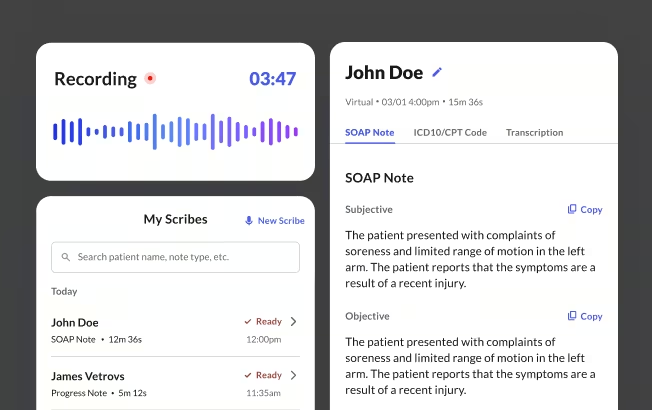
The first value moment for a pediatrician comes right after clicking End Recording. Within seconds, a structured SOAP note appears, highly accurate, with suggested ICD-10 and CPT codes generated. The note captures the full clinical context of the encounter, including the parent-reported history from a crowded exam room. Clinicians say "the AI caught things I would have missed."
The criteria above frame the fit. Four points stand out:
- Multi-speaker capture: the system recognizes multiple speakers, the baseline need for a pediatric AI scribe.
- Language support: 90 languages with automatic detection, no manual selection.
- EHR fit: 60+ EHR integrations. Solo and small practices use copy/paste; medium and large group practices can access one-click sync with EHR.
- Templates: specialty-specific templates plus a custom template builder. Pediatricians adapt the tool to their clinical voice, and the AI learns their phrasing.
The honest caveat for any best AI scribe for pediatrics shortlist stands. Commure Scribe does not ship an out-of-box Bright Futures template set. A pediatric practice builds well-child structure in the template builder rather than inheriting a vendor format. For teams that want their own charting style encoded, that is the design intent. For teams that want a preconfigured AAP-aligned format on day one, the trial is the place to test whether the builder closes that gap.
For a ranked breakdown across specialties and practice sizes, see the AI medical scribe and best AI medical scribes guides.
Frequently Asked Questions
Can AI scribes tell apart parent and child speakers?
Several can, with varying reliability. Commure Scribe and Sunoh.ai document multi-speaker separation as a core pediatric AI scribe feature. Sunoh names patient, parent, clinician, and translator roles⁶. Freed handles it but can misattribute when caregiver involvement is heavy. The dependable test is recording a real visit with a talkative parent during a trial.
Do AI scribes support Bright Futures templates?
None of the five reviewed tools publishes Bright Futures-aligned well-child templates out of the box. All five (Commure Scribe, Freed, Sunoh, Heidi, and Abridge) rely on templates the practice configures or adapts.
How do AI scribes document immunizations?
They draft the vaccine conversation, not the structured record. CVX codes, lot numbers, VIS dates, and IIS export still run through the EHR¹⁰. Some AI scribes for pediatrics give immunizations a dedicated note section. No tool reviewed here claims to populate registry-grade vaccine data from audio alone.
Can AI scribes handle EPSDT documentation?
An AI scribe for pediatrics can draft the narrative an EPSDT note needs. The practice still has to confirm the required screening components appear. EPSDT entitles children under 21 to periodic screening, vision, dental, and hearing services¹¹. State Medicaid requirements vary, so compare generated notes against your state's component checklist during a trial.
How do I explain an AI scribe to parents?
Keep it short and concrete. The AI scribe listens during the visit and drafts the note, the clinician reviews and approves it, and the family can decline. Mention that recordings are handled under HIPAA safeguards. State consent rules for recording vary, so follow your state's requirements and your practice's consent script.
This article is for informational and educational purposes only, does not constitute legal, medical, or professional advice, and does not guarantee billing or compliance outcomes.
Sources
- American Academy of Pediatrics. Bright Futures. https://brightfutures.aap.org
- Pelletier, J.H., Watson, K., Michel, J., McGregor, R., & Rush, S.Z. (2025). Effect of a generative artificial intelligence digital scribe on pediatric provider documentation time, cognitive burden, and burnout. JAMIA Open, 8(4), ooaf068. https://doi.org/10.1093/jamiaopen/ooaf068
- Rabbani, N., Ray, M., Verhagen, E., Hatoun, J., Burckett Patane, L., & Vernacchio, L. (2025). Ambient artificial intelligence scribes in pediatric primary care: A mixed methods study. Applied Clinical Informatics, 16(5), 1578–1587. https://doi.org/10.1055/a-2625-0750
- Freed AI. (2026). Pricing. https://www.getfreed.ai/pricing
- Freed AI. (2026). AI Scribe for Multilingual Visits. https://www.getfreed.ai/resources/ai-scribe-multilingual-visits
- Sunoh.ai. (2025). Pediatrics AI Medical Scribe Software Solutions. https://sunoh.ai/ai-medical-scribe-for-pediatrics/
- Sunoh.ai. (2024). Priority Care Pediatrics Selects Sunoh AI-Powered Medical Scribe. https://sunoh.ai/press-releases/priority-care-pediatrics-selects-the-sunoh-ai-ai-powered-medical-scribe/
- Heidi Health. (2026). Pricing. https://www.heidihealth.com/en-us/pricing
- Abridge. (2026). Trust Center. https://trust.abridge.com
- Centers for Disease Control and Prevention. CVX: Vaccines Administered Code Set. https://www2.cdc.gov/vaccines/iis/iisstandards/vaccines.asp?rpt=cvx
- Centers for Medicare & Medicaid Services. Early and Periodic Screening, Diagnostic, and Treatment. https://www.medicaid.gov/medicaid/benefits/early-and-periodic-screening-diagnostic-and-treatment/index.html
.jpeg)
.jpeg)
.jpeg)


.jpeg)
.jpeg)
.jpeg)
.jpeg)