



Heidi Health Review (2026): Features, Pricing, and Limitations
Covers note quality, EHR integration, coding, compliance, pricing, and fit by practice size for Heidi Health.

Medically Reviewed by Dr. Jean-Luc "JL" Neptune, Clinical Commercial Leader
Written by the Commure Scribe Team
Published: March 11, 2026
•
8 min read
Updated March 11, 2026
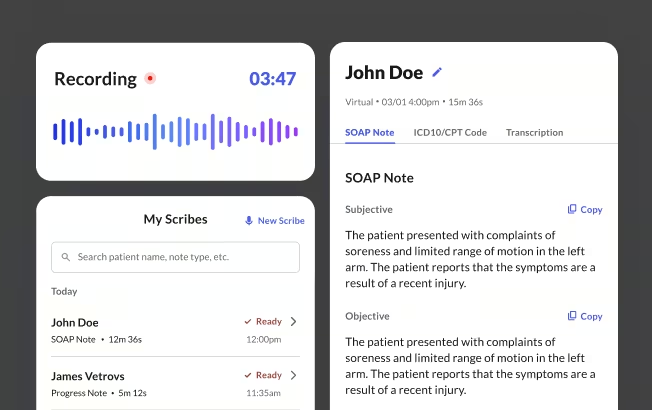
Heidi Health is an AI medical scribe with strong template customization and multilingual support. It also offers a free plan with no time limit. For US practices, the limits sit at the plan boundary. Electronic health record (EHR) write-back and a signed business associate agreement (BAA) need the custom-quoted Practice tier. The self-serve Clinician plan costs $150 per user per month, billed yearly. Its templates stay static and do not learn from each clinician's edits.
What You Need to Know About Heidi Health
- Heidi Health is an AI medical scribe with genuine strengths in template customization and multilingual support, and a free plan that lowers the barrier to entry. The limits appear at the plan boundary: electronic health record (EHR) write-back and coding both sit above the self-serve Clinician tier.
- Its most significant gaps for US practices: EHR write-back is gated behind the Practice tier or above (not available on the $150/month Clinician plan), the Clinician tier increased significantly in price with the 2026 rebrand, and there is no adaptive learning that adjusts to individual clinician documentation style.
Documentation burden is one of the most consistent drivers of clinician burnout in US healthcare, with EHR use linked to reduced job satisfaction, cognitive fatigue, and after-hours administrative time across practice settings.¹⁰,¹¹,¹² Heidi Health is an AI medical scribe built initially for the Australian market and now actively expanding into the US. It transcribes patient encounters in real time and generates structured clinical notes across 200+ specialties. With 2M+ weekly consultations processed and a documented enterprise rollout at Beth Israel Lahey Health, Heidi has reached a scale that puts it alongside established US market competitors.
This review covers what Heidi does well, where it falls short for US outpatient practices, and when a different tool is worth evaluating. See the complete guide to AI medical scribes for a full evaluation framework.
What Heidi Health Is
Heidi Health is an AI medical scribe that listens to clinical encounters, in-person or via telehealth, and generates structured clinical documentation. It supports SOAP and specialty-specific note formats, customizable templates, and an AI assistant ("Ask Heidi") for inline queries during documentation. HIPAA compliance is available for US practices. A signed BAA requires the Practice tier or above; it is not included on the Clinician plan or lower.
The product expanded significantly in early 2026. Heidi Evidence adds ad-free, citation-backed clinical decision support via partnerships with HealthPathways, BMJ Group, and NICE. Heidi Comms adds AI-powered patient outreach (calls, bookings, reminders, follow-ups). An acquisition of UK-based AutoMedica extended the platform's reach into British GP workflows.
What Heidi Health Does Well
Template customization is Heidi's most consistent differentiator. The template builder offers deeper control over note structure and formatting than most competitors. Clinicians in multi-specialty environments who need visit-type-specific note layouts consistently cite this as a reason to stay on the platform.
Multilingual support is genuine. Most competing AI scribes are effectively English-only. Heidi supports clinical encounters across multiple languages, a meaningful advantage for practices serving diverse patient populations. Confirm current language coverage and detection method at heidihealth.com.
The Free plan provides real evaluation time. Unlike trial models that expire after 7 days, Heidi's Free plan provides ongoing access to basic transcription and standard template notes. The 10 Pro Actions per month limit means it is not a production solution at that tier, but it gives clinicians time to assess note quality on their actual case mix before any payment decision.
Enterprise traction is documented. Beth Israel Lahey Health completed a system-wide rollout following a 6-month pilot with 1,000 providers. Published results from the health system: 89% of providers satisfied with note quality, 90% felt more present with patients, 82% reported reduced cognitive load, 74% reported reduced after-hours time.¹ These outcomes align with broader published evidence showing AI scribes can meaningfully reduce administrative burden and burnout,⁷ with some large health system deployments reporting more than 15,000 clinician hours saved annually.⁹
Heidi Evidence adds clinical decision support. The Evidence Plus tier ($40/user/month) provides access to premium sources including BMJ and NICE guidelines. For practices where inline decision support matters at the point of documentation, this differentiates Heidi from pure-scribe competitors.
The 2026 price increase is significant context for US practices evaluating cost. The Clinician plan increased substantially with the February 2026 rebrand.² For US practices evaluating Heidi today, $150/month on annual billing is the standard paid option.
The Free plan becomes restrictive in regular clinical use. Ten Pro Actions per month runs out quickly. Custom templates and advanced AI features are gated behind Pro Actions; once the monthly limit is reached, those capabilities are unavailable until the next billing cycle.
EHR write-back is not included in the Clinician plan. At $150/month, notes must be manually transferred to the EHR. Push-to-chart requires the Practice tier or above; both are custom-quoted. For a broader look at what AI scribe pricing includes across the market, see the AI medical scribe pricing guide.
EHR Integration
Heidi confirms write-back EHR integrations with athenahealth through the Athena Marketplace, Epic through SmartSections and eClinicalWorks through Vim.³ A developer application programming interface (API) is available for custom EHR connections. All write-back requires the Practice tier or above. Cerner and Oracle Health have no confirmed write-back case study, and ISV certification status is not confirmed in the published product pages.³
All write-back integrations require the Practice tier or above. The Clinician plan at $150/month does not include push-to-chart. For a full clinic day without write-back, the scribe produces a note that still requires manual transfer, the same 30–60 minutes of end-of-day editing the tool is designed to eliminate.
Epic integration, even at Enterprise, carries meaningful deployment overhead: SMART on FHIR app registration, institutional security review, interconnect server configuration, Connection Hub setup, and user provisioning.³ This is standard for Epic, but it is not a same-day activation and requires IT resources most independent and small group practices do not have on staff.
What the Research Says About AI Scribe Accuracy
No AI scribe has been independently tested without finding some inaccuracies. A 2025 NEJM AI trial of 238 physicians at UCLA tested two AI scribes head-to-head and found real benefits (one tool cut documentation time by nearly 10%) but also found errors in every category reviewed: missed information, over-simplified note structure, and pronoun mix-ups. One mild patient safety event was reported.⁴ A separate review of clinician experience with ambient scribes found that results varied significantly by visit type and specialty.⁶,⁸
This is not unique to any one product. It is how the category works today. Every AI scribe, including Heidi, produces notes that require clinician review before they go in the chart. The question for any practice is not whether to review, but how much editing is typically required. For a closer look at how it works in practice, check our ambient listening guide.
Documentation Style and Customization
Heidi does not adapt to individual clinician documentation style. If a clinician has specific preferences for how a history of present illness (HPI) is structured, how the Assessment is framed, or what phrasing appears in a particular section, those preferences require manual re-application via template editing. The tool does not learn from corrections or edits made to its output over time.
Heidi's template customization partially offsets this. The template builder gives clinicians meaningful control over note structure upfront. But the customization is static: it does not update based on how a clinician edits notes session to session. For practices with highly consistent documentation patterns, this is workable. For clinicians whose documentation preferences evolve or vary by patient type, it adds recurring manual overhead.
US Market Infrastructure
Heidi is still building its US market infrastructure. The product was built for the Australian GP market; Best Practice and MedicalDirector are its native EHR targets. It has been expanding into the US EHR ecosystem over the past two years. The BILH deployment demonstrates enterprise-level capability. Independent and small group practices that need responsive support on integration or billing questions are more exposed to the gaps in that infrastructure. Confirm current US support availability and response SLAs before deployment.
Who Heidi Is Best For
Heidi is strongest for solo and small-practice clinicians who want a free evaluation tier with no time limit, practices with genuine multilingual documentation needs, large enterprise deployments with IT resources to manage EHR integration overhead, and UK/EU practices where native EHR alignment is more favorable.
Heidi is a harder fit for US practices that need EHR write-back without a Practice or Enterprise contract, practices where coding automation is a day-one requirement at self-serve pricing, and clinicians who need a tool that adapts to their documentation style over time.
Where Heidi Falls Short: What Commure Scribe Addresses
Heidi's four documented gaps are EHR write-back gated to the Practice tier, a $150 per month Clinician plan with a 2026 price increase, no adaptive style learning, and coding excluded from the self-serve paid plan. Commure Scribe covers each: 60+ integrations with the Chrome Extension on all tiers, $59 per month annual on ScribePro, style learning for tone, structure and phrasing, and ICD-10 and CPT coding on all paid tiers.
EHR integration without enterprise gating. Commure Scribe offers 60+ EHR integrations. Notes transfer into any web-accessible EHR. One-click EHR sync is available for medium to large group practices with verified native integrations for athenahealth, eClinicalWorks, and AdvancedMD, among others. The Chrome Extension and copy-paste options covers most outpatient stacks for independent and small group practices.
Pricing. ScribePro is $89/month billed monthly or $59/month billed annually. (view the most up-to-date pricing here)That tier includes unlimited transcription, custom templates, AI Copilot, and automated ICD-10/CPT coding. Heidi's equivalent paid tier (Clinician) is $150/month on annual billing, with EHR write-back requiring a separate Practice or Enterprise contract on top.
Adaptive style learning. Commure Scribe learns tone, structure, and phrasing automatically from how clinicians use and edit notes. Documentation preferences are applied without requiring manual template reconfiguration each session.
Transcription accuracy. Commure Scribe delivers 99.4% verified transcription accuracy with multi-speaker differentiation, distinguishing between provider, patient, and family voices in complex visits. Average chart close time is 43 seconds per clinician report.
Coding automation at self-serve pricing. Automated ICD-10 and CPT code generation is included on ScribePro and ScribeEnterprise, not gated behind enterprise pricing.
For a broader comparison of the top tools in the category, see the best AI medical scribes guide.
Frequently Asked Questions
Heidi AI builds notes from templates the clinician sets up. The plan section reflects what the template captures. Commure Scribe drafts the plan from the encounter itself. Clinicians report the output is more detailed than their own notes. Both tools rely on copy-paste for EHR transfer unless your system is among the supported integrations. Heidi AI’s EHR integration is a paid add-on on all plans.
Heidi AI’s free tier is permanent and includes unlimited transcription with limited features. Individual paid plans are Evidence Plus at $30 per user per month and Clinician at $110 per user per month, both billed annually. Team plans are Evidence Team at $50 per user per month and Practice at $180 per user per month. Enterprise pricing is custom, so confirm current rates with Heidi.
Yes. Heidi AI has a free tier with no time limit for basic note creation. Advanced features, including EHR sync, require a paid plan. Commure Scribe offers a 7-day trial with no credit card required. The trial expires after 7 days. Check what each tool gates before you start so the comparison is fair.
Heidi AI stores notes and transcripts but not audio, according to Heidi. Audio is transcribed during the visit and then deleted. Users can set retention for transcripts and notes from 1 to 90 days, after which Heidi deletes them irreversibly. Confirm the current policy on Heidi's security page before clinical use.
Heidi AI is HIPAA compliant and SOC 2 Type II certified. A BAA is available. Request their audio handling policy and full security documentation before clinical deployment, as published compliance pages may not reflect the latest policies.
Sources
- FierceHealthcare. Beth Israel Lahey Health / Heidi Health system-wide rollout. April 2026. https://www.fiercehealthcare.com
- Heidi Health. Pricing. 2026. https://heidihealth.com/en-us/pricing
- Heidi Health. EHR Integration. April 2026. https://heidihealth.com/en-us/blog/ehr-integration
- Lukac PJ, et al. Ambient AI Scribes in Clinical Practice: A Randomized Trial. NEJM AI. 2025;2(12). https://ai.nejm.org/doi/abs/10.1056/AIoa2501000
- Cohen IG, Ritzman J, Cahill RF. Ambient Listening—Legal and Ethical Issues. JAMA Network Open. 2025. https://jamanetwork.com/journals/jamanetworkopen/fullarticle/2830390
- Duggan MJ, et al. Clinician Experiences With Ambient Scribe Technology to Assist With Documentation Burden and Efficiency. JAMA Network Open. 2025;8(2):e2460637. https://pmc.ncbi.nlm.nih.gov/articles/PMC11840636/
- Olson KD, et al. Use of Ambient AI Scribes to Reduce Administrative Burden and Professional Burnout. JAMA Network Open. 2025;8(10):e2534976. https://jamanetwork.com/journals/jamanetworkopen/fullarticle/2839542
- The impact of using AI-powered voice-to-text technology for clinical documentation on quality of care in primary care and outpatient settings: a systematic review. PMC. 2025. https://pmc.ncbi.nlm.nih.gov/articles/PMC12301838/
- AI scribes save 15,000 hours and restore the human side of medicine. American Medical Association / NEJM Catalyst. 2025. https://www.ama-assn.org/practice-management/digital-health/ai-scribes-save-15000-hours-and-restore-human-side-medicine
- Burnout Related to Electronic Health Record Use in Primary Care. PMC. 2023. https://pmc.ncbi.nlm.nih.gov/articles/PMC10134123/¹
- Electronic Health Record Usability, Satisfaction, and Burnout for Family Physicians. JAMA Network Open. 2024. https://jamanetwork.com/journals/jamanetworkopen/fullarticle/2822959
- Wu Y, Wu M, et al. Evaluating the Prevalence of Burnout Among Health Care Professionals Related to Electronic Health Record Use: Systematic Review and Meta-Analysis. JMIR Medical Informatics. 2024;12:e54811. https://medinform.jmir.org/2024/1/e54811
.jpeg)
.jpeg)


.jpeg)
.jpeg)
.jpeg)
.jpeg)