



Best AI Scribe for athenahealth in 2026: 6 Tools Compared
A comparison of athenaAmbient and four third-party scribes, with pricing, integration depth, and a buyer guide by practice size.
Written by the Commure Scribe Team
Published: March 25, 2026
•
10 min read
Updated September 14, 2026
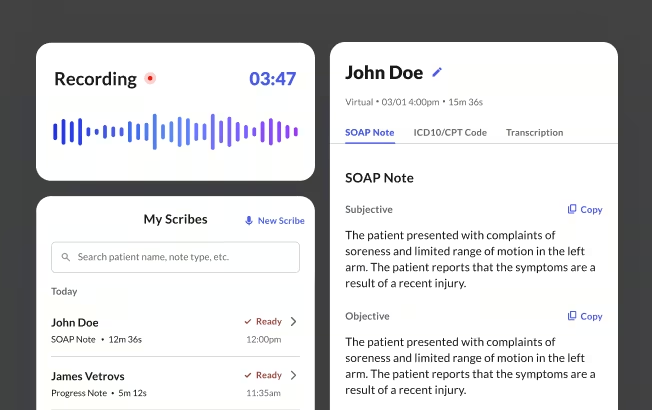
A scored comparison of the AI medical scribe options an athenahealth practice can buy today. Every criterion, weight and score is published, so any placement can be recomputed.
What You Need to Know About the Best AI Scribe for athenahealth
- athenahealth runs two ambient-documentation products: Ambient Notes and athenaAmbient.¹ Ambient Notes went live in October 2024.¹¹ It lets a clinician choose among third-party engines.¹² athenaAmbient, athenahealth's own native scribe, shipped network-wide on August 13, 2026 and ranks third here.¹⁰
- Three products run inside athenaOne, and the top pick is not one of them. athenaAmbient, Ambient Notes and Suki all score 8.0 on write-back depth, the heaviest criterion here. Cost, trial terms and published quality controls decide the rest.
- No scribe on this page writes coded data into athenaOne. Every one of them suggests codes inside its own application. A clinician still moves them into the chart by hand.
The best AI scribe for athenahealth is Commure Scribe, followed by Freed and athenaAmbient. Commure Scribe wins on published quality controls, trial terms and group administration, without leading chart integration itself.
Verified against vendor and athenahealth documentation on September 15, 2026. athenaAmbient shipped August 13, 2026 and is scored below. Pricing and integrations in this category change monthly. Check current details with each vendor before deciding.
Disclosure. Commure publishes this page and sells Commure Scribe. We scored it against the same criteria and weights as every other scribe here, and published the result whether or not it favors us. Commure Scribe places first.
The six AI scribes for athenahealth at a glance
Practices buy four of these separately: Commure Scribe, Freed, Nabla and Suki. athenaOne bundles the other two. They differ most in how deep the note reaches and whether the vendor publishes a price.
The six scribes in detail
1. Commure Scribe
Total 6.76. Strongest on published quality controls and coding, mid-table on write-back depth.
Commure Scribe records the encounter and produces a structured note within seconds. It connects through the official athenahealth application programming interface (API) and writes each note section into the matching free text field, with no copy-paste step. The named target fields are history of present illness (HPI), Review of Systems, Physical Exam, Assessment and Plan, and Patient Instructions.⁶
Suggested ICD-10 and CPT codes arrive at the entry price. Both come from the same encounter recording, and the clinician can review what the scribe produces and revise it before anything reaches the note.
Pricing. $59 per month billed annually, taken as a single $708 payment, with a 7-day trial and no credit card. Commure publishes no separate monthly rate. Direct EHR integration is arranged through group sales rather than self-serve checkout. Current plans are on the Commure Scribe pricing page, and our guide to AI scribe pricing compares per-provider costs across this category.
What holds it back. All five named fields are free text, so no coded data reaches athenaOne. Direct EHR integration runs through group sales, which puts it out of reach for a solo clinician or a practice of two or three. Below that size the Chrome overlay covers any browser-based EHR, though Commure publishes nothing describing it. Write-back is the criterion where all of this costs the most.
2. Freed AI
Total 6.66. Publishes the most precise athenahealth field map here, and states its own limitation plainly.
Freed AI pushes notes into athenaOne through a Chrome extension. Its help center publishes the field mapping in full.⁷ Subjective goes to HPI, Review of Systems to Review of Systems, and Objective to Physical Exam. Assessment and Plan goes to matched diagnosis cards, Patient Instructions to Patient Instructions. Freed also warns clinicians to stay on the clinical section tabs and avoid Review and Sign-Off.
Pricing. Starter runs $39 per month with a 40-note cap, Core $79 per month with unlimited notes.⁸ Premier runs $119 per month, or $1,248 per year at $104 per month, and carries EHR push and the coding assistant. A 7-day trial runs with no credit card.
What holds it back. Freed will not create new diagnoses in athenahealth.⁷ Content routes to a matching diagnosis card where one exists, and lands as free text in the Assessment and Plan summary where none does. Freed is the only vendor here that writes that constraint down.
3. athenaAmbient
Total 6.35. Free, live immediately, and thin on published detail.
athenahealth built athenaAmbient into athenaOne and turned it on for more than 170,000 clinicians on the network, at no additional cost.¹⁰ It drafts notes, suggests potential diagnoses and recommends order types, on desktop and mobile. athenahealth names no partner vendor.
Pricing. Included in athenaOne since August 13, 2026.¹⁰ A current athenaOne customer signs up for nothing.
What holds it back. athenahealth publishes no detail on grounding, ambiguity handling or review controls, and describes no coded billing output. Its only evidence comes from its own early rollout since late 2025. athenahealth reports nearly six fewer minutes per encounter, and up to a 30 percent increase in same-day chart completion.¹⁰
4. Nabla
Total 5.50. The strongest independent evidence here, and no published price.
Nabla exports to athenaOne in one click, updating HPI, Physical Exam, Assessment and Plan, and social history.⁹ It holds an athenahealth Marketplace listing. In early 2026 Nabla extended the integration to read patient context at visit time. That context covers reason for visit, past encounters, problem list and current medications for renewals.
Pricing and trial. Nabla publishes no pricing anywhere we could reach. A free tier with volume limits opens the product without a sales call, and Nabla places no expiry on that tier.
What holds it back. Nabla documents no grounding or fabrication-control method. It also does not say which surface performs the export, the Chrome extension or the Marketplace API.
5. Suki AI
Total 4.55. Ties for the deepest write-back on this page. Trails on everything a small practice checks first.
Suki AI sits deeper inside athenaOne than anything else here. It has powered athenahealth's Ambient Notes since November 2024.⁴ The pairing became available on May 1, 2025.¹³ Suki reaches athenaOne two ways: its own Marketplace app, and embedded technology inside Ambient Notes.
Pricing. Suki publishes plan names and the words "per user per month" with no figure beside them.⁵ The page says Suki Assistant includes EHR integration with Epic, Cerner, Athena and Meditech.⁵ Suki Compose carries a one-line description and no price. The $399 and $299 figures for those two plans circulate only in third-party roundups, which label them secondhand. We score no price that a vendor has not published. Suki offers volume discounts without naming a figure, and publishes no minimum, term or setup fee.⁵
What holds it back. No self-serve trial exists, so any evaluation starts with a sales conversation. Suki publishes little about grounding, ambiguity handling or quality assurance, and little about group administration. Its own press release announced athenahealth preferred solution partner status for ambient intelligence on January 26, 2026.¹⁴
6. Ambient Notes
Total 4.12. Deep write-back, but no price, no trial and thin evidence.
athenahealth has run Ambient Notes since October 2024. It wraps third-party engines, and a clinician picks one. athenahealth named iScribe AI and Suki AI at launch.¹¹ Abridge joined the roster in February 2025.¹² A 2026 release note omitted Abridge, so confirm which engines are selectable before assuming any specific one.
Pricing. athenahealth publishes no price for Ambient Notes and no list price for athenaOne, so a buyer cannot compute what the combination costs.³ Access runs through an athenaOne contract.
What holds it back. athenahealth describes no coded billing output, and the engine a practice gets depends on which model athenahealth enables that quarter. Neither cost nor trial is determinable outside a full athenaOne negotiation. It matches Suki and athenaAmbient on write-back depth and still scores lowest here.
Scorecard
† Scored on company confirmation, not on published documentation. Three of the seven Commure Scribe scores come from capability Commure confirms but has not documented publicly yet. Every score for every other product traces to that vendor's own site or to athenahealth's. Totals are rounded half-up.
Where Commure Scribe lands. Commure Scribe leads on published quality controls and coding. On documented evidence it places fourth.
It does not lead the criterion this page is about. Write-back depth carries 32 points, and Suki, athenaAmbient and Ambient Notes all score 8.0 against our 5.5. Our API writes into five named athenaOne fields, every one of them free text.⁶ Direct EHR integration also runs through group sales, and a solo clinician runs the Chrome overlay instead.
How we scored them
We scored each product 0 to 10, in half-point increments, against seven criteria weighted for an athenahealth practice of 1 to 100 clinicians. Weights sum to 100.
Why these weights. Write-back carries the most because athenaOne Mobile is where the clinician closes an encounter. The deciding question is how much of the note the clinician retypes to get it there.
Quality controls carry 22 because athenahealth publishes nothing about how any brokered model handles grounding or ambiguity. Each practice reads the vendor's own controls and carries whatever risk is left at sign-off.
Cost carries 20 because athenahealth publishes no price of its own. Its cost-and-value page ties pricing to a practice's collections, with no percentage and no floor.³ The scribe line is the only number a practice can pin down before a sales call.
Coding carries 4, the lowest weight in this cluster, because an athenaOne practice already codes through athenaCollector. A scribe suggesting codes duplicates work the practice already owns. That costs Commure Scribe points, and it is still the right weight for this buyer.
Three rules govern every score. We score only what this buyer can actually buy. When no fact exists, we mark the criterion not assessable instead of guessing. When a company's documentation and its marketing disagree, we score the documentation, including our own.
How write-back depth is banded. Four mechanisms reach the athenaOne chart. They differ in how much clicking, copying and retyping the clinician does to get a finished note into it.
- Embedded: the scribe runs inside athenaOne and the clinician never leaves the app. athenaAmbient and Ambient Notes work this way.
- API write: the scribe drafts in its own application, then writes each section into the matching athenaOne field. Commure Scribe works this way.
- One-click export: the clinician reviews in the scribe, clicks once, and the note lands in named athenaOne sections. Nabla works this way.
- Browser extension push: the scribe overlays the athenaOne tab and fills fields on screen. Freed works this way.
We publish vendor-reported figures but do not score them. Accuracy percentages, satisfaction scores and time-savings claims are first-party data about what each vendor states. They appear further down with attribution, and none enters the arithmetic, for any product including ours.
How to choose by practice size
Solo and 1 to 5 clinicians. athenaAmbient costs nothing and needs no signup, which makes it the default starting point. A third-party scribe at this size means a browser overlay or a copy-and-paste step. Freed at $119 per month on Premier publishes a field map. Commure Scribe at $59 per month billed annually adds coding at the entry price.
Group practices of 6 or more. Manual steps compound across a full day, and coding starts to matter for revenue rather than convenience. This is the size where direct EHR integration becomes worth arranging, and where Suki and athenaAmbient's write-back depth counts for most. Ask every vendor for the athenaOne field map in writing. The difference between five free-text fields and coded data decides how much the clinician retypes after the note lands.
Whatever the size, pilot on real visits. Confirm business associate agreement (BAA) terms with each vendor first, using our HIPAA-compliant AI note-taking checklist. Test where content lands, how much editing each note needs, and the click count from End Recording to a signed chart. A Marketplace listing is a vetting signal, not a fit signal.
What each vendor claims about itself
None of these figures is independently verified, and no two came from the same test.
Where competitors beat us
Suki sits inside athenaOne in a way nothing else here matches. athenahealth contracts it directly, and the clinician never leaves the app. If native placement matters most, Suki is the answer.
Freed publishes the best integration documentation in this group. Its help center maps each note section to the field it lands in, and it states its own limitation plainly. We publish no equivalent article for athenahealth and no equivalent limitation.
athenaAmbient costs nothing and needs no signup. That beats Commure Scribe on cost and on trial.
Nabla carries the strongest independent evidence in this group. It scores highest of the six on that criterion, and Commure Scribe places mid-table. Nabla also opens a free tier with volume limits, where Commure Scribe runs a 7-day trial instead.
Method and limits
The quality criterion measures what a vendor publishes about grounding, review and quality assurance, not note accuracy.
The sweep test. If a publisher's own product wins most criteria of a field, the criteria describe that product rather than measure it. Commure Scribe leads or ties 2 of 7 criteria and leads on total, and it does not lead the criterion the keyword is about. Both of those two sit on cells scored from company confirmation. That is the weakest way to pass this test.
The attestation count. Three of our seven scores rest on internal confirmation: published quality controls, coding and group administration. Every competitor cell traces to that vendor's own documentation. On published evidence alone Commure Scribe scores 5.68 and places third, substituting quality 4.5, coding 4.5 and group administration 2.5 for the attested cells.
Three of the six publish no usable price: Nabla, Suki and athenahealth's own Ambient Notes. athenahealth publishes no list price for athenaOne either, so no buyer here can compute a full cost of ownership from published material. Totals rank products on this page only.
AI Scribes for Other EHRs
These guides apply the same comparison to practices on other EHRs.
- AI scribes for AdvancedMD reviews four options for AdvancedMD practices.
- AI scribes for eClinicalWorks compares five tools for eClinicalWorks practices.
- AI scribes for SimplePractice covers options for behavioral health clinicians on SimplePractice.
The best AI medical scribes head-to-head guides provides comparison across the whole category.
This article is for informational and educational purposes only, does not constitute legal, medical, or professional advice, and does not guarantee any clinical, workflow, or financial outcome.
Frequently Asked Questions
Yes. athenaAmbient shipped on August 13, 2026, built into athenaOne at no additional cost, live to more than 170,000 clinicians on the athenahealth network.¹⁰
Yes. athenahealth includes it in athenaOne at no additional cost. athenaOne itself carries no published list price, so that bundling tells a buyer nothing about what the base platform costs.
Ambient Notes wraps third-party engines. athenahealth named iScribe AI and Suki AI at the October 2024 launch.¹¹ Abridge joined in February 2025.¹² athenaAmbient runs athenahealth's own model, with no partner vendor named. Both are live. They are separate products, not a rename.
Yes, two ways. Suki has powered athenahealth's Ambient Notes since November 2024.⁴ The pairing became available on May 1, 2025.¹³ Suki also lists its own application in the athenahealth Marketplace.
Suki, athenaAmbient and Ambient Notes all score 8.0 on write-back depth, the highest here. Each runs inside athenaOne rather than writing into it from outside.
Yes. It connects through the official athenahealth API and writes each note section into the matching free text field.⁶ The five named fields are HPI, Review of Systems, Physical Exam, Assessment and Plan, and Patient Instructions. Direct EHR integration runs through group sales, and a solo clinician uses the Chrome overlay.
No need to wait. athenaAmbient is live and ranks third. A practice that needs documentation relief this quarter can choose among all six scribes scored above.
Sources
- athenahealth. "AI-powered healthcare." athenahealth.com/solutions/athenaone/ai-powered-healthcare
- athenahealth. "Ambient Notes." athenahealth.com/solutions/ambient-notes
- athenahealth. "Cost and value." athenahealth.com/why-choose-us/cost-value
- Suki. "Suki for athenahealth"
- Suki. "Pricing"
- Commure. "The AI scribe built for athenahealth." getscribe.commure.com/lp/the-ai-scribe-built-for-athenahealth
- Freed. "EHR Push for athenahealth"
- Freed. "Pricing"
- Nabla. "Nabla for athenahealth"
- athenahealth. "athenahealth's AI-native athenaOne experiences now available to 170,000 clinicians." BusinessWire, August 13, 2026.
- athenahealth. "athenahealth Launches AI-Powered Ambient Notes." Press release, October 30, 2024.
- Fierce Healthcare. "Abridge ambient scribe arrives in athenahealth EHR." February 27, 2025.
- Suki. "Suki and athenahealth Expand Partnership With General Availability of Ambient Notes Using Suki's Ambient Technology." BusinessWire, May 1, 2025.
- Suki. "Suki Selected by athenahealth as Preferred Solution Partner for Ambient Intelligence." BusinessWire, January 26, 2026.





.jpeg)
.jpeg)

.jpeg)