



Clinical Documentation: A Complete Guide
From SOAP notes to the 2021 CMS E/M overhaul: what independent and group practices need to know about clinical documentation in 2026.
Written by the Commure Scribe Team
Published: June 12, 2026
•
8 min read
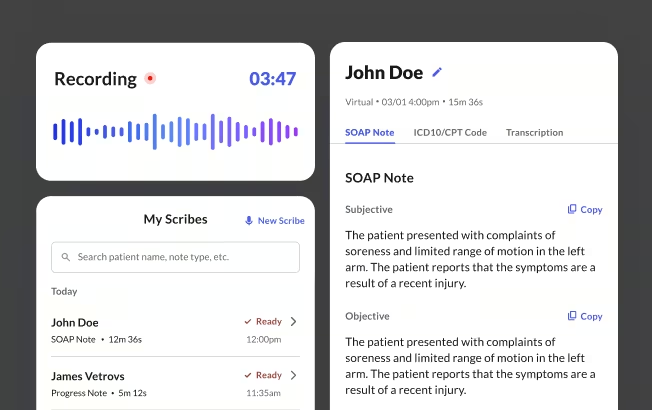
Clinical documentation covers the records made during patient care. Visit records cover history and physical (H&P) exams, Subjective, Objective, Assessment, Plan (SOAP) notes and progress notes. Procedure notes, referral letters and discharge summaries are part of it too. These records support clinical care and back up billing and coding. They also form the legal record of services given. Each type has its own content needs, regulatory rules and effects on payment.
What You Need to Know About Clinical Documentation
- Clinical documentation is every record created during patient care, from SOAP notes and referrals to procedure records and discharge summaries.
- A 2025 JAMA Network Open study found AI scribes cut physician burnout odds by 74% within 30 days.¹
- Independent practices can evaluate AI scribes using published RCT evidence and verify HIPAA compliance before onboarding.
Every patient encounter generates records that serve at least three purposes: clinical care, billing and coding, and legal documentation. Understanding what falls under clinical documentation helps practices set standards, train staff, and evaluate tools that might cut the time spent on it.
The records involved range from initial history and physical exams to progress notes, procedure records, referral letters, and discharge summaries. Each type has different content needs, different regulatory rules, and different implications for reimbursement.
Two changes have shifted how independent and group practices approach this work. In 2021, Centers for Medicare & Medicaid Services (CMS) revised its E/M coding rules for office visits. The change removed the need to document history and physical exam elements for code selection. Since 2023, ambient docuentation tools have moved from pilots in academic medical centers to tools available to solo and small-group practices. The evidence base for these tools is now substantial enough to evaluate.
The sections below cover formats, accuracy, the 2021 CMS changes, the documentation burden, and how AI scribes address it.
What are the common types of clinical documentation?
The common types are SOAP notes, history and physical exams, progress notes, procedure notes, discharge summaries, and referral letters, each serving a different purpose in the care cycle. Independent and group practices use these record types throughout a patient relationship.
- SOAP notes organize each encounter into four parts: Subjective (patient history), Objective (exam findings), Assessment (diagnosis), and Plan (treatment). They are the default format in most outpatient EHRs.
- History and physical (H&P) exams document a patient's full medical background at the start of a care relationship or before a procedure. They are more detailed than a standard encounter note.
- Progress notes track ongoing treatment for patients with chronic or recurring conditions. They focus on changes since the last visit rather than the full clinical picture.
- Procedure notes record what was done during a clinical intervention, including technique, materials, and patient response.
- Discharge summaries capture the reason for a stay, course of treatment, medications at discharge, and follow-up instructions.
- Referral letters communicate patient information to a specialist. Their accuracy directly affects the quality of care the patient receives downstream.
The format required for any encounter depends on the setting and payer. Whether the record is used for billing or patient handoffs determines which fields matter most.
Why does clinical documentation accuracy matter for billing and care?
Accuracy matters because the note determines whether a claim is reimbursed correctly and whether the next clinician inherits a trustworthy picture of the patient. These are two outcomes that are hard to recover from when they go wrong.
On the billing side, the E/M code billed for an office visit must be supported by what the note documents. A note that doesn't reflect visit complexity can cause a claim to be billed at a lower level. That leaves revenue on the table. A note that overstates complexity can trigger a payer audit.
On the care side, clinical notes copied forward without review accumulate errors over time. Stopped medications, resolved diagnoses, and outdated lab values persist in copy-forwarded notes. They can mislead the next clinician who reads them. Auto-populated fields that don't reflect what happened during the visit carry the same risk.
Clinical documentation improvement (CDI) programs address these gaps by reviewing notes for coding accuracy and completeness before claims go out. CDI is more common in hospital systems, but independent and group practices apply the same principles at smaller scale.
Documentation gaps also create workflow friction. Over one-third of physicians report that EHR systems and after-hours documentation take time away from patient care.² Accurate, complete notes cut correction cycles, claim denials, and the time spent resolving discrepancies after the encounter.
What did the 2021 CMS documentation changes require for outpatient visits?
The 2021 changes let physicians select E/M codes for office and outpatient visits based on medical decision making or time, dropping the old requirement to document specific history and exam elements. Effective January 1, 2021, the rule cut the documentation work required for each encounter.
Before 2021, E/M code selection for office visits (CPT codes 99202–99215) required documenting specific elements of a history and physical exam. The level of detail documented determined the code level billed. After 2021, CMS eliminated that rule. Code selection now relies on either Medical Decision Making (MDM) or the total time spent on the date of the encounter. CMS stated: "The requirement to document the elements of History and Physical Examination in the medical record will no longer be used to determine the level of the E/M office/outpatient visit."³ ⁴
In practice, physicians no longer need to document system reviews or multi-element exams to justify a billing code. Documentation can focus on clinical decisions and time spent, not on satisfying an element checklist.
Practices that haven't updated their note templates since 2021 may still be documenting more than payers require. Auditing templates against current MDM criteria can cut note length without affecting reimbursement. A medical report template structured for CMS E/M documentation gives that audit a baseline to compare existing note templates against.
Any AI scribe that processes protected health information (PHI) requires a signed Business Associate Agreement (BAA) before use.⁹ This applies regardless of practice size. For what to verify before signing, see our guide to HIPAA-compliant AI scribes.
How much time does clinical documentation take each day?
Clinical documentation takes roughly two hours for every hour of patient care, per researchers at UCLA Health.⁵ That imbalance affects both how many patients a practice can see and how often physicians finish charts at home.
The AMA's 2024 survey found 43.2% of physicians reported at least one burnout symptom, down from 48.2% in 2023 and 53% in 2022.² EHR demands and after-hours documentation are among the most cited contributors. Finishing notes after clinic hours is common in independent practices without dedicated scribes or support staff. Clinicians call this pajama time.
AMA data also shows a gap in AI adoption between practice settings. Private practice physicians report 64% AI use, compared with 72% of employed physicians.¹⁰ Small practices most often cite per-provider cost, limited IT support, and the sense that these tools are built for large systems.
That gap matters. In smaller practices, the documentation load falls entirely on the treating physician, with no scribes or support staff to absorb overflow. A documentation time savings calculator can estimate the hours recoverable with an AI scribe at your practice volume.
How do AI scribes reduce clinical documentation time?
AI scribes cut documentation time by capturing the clinical conversation and generating the draft note automatically, so the physician edits and approves rather than writing from scratch. That draft enters the EHR only after the physician reviews and signs it. How the signed draft reaches the chart depends on the type of EHR integration, from HL7 interfaces to write-back or copy-paste, each with its own time cost.
The largest published dataset comes from The Permanente Medical Group (TPMG). The analysis tracked 7,260 physicians over 63 weeks and 2.5 million AI scribe uses.⁷ AI scribe users saved an estimated 15,791 hours of documentation time compared to non-users. Eighty-four percent of participating physicians reported a positive effect on patient communication, and 56% of patients reported a positive impact on visit quality.⁷
A 2025 randomized controlled trial at UCLA tested two AI scribes across 238 physicians and 72,000 patient encounters.⁶ Physicians using Nabla reduced documentation time by nearly 10% compared to the control group. Both AI tools showed approximately 7% improvement in burnout scores.⁶
A multicenter study in JAMA Network Open found burnout rates dropped from 51.9% to 38.8% within 30 days of AI scribe use.¹ That represents a 74% reduction in the odds of burnout across 263 physicians and advanced practice practitioners at 6 health systems.¹
The UCLA trial found AI-generated notes sometimes contained clinically significant inaccuracies, including omissions.⁶ Researchers at Columbia School of Nursing warned that "the speed of adoption has outpaced validation, transparency, and regulatory oversight."⁸ Speech recognition tools also tend to be less accurate for patients with non-standard speech patterns.⁸ Physicians must review and edit every AI-generated note before signing.
For a ranked breakdown of AI scribes by practice size and specialty, see the best AI medical scribes guide.
How Commure Scribe Reduces Clinical Documentation Time
Commure Scribe is an AI medical scribe that addresses the documentation burden described above through ambient capture. During the visit, Scribe records the clinical conversation. Within seconds of the encounter ending, a structured note appears, covering the SOAP, progress, and procedure formats outpatient practices rely on. The clinician reviews the draft, edits as needed, and finalizes it before it enters the chart, keeping the physician review step every AI-generated note requires.
Across 25 specialties, 90%+ of providers reduce clinical documentation time and digital fatigue, with an average chart close time of 43 seconds. All patient data is HIPAA compliant, System and Organization Controls 2 (SOC 2) certified, and stored onshore. Audio from each session is encrypted, retained per HIPAA requirements, and never used for AI training.
This article is for general informational and educational purposes only. It does not constitute legal, medical, or professional advice and does not guarantee compliance. Requirements vary by state, payer, and clinical setting and can change over time. Verify current details with your own compliance officer, legal counsel, or the relevant authority before relying on this information.
Frequently Asked Questions
Clinical documentation refers to all records created during patient care, including history and physical exams, SOAP notes, progress notes, procedure records, and discharge summaries. These records serve three purposes: supporting clinical care, enabling accurate billing and coding, and providing a legal record of services delivered.
The most common types for independent and group practices are SOAP notes, progress notes, H&P exams, procedure notes, discharge summaries, and referral letters. SOAP notes are the default in most outpatient EHRs. The right format depends on visit type, specialty, and payer requirements.
Starting January 1, 2021, CMS changed E/M code selection for office visits. Physicians can now select a code level based on Medical Decision Making (MDM) or total time, without documenting specific history and physical exam elements. The requirement to document exam elements for code selection was eliminated.³ ⁴
Physicians spend roughly two hours on documentation for every hour of direct patient care, per UCLA Health researchers.⁵ The AMA's 2024 survey found 43.2% of physicians reported burnout symptoms, with EHR demands and after-hours charting among the most cited causes.²
AI scribes that process protected health information must have a signed Business Associate Agreement (BAA) with your practice before use.⁹ HIPAA compliance depends on the vendor's specific security practices. Look for SOC 2 certification, onshore data storage, encryption in transit and at rest, and a clear data retention policy.
AI scribes capture the clinical conversation and generate a draft note for physician review. A 2025 multicenter study found burnout dropped from 51.9% to 38.8% within 30 days of AI scribe adoption.¹ A large-scale analysis at TPMG found users saved an estimated 15,791 hours of documentation time compared to non-users over one year.⁷
Sources
¹ Olson KD, et al. "Use of Ambient AI Scribes to Reduce Administrative Burden and Professional Burnout." JAMA Network Open, 2025. https://jamanetwork.com/journals/jamanetworkopen/fullarticle/2839542
² American Medical Association. "U.S. physician burnout hits lowest rate since COVID-19." Sara Berg, MS. May 1, 2025. https://www.ama-assn.org/practice-management/physician-health/us-physician-burnout-hits-lowest-rate-covid-19
³ Centers for Medicare & Medicaid Services. "Evaluation & Management Visits." Page last modified 03/10/2026. https://www.cms.gov/medicare/payment/fee-schedules/physician/evaluation-management-visits
⁴ Centers for Medicare & Medicaid Services. "Physician Fee Schedule Payment for Office/Outpatient Evaluation and Management (E/M) Visits – Fact Sheet." Updated 01/14/2021. https://www.cms.gov/files/document/physician-fee-schedule-pfs-payment-officeoutpatient-evaluation-and-management-em-visits-fact-sheet.pdf
⁵ UCLA Health. "UCLA study finds AI scribes may reduce documentation time and improve physician well-being." November 26, 2025. https://www.uclahealth.org/news/release/ucla-study-finds-ai-scribes-may-reduce-documentation-time
⁶ Lukac PJ, Turner W, Vangala S, et al. "Ambient AI Scribes in Clinical Practice – A Randomized Trial." NEJM AI, 2025. DOI: 10.1056/AIoa2501000. https://ai.nejm.org/doi/full/10.1056/AIoa2501000
⁷ Tierney AA, et al. (The Permanente Medical Group). "Effectiveness and Satisfaction With Ambient AI Scribe Use." NEJM Catalyst, June 2025. DOI: 10.1056/CAT.25.0040. https://catalyst.nejm.org/doi/full/10.1056/CAT.25.0040
⁸ Topaz M, Zhang Z, Peltonen LM. Commentary on AI scribe safety and validation. npj Digital Medicine, September 24, 2025. Via Columbia School of Nursing, October 8, 2025. https://www.nursing.columbia.edu/news/health-cares-rush-ai-scribes-risks-patient-safety-researchers-warn
⁹ U.S. Department of Health & Human Services. "Business Associate Contracts." HHS.gov. https://www.hhs.gov/hipaa/for-professionals/covered-entities/sample-business-associate-agreement-provisions/index.html
¹⁰ Robeznieks A. "Ready for health AI? It may depend on your practice setting." American Medical Association. May 27, 2025. https://www.ama-assn.org/practice-management/digital-health/ready-health-ai-it-may-depend-your-practice-setting
.jpeg)
.jpeg)
.jpeg)
.jpeg)



.jpeg)
.jpeg)