



The Benefits of AI in Healthcare: What Group Practices Need to Know
A guide on what AI in healthcare means for the independent and group practices.

Medically Reviewed by Dr. Jean-Luc "JL" Neptune, Clinical Commercial Leader
Written by the Commure Scribe Team
Published: May 11, 2026
•
12 min read
Updated May 11, 2026
AI helps group practices in five areas: faster documentation, diagnostic support and a lighter admin burden. Prior authorization and coding accuracy make up the other two. Ambient AI scribes target the 36.2 minutes physicians spend in the EHR per 30-minute visit. Decision support can flag drug interactions and prompt guideline care. Prior authorization tools draft payer documents for the 39 weekly requests the American Medical Association (AMA) reports. A UCSF study of 1,565 physicians linked ambient AI use to about $3,044 more yearly revenue per physician.
What You Need to Know
- More than 80% of US physicians now use AI at work, double the rate in 2023. The benefits span documentation, diagnostics, coding, and administrative workflows.
- The most proven benefits for group practices are faster notes, better coding accuracy, prior authorization support, and clinical decision alerts at the point of care.
- Effect sizes vary by vendor, practice size, and how well the rollout is managed. Large health system data does not transfer directly to smaller group practices.
The benefits of AI in healthcare are no longer theoretical. More than 80% of US physicians now use AI at work, more than double the rate in 2023, per the AMA's 2026 survey.1 For group practices managing notes, coding, prior authorizations, and clinical decisions across multiple providers, the question has changed. It is no longer whether AI is useful. It is which tools deliver real value and what risks are involved.
This article covers what AI in healthcare means for the clinical and admin tasks that matter most to group practices, what the evidence shows, what the risks are, and how to pick tools that fit your size and workflows.
What Does "AI in Healthcare" Mean for a Group Practice?
AI in healthcare covers many different tools. The term includes imaging tools that spot disease early, predictive models that flag high-risk patients, prior authorization bots, and ambient scribes that generate clinical notes. These tools have different evidence bases and different risk profiles. Grouping them all together leads to bad purchasing decisions.
For group practices, the tools with the most direct impact fall into four categories:
- Ambient documentation tools that convert clinical conversations into structured notes
- AI-assisted coding and revenue cycle tools
- AI-supported prior authorization workflows
- Clinical decision support systems embedded in the electronic health record
Most of these tools run on machine learning, natural language processing, and LLMs like ChatGPT. Machine learning finds patterns in clinical data and uses them to make predictions. Natural language processing converts spoken or written clinical language into structured text. The FDA has cleared about 950 AI-enabled medical devices as of 2024, most of them focused on radiology.2 For outpatient group practices, the most useful AI is in notes and admin work, not imaging.
What Are the Key Benefits of AI in Healthcare for Group Practices?
The benefits of AI in healthcare for group practices fall into five areas:
- Documentation efficiency
- Diagnostic support
- Administrative burden reduction
- Prior authorization management
- Coding accuracy
Documentation efficiency is the most consistently measured benefit. Physicians spend 36.2 minutes in the electronic health record per 30-minute patient visit, including 6.2 minutes of after-hours work per encounter, per a 2024 study in JAMA Network Open.3 Ambient AI scribes target this directly. They record the visit and generate a structured note, so the clinician does not need to type during or after the appointment.
Diagnostic support has the longest research track record among AI tools in outpatient care. AI-assisted clinical decision support systems can flag potential errors, surface drug interactions, and prompt clinicians to follow care guidelines.4 About 5% of adult outpatients in the United States experience a diagnostic error each year. Roughly one-third of those errors lead to serious harm.5
Administrative burden reduction matters because admin is one of the biggest non-clinical time costs in a group practice. The AMA's 2026 survey found that 70% of physicians see admin automation as the area where AI can do the most good.1 That covers notes, in-basket messages, referral letters, and patient correspondence.
Prior authorization management is one of the most frequently cited administrative burdens for group practices. The AMA's 2024 survey found physicians handle 39 prior authorization requests per week on average, which takes 13 hours of physician and staff time.6 AI tools can pull relevant clinical criteria and draft supporting documents from the patient record, reducing the manual effort per request.
Coding accuracy improves when AI-suggested codes come from the clinical note automatically. A study of 1,565 physicians at UCSF found that ambient AI use was linked to 1.81 more relative value units per week and about $3,044 more in annual revenue per physician, with no rise in denial rates.7 For group practices without a dedicated coding team, under-coding is a consistent revenue loss.
How Does AI Reduce Documentation Burden in Group Practices?
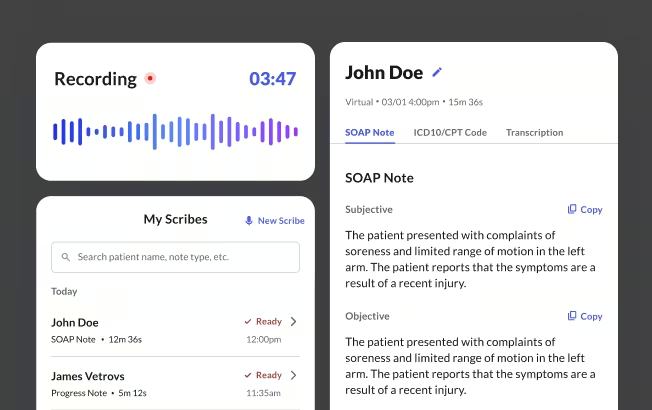
Ambient AI scribes are an increasingly common documentation tool in outpatient group practices. The tool listens to the clinical visit, converts it into a structured note using natural language processing, and shows the note to the clinician for review. The clinician always has the option to edit before finalizing. This substantially reduces typing but still requires review and edits before the note is complete.
The best clinical evidence comes from a randomized controlled trial in NEJM AI in 2025. It was the first randomized controlled trial of ambient AI scribes in outpatient settings. Results differed by product: one ambient solution cut time by a significant margin while another did not.8 Both tools showed signs of lower burnout and task load. The trial ran at one site for two months, which limits how broadly the findings apply.
A large observational study at Mass General Brigham and Emory Healthcare found a 21.2% drop in burnout rates at MGB at 42 days.9 Also, 30.7% more clinicians also reported that documentation had a positive impact on their wellbeing at 60 days.9
What clinicians say most often is not about the time savings. In one qualitative study using an implementation science framework, physicians said they could put down the computer and actually listen during visits.10
Earlier solutions fell short for specific reasons. Voice dictation trades typing for speaking but does not remove the cognitive work. A human scribe, on the other hand, costs $30,000 to $50,000 per year per provider in salary before benefits, and does not cover telehealth or evenings. Finally, first-generation AI scribes needed so much editing that the time savings disappeared.
How Does AI Improve Diagnostic Accuracy and Clinical Decision-Making?
Clinical decision support systems are the most studied AI tool in outpatient care. A 2024 scoping review in PMC of AI-based decision support in primary care found that deployed systems improved guideline adherence, cut prescription errors, and caught complications sooner.4 The benefit was clearest when the tool was built into the electronic health record workflow rather than added as a separate step.
Diagnostic errors are a real patient safety problem. About 5% of adult United States outpatients experience a diagnostic error each year, and roughly one-third of those cases lead to serious harm.5 An AI tool that flags missed diagnoses, abnormal labs, and off-guideline orders adds a safety layer. This matters most in group practices without a specialist down the hall for a quick consult.
The evidence for AI diagnostics is strongest in imaging. The FDA has cleared roughly 950 AI-enabled devices, most of them for radiology. AI tools for detecting lung nodules, breast cancer, and cardiac findings have matched or beaten specialist readers in controlled studies.2 For primary care, internal medicine, or behavioral health groups, the more useful evidence is in decision support and documentation tools, not imaging.
One key caveat applies to all decision support evidence. A 2025 systematic review found that AI-based decision support shows strong accuracy in imaging and lab settings, but many tools work as black boxes.11 When clinicians cannot see how the tool reached a finding, trust is low and adoption suffers. The benefit comes through when the tool explains its reasoning, fits the workflow, and is checked regularly for accuracy drift.
How Does AI Help with Prior Authorization and Administrative Work?
Prior authorization is one of the most frequently cited administrative burdens for group practices. The AMA's 2024 survey found physicians handle 39 prior authorization requests per week on average, using 13 hours of physician and staff time.6 40% of practices have staff whose only job is handling prior authorizations. 89% of physicians say the process adds to burnout.
AI tools designed to help on the provider side work by pulling clinical criteria from the patient record and drafting the supporting documents payers require. This can reduce per-request time for chart review and form work, and may allow practices to reallocate staff effort to other tasks. IDC research found that AI-driven prior authorization tools can align submissions with payer policies in real time and shorten turnaround through automated workflow.12
There is a dual risk to understand. The AMA's 2025 survey found that 61% of physicians are concerned that AI on the insurer side is producing more denials, not fewer.13 For group practices, the response is to use AI tools that build stronger initial submissions. That improves clean claim rates without giving up clinical judgment.
Beyond prior authorization, AI can generate first drafts of work excuse letters, patient instructions, referral notes, and in-basket replies from the visit context. In a group practice where medical assistants and front desk staff handle this work alongside scheduling, cutting per-task time adds up fast across the week.
What Are the Challenges and Risks of AI in Healthcare?
The risks of AI in healthcare for group practices fall into four areas. Each one needs active review, not just a vendor checkbox.
Accuracy and failure modes. Research in npj Digital Medicine found error rates of about 1-3% for current ambient AI scribes, versus 7-11% for older dictation tools.14 The failure modes are different, though. AI can add false information to plan sections, leave out key details, or misread context. These errors are harder to predict than simple word-level mistakes. Reviewing the note before finalizing is not optional. For decision support tools, black-box outputs face the same trust barrier.
HIPAA and data governance. Any AI tool that handles patient data needs a signed Business Associate Agreement before first use. Check where audio and transcripts are stored, how long they are kept, and whether the data trains the model. Ambient AI scribes are classed as administrative tools, not medical devices, so they currently sit outside FDA review.14 That may change.
Patient consent. Some patients are not comfortable with AI recording their visits. Notice and an opt-out option are both ethical obligations and legal requirements in several states. Have a patient notice script and an opt-out process ready before you go live.
Adoption gaps. A 2025 randomized controlled trial found that about 15% of physicians assigned an AI scribe never used it during the study period.8 Deploying a tool does not mean clinicians will use it. Group practices rolling out AI across multiple providers need onboarding plans, change management, and a structured trial period.
What Does HIPAA Compliance Require from an AI Vendor?
HIPAA compliance means more than a feature checklist. The vendor review should cover the following:
- Signed Business Associate Agreement before any patient data is processed
- Audio and transcripts encrypted in transit and at rest
- Retention policy with a minimum of six years per HIPAA requirements
- Written confirmation that data is not used to train the AI model
- An expedited archiving option if your state or practice policy requires faster access restrictions
Consent rules differ by state. Some states need explicit consent for recording. Others allow implied consent through notice. Put a brief notice at check-in and offer a clear opt-out. Practices in two-party consent states should check with a healthcare attorney before going live.
For practices with 10 or more providers, IT sign-off on data governance docs is often required before any clinical rollout. Collect Business Associate Agreements, data flow diagrams, and System and Organization Controls 2 (SOC 2) certification before deployment.
How Should a Group Practice Calculate ROI on AI Tools?
The ROI calculation for AI tools in a group practice has three parts:
- Documentation time recovered per provider
- Revenue gained through better coding accuracy
- Admin labor shifted to higher-value tasks
On revenue, the UCSF study of 1,565 physicians found ambient AI use was linked to 1.81 more relative value units per week and about $3,044 more in annual revenue per physician, with no rise in denials.7 Across a 10-provider group, that is a real number, though it depends on how strong the baseline coding was.
On documentation cost, the comparison to a human scribe is clear. A full-time scribe costs $30,000 to $50,000 per year per provider before benefits and training. Ambient AI costs far less, works during telehealth and evenings, and has no turnover risk. The savings scale with provider count.
On admin burden, a practice spending 13 staff hours per week per physician on prior authorizations has a measurable labor cost.6 AI tools that reduce per-authorization time may allow practices to reallocate some of that staff effort to other tasks.
The adoption caveat matters for ROI too. Practices where only some providers use AI tools will see smaller returns than models that assume full adoption. When building a cost case for a clinical director or practice manager, use a realistic adoption estimate, not the numbers from the highest user in the group.
What Is the Future of AI in Healthcare for Group Practices?
The near-term direction is tighter integration across clinical and billing workflows. The documentation-to-coding-to-claim chain is a high-value sequence to automate in outpatient practices. As ambient AI adds deeper electronic health record write-back capability, the steps between recording a visit and submitting a clean claim will keep shrinking.
Regulatory rules are changing. Ambient AI scribes are classed as administrative tools outside FDA oversight right now.14 That may shift. The Centers for Medicare & Medicaid Services (CMS) Interoperability and Prior Authorization rule also requires Fast Healthcare Interoperability Resources-based electronic prior authorization submissions starting in 2027.15 Group practices signing multi-year vendor contracts today should plan for compliance changes within the contract window.
Adoption is moving fast. The AMA's 2026 survey found that 81% of physicians now use AI at work, up from 38% in 2023. The average number of AI use cases per physician rose from 1.1 to 2.3 in the same period.1 Survey data suggest adoption is rising across practice types. Self-serve tools with free trial access now give small groups access to similar categories of documentation and administrative tools used in large systems, though implementation depth and support structures differ.
How Does Commure Scribe Deliver These Benefits for Group Practices?
Commure Scribe is an ambient AI medical scribe for clinical practice. The workflow is “Capture, Edit, Finalize”: the clinician records the visit, Commure Scribe generates a structured note, the clinician reviews and edits, and finalizes when ready. The clinician always has the option to review before finalizing. It works across in-person and telehealth visits on any device, in 90+ languages with automatic detection, and supports 60+ electronic health record integrations, including Athenahealth, eClinicalWorks, Elation, SimplePractice, Tebra, Practice Fusion, AdvancedMD, WebPT, Cerbo, and Kipu, among others.
At End Recording, a structured note appears in seconds with suggested diagnostic and billing codes in a separate tab. The clinician confirms codes before submission. 99.4% transcription accuracy. 90%+ of providers reduce clinical documentation time and digital fatigue. Proven documentation time reduction across 25 specialties. 75,000+ clinicians. 25M+ patient encounters annually.
Data practices: Fully HIPAA compliant and SOC 2 certified. Audio not used for AI training. Default retention one year active, then archived for at least six years. Business Associate Agreement available before first use. 7-day free trial with unlimited notes, no credit card required.
What Should a Group Practice Check Before Choosing an AI Tool?
Before committing past a trial period, cover these eight areas:
- Business Associate Agreement availability. Confirm a Business Associate Agreement is available and review it before any patient data is processed.
- electronic health record integration. Confirm the tool connects to your electronic health record and find out exactly what that means: copy-paste, direct integration, or write-back.
- Accuracy on your visit types. Test on the visits your practice sees most, including complex encounters and specialty-specific documentation.
- Patient consent process. Confirm a notice template is available and check your state's recording consent rules.
- Data governance. Verify storage location, retention period, archiving options, and that data is not used for model training.
- Cost at group scale. Calculate per-provider monthly cost across your full provider count and compare to equivalent human scribe coverage.
- IT and deployment requirements. Find out what setup needs and whether your practice can handle it or needs outside help.
- Onboarding and adoption support. Ask whether live onboarding is available for multi-provider rollouts and what ongoing support looks like.
Frequently Asked Questions
For group practices, the most proven benefits of AI in healthcare are: faster notes through ambient AI scribes, better coding accuracy that reduces under-billing, clinical decision support that catches errors and flags drug interactions, and prior authorization tools that reduce the 13 staff hours per physician per week that prior authorization currently takes.3,6 Admin drafting for letters and patient messages is an added benefit at group practice scale.
HIPAA compliance requires a signed Business Associate Agreement before first use, encryption of audio and transcripts in transit and at rest, a retention policy meeting the six-year minimum, and written confirmation that data is not used for model training. Ambient AI scribes are currently classed as administrative tools outside FDA oversight.14 Group practices should review vendor data governance directly rather than relying on vendor marketing.
AI cuts admin burden through three channels: ambient scribes that generate notes from the visit; prior authorization tools that draft supporting documents from the clinical record; and administrative tools that write first drafts of letters and messages. The AMA found that 70% of physicians see admin automation as the area where AI can help most.1
The main risks are: accuracy problems in complex visits where AI can add false details or miss key information; data privacy obligations that require active verification through a Business Associate Agreement; patient consent rules that differ by state; and adoption gaps. A 2025 randomized controlled trial found 15% of assigned physicians never used their AI scribe.8 AI decision support tools that cannot explain their reasoning also face adoption barriers.11
70% of physicians in the AMA's 2026 survey see AI as a tool to reduce the admin tasks that drive burnout.1 An observational study at Mass General Brigham found a 21.2% drop in burnout rates at 84 days after ambient AI rollout, though that study had no control group.9 The burnout benefit ties most directly to documentation time cut and notes finished before leaving the building.
The near-term direction is tighter links between notes, coding, and billing workflows. The AMA's 2026 survey found AI use among physicians doubled in one year, with an average of 2.3 use cases per physician.1 Regulatory oversight of ambient AI tools and electronic prior authorization requirements are both evolving. Group practices signing vendor deals now should plan for compliance changes in the next 2 to 3 years.
.jpeg)
.jpeg)
.jpeg)
.jpeg)



.jpeg)
.jpeg)